1800s Early Tattersall’s Horse Auctions, London, U.K.. Top sporting venue for Regency Life in London. ‘A mixture of persons of nearly all ranks’. By Pierce Egan. Via Wikimedia Commons (PD-ART)
In Jane Austen’s and Bridgerton times, or the Regency Era, horse riding was a vital mode of transport and Tattersall’s was the best place to buy and sell horses. Tattersall’s was established in 1773 near Hyde Park Corner for the sale by auction of horses, carriages, hounds and harnesses. Sales during the winter months were every Monday and Thursday, and on Mondays only during the spring and summer. On the mornings when there was no sale, Tattersall’s was a meeting place for fashionable sporting gentlemen.
Pierce Egan’s Description of Tattersall’s
A masquerade could scarcely exhibit more motley groups than the attendants of this place of fashionable resort. There were Peers, Baronets, Members of Parliament, Turf gentlemen and Turf-servants, Jockies, Grooms, Horse-dealers, Gamblers, &c. There you might see the oldest and some of the best blood in England, disguised like coachmen.
From: 1820 Sporting Anecdotes by Pierce Egan via Google Books (PD-150)
1826 Cartoon: A squeeze at Carlton Palace in Bridgerton and Jane Austen times. From Regency Social Life. #JaneAusten #Bridgerton #Cartoon #England https://books2read.com/suziloveYGD
I love these snippets from Captain Gronow’s Recollections 1864. Even though they were written after the Regency, they give us fun bits of information about Almack’s Assembly Rooms, the Prince Regent or later King George IV.
“Good society at the period to which I refer was, to use a familiar expression, wonderfully “select.” At the present time one can hardly conceive the importance which was attached to getting admission to Almack’s, the seventh heaven of the fashionable world. Of the three hundred officers of the Foot Guards, not more than half a dozen were honoured with vouchers of admission to this exclusive temple of the beau monde; the gates of which were guarded by lady patronesses, whose smiles or frowns consigned men and women to happiness or despair. These lady patronesses were the Ladies Castlereagh, Jersey, Cowper, and Sefton, Mrs Drummond Burrell, now Lady Willoughby, the Princess Esterhazy, and the Countess Lieven.
Almack’s: Exclusive temple of the beau monde. The gates of which were guarded by the lady patronesses,The Ladies Castlereagh, Jersey, Cowper, Sefton, Willoughby, Princess Esterhazy, and Countess Lieven.
From Captain Gronow’s Recollections 1864.
The most popular amongst these grandes dames was unquestionably Lady Cowper, now Lady Palmerston. Lady Jersey’s bearing, on the contrary, was that of a theatrical tragedy queen; and whilst attempting the sublime, she frequently made herself simply ridiculous, being inconceivably rude, and in her manner often ill-bred. Lady Sefton was kind and amiable, Madame de Lieven haughty and exclusive, Princess Esterhazy was a hon enfant, Lady Castlereagh and Mrs Burrell de tres grandes dames.
Many diplomatic arts, much finesse, and a host of intrigues, were set in motion to get an invitation to Almack’s. Very often persons whose rank and fortunes entitled them to the entree anywhere, were excluded by the cliqueism of the lady patronesses; for the female government of Almack’s was a pure despotism, and subject to all the caprices of despotic rule: it is needless to add that, like every other despotism, it was not innocent of abuses.
Almack’s
The fair ladies who ruled supreme over this little dancing and gossiping world, issued a solemn proclamation that no gentleman should appear at the assemblies without being dressed in knee-breeches, white cravat, and chapeau bras.
From Captain Gronow’s Recollections 1864.
1815 The First Quadrille at Almack’s Assembly Rooms, London. Left to Right: Marquis of Worcester, Lady Jersey, Clanronald MacDonald and Lady Worcester. “It was not until 1815 that Lady Jersey introduced from Paris the favourite quadrille, which has so long remained popular. I recollect the persons who formed the very first quadrille that was ever danced at Almack’s: they were Lady Jersey, Lady Harriett Butler, Lady Susan Ryde, and Miss Montgomery; the men being the Count St Aldegonde, Mr Montgomery, Mr Montague, and Charles Standish.” From The Reminiscences of Captain Gronow 1810-1860.RL_1_D2D_Regency Overview RetailerLinks
https://books2read.com/suziloveROver
1818 ‘The Stamford Dandy or A Modern Peeping Tom’. Lord Stamford rides past a row of houses looking through his glass at a woman who stands at an open first-floor window. Other women watch him from the two other windows. Dressed as a dandy with red tailcoat, high white collar and cravat, black top hat and wearing loose white trousers. Artist not known. Via British Museum, London, UK. britishmuseum.org (PD-Art)
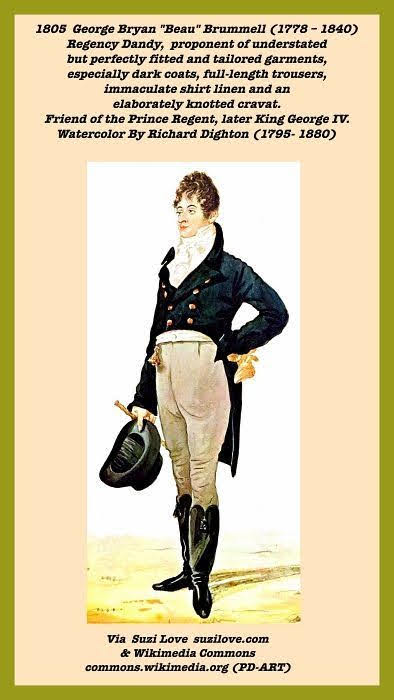
George Bryan “Beau” Brummell (June 7th 1778 – March 30th 1840) Arbiter of men’s fashion and friend of the Prince Regent, the future King George IV. Established mode of dress for men that rejected overly ornate fashions for understated but perfectly fitted and tailored clothing. Look based on dark coats, full-length trousers rather than knee breeches and stockings, with immaculate shirt linen and an elaborately knotted cravat. 1855 Engraving of Beau Brummell from an article in Harper’s New Monthly Magazine.
1805 Beau Brummell (1778-1840) Regency Dandy, proponent of understated but perfectly fitted and tailored garments, especially dark coats, full-length trousers, immaculate shirt linen and an elaborately knotted cravat. Friend of the Prince Regent, later King George IV. Watercolor By Richard Dighton (1795- 1880) Via Wikimedia Commons commons.wikimedia.org (PD-ART) https://books2read.com/SuziLoveFashionMen1800-1819
What did an older lady do in the Bridgerton family’s and Jane Austen’s times, or the early 1800s. An easy to read overview of what an older lady did, wore, and how she lived in the early 19th Century. Information for history buffs and pictures for readers and writers of historical fiction. Older Lady’s Day, Regency Life Series, Book 5, by Suzi Love. books2read.com/suziloveOLD
Through historic images, historical information, and funny anecdotes, it shows how an older lady in Jane Austen’s times fills her day, where she goes, and with whom she spends her time. This light-hearted look at the longer Regency years is an easy to read overview of what people did and wore, and where they worked and played. There is plenty of information to interest history buffs, and lots of pictures to help readers and writers of historical fiction visualize the people and places from the last years of the 18th Century until Queen Victoria took the throne.
1808 Christie’s Auction Room, London, U.K. From: Microcosm of London By Rudolph Ackermann. The Microcosm of London was published in three volumes between 1808 and 1810 and was coordinated by German born printseller, Rudolph Ackermann, from his Repository of Arts at 101 The Strand, London, U.K. and included numerous contributors. Visitors to London in Jane Austen’s time would go to all the important buildings. https://books2read.com/suziloveROver
What did ladies do and wear in Jane Austen’s time, or early 1800s? #Regency #History #nonfiction Books 4 and 5 Regency Life Series. Young Lady’s Day and Older Lady’s Day in Books 4 and 5 in the Regency Life Series. These books depict the often-frivolous life and fashions of ladies in the early 1800’s, or during the lifetime of Jane Austen, but also gives a glimpse into the more serious occupations ladies may undertake. Through historic images, historical information, and funny anecdotes, they show how a lady fills her day, where she is permitted to go, and who she spends time with. These light-hearted looks at the longer Regency years are an easy to read overview of what people did and wore, and where they worked and played. There is plenty of information to interest history buffs, and lots of pictures to help readers and writers of historical fiction visualize the people and places from the last years of the 18th Century until Queen Victoria took the throne. Young Lady’s Day ~ Older Lady’s Day
1826 House Of Lords In High Debate. From A Regency Gentleman’s Life. From The English Spy By Robert Cruikshank.
Light-hearted look at a young man’s day in the early 1800s. Depicts the ups and downs of a young gentleman’s day in the Regency Era, or Jane Austen’s years. Through historic images, historical information, and funny anecdotes, it shows how a young man about town fills his day, where he goes, and who he spends time with. This light-hearted look at the longer Regency years is an easy to read overview of what people did and wore, and where they worked and played. There is plenty of information to interest history buffs, and lots of pictures to help readers and writers of historical fiction visualize the people and places from the last years of the 18th Century until Queen Victoria took the throne. Regency Life Series Book 3 Young Gentleman’s Day.com/suziloveYGD
1826 An Affair Of Honor Decided With Pistols In Hyde Park London, U.K. A Regency Gentleman’s Life. From The English Spy By Robert Cruikshank. By the Regency Era, dueling was outlawed, yet duels still happened because the courts were made up of peers who were reluctant to charge another peer with murder as a result of a duel. Gentlemen considered a duel a matter of honor and death was preferable to being labeled a coward.
Duels had a code of honor and were fought not so much to kill the opponent as to gain satisfaction and restore honor by demonstrating a willingness to risk your life. Originally dueling was only for the male members of nobility but then extended to all members of the upper classes. At first, duels were fought with swords but by the Regency Era, duels with pistols were more common. Some duels were also fought between women.
Favorite dueling grounds near London included Hampstead Heath, Chalk Farm and the common land that extended south of the Thames over modern Battersea, Putney and Wimbledon. The windmill there was a popular landmark beneath which duelists often agreed to meet. These locations were convenient for their proximity to the city, yet also sufficiently remote to avoid interruption and in the event of a fatality, attractively close to potential getaway routes on the roads out of London.
1826 An Affair Of Honor Decided With Pistols In Hyde Park London, U.K. A Regency Gentleman’s Life. From The English Spy By Robert Cruikshank.