↓
 

Suzi Love

Making history fun, one year at a time.

Header_
  • Home
  • Newsletter
  • Pre order form
  • Shop
    • Cart
    • Checkout
    • My account
    • Refund and Returns Policy
  • Blog
  • BOOKS
    • History Events
    • Kelly’s Justice
    • Irresistible Aristocrats
    • History Notes
    • Scandalous Siblings
    • Love After Waterloo
    • Regency Life Series
  • Privacy Policy
  • EVENTS
Home » WikiMedia Commons 1 2 >>

Tag Archives: WikiMedia Commons

Post navigation

← Previous Post

1800s Early Gentleman John Jackson, London, U.K. #Regency #Boxing #Pugilism

Suzi Love Posted on April 12, 2026 by Suzi LoveMarch 2, 2026

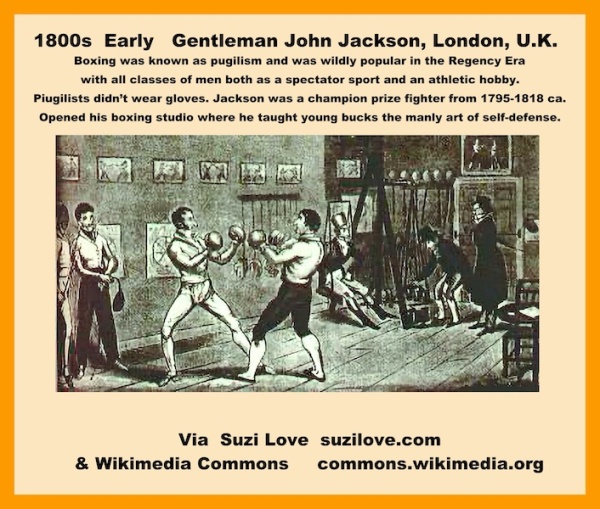
1800s Early Gentleman John Jackson, London, U.K. #Regency Boxing was known as pugilism and was wildly popular in the Regency Era with all classes of men both as a spectator sport and an athletic hobby. Pugilists didn’t wear gloves. Jackson was a champion prize fighter from 1795-1818 ca. Opened his boxing studio where he taught young bucks the manly art of self-defense. via Wikimedia Commons.

1800s Early Gentleman John Jackson, London, U.K. #Regency Boxing was known as pugilism and was wildly popular in the Regency Era with all classes of men both as a spectator sport and an athletic hobby. Piugilists didn’t wear gloves. Jackson was a champion prize fighter from 1795-1818 ca. Opened his boxing studio where he taught young bucks the manly art of self-defense.
1800s Early Gentleman John Jackson, London, U.K. #Regency #Boxing #Pugilism https://books2read.com/suziloveYGD Share on X
RL_2_D2D_RetailerBuyLink_RL_2
RL_2_D2D_RetailerBuyLink_RL_2 https://books2read.com/suziloveYGD
Posted in 1800s, 1800s Mens Fashions, cartoon, England, History, Regency Era, sports, Suzi Love Images | Tagged art, boxing, Cartoons, London, Regency London, Regency Men, sports, WikiMedia Commons

1552 Onwards Covent Garden, London, England. #BritishHistory #London #CoventGarden

Suzi Love Posted on February 12, 2026 by Suzi LoveJanuary 30, 2026

Covent  Garden is within the London boroughs of Westminster and Camden, and the parliamentary constituencies of Cities of London and Westminster and Holborn and St Pancras. The district is divided by the main thoroughfare of Long Acre, north of which is given over to independent shops centred on Neal’s Yard and Seven Dials, while the south contains the central square with its street performers and most of the elegant buildings, theatres and entertainment facilities, including the Theatre Royal, Drury Lane, and the London Transport Museum.

In 1552, the land was seized by Henry VIII and granted to the Earls of Bedford. The 4th Earl  commissioned Inigo Jones to build fine houses to attract wealthy tenants. It was the first modern square in London, with Italian arcades and a flat, open space or piazza with low railings. This layout was copied in other new estates in London.

1555 John Russell, 1st Earl Of Bedford. By a follower of John Bettes. Given land of Covent Garden by Herny VIII after the dissolution of the Monasteries.
1650 The piazza of Covent Garden about 1650, as engraved by Wenceslaus Hollar. Courtesy University of Toronto.
1721-1789 ca. St. Paul's Church, Covent Garden, London, U.K. From between two arches of the plaza. Watercolor with grey wash. By Thomas Sandy. Via Suzi Love suzilove.com & British Museum, London, UK. britishmuseum.org
1721-1789 ca. St. Paul’s Church, Covent Garden, London, U.K. From between two arches of the plaza. Watercolor with grey wash. By Thomas Sandy. Via British Museum, London, UK. britishmuseum.org
1800s Early Covent Garden Market, London, U.K.

In 1654, an open-air fruit and vegetable market grew on the south side of the fashionable square but over time the market and the surrounding area fell into disrepute. Taverns, theatres, coffee-houses and brothels opened up, the gentry moved away, and rakes, wits and playwrights moved in.

By the 18th century Covent Garden had become a well-known red-light district, attracting notable prostitutes such as Betty Careless and Jane Douglas. Descriptions of the prostitutes and where to find them were provided by Harris’s List of Covent Garden Ladies, the “essential guide and accessory for any serious gentleman of pleasure”. 

Covent Garden’s market was always disorderly, the buildings in bad shape, and overcrowded with stalls, donkeys, carts, and peddlers. The small number of passageways into the piazza were small and with bottle necks of carts moving goods and market sellers fighting for right of way. The markets supplied fruits and vegetables, mostly homegrown but with imported goods increasing. Many sellers missed paying tolls for selling in the piazza or refused to pay them so the owner, the Earl of Bedford, took many people to court for not paying tolls. He realized the markets were in such poor condition that he couldn’t charge sellers until he improved them. In 1830, a new market hall was built with sections dividing the kind of goods sold which did improve things, but the markets remained chaotic. By 1890, people were again complaining about the narrow streets and congestion.

Covent Garden’s flower girls attracted attention by shouting:

“Two bundles a penny, primroses!”

“Sweet violets, penny a bunch!”

In 1851, Henry Mayhew wrote London Labour and the London Poor describing two types of flower girl. The young girls, or waifs, sold flowers to feed the family. The other type of flower girl stayed out late, doubled as prostitutes, and had bad reputations.

In 1913, Herbrand Russell, 11th Duke of Bedford agreed to sell the Covent Garden Estate for £2 million to the MP and land speculator Harry Mallaby-Deeley, who sold his option in 1918 to the Beecham family for £250,000.

1809 View Of the New Covent Garden Theatre, London. From Hart Street, showing the King's entrance. Watercolor drawn by James Winston. via British Museum.
1809 View Of the New Covent Garden Theatre, London. From Hart Street, showing the King’s entrance. Watercolor drawn by James Winston. via British Museum.
1811 Bird’s Eye View of Covent Garden Market, London, UK. Main fruit, flower and vegetable market in London in early 19th century. Began here in 1656 with few temporary stalls in back garden of home of Earl of Bedford. Charles II granted market lease and in 1678 bought by Adam Piggot and others who built permanent stalls. By 1811, smelly, dirty, and overcrowded. Engraver J. Bluck. After Augustus Charles Pugin and Thomas Rowlandson published by Ackermann. Via Suzi Love suzilove.com & British Museum, London, UK. britishmuseum.org
1811 Bird’s Eye View of Covent Garden Market, London, UK. Main fruit, flower and vegetable market in London in early 19th century. Began here in 1656 with few temporary stalls in back garden of home of Earl of Bedford. Charles II granted market lease and in 1678 bought by Adam Piggot and others who built permanent stalls. By 1811, smelly, dirty, and overcrowded. Engraver J. Bluck. After Augustus Charles Pugin and Thomas Rowlandson published by Ackermann. Via British Museum, London, UK. britishmuseum.org
1827 Covent Garden Market, Westminster, London, U.K.  By Frederick James Havell.
1827 Covent Garden Market, Westminster, London, U.K. By Frederick James Havell.

In 1830, Charles Fowler’s neo-classical building was erected to cover the market and as the market grew, the prostitutes moved on. The Floral Hall and Charter Market were added and the Jubilee Market in 1904.

1835 Covent Garden Watch House, London, UK. Next to the church of St. Paul's Church, Covent Garden. Two story white building with 'Watch House' painted on its upper floor is shown with a lively street scene in the foreground. via Museum of London.
1835 Covent Garden Watch House, London, UK. Next to the church of St. Paul’s Church, Covent Garden. Two story white building with ‘Watch House’ painted on its upper floor is shown with a lively street scene in the foreground. via Museum of London.
1852 J.M.W. Turner’s birthplace in Maiden Lane, Covent Garden. Brick terraced house at night with a figure in top hat walking past and two figures with a candlelight in the doorway_Watercolour with body color over graphite. Drawn by John Wykeham Archer.

In 1913,Herbrand Russell, 11th Duke of Bedford agreed to sell the Covent Garden Estate for £2 million to the MP and land speculator Harry Mallaby-Deeley, who sold his option in 1918 to the Beecham family for £250,000. By the end of the 1960s, traffic had become congested until in 1974 the market relocated to the New Covent Garden Market about three miles (5 km) south-west at Nine Elms. In 1980, the central building re-opened as a shopping centre and then became a tourist location with cafes, pubs, small shops, a craft market called the Apple Market, and another market in the Jubilee Hall.

1552 Onwards Covent Garden, London, England. #BritishHistory #London #CoventGarden https://www.books2read.com/suziloveROver Share on X
RL_1_D2D_Regency Overview RetailerLinks
https://books2read.com/suziloveROver
RL_1_D2D_Regency Overview RetailerLinks https://books2read.com/suziloveROver
Posted in 1700s, 1800s, England, Food and Drink, Georgian Era, History, London, Regency Era, Romantic Era, Suzi Love Images, Victorian Era | Tagged 1700s Or Georgian Era, 1800s Or 19th Century, British history, British Museum, Covent Garden, Food, Georgian era, google books, London, Museum Of London, Regency London, Suzi Love Images, theatre, WikiMedia Commons | Leave a reply

1840 The York To London Royal Mail In The Village Of Bedale, England. #RegencyEra #BritishHistory #carriages #postage

Suzi Love Posted on January 25, 2026 by Suzi LoveJanuary 17, 2026

1840 ca. The York To London Royal Mail. By A. Anson Martin. Mailcoach in the village of Bedale, Yorkshire, U.K. Church at the end of the wide country road and thatched cottages behind the coach. Signed and Inscribed ‘(All Right)’. Via British Postal Museum, London, U.K. ~ postal museum.org

The dreadful condition of British roads caused great apprehension to all classes of travelers. Making a journey anywhere in the country was a big undertaking and often a gentleman composed his last will and testament before his departure.  Traveling in vehicles was only possible during the day or on the nights with very bright moonlight with few vehicles attempting road travel in winter and any travel on a Sunday was frowned upon. books2read.com/SuziLoveTravel

Description of Stage Coach Travel in England.  via 1815 Journal Tour of Great Britain. “The gentlemen coachmen, with half-a dozen great coats about them, immense capes, a large nosegay at the button-hole, high mounted on an elevated seat, with squared elbows, a prodigious whip, beautiful horses, four in hand, drive in a file to Salthill, a place about twenty miles from London, and return, stopping in the way at the several public-houses and gin-shops where stage-coachmen are in the habit of stopping for a dram, and for parcels and passengers on the top of the others as many as seventeen persons. These carriages are not suspended, but rest on steel springs, of a flattened oval shape, less easy than the old mode of leathern braces on springs. Some of these stage coaches carry their baggage below the level of the axletree.”

1840 ca. The York To London Royal Mail. By A. Anson Martin. Mailcoach in the village of Bedale, Yorkshire, U.K. Church at the end of the wide country road and thatched cottages behind the coach. Signed and Inscribed '(All Right)'.Via Suzi Love ~ suzilkove.com & British Postal Museum, London, U.K. ~ postal museum.org
1840 The York To London Royal Mail In The Village Of Bedale, England. #RegencyEra #BritishHistory #carriages #postage https://www.suzilove.com/wp-admin/books2read.com/SuziLoveTravel Share on X
HN_10_D2D_RetailerBuyLink
books2read.com/SuziLoveTravel
HN_10_D2D_RetailerBuyLink_Travel and Luggage By Suzi Love History Notes Book 10 #History #travel How did people travel in past centuries? What did they take with them to make their long journeys easier? books2read.com/SuziLoveTravel
Posted in 1800s, Carriage, England, History, London, postal, Regency Era, Suzi Love Images, travel | Tagged art, British history, carriages, England, google books, postal, Romantic Era, Suzi Love Images, travel, WikiMedia Commons

1800s Early Beau Brummell, Arbiter of Men’s Fashion and friend of Prince Regent. #RegencyEra #BritishHistory #JaneAusten

Suzi Love Posted on January 12, 2026 by Suzi LoveJanuary 12, 2026

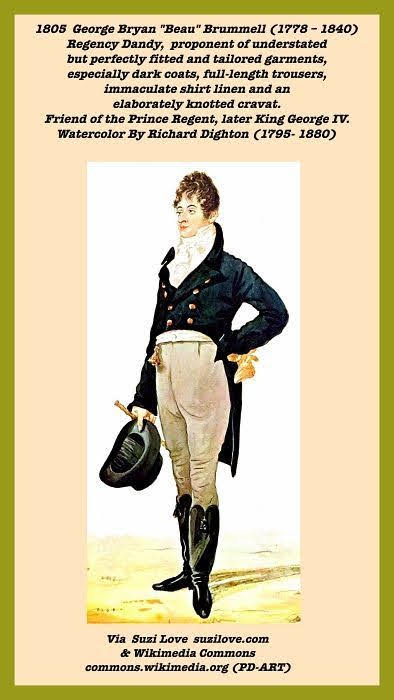
George Bryan “Beau” Brummell (June 7th 1778 – March 30th 1840) Arbiter of men’s fashion and friend of the Prince Regent, the future King George IV. Established mode of dress for men that rejected overly ornate fashions for understated but perfectly fitted and tailored clothing. Look based on dark coats, full-length trousers rather than knee breeches and stockings, with immaculate shirt linen and an elaborately knotted cravat. 1855 Engraving of Beau Brummell from an article in Harper’s New Monthly Magazine.

George Bryan "Beau" Brummell (June 7th 1778 – March 30th 1840) Arbiter of men's fashion and friend of the Prince Regent, the future King George IV. Established mode of dress for men that rejected overly ornate fashions for understated but perfectly fitted and tailored clothing. Look based on dark coats, full-length trousers rather than knee breeches and stockings, with immaculate shirt linen and an elaborately knotted cravat. 1855 Engraving of Beau Brummell from an article in Harper’s New Monthly Magazine.
Beau_1805 Beau Brummell (1778-1840) Regency Dandy, proponent of understated but perfectly fitted and tailored garments, especially dark coats, full-length trousers, immaculate shirt linen and an elaborately knotted cravat. Friend of the Prince Regent, later King George IV. Watercolor By Richard Dighton (1795- 1880) Via Wikimedia Commons commons.wikimedia.org (PD-ART)
1805 Beau Brummell (1778-1840) Regency Dandy, proponent of understated but perfectly fitted and tailored garments, especially dark coats, full-length trousers, immaculate shirt linen and an elaborately knotted cravat. Friend of the Prince Regent, later King George IV. Watercolor By Richard Dighton (1795- 1880) Via Wikimedia Commons commons.wikimedia.org (PD-ART)

George Bryan "Beau" Brummell Arbiter of Men's Fashion and friend of Prince Regent. #BeauBrummell #RegencyEra #BritishHistory #JaneAusten https://books2read.com/SuziLoveFashionMen1800-1819 Share on X
HN_23_D2D_Fashion Men 1800-1819
https://books2read.com/SuziLoveFashionMen1800-1819
Posted in 1800s, 1800s Mens Fashions, cartoon, Coat or Pelisse Or Redingote, Customs & Manners, England, fashion accessories, hats, Jane Austen, London, pants, Regency Era, Regency Fashion, shoes, Suit, Suzi Love Images, Vest or Waistcoat | Tagged art, Beau Brummell, boots, breeches, British history, Cartoons, fashion accessories, Hats And Hair, Jane Austen, Prince Regent, Regency Fashion, Regency London, Regency Men, Shoes, Tailcoat, WikiMedia Commons

1810 January 1st. West India Docks, London. By Thomas Rowlandson and Augustus Charles Pugin. #RegencyEra #London #BritishHistory #Art

Suzi Love Posted on January 10, 2026 by Suzi LoveJanuary 10, 2026

1810 January 1st. West India Docks, London. By Thomas Rowlandson and Augustus Charles Pugin. Printed in 1810 By Rudolph Ackermann in Microcosm Of London, or London In Miniature. Volume 1. Aquatint showing warehouses at quayside and several West Indiamen moored alongside. Warehouses held thousands of tons of cargo, including sugar, rum, molasses, coffee, spices and hardwood. Docks were constructed by powerful group of businessmen led by Robert Milligan, wealthy merchant and ship-owner outraged at losses suffered due to theft and delay at riverside wharves. via National Maritime Museum, Greenwich, London, U.K. ~ collections.rmg.co.uk
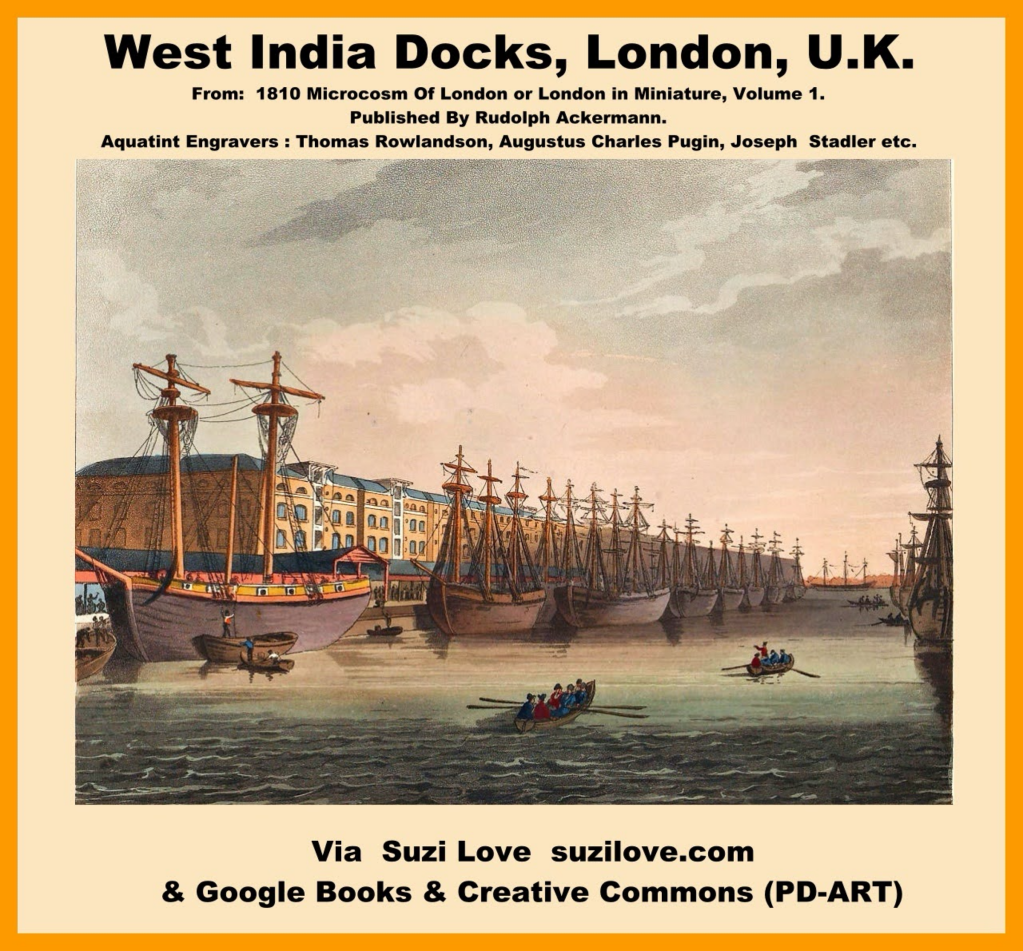
1810 January 1st. West India Docks, London. By Thomas Rowlandson and Augustus Charles Pugin. Aquatint showing warehouses at quayside and several West Indiamen moored alongside. Warehouses held thousands of tons of cargo, including sugar, rum, molasses, coffee, spices and hardwood. Docks were constructed by powerful group of businessmen led by Robert Milligan, wealthy merchant and ship-owner outraged at losses suffered due to theft and delay at riverside wharves. collections.rmg.co.uk
West India Docks, London, U.K. From: 1810 Microcosm of London or London in Miniature Published By Rudolph Ackermann. Via Google Books & Creative Commons (PD-ART)
1810 January 1st. West India Docks, London. By Thomas Rowlandson and Augustus Charles Pugin. #RegencyEra #London #BritishHistory #Art https://books2read.com/suziloveROver Share on X
RL_1_D2D_Regency Overview RetailerLinks
https://books2read.com/suziloveROver
RL_1_D2D_Regency Overview RetailerLinks https://books2read.com/suziloveROver
Posted in 1800s, art, Google Books, History, London, Regency Era, Suzi Love Images, travel | Tagged art, British history, google books, London, National Maritime Museum, Regency London, Rudolph Ackermann, trades, WikiMedia Commons

18th-19th Century East and West India Docks, London. #London #docks #britishhistory

Suzi Love Posted on January 10, 2026 by Suzi LoveJanuary 10, 2026

East and West India Docks London’s Historic Places

The East India Docks was a group of docks in Blackwall, east London, north-east of the Isle of Dogs. In 1607, the East India Company decided to build its own ships and leased a yard in Deptford. In 1614 the East India Company ordered William Burrell to begin work on a bigger yard for repair, construction and loading of out-going ships. The site selected was at Blackwall, which was further down river and had deeper water, allowing laden ships to moor closer to the dock. During the early 17th century, the site was enlarged repeatedly. Later in the 17th century, the East India Company reverted to its practice of hiring vessels, although many owners who chartered their vessel to the East India Company had them built at Deptford and Blackwall.

Before 1800, the Thames river was overcrowded with ships. They carried cargoes of tea, china and cloth in their lower parts along with casks of water, salted meat, beer, wine and rum for their crews. Brandy, wine, and tobacco were also shipped and stored in the warehouses. In 1800, the London Dock Company was formed and the planned docks in Wapping went ahead in 1801. The first was the West India Dock. In 1806, the East India Company opened their own docks to the north-east of the West India Docks after deciding that the Brunswick Dock at Blackwall, where ships were fitted out, was unsuitable for storing cargo.

The Brunswick Dock, which had originally been connected directly to the Thames to the south, became the Export Dock. To the north the company built a larger 18-acre (7.3 ha) Import Dock. Both were connected to the Thames via an eastern entrance basin. The number of ships discharged in the docks rose from 354 in 1804, to 598 in 1808, and to 641 in 1810. In 1808, the warehouses were full, as blockades prevented the re-export of goods. The dock company calculated that the almost total prevention of theft made possible by the building of the docks was saving West India merchants almost £400,000, and the Exchequer about £150,000 each year. During the 1840s and early 1850s, shipping and tonnage handled at the East and West India docks increased so much that dividends of 5 and 6 per cent were paid.

The East India Docks didn’t have many warehouses because cargoes were taken straight to their warehouses in the City. So instead of building warehouses, the company built private toll roads like Commercial Road and East India Dock Road to carry traffic to and from the docks.

The company made large profits on tea, spices, indigo, silk and Persian carpets. The tea trade alone was worth £30m a year. Spice merchants and pepper grinders set up around the dock to process goods. Although the East India docks were smaller than the West India Docks, they handled up to 250 ships at one time and East Indiamen of 1000 tons but larger ships and steam power reduced the importance of the dock.

The  West India Docks were a series of three docks, quaysides, and warehouses built to import goods from, and export goods and occasionally passengers to the British West Indies. In 1802, the first dock opened on the Isle Of Dogs. When they closed for commerce in 1980, the Canary Wharf  development was built around the wet docks by narrowing some of their broadest tracts.

The docks were constructed in two phases. The two northern docks were constructed between 1800 and 1802 for the West India Dock Company and were the first commercial wet docks in London. For 21 years, all vessels in the West India trade using the Port Of London had to use the West India docks by a clause in the act of Parliament that had enabled their construction.

In 1838 the East and West India companies merged. The southern dock, the South West India Dock, later known as South Dock, was constructed in the 1860s and in 1909 the Port Of London Authority took over the West India Docks,

The docks played a key role in the Second World War as a location for constructing the floating Mulberry harbours used by the Allies to support the D-Day landings in France. Following the Second World War, in which all the docks were badly damaged, the East India Docks were confined to occasional Channel Islands traffic and to the maintenance of dredger equipment.

The docks were the first London docks to close, in 1967. Today the docks have been mostly filled in. Only the entrance basin remains, as a wildlife refuge and an attractive local amenity. The area is predominantly residential with several major developments around it.

West India and East India Docks, London.
18th-19th Century East and West India Docks, London. #London #docks #britishhistory https://books2read.com/suziloveROver Share on X
RL_1_D2D_Regency Overview RetailerLinks
https://books2read.com/suziloveROver
RL_1_D2D_Regency Overview RetailerLinks https://books2read.com/suziloveROver
Posted in 1700s, 1800s, Georgian Era, London, Regency Era, Romantic Era, Victorian Era | Tagged British history, google books, London, trades, WikiMedia Commons | Leave a reply

1813 The Spa Terrace. From Poetical Sketches of Scarborough In the Time Of Jane Austen. #JaneAusten #RegencyEra #Art #BritishHistory

Suzi Love Posted on July 16, 2025 by Suzi LoveJuly 9, 2025

1813 Spa Terrace. From: Poetical Sketches of Scarborough. Meant as souvenirs and not intended for publication. By Thomas Rowlandson & Aquatint by John Bluck and Joseph Stadler. Via Wikimedia Commons commons.wikimedia.org (PD-ART) Spa towns were very fashionable retreats from London’s pollution for people in Jane Austen’s times.
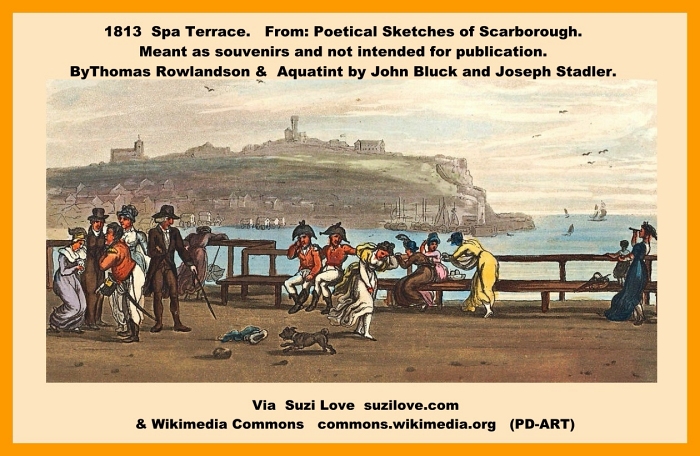
1813 Spa Terrace. From: Poetical Sketches of Scarborough. Meant as souvenirs and not intended for publication. By Thomas Rowlandson & Aquatint by John Bluck and Joseph Stadler. Via Wikimedia Commons commons.wikimedia.org (PD-ART)
1813 The Spa Terrace. From Poetical Sketches of Scarborough In the Time Of Jane Austen. #JaneAusten #RegencyEra #Art #BritishHistory https://books2read.com/suziloveROver Share on X
RL_1_D2D_Regency Overview RetailerLinks
https://books2read.com/suziloveROver
RL_1_D2D_Regency Overview RetailerLinks https://books2read.com/suziloveROver
Posted in 1800s, 1800s Mens Fashions, 1800s women's fashion, art, cartoon, England, History, Jane Austen, Regency Era, Regency Fashion, Suzi Love Images, travel | Tagged 1800s men fashion, 1800s women's fashion, art, British history, Cartoons, England, Jane Austen, Regency Era, Thomas Rowlandson, travel, WikiMedia Commons

1804 Royal Mint, Stamping Room, London, U.K. As Jane Austen saw it. From Ackermann’s Microcosm of London. #JaneAusten #RegencyEra #London #BritishHistory #Art

Suzi Love Posted on June 24, 2025 by Suzi LoveJune 14, 2025

1804 Royal Mint, Stamping Room, London, U.K. As Jane Austen would have known it. From Ackermann’s Microcosm of London by A.C. Pugin and Thomas Rowlandson.

1804 Royal Mint, Stamping Room, London, U.K. From Ackermann's Microcosm of London by A.C. Pugin and Thomas Rowlandson.
1804 Royal Mint, Stamping Room, London, U.K. From Ackermann’s Microcosm of London by A.C. Pugin and Thomas Rowlandson.
1804 Royal Mint, Stamping Room, London, U.K. As Jane Austen would have known it. #JaneAusten #RegencyEra #London #BritishHistory #Art https://books2read.com/suziloveROver Share on X
RL_1_D2D_Regency Overview RetailerLinks
https://books2read.com/suziloveROver
RL_1_D2D_Regency Overview RetailerLinks https://books2read.com/suziloveROver
Posted in 1800s, art, England, History, Jane Austen, London, money, postal, Regency Era, Suzi Love Images | Tagged art, British history, Cartoons, google books, Jane Austen, London, money, postal, Regency London, Rudolph Ackermann, Suzi Love Images, WikiMedia Commons

1800s “Admiration”. By Vittorio Reggianini. Jane Austen Era oil on canvas. #RegencyEra #JaneAusten #Arthistory

Suzi Love Posted on June 8, 2025 by Suzi LoveJune 8, 2025

1800s “Admiration”. By Vittorio Reggianini. Oil on canvas. This looks like a typical drawing room scene from Jane Austen’s lifetime, or the early 1800s, or the Regency Era. Via Wikimedia Commons commons.wikimedia.org

1800s "Admiration". By Vittorio Reggianini. Oil on canvas. #Regency #Art
1800s "Admiration". By Vittorio Reggianini. Jane Austen Era oil on canvas. #RegencyEra #JaneAusten #Arthistory https://books2read.com/SuziLoveFashionWomen1801-1804 Share on X
HN_25_D2D_fashwomen1801-1804
https://books2read.com/SuziLoveFashionWomen1801-1804
HN_25_D2D_fashwomen1801-1804 https://books2read.com/SuziLoveFashionWomen1801-1804

Posted in 1800s, 1800s Mens Fashions, 1800s women's fashion, art, Customs & Manners, Dress Or Robe, fashion accessories, household, Regency Era, Regency Fashion, Suzi Love Images | Tagged 1800s women's fashion, art, Customs and Traditions, Dress Or Gown, fashion accessories, household, Jane Austen, Regency Fashion, WikiMedia Commons | Leave a reply

Love Jane Austen and the Bridgertons? Easy to read overview of what an older lady did, wore, and how she lived in Jane Austen’s time. #Bridgerton #JaneAusten #RegencyEra #BritishHistory

Suzi Love Posted on January 28, 2025 by Suzi LoveJanuary 18, 2025

Easy to read overview of what an older lady did, wore, and how she lived in Jane Austen and Bridgerton’s time. Information for history buffs and pictures for readers and writers of historical fiction.  Older Lady’s Day Regency Life Series Book 5 by Suzi Love books2read.com/suziloveOLD

Older Lady’s Day Regency Life Series Book 5 by Suzi Love #Regency An easy to read overview of what an older lady did, wore, and how she lived in the early 19th Century. Information for history buffs and pictures for readers and writers of historical fiction.   books2read.com/suziloveOLD
Love Jane Austen and the Bridgertons? Easy to read overview of what an older lady did, wore, and how she lived in Jane Austen's time. #Bridgerton #JaneAusten #RegencyEra #BritishHistory https://books2read.com/suziloveOLD Share on X
RL_5_D2D_RetailerBuyLink_RL_5_2
https://books2read.com/suziloveOLD

Posted in 1800s, 1800s women's fashion, art, bedroom fashion, Canada, Coat or Pelisse Or Redingote, Corset, Customs & Manners, dancing, Decorative Item, Dress Or Robe, England, Europe, fashion accessories, Food and Drink, Google Books, hats, household, Jane Austen, London, medical, mourning, Pastimes, postal, Quotations, Regency Era, Regency Fashion, Regency Life Series, Reticule or Bag, riding, Royalty, sewing, shoes, Spencer, Suzi Love Books, Suzi Love Images, U.S.A, underclothing | Tagged 1800s women's fashion, art, Book 5, Bridgerton, Cartoons, Dress Or Gown, Fashion Plate, Hats And Hair, Jane Austen, Journal des Dames et des Modes, medical, Regency Fashion, Regency Life Series, Shoes, Suzi Love Books, The Repository Of Arts, WikiMedia Commons

Post navigation

← Previous Post

SUBSCRIBE TO SUZI LOVE'S NEWSLETTER.

Recent Posts

  • What shoes did the Bridgertons and Jane Austen wear? Gray Slippers, American, with long ankle ties. #JaneAusten #Bridgerton #shoes #regencyfashion
  • Book Hooks: Lady Laura Jamison believes her extraordinary olfactory senses will sniff out her perfect match, but will the Earl prove her wrong? #HistoricalRomance #RomCom #RegencyRomance
  • 1880’s Gorgeous corset of silk satin, steel busk, and bone, French. #VictorianEra #Corset #VictorianFashion
  • “Happiness in marriage is entirely a matter of chance.” Jane Austen #PrideandPrejudice (1813) #JaneAusten #Quote #RegencyEra
  • Do You Know What A Half Parure Is? 1806 Muslin Dress With Train, Shawl and Half Parure Jewelry Set. #RegencyFashion #JaneAusten #HistoricalFashion

Recent Comments

  1. Kayelle Allen on Book Hooks: Lady Laura Jamison believes her extraordinary olfactory senses will sniff out her perfect match, but will the Earl prove her wrong? #HistoricalRomance #RomCom #RegencyRomance
  2. Tina Donahue on Book Hooks: Lady Laura Jamison believes her extraordinary olfactory senses will sniff out her perfect match, but will the Earl prove her wrong? #HistoricalRomance #RomCom #RegencyRomance
  3. Maggie Blackbird on Book Hooks: Lady Laura Jamison believes her extraordinary olfactory senses will sniff out her perfect match, but will the Earl prove her wrong? #HistoricalRomance #RomCom #RegencyRomance
  4. James DiBenedetto on Book Hooks: Lady Laura Jamison believes her extraordinary olfactory senses will sniff out her perfect match, but will the Earl prove her wrong? #HistoricalRomance #RomCom #RegencyRomance
  5. Suzi Love on Book Hooks: Lady Laura Jamison believes her extraordinary olfactory senses will sniff out her perfect match, but will the Earl prove her wrong? #HistoricalRomance #RomCom #RegencyRomance

Login

  • Log in

Archives

  • May 2026
  • April 2026
  • March 2026
  • February 2026
  • January 2026
  • December 2025
  • November 2025
  • October 2025
  • September 2025
  • August 2025
  • July 2025
  • June 2025
  • May 2025
  • April 2025
  • March 2025
  • February 2025
  • January 2025
  • December 2024
  • November 2024
  • October 2024
  • September 2024
  • August 2024
  • July 2024
  • June 2024
  • May 2024
  • April 2024
  • March 2024
  • February 2024
  • January 2024
  • November 2023
  • October 2023
  • September 2023
  • August 2023
  • July 2023
  • June 2023
  • April 2023
  • March 2023
  • February 2023
  • June 2022
  • April 2022
  • March 2022

Categories

  • 1700s
  • 1700s Mens fashion
  • 1700s Womens Fashion
  • 1800s
  • 1800s Mens Fashions
  • 1800s women's fashion
  • 1900s
  • art
  • Australia
  • Bath
  • bedroom fashion
  • Book Hooks
  • Box Or Container
  • Bridgerton
  • Bus Trips
  • Canada
  • Carriage
  • cartoon
  • Celebrity
  • Chatelaine
  • children
  • Children
  • Christmas
  • Coat or Pelisse Or Redingote
  • Contemporary
  • Corset
  • Couple
  • Customs & Manners
  • dancing
  • December Scandal
  • Decorative Item
  • Dress Or Robe
  • Easter
  • Edwardian Era
  • Embracing Scandal
  • England
  • Ester In Images
  • Europe
  • Events
  • Fashion
  • fashion accessories
  • Food and Drink
  • Four Times A Virgin
  • France
  • furniture
  • Georgian Era
  • Georgian Fashion
  • Google Books
  • Grand Tour
  • Group
  • hats
  • History
  • History Events
  • History Notes
  • History Of Christmases Past
  • household
  • Hygiene
  • Irresistible Aristocrats
  • Jane Austen
  • Keanu Reeves
  • Kellys Justice
  • Legal
  • London
  • Love After Waterloo
  • Loving Lady Katharine
  • medical
  • military
  • money
  • mourning
  • Music
  • Outback Arrival
  • pants
  • Pastimes
  • peerage
  • People
  • Petunia and Pearl Diver
  • Places
  • Pleasure House Ball
  • postal
  • Queensland
  • Quotations
  • Regency Era
  • Regency Fashion
  • Regency Life Series
  • Reticule or Bag
  • riding
  • Romantic Era
  • Royalty
  • Russia
  • Scandalous Siblings Series
  • Scenting Scandal
  • Self Publishing
  • sewing
  • Shirt
  • shoes
  • South Pacific
  • Spencer
  • sports
  • Suit
  • Sunday Snippet
  • Suzi Love
  • Suzi Love Books
  • Suzi Love Images
  • Suzi Love Writing
  • Swain Cove
  • THe Viscount's Pleasure House
  • travel
  • U.S.A
  • underclothing
  • Vest or Waistcoat
  • Victorian Era
  • Victorian Fashion
  • weapons
  • weddings
  • Writing Tools

1800s men fashion 1800s women's fashion antiques Bridgerton British history Cartoons Corset cravat decorative Dress Or Gown England europe fashion accessories Fashion Plate France Georgian era Georgian Fashion gloves google books Hats And Hair historical romance History Notes household Jane Austen jewelry Journal des Dames et des Modes London Metropolitan Museum NYC pants Redingote Or Pelisse Or Coat Regency Era Regency Fashion Regency London reticule or bag riding sewing shawls Shoes Suzi Love Books Suzi Love Images Tailcoat The Repository Of Arts underclothing Vest or Waistcoat Writing Tools

©2026 - Suzi Love - Weaver Xtreme Theme Privacy Policy
↑