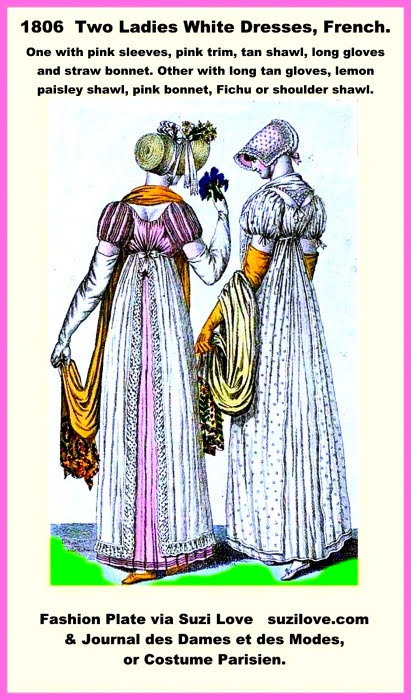
1806 Two Ladies In White Dresses, French. One with pink sleeves, pink trim, tan shawl, long gloves and straw bonnet. Other with long tan gloves, lemon paisley shawl, pink bonnet, Fichu or shoulder shawl. Fashion Plate via Journal des Dames et des Modes, or Costume Parisien. These fashionable ensembles with a variety of fashionable and practical accessories would have been worn by Jane Austen and her family and friends during the day when out walking in the park or visiting village shops. Hats were a necessity to protect fair skin from the sun and scarfs and shawls added color and warmth to an outfit.
Definition Fichu: Draped scarf or shawl worn about shoulders and tied in knot at breast, with ends hanging down loosely. Word, meaning negligee or careless, first used to describe breaking away from stiff collar of the past.
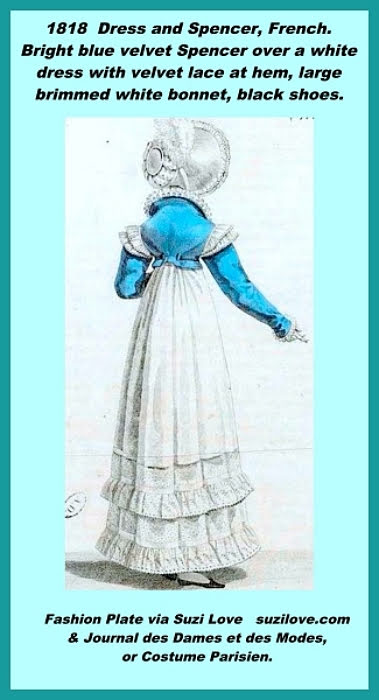
1818 Dress and Spencer, French. Bright blue velvet Spencer over a white dress with velvet lace at hem, large brimmed white bonnet, black shoes. Fashion Plate via Journal des Dames et des Modes, or Costume Parisien.
1864 Silk corset, made to be worn over a chemise. Made in France or Britain. Aqua blue silk lined with linen, edged with machine-made lace, reinforced with whalebone, metal, lined with cotton twill. The front has fastenings and the back has lacings. The wearer of this corset could dress without help because the steel ‘split busk’ fastens in front. The front fastening was invented in 1829 but did not become common until the 1850s. The whalebones press into the waist to shape the hipline into an extravagant curve, to flatter and support the fashionable cage crinoline. In the 1860s women relied on voluminous skirts, in addition to corsets, to make their waists appear small.
Flossing, or embroidery, to stop bones poking through fabric, edged with machine-made lace, reinforced with whalebone, metal fasteners, V-shaped front for better fit & extra shaping. The front has fastenings and the back has lacings. There are fewer bones in the back of the corset than the front and none over the hips. Trimmed at the top edge with a narrow band of machine-made lace. Stiffened with whalebone and machine-stitched with an incised swivel latch to lock the busk fastening. Boned at the centre front, back and diagonally from the side to back and sides to front. The boning is hand-stitched into place. Metal eyelets. Lined with cotton twill. The corset reaches the top of the hips and is gored at the bust and hips.
During the 19th century, corsets were made from a variety of materials and shapes changed often. Sometimes breasts were pushed up and almost over the top and waists could be tiny and other curves were emphasized. By the end of the 19th century, corsets weren’t laced so tightly because wide crinolines created the illusion of tiny waists. There are fewer bones in the back of the corset than the front and none over the hips. From the late 1840s to the 1860s skirts were full and bell-shaped, at which point corsets were relatively short and not particularly tightly laced, since the massive skirts made all waists look proportionally small.
The corset was worn over the chemise and it moulded the figure of the wearer into the fashionable shape of the day. These shapes ranged from slender to curvaceous and everything in between during the 19th century. Like the chemise, the corset in the 19th century was made of a wider variety of materials, in this case blue silk lined with linen. It did not need to be very tightly laced, for the illusion of a small waist was created by the very wide circumference of the crinoline.
Credit : Given by the Burrows family. Museum number:T.169-1961. The donors of this corset linked it to a 1864 marriage in the family. Victoria and Albert Museum, London, U.K.
1817 February Pelisse, or Redingote, English. Carriage dress of white poplin with a deep blond flounce. Blue levantine pelisse or walking dress, or Redingote in France, shorter than the dress and edged with floss silk. Coburg cap of black velvet turns up on one side in front and is lined and edged with blue satin. The head-dress worn with it has a profusion of white ostrich feathers. Ruff is of plain blond, edged with narrow white satin ribbon, and a pink Indian scarf over the shoulders. An ermine muff, gloves and slippers of blue kid, complete the elegant dress. Fashion Plate via John Belle’s La Belle Assemblée or, Bell’s Court and Fashionable Magazine, London.
Definition Coat or Redingote Or Pelisse: Long fitted outdoor coat worn over other garments for warmth. French word developed from English words, riding coat.
1807 Regency Couple, French.Dressed As In Jane Austen’s times.Back view of a lady’s white dress with a cute back bow, long draping scarf with knotted ends, and straw bonnet with a blue ribbon and bows. Gentleman in a long grey coat, orange vest, extremely high collar of a ruffled shirt, tight taupe pants tucked into topped boots, and with a fashionable short curly hairstyle. Fashion Plate via Costume Parisien.
1808 Lady In A High-Waisted White Dress Reading A Book Outdoors, French. Dress has short puffed sleeves and is worn under a frilled Pelerine, or shoulder cape, long tan gloves, walking shoes and a white country style hat with a blue bow. The lady is leaning on a post and reading a book. Fashion Plate via Journal des Dames et des Modes, Costume Parisien.
Empire Style Dress: Named after the First Empire in France. Empire dresses had a low neckline and skirts started directly under the bust and flowed into the classical relaxed wide styles of Greece and Rome. This style of dress is associated with Jane Austen and her contemporaries as a high-waisted dress was worn most days. Cotton, silk or taffeta were the popular fabrics.
Definition Pelerine: Tippet or shoulder cape, usually waist-length, with long, pointed ends in front. Popular in England and colonial America.
Writing Regency Era Fiction Or Nonfiction? Need more information on Older Gentleman’s Day in early 1800s, or the Bridgerton family or Jane Austen’s Regency Era. A lighthearted overview of an older gentleman’s clothing, social life, and responsibilities in the early 1800s. Take a look at where an older man went, what he wore, and how he managed the family’s finances and his estates. Older Gentleman’s Day Regency Life Series Book 3 books2read.com/suziloveOGD
Fan of Regency London in the times of Jane Austen and Bridgertons? Regency Overview Book 1 Regency Life Series #JaneAusten #RegencyEra #Bridgerton #Nonfiction #amwriting https://books2read.com/ROver
1807 Fashionable French Couple. Man: Blue cutaway coat and yellow breeches. Lady: Lemon and blue dress and bonnet. Typical of the ensembles worn by Jane Austen and her family and friends. Fashion Plate via Journal des Dames et des Modes, or Costume Parisien.
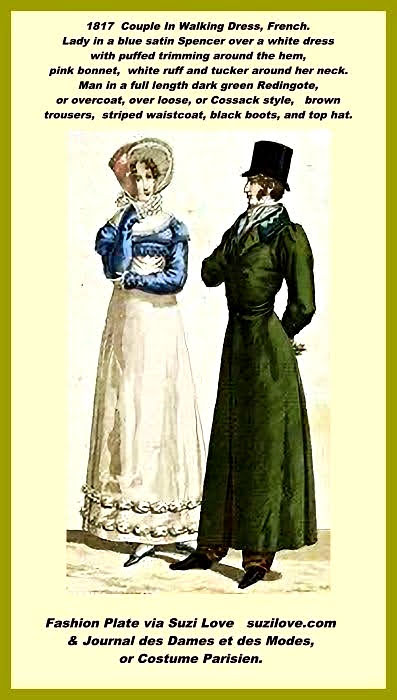
1817 Couple In Jane Austen and Bridgerton style Walking Dress and Gentleman in Same Green Redingote.
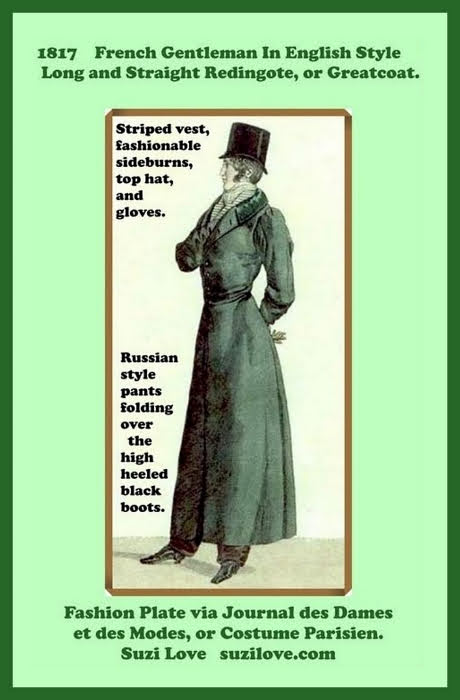
Lady: Blue satin Spencer over a white dress with puffed trimming around hem, pink bonnet, white ruff and tucker. Man: Long green Redingote, or overcoat, in the English style. Long brown trousers, striped waistcoat or vest, top hat, gloves and boots. Fashion Plate via Journal des Dames et des Modes, or Costume Parisien. Definition Redingote Or Coat Or Pelisse: Long fitted outdoor coat worn over other garments for warmth. French word developed from English words, riding coat. French fashion plates call these coats a Redingote and English plates call them a Pelisse, Or Walking Dress, or Carriage Costume. These are the types of outfits worn by Jane Austen and contemporaries in English magazines, where French fashions were obsessively copied despite the two countries being at war for many years.
This same Fashion Plate is seen below for the gentleman.