1819 January ‘Going to White’s’. By Richard Dighton. Lord Alvanley walks on the pavement going to White’s Club for gentlemen in London wearing a top-hat, double-breasted coat, strapped trousers, and the high collar of a dandy. Via British Museum, London, UK. britishmuseum.org (PD-Art)
White’s was an exclusive Gentlemen’s Club on St. James Street, London, U.K where well-dressed men, or Dandies, gathered at a special table in front of the large bow window looking out at the street. This became known as a seat of privilege and was used by London’s most famous Dandy, Beau Brummell. Other well-known dandies were William Arden, Joshua Allen, Thomas Raikes and Ball Hughes. Cartoonists loved to ridicule these high-in-the-instep gentlemen who wore the most fashionable clothes and set the fashion trends for the Regency years, and the years when Jane Austen was writing her famous novels.
‘Omnibuses, under the name of carrosses a cinq sous, were started in Paris in 1662. Seven vehicles to carry eight passengers each, all inside, were built, and on March 18th, 1662, they began running. The first one was timed to start at seven o’clock in the morning, but an hour or two earlier a huge crowd had assembled to witness the inauguration ceremony, which was performed l)y two Commissaires of the Chatelet, attired in their official robes. Accompanying them were four guards of the Grand Prevot, twenty men of the City Archers, and a troop of cavalry. ‘
In 1828, George Shillibeer, a London coach builder, visited Paris where he was impressed by the efficiency of the new horse-drawn bus service. The following year, he started a single horse-drawn omnibus connecting Paddington and Regent’s Park to the City of London. Passengers were picked up and set down anywhere along the route and fares were paid on board, in contrast to short-stage coaches which had to be booked in advance.
This new omnibus was pulled by three horses and carried 22 passengers who sat inside and were protected from the weather. Fares were sixpence and one shilling, less than a hackney cab or short-stage coach, but still too expensive for the lower classes.
1829 July 4th George Shillibeer Omnibus, London, U.K. First Omnibus between Paddington and Bank of England via the New Road, now Marylebone Rd., Somers Town and City Rd. Via Wikimedia Commons.
In 1832, the London City monopoly of hackney carriages was removed, so horse buses expanded and within two years there were 620 licensed horse buses in London. By the Great Exhibition in 1851, London’s increase in visitors meant this number doubled and the number of routes increased to 150. By 1856, several bus operators were taken over by the new London General Omnibus Company until, with 600 omnibuses, they were the largest bus company in the world. In 1833, the first real steam omnibuses, the ‘Era’ and ‘Autopsy’ were invented by Walter Hancock, of Stratford, and started on the London roads. The ‘Era’ was the better omnibus of the two, and the most flattering things were said and predicted of it. Enthusiasts declared that omnibuses of this type would enable passengers to be carried at a cheaper rate and greater speed. The ‘Era’ ran from Paddington to the Bank, the same route as the horse-drawn omnibuses, and carried fourteen passengers, the fare being sixpence all the way. It travelled at the rate of ten miles an hour. Travel on these roads was also dangerous as highwaymen stopped and robbed anyone who came along. Male or female made no difference to highwaymen in Britain, nor to the bushrangers in Australia or the gangs on American roads, as they robbed indiscriminately and often with violence.
By the end of the 18th Century, however, travel as a pleasurable pursuit came into vogue and numerous guides were written for traveling all over the British Isles as well as on the continent. The 1812 ‘Tour Of Dr. Syntax’ was an ironic look at the new obsession of travel and travel guides. Before he set off for the Lake District, Dr. Syntax said to his wife, “You well know what my pen can do, and I’ll employ my pencil too: I’ll ride and write, and sketch and print and thus create a real mint: I’ll prose it here, I’ll verse it there and picturesque it everywhere. I’ll do what all have done before; I think I shall and somewhat more.” Georgian and Regency travelers were envious of aristocrats, even if they were of the nobility themselves, and loved to view all the British Great Houses.
A gentleman and his wife would even drive up to the front door of a mansion house and demand to be given a tour of the house. If they weren’t admitted, they would write in their journals of the inhospitable nature of the people on a particular estate. Thomas Pennant, William Mavor, and others, loved to write about these bad experiences and have them published. Paterson’s British Itinerary, a travel guide had 17 editions between 1785-1832 – it outlined the roads used by the stage and mail coaches, the tolls, the bridges, etc. This new touring craze created an industry of hospitality that encompassed more than simple mail coach trips from place to place, and more than a noble family traveling from their country seat to the Metropolis of London for parliamentary sittings. Inns had to improve the quality of the linens and meals if they wanted to attract the wealthier traveling class. Before that, many travelers carried their own linen, crockery, glasses, and utensils, as they didn’t trust the hygiene or standards of country inns.
Travel became something written about by poets with many sonnets written to the beauty of places like the Lake District in England, or the pyramids in Egypt. Inns became cleaner and more respectable so they could welcome travelers of the upper classes. This also meant that women could travel more as roads were slowly improved from rutted tracks that were only suitable for horse riding to roads that family coaches could travel along, though these roads were still narrow and subject to extremes of weather, such as flooding. The race was on to travel from places like London to Edinburgh in the fastest possible time.
HN_10_D2D_RetailerBuyLink_ History Notes Book 10 books2read.com/SuziLoveTravel
1826 Almack’s Revisited by Charles White. The ball of this evening passed off as all other balls at the same place, creating envy, jealousy, and hatred in the minds of many of those who have been unsuccessful in procuring tickets; affording real amusement to few, and disappointing a greater portion of those who, by dint of manoeuvring, petitioning, parliamentary interest, or presents, have been enabled to obtain the desired vouchers; and as this was one of the last balls of the season, and a general election already talked of, the mixture of company and the number was much greater than usual; and, consequently, it was what the most correct persons called, “horrid bad Almack’s!”
Almack’s or Willis’s Rooms, King Street, St James, London, UK. Almack’s Assembly Rooms, founded by William Almack at No. 26-28, were on the site of the present Almack House. The club was originally a gaming establishment but moved from Pall Mall. The Assembly rooms were on the South side of King Street in St James’s and were opened on February 12, 1765. At the time the subscription was ten guineas for which there was a ball and supper each week for the twelve weeks of the season.
1826 Almack’s Revisited by Charles White.: ‘It was what most correct persons called ‘horrid bad Almack’s’. #RegencyEra #London #BritishHistory
1829 July 4th George Shillibeer’s Omnibus, London, U.K. First Omnibus between Paddington and Bank of England via the New Road, now Marylebone Rd., Somers Town and City Rd. Via Wikimedia Commons. books2read.com/SuziLoveTravel
1829 July 4th George Shillibeer’s Omnibus, London, U.K. First Omnibus between Paddington and Bank of England via the New Road, now Marylebone Rd., Somers Town and City Rd. Via Wikimedia Commons. D2D_RetailerBuyLink_HN_10. books2read.com/SuziLoveTravel
1808 Richard Trevithick’s Steam Circus, Bloomsbury, London, U.K. Site where Trevithick ran his locomotive ‘Catch Me Who Can’. Trevithick wanted to prove that traveling by train was faster than on horseback. Locomotive ran at top speed of 19 km per hour and people paid a shilling to sit in an attached car and be pulled around. Via Wikimedia Commons commons.wikimedia.org (PD-ART) This was the start of the railway expansions across England in Jane Austen’s time.
1808 Richard Trevithick’s Steam Circus, Bloomsbury, London, U.K. Site where Trevithick ran his locomotive ‘Catch Me Who Can’. Trevithick wanted to prove that traveling by train was faster than on horseback. Locomotive ran at top speed of 19 km per hour and people paid a shilling to sit in an attached car and be pulled around. Via Wikimedia Commons commons.wikimedia.org (PD-ART)
D2D_RetailerBuyLink_HN_10.books2read.com/SuziLoveTravel
Early 1800s Typical Regency Couple in a Curricle. The sort of vehicle Jane Austen and her contemporaries would have driven in. Young men loved them and occasionally women drove them.
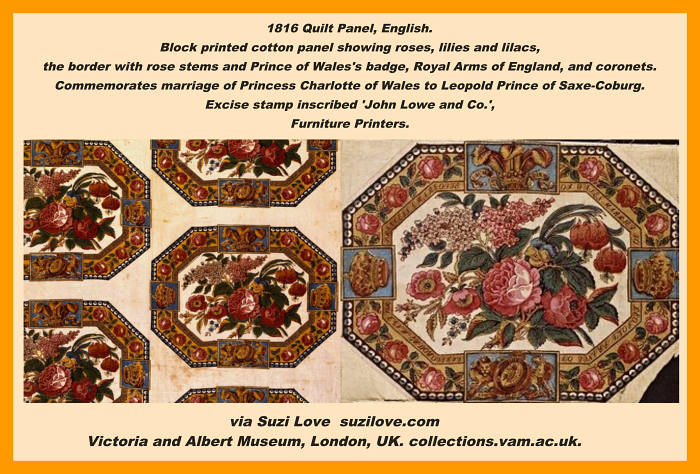
1816 Block Printed Quilt Panel made to celebrate the Marriage of Princess Charlotte to Prince Leopold of Saxe-Coburg.
Textile of block-printed white cotton in madder colours with pencilled blue. The cotton is printed with 9.5 octagonal panels intended to be cut out and applied to patchwork quilts. Each panels contains a bunch of flowers. Around the inner border is an inscription of Princess Charlotte of Wales married to Leopold Prince of Saxe-Coburg May 2, 1816. In the borders are three Prince of Wales feathers, the Royal Arms, and a crown on each side. At the end of the textile is printed a rectangular panel containing the manufacturers name and in a corner is the name ‘G. Swindels’.
This quilt has an excise stamp for 1816 and is inscribed ‘John Lowe and Co. Furniture Printers, Shepley Hall’, providing the name of the only identifiable manufacturer of these panels, although there are likely to have been others. John Lowe was a well-known firm of calico printers with large cotton factories and extensive bleaching grounds close to the River Tame near Ashton-under-Lyne in Lancashire.
Hand-quilting is done on a frame using needles called ‘betweens’. The stitches are executed with one hand; the other hand is kept underneath the quilt to feel for the needle. Small, uniform stitches (usually a ‘running stitch’) are taken through the three layers to form a decorative design. In ‘piecing’ or ‘patchwork’, small pieces of fabric are sewn together to produce a decorative design. The most enduring method in Britain is done by hand, and is known as ‘piecing over paper’. The pattern is first drawn onto paper and then accurately cut. Small pieces of fabric are tacked round each of the shapes, and then joined together from the back using overstitch. Most of the quilt top visible here has been pieced over paper, but in some areas the fabrics have been applied directly on to the earlier quilt that forms the wadding.
1820 ca. Writing Box, English. Rosewood and brass inlaid writing box by William Dobson, The Strand, London. Makers label, gilded candle holders, ink wells. via antiques-atlas.com. Portable boxes for writing materials existed for many centuries but in the last decades of the 18th century socio-economic circumstances in England necessitated the wide use of a portable desk in the form of a box which could be used on a table or on one’s lap. Hence “Lap Desk”.
HN_13_D2D_WritingTools Book 13 What did the lady of the house use to pen notes? What sat on the desk of the man of the house when managing his accounts? #History #Nonfiction #travel books2read.com/SuziLoveWritingTools