This book shows how corsets changed to both provide support and also fit well under clothing to give a fashionable silhouette. Corsets started being a fashion item, rather than simply underclothing to be hidden. Romantic Era women’s fashionable corsets. Corsets worn from 1830-1850, or the Romantic Era of fashion. https://books2read.com/SuziLoveCorsetBook18 Corsets 1830-1850 History notes Book 18
1887 Front View. Wedding Corset, American. Cotton twill, silk thread embroidery. Fully boned wedding corset with front hooks and back lacing. Every boning channel is flossed top and bottom. Via Chicago History Museum, U.S.A. digitalcollection.chicagohistory.org https://books2read.com/SuziLoveCorsetBook20
1800-1870 ca. Stocking Purses, British. Beaded stocking purses crocheted in silk and steel beads, with steel rings with tassels and fringes. via Victoria and Albert Museum, London, UK. collections.vam.ac.uk.
Definition Miser or Long or Stocking or Ring Purses: Long, narrow, tubular shape, often wider at ends and narrow in middle, which had a short slit opening. Popular in England and France from the mid-18th century through the early 20th century.
From the Curator Victoria and Albert Museum, London: Stocking purses are also known as misers’ or wallet purses. The majority were netted, but some were knitted or crocheted, like this one. Once worked, the elongated tube was put on an expandable purse stretcher to shape it. It was then sewn up, leaving a central opening, and squeezed through a pair of rings known as sliders, which were used to secure and separate the different coins stored at either end. It could be carried in the hand, bag or pocket, or tucked over a belt. Many stocking purses were made as presents, and were thought a suitable object to give to a gentleman. Crochet is a type of needlework with an open, lacy appearance, which is formed with a hook and single length of thread making a series of loops, chains and knots. The technique developed out of ‘tambouring’, a type of embroidery, after the tambour hook began to be used to create series of loops, free from a ground fabric. This could then be used as a separate trimming, like lace, or made to form items like this purse. Crochet was thus added to the varieties of fancy needlework available to ladies, and instructions for making it can be found in manuals from the 1820s onwards.
1800-1870 ca. Beaded Stocking Purses, British #RegencyFashion #RomanticEra #HistoricFashion books2read.com/suziloveReticules
1845 Woman’s Dress, Probably Made In England. Silk Taffeta and glazed linen plain weave. via Los Angeles County Museum of Art, California, USA. collections.lacma.org
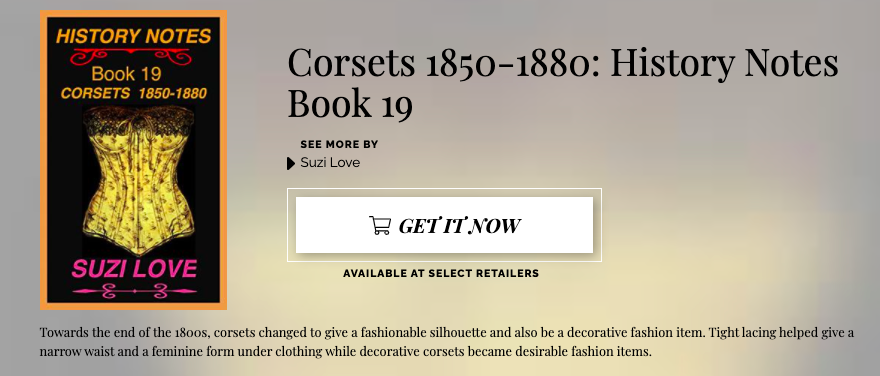
1879-1885 ca. Linen Riding Corset, English. https://books2read.com/SuziLoveCorsetBook19 Woven linen corset, weighs 0.14kg, and worn for riding. Made on a loom with pockets for bones and busk, woven corsets were lightweight, flexible, washable and patented in France in 1832 by Jean Werly. Stitched corsets made from seamed pattern pieces provided more support when on horseback. Manufacturer: Charles Bayer. via Victoria and Albert Museum, London, UK.
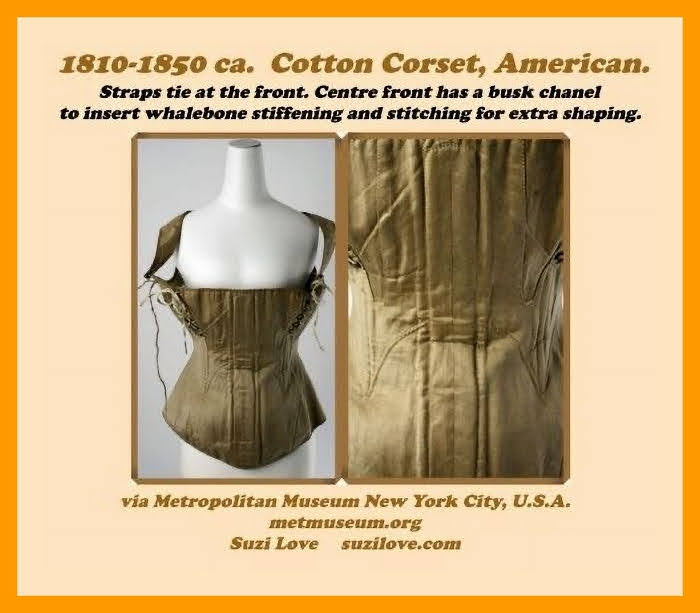
1810-1850 ca. Cotton Corset With Whalebone Busk, American. Straps tie at the front. Center front has a busk Chanel to insert a whalebone to keep the corset stiff and in place. There is extra stitching on the corset to give more shape and extra reinforcing to keep the corset upright and the dress worn over it smooth and flat. Marking stamped on the lining, ‘Jane Laney’ and Mrs. Bishop, Corset Maker, 108 Hudson St., New. York, USA. via Metropolitan Museum New York City, U.S.A. metmuseum.org
Surviving stays, or corsets as they became to be called in the nineteenth century, show that both longline and shorter corsets were worn and that they were made of cotton, silk and sateen. A lot of these corsets were front fastening, plus many were laced at both the front and the back so our aristocratic fictional heroines could indeed dress and undress themselves without the assistance of a maid.
Definition Busk: Central panel in a corset to give it extra shape. Made from wood, bone which was usually whalebone, ivory, and in the latter 1800s from metal.
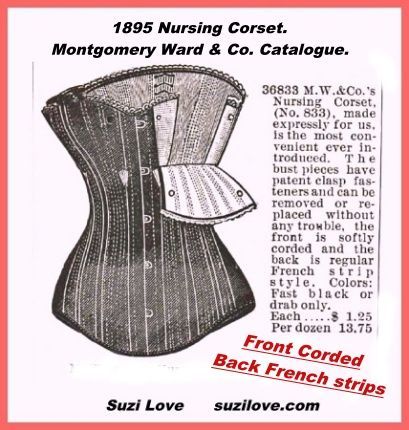
1895 Nursing Corset, French. via Montgomery Ward and co. Catalogue. Boned, soft and pliable busts, French sateen covered strips.
Definition Montgomery Ward: World first American mail order business and later a department store chain that operated between 1872 and 2001.
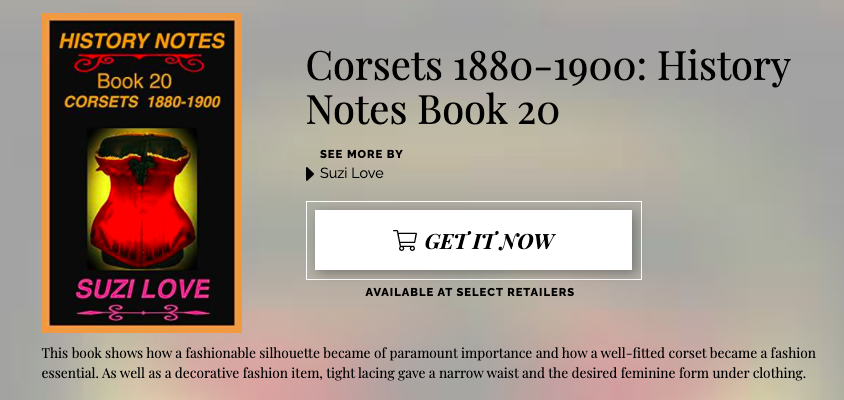
Corsets 1880-1900 History Notes Book 20 This book shows how a fashionable silhouette became of paramount importance and how a well-fitted corset became a fashion essential. As well as a decorative fashion item, tight lacing gave a narrow waist and the desired feminine form under clothing. https://books2read.com/SuziLoveCorsetBook20
1864 Silk corset, made to be worn over a chemise. Made in France or Britain. Aqua blue silk lined with linen, edged with machine-made lace, reinforced with whalebone, metal, lined with cotton twill. The front has fastenings and the back has lacings. The wearer of this corset could dress without help because the steel ‘split busk’ fastens in front. The front fastening was invented in 1829 but did not become common until the 1850s. The whalebones press into the waist to shape the hipline into an extravagant curve, to flatter and support the fashionable cage crinoline. In the 1860s women relied on voluminous skirts, in addition to corsets, to make their waists appear small.
Flossing, or embroidery, to stop bones poking through fabric, edged with machine-made lace, reinforced with whalebone, metal fasteners, V-shaped front for better fit & extra shaping. The front has fastenings and the back has lacings. There are fewer bones in the back of the corset than the front and none over the hips. Trimmed at the top edge with a narrow band of machine-made lace. Stiffened with whalebone and machine-stitched with an incised swivel latch to lock the busk fastening. Boned at the centre front, back and diagonally from the side to back and sides to front. The boning is hand-stitched into place. Metal eyelets. Lined with cotton twill. The corset reaches the top of the hips and is gored at the bust and hips.
During the 19th century, corsets were made from a variety of materials and shapes changed often. Sometimes breasts were pushed up and almost over the top and waists could be tiny and other curves were emphasized. By the end of the 19th century, corsets weren’t laced so tightly because wide crinolines created the illusion of tiny waists. There are fewer bones in the back of the corset than the front and none over the hips. From the late 1840s to the 1860s skirts were full and bell-shaped, at which point corsets were relatively short and not particularly tightly laced, since the massive skirts made all waists look proportionally small.
The corset was worn over the chemise and it moulded the figure of the wearer into the fashionable shape of the day. These shapes ranged from slender to curvaceous and everything in between during the 19th century. Like the chemise, the corset in the 19th century was made of a wider variety of materials, in this case blue silk lined with linen. It did not need to be very tightly laced, for the illusion of a small waist was created by the very wide circumference of the crinoline.
Credit : Given by the Burrows family. Museum number:T.169-1961. The donors of this corset linked it to a 1864 marriage in the family. Victoria and Albert Museum, London, U.K.
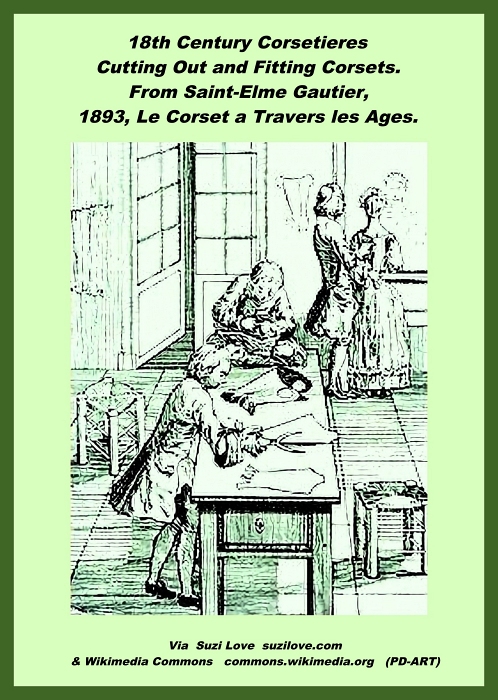
There has been some discussion on the names for Corset Makers. I’ve seen lots of names, including Stay Maker, Stay Manufacturer, Corset Maker, Body Tailor and Milliner. It was mainly men who were Stay Makers, but there were also some women who included stay making with their millinery.
Corsets Overview History Notes Nonfiction Book 14. This book shows how body wraps, stays, and corsets were worn to create a variety of fashionable silhouettes through past centuries. Corsets flattened breasts and accentuated rounded hips or pushed up breasts and showed off the bust line depending on the fashions of the time and the desired silhouette. Includes corsets through the Georgian, Regency, Victorian and Edwardian Eras and Jane Austen’s lifetime. Overview of corsets through history, including the Georgian, Regency, Victorian and Edwardian Eras and Jane Austen’s lifetime.
1776 April 28th John McQueen, Stay Maker., New York. At the sign of the White Stays in Smith Street,near the Mayor’s baths, New York. Making all sorts of stays in the newest fashion that is worn by the ladies of Great Britain or France. Packthread stays for babies from one month to seven years, stays for children of Tabby, Ruffled Canvas, Or Buckram, and for older girls an assortment of thin boned stays of different sorts and sizes.1835 Milliner, Dress and Corset Maker to the Royal Family. Mrs. Langdon. 37 Milson Street, Bath, U.K. Local Trade Advertisements. From 1835 The Historical and Local New Bath Guide By C. Duffield. via Google Books (PD- 150)18th Century Interior of the shop of a body tailor, or corset maker. From 1893 The Art of the Tailor of the Bodies of Women and Children.1835 Fashionable Long and Short Stay Manufacturer. Robert Drew & Co. Local Trade Advertisements. From- 1835 The Historical and Local New Bath Guide. Published by C. Duffield via Google Books (PD-150)18th Century Corset Maker From 1893 Le Corset, A Travers Les Ages.18th Century Corsetieres cutting out and fitting. From Saint-Elme Gautier, Le Corset a Travers les Ages. en.wikipedia.orgNames For Corset Makers in Jane Austen and Bridgerton times? Lots of them including Stay Maker, Corset Maker, Body Tailor and Milliner. #janeausten #bridgerton #Corset https://books2read.com/SuziLoveCorsetBook14 Share on X