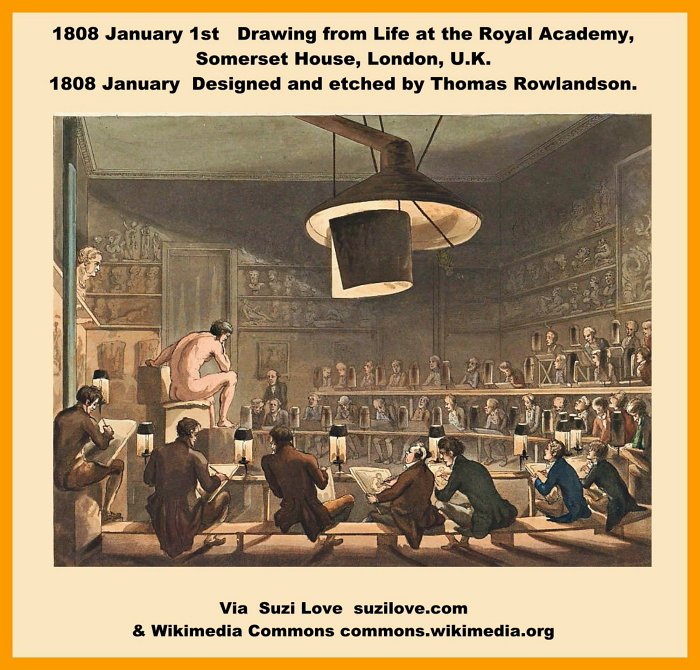
1808 January 1st Drawing from Life at the Royal Academy, Somerset House, London, U.K. The Royal Academy would have held art classes like this in London during Jane Austen’s time. Designed and etched by Thomas Rowlandson. Via Wikimedia Commons. commons.wikimedia.org
Covent Garden is within the London boroughs of Westminster and Camden, and the parliamentary constituencies of Cities of London and Westminster and Holborn and St Pancras. The district is divided by the main thoroughfare of Long Acre, north of which is given over to independent shops centred on Neal’s Yard and Seven Dials, while the south contains the central square with its street performers and most of the elegant buildings, theatres and entertainment facilities, including the Theatre Royal, Drury Lane, and the London Transport Museum.
In 1552, the land was seized by Henry VIII and granted to the Earls of Bedford. The 4th Earl commissioned Inigo Jones to build fine houses to attract wealthy tenants. It was the first modern square in London, with Italian arcades and a flat, open space or piazza with low railings. This layout was copied in other new estates in London.
1555 John Russell, 1st Earl Of Bedford. By a follower of John Bettes. Given land of Covent Garden by Herny VIII after the dissolution of the Monasteries.
1650 The piazza of Covent Garden about 1650, as engraved by Wenceslaus Hollar. Courtesy University of Toronto.
1721-1789 ca. St. Paul’s Church, Covent Garden, London, U.K. From between two arches of the plaza. Watercolor with grey wash. By Thomas Sandy. Via British Museum, London, UK. britishmuseum.org
1800s Early Covent Garden Market, London, U.K.
In 1654, an open-air fruit and vegetable market grew on the south side of the fashionable square but over time the market and the surrounding area fell into disrepute. Taverns, theatres, coffee-houses and brothels opened up, the gentry moved away, and rakes, wits and playwrights moved in.
By the 18th century Covent Garden had become a well-known red-light district, attracting notable prostitutes such as Betty Careless and Jane Douglas. Descriptions of the prostitutes and where to find them were provided by Harris’s List of Covent Garden Ladies, the “essential guide and accessory for any serious gentleman of pleasure”.
Covent Garden’s market was always disorderly, the buildings in bad shape, and overcrowded with stalls, donkeys, carts, and peddlers. The small number of passageways into the piazza were small and with bottle necks of carts moving goods and market sellers fighting for right of way. The markets supplied fruits and vegetables, mostly homegrown but with imported goods increasing. Many sellers missed paying tolls for selling in the piazza or refused to pay them so the owner, the Earl of Bedford, took many people to court for not paying tolls. He realized the markets were in such poor condition that he couldn’t charge sellers until he improved them. In 1830, a new market hall was built with sections dividing the kind of goods sold which did improve things, but the markets remained chaotic. By 1890, people were again complaining about the narrow streets and congestion. The market hall provided a more permanent trading centre and Charles Fowler’s neo-classical building was erected to cover the market. As the market grew, the prostitutes moved on. The Houses of Parliament were the centre of Britain’s political world. But there was also an abundance of grand mansions and other buildings of interest in the City.
Covent Garden’s flower girls attracted attention by shouting:
“Two bundles a penny, primroses!”
“Sweet violets, penny a bunch!”
In 1851, Henry Mayhew wrote London Labour and the London Poor describing two types of flower girl. The young girls, or waifs, sold flowers to feed the family. The other type of flower girl stayed out late, doubled as prostitutes, and had bad reputations.
In 1913, Herbrand Russell, 11th Duke of Bedford agreed to sell the Covent Garden Estate for £2 million to the MP and land speculator Harry Mallaby-Deeley, who sold his option in 1918 to the Beecham family for £250,000.
1809 View Of the New Covent Garden Theatre, London. From Hart Street, showing the King’s entrance. Watercolor drawn by James Winston. via British Museum.
1811 Bird’s Eye View of Covent Garden Market, London, UK. Main fruit, flower and vegetable market in London in early 19th century. Began here in 1656 with few temporary stalls in back garden of home of Earl of Bedford. Charles II granted market lease and in 1678 bought by Adam Piggot and others who built permanent stalls. By 1811, smelly, dirty, and overcrowded. Engraver J. Bluck. After Augustus Charles Pugin and Thomas Rowlandson published by Ackermann. Via British Museum, London, UK. britishmuseum.org
1827 Covent Garden Market, Westminster, London, U.K. By Frederick James Havell.
1835 Covent Garden Watch House, London, UK. Next to the church of St. Paul’s Church, Covent Garden. Two story white building with ‘Watch House’ painted on its upper floor is shown with a lively street scene in the foreground. via Museum of London.
1852 J.M.W. Turner’s birthplace in Maiden Lane, Covent Garden. Brick terraced house at night with a figure in top hat walking past and two figures with a candlelight in the doorway. Watercolour with body color over graphite. Drawn by John Wykeham Archer.
In 1913,Herbrand Russell, 11th Duke of Bedford agreed to sell the Covent Garden Estate for £2 million to the MP and land speculator Harry Mallaby-Deeley, who sold his option in 1918 to the Beecham family for £250,000. By the end of the 1960s, traffic had become congested until in 1974 the market relocated to the New Covent Garden Market about three miles (5 km) south-west at Nine Elms. In 1980, the central building re-opened as a shopping centre and then became a tourist location with cafes, pubs, small shops, a craft market called the Apple Market, and another market in the Jubilee Hall.
Light-hearted look at Young Lady in Jane Austen’s times, or early 1800s. A glimpse into both the frivolous and more serious occupations filling a young lady’s day in the lifetime of Jane Austen, or the Regency Era, or the early 19th Century. Historic images and historical information show her fashions and frolics. https://books2read.com/suziloveYLD
1700 ca. Chess and Backgammon Box, Augsburg. Decorated in violet wood veneer, ebony and ivory. Ivory checkers and chess pieces, hinges and push button lock in gilded brass, two horn goblets, two ivory dice, thirty-none checkers’ pawns stamped both sides with effigies of cities, Munich, Vienna, Nuremberg, Prague, Danzig, of kings and queens, Prussia, England, Scotland, Poland, and various scenes. Via AnticStore.com
1801-1818 ca. ‘Diablo, or devil on two sticks’. Lessons In The Devil Series Plate 55: Man teaching a woman how to play diabolo, or devil on two sticks. via 1801-1818 Le Bon Genre, French. Gentleman in blue tailcoat, high white shirt and cravat, pants and black shoes. Lady in white dress with high frilled neckline, long sleeves and wearing green walking boots. Hand-colored etching. Published by: Pierre La Mésangère. Via British Museum, London, UK britishmuseum.org (PD-Art)
Jane Austen and Games: In Jane Austen’s times, games were a part of daily life. Families played all sorts of games, indoors and outside, to pass the time, especially at house parties or family gatherings.
Diablo, Or Devil On Two Sticks: Double cone type of yo-yo that is twirled, spun, tossed and caught on a string attached to two hand sticks. The toy, or Diablo, is kept spinning by manipulating it back and forth along the string and by tossing into the air. Numerous tricks can be performed e.g. toss, trapeze, cat’s tail and the umbrella.
Fashion Women 1815-1819 History Notes Book 28 https://books2read.com/SuziLoveFashionWomen1815-1819
Are you a Bridgerton fan? Love Jane Austen? Love history? Take a look at a Young Gentleman’s Day in the early 1800s. Light-hearted look at a young man’s day in the early 1800s. Depicts the ups and downs of a young gentleman’s day in the Regency Era, or Jane Austen’s years. Through historic images, historical information, and funny anecdotes, it shows how a young man about town fills his day, where he goes, and who he spends time with. This light-hearted look at the longer Regency years is an easy to read overview of what people did and wore, and where they worked and played. There is plenty of information to interest history buffs, and lots of pictures to help readers and writers of historical fiction visualize the people and places from the last years of the 18th Century until Queen Victoria took the throne. books2read.com/suziloveYGD
RL_2 Love the Bridgertons? Are you a fan of Jane Austen and her era? Easy to read view of what a young gentleman did and wore in the early 1800s. #RegencyEra #JaneAusten #amwriting books2read.com/suziloveYGD RL_2_D2D_RetailerBuyLink_RL_2
https://books2read.com/suziloveYGD
1810-1820 ca. Double Breasted Red Hunting Coat, English.
1810-1820 ca. Red Hunting Coat, English. Hunting was both a popular sport and an essential part of social success. Double-breasted tailcoat of woolen superfine, lined with sateen and cotton, M-notch lapels, nine gold buttons with heraldic crest, cuffs with three smaller matching buttons. via Collection from Castle Howard, Yorkshire, U.K. Victoria and Albert Museum, London, UK. Hunting coats, or colors, often red coats called pinks, were worn by hunt masters and hunters. In Bridgerton and Jane Austen times, or the early 1800s, gentlemen wore red coats like this while riding to the hounds.
Historically, hunt members wore ‘colors’ to distinguish between types of hunters and their level of experience. Traditional red coats were worn by huntsmen, masters, former masters, whippers-in, regardless of sex, while other hunt staff members and male members invited by masters wore colors and hunt buttons as a mark of appreciation for their involvement in the organization and running of the hunt. After the Hunting Act in England and Wales, only Masters and Hunt Servants wore red coats or hunt livery. Gentleman subscribers usually wore black coats, with or without hunt buttons and in some countries, women wore colored collars on their black or navy coats to help them stand out from the rest of the field. Some hunts, including most harrier and beagle packs, wear green rather than red jackets, and some hunts wear other colors such as mustard.
1807 Game of Billiards By Louis Leopold Boilly, French. Ladies playing billiards as they did in Jane Austen’s time. via Heritage Museum, Russia ~ heritagemuseum.org
Fashion Women 1805-1809 History Notes Book 26 What did Jane Austen and friends wear? https://books2read.com/SuziLoveFashionWomen1805-1809
What did an older lady do and wear in the Regency Era? Information & pictures for readers and writers of early 1800s history, nonfiction and fiction. books2read.com/suziloveOLD
The older lady’s day usually started with her toilette in her bedroom, where her maid helped her dress for the day and styled her hair. After that, she would join her family downstairs for breakfast unless she preferred a tray with either tea or hot chocolate in her bedroom as she prepared for her busy day. Her day would be made up of speaking with the housekeeper and the cook about the week’s menus, assuring that the servants were all available that day and no one was ill, and checking the list of foods needed. She would also enquire if the laundry was up to date and that they had enough good linen to make up all the beds before extended family members and guests arrived. If she was in the country and hosting a weekend house party, she would assign rooms to the guests on her lists and query that all was in readiness for their arrival.
The Lord of Misrule was generally a peasant, or sub-deacon, and the revelries followed the Pagan tradition of Saturnalia and was a time of drunkenness and wild partying. The Church’s festival with a Boy Bishop, the leader of children’s festivities in choir schools, was similar, but was abolished by Henry VIII in 1541, restored by the Catholic Queen Mary, but again abolished by Protestant Elizabeth I. On the Continent, the Council of Basle suppressed it in 1431 but the custom was revived in some places from time to time, even as late as the eighteenth century. After the death of Edward VI in 1553, the English court stopped appointing a Lord of Misrule.
From A Survey of London by John Stow: Reprinted from the text of 1603.
‘…in the feaste of Christmas, there was in the kings house, wheresoeuer he was lodged, a Lord of Misrule, or Maister of merry disports, and the like had yee in the house of euery noble man, of honor, or good worshippe, were he spirituall or temporall.’
During the late medieval and early Tudor periods in England, Lord of Misrule, also called Abbot Of Misrule, or King Of Misrule, was appointed to manage the Christmas festivities held at court, in the houses of great noblemen, in the law schools of the Inns of Court, and in many of the colleges at the universities of Cambridge and Oxford.
His reign lasted anywhere from 12 days to 3 months and his role was to direct the masques, processions, plays, and feasts. Although this was mostly a British custom, in ancient Rome from the 17th to 23rd of December, a Lord of Misrule took on the guise of Saturn for the feast of Saturnalia and the ordinary rules were changed so that masters became slaves and the offices of state were held by slaves. The Lord of Misrule presided and could command anyone to do anything. Our contemporary Christmas holidays seem to have originated from this idea of festive holidays.
The custom began in December 1551 when the Duke of Somerset, Edward VI’s uncle Edward Seymour, was in the Tower of London awaiting execution. He sent a note to the Master of Revels to appoint George Ferrers as Lord of Misrule. Ferrers was a courtier and poet who later contributed to A Mirror for Magistrates, described by Scott Lucas as a “compendium of tragic monologues” by a series of historical personages.
Scotland had the Abbot of Unreason (suppressed in 1555) as their equivalent to the Lord of Misrule and scholars believe both ideas came from the “king” or “bishop” who presided over the earlier Feast of Fools.