1780 Stays and Panier, or Hoop Petticoat, England. via suzilove.com and Los Angeles County Museum of Art, California, USA. Stays: Brown linen twill and baleen. Panier: Woman’s hoop petticoat, or pannier, of linen plain weave and cane 1750-1780. via Los Angeles County Museum of Art, California, USA. collections.lacma.org
1780 Stays and Panier, or Hoop Petticoat, England. via suzilove.com and Los Angeles County Museum of Art, California, USA. collections.lacma.org
Fashion Must Haves In Jane Austen’s Times: Reticules, Spencers, Redingotes. History Notes Series Books 3, 4, and 5.
Reticule Or Bag: Purse, often with a drawstring to pull closed and usually made of cloth or covered cardboard and often decorated with beading or embroidery. Carried by a woman during the Regency period to carry all their daily necessities. in the place of pockets.
Spencer: Short jacket, cropped at the waist, worn over a dress, or gown. Delicate and regency dresses provided so little protection from the cold, so over garments were essential for warmth, modesty and good health.
Pelisse Or redingote Or Walking Dress: Coat worn over clothing of both sexes for warmth and protection from the elements.
1785–1800 ca. Cotton Breeches, American or European. Man’s cotton breeches, drop down, or fall, front opening, button fastening at the waist, extra material in the back allows more movement for riding etc., and buttons secure the leg openings so they can be fitted to wear with boots for riding. via Metropolitan Museum, NYC, U.S.A. These are the sort of pants that the men Jane Austen knew would have worn for riding or in the country.
1700s Late Pair of Pattens, English. Iron supports underneath leather and wood. Pattens: Under shoes that strapped onto shoes and worn outdoors and to lift shoes and dresses out the mud. People in Jane Austen’s lifetime would have used these to protect the hems of dresses and legs of men’s pants, plus protect delicate shoes. via Victoria and Albert Museum, London, UK. collections.vam.ac.uk.
HN_1 Fashion Women Late 1700s History Notes Book 1 by Suzi Love.
What was fashionable for women in the late 1700s? Extravagant colors and fabrics and outrageous styles were all seen in these flamboyant fashions.
books2read.com/suziloveFashWomen1700s
Lover of Bridgerton and Jane Austen fashions? What was fashionable for their outer wear? Different names in different countries: Pelisse, Redingote, Or Walking Dress. #Regency #Fashion #History http://books2read.com/suzilovePelisse
The Pelisse or Redingote was essentially a coat or robe like garment worn both indoors and out. Worn indoors open to reveal a dress, the outdoor version was made of heavier materials and of darker colors than the type worn indoors. The name comes from the term ‘riding coat.’ In the Georgian Era, Redingotes were worn by men, women and children when outdoors and especially as part of a riding costume by both sexes.
In England, the Pelisse was the main sort of fashionable outerwear, or coat, for women in the Regency Era, or Jane Austen’s times. Though this sort of coat was popular from the late 1700s until around 1850. In the early 1800s, this sort of Empire style coat reached the hip or knee but around 1810 the Pelisse lengthened to become a full length coat. Around 1812, the Pelisse often had a broad, cape-like collar with fur trim and thanks to the Napoleonic Wars and an avid interest in all things military, a Pelisse took on a military look with epaulettes and braiding very popular.
While the terms Redingote and Pelisse are often used interchangeably, Pelisse and Walking Dress and Carriage Costume were the names used in English Fashion Plates, whereas French Fashion Plates refer to the longer style of coats as a Redingote and the shorter shoulder capes worn by military men as a Pelisse.
Pelisse, Redingote, Or Walking Dress. History Notes Book 5 By Suzi Love. What was fashionable for outer wear in past centuries? Call them what you like: Coat, Pelisse, Redingote, Walking Dress, Promenade Dress. Take a look at what was being worn by women, men, and children. books2read.com/suzilovePelisseD2D_RetailerBuyLink_HN_5_books2read.com/suzilovePelisse
16th-19th Centuries Gentlemen’s Banyans. Banyan’s were worn before the Georgian Era and continued to be popular through the Regency and Victorian Eras for Men’s At-Home Fashion. After this, banyans were replaced buy shorter smoking jackets, yet all through these many hundred years banyans served the same purpose of being a comfortable yet respectable item of clothing that could be worn at home by men when they spent time in the evenings with family or friends.
Fabrics imitating animal patterns and colors appeared in European fashionable dress as early as the 18th century, when elaborate trompe l’oeil silk designs emulated exotic furs intertwined with expensive laces. Such fabrics communicated a sense of luxury, wealth and power. Cultural crossdressing was a long-established tradition among merchants working in the East. While it helped them to assimilate into the local community, adopting exotic forms of dress at home also played an important part in fashioning their identity as a worldly traveller. International experience heightened social standing so wearing a banyan showed a high social status. Surviving garments from the 18th and 19th centuries show that it changed little over time, other than to loosely reflect the fashionable line of menswear of the period in the cut of the skirts, choice of collar and fit of the body.
16th-19th Centuries. Collage of Gentlemen’s BanyansDefinition Banyan: Loose coat worn by men as a dressing gown. Often worn with a matching waistcoat over shirt and pants in the comfort of their own home.
HN_23_d2d_fashionmen1800-1819
https://books2read.com/SuziLoveFashionMen1800-1819
1799 Gentleman’s daily outfit of brown cutaway coat and baggy white trousers. #GeorgianEra #FashionPlate #France https://www.books2read.com/suziloveFashMen1700
1770 Yellow Silk Corset, Italian. Front and Back Lacing. By the 1770s, steel was being used in stays, which increased their strength, though not their flexibility. Credit Line: Gift of The Metropolitan Museum of Art, 1940 Accession Number:C.I.40.173.6a–e Metropolitan Museum, N.Y.C, U.S.A.
By the 1770s, steel was being used in stays, which increased their strength, though not their flexibility. With the tight lacing made possible by stronger stays, doctors and others voiced health concerns, such as this comment from a 1775 correspondence: “I hope Miss Sparrow will not fall into the absurd fashion of ye wasp-waisted ladies. Dr. Pringle declares he has had four of his patients martyrs to that folly (indeed wickedness), and when they were opened it was evident that their deaths were occasioned by straight lacing.” Although admonitions on the dangers of straight lacing are common in the eighteenth and nineteenth centuries, recent scholarship by Valerie Steele has called into question the reality of the many “death by tight lacing” stories of the period.
History Notes Book 15 shows how body wraps, stomachers and stays were worn during the 1700s, or Georgian Era, to create a variety of fashionable silhouettes to suit the elaborate fashions worn for court and daily life. https://books2read.com/SuziLoveCorsetBook15
1770 Yellow Corset, Italian. Front and Back Lacing. By the 1770s, steel was being used in stays, which increased their strength, though not their flexibility. via Metropolitan Museum NYC, U.S.Ametmuseum.org1770 Yellow Corset, Italian. Front and Back Lacing. By the 1770s, steel was being used in stays, which increased their strength, though not their flexibility. via Metropolitan Museum NYC, U.S.Ametmuseum.org
What was fashionable outdoor wear for Jane Austen and contemporaries? Reticules, Spencers, and Pelisses, or Walking Dresses, Or Redingotes. History Notes Books 3, 4, and 5 By Suzi Love.
What sort of coats did women wear during the Regency years? them what you like: Coat, Pelisse, Redingote, Walking Dress, Promenade Dress. Take a look at what was being worn by women, men, and children. books2read.com/suzilovePelisse
HN_5_What was fashionable for outer wear in past centuries? Different names in different countries- Pelisse, Redingote, Or Walking Dress. #Regency #Fashion #History books2read.com:suzilovePelisse
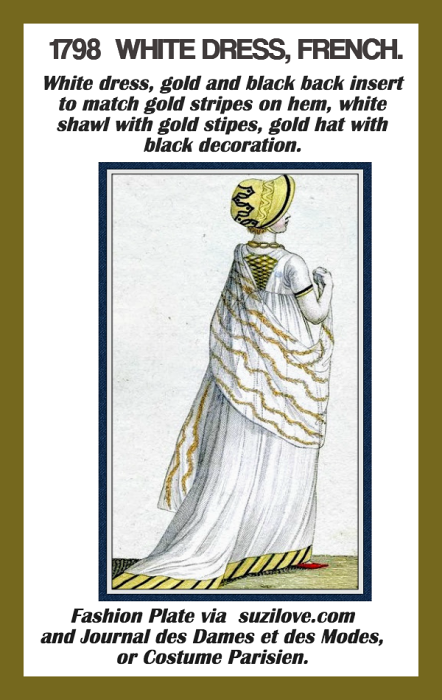
1798 White Dress, French. Gold and black back insert to match gold stripes on the hem, white shawl with gold stripes, gold hat with black decoration. Via Journal des Dames et des Modes or Costume Parisien.
1798 White Dress, French. Gold and black back insert to match gold stripes on the hem, white shawl with gold stripes, gold hat with black decoration. Via Journal des Dames et des Modes or Costume Parisien.What was fashionable for women in the late 1700s? Extravagant colors and fabrics and outrageous styles were all seen in these flamboyant fashions. #Georgian #nonfiction #amwriting books2read.com/suziloveFashWomen1700s