1826 The Cyprian’s Ball At the Argyll Rooms. A Regency Gentleman’s Life. From The English Spy By Robert Cruikshank.



1826 The Cyprian’s Ball At the Argyll Rooms. A Regency Gentleman’s Life. From The English Spy By Robert Cruikshank.
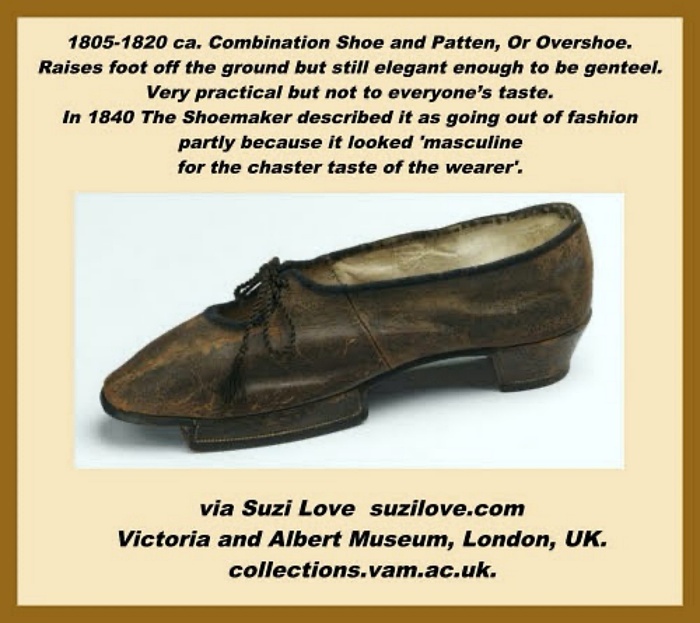
1805-1820 ca. Combination Shoe and Patten, Or Overshoe. Raises foot off the ground but still elegant enough to be genteel. Very practical but not to everyone’s taste. When Jane Austen and her family and friends went walking in the country, the ground was often very wet due to England’s high rainfall and snowfall so pattens were used to keep shoes and the hems of clothing out of the mud.
Only one of this pair of shoes survives. It effectively combines shoe and patten (overshoe) in one, so raising the foot off the ground but remaining sufficiently elegant to be considered genteel. This type of shoe was very practical but not to everyone’s taste. In 1840 The Shoemaker described it as going out of fashion partly because it looked ‘masculine for the chaster taste of the wearer’. via Victoria and Albert Museum, London, UK. collections.vam.ac.uk

Petunia and the Pearl Diver: A hot Regency romance. Petunia needs money to save her aristocratic family. The pearl diver needs a woman to save him, body and soul. Their night together at a London brothel could solve both problems. But can their relationship survive in the real world? Because walking away becomes impossible when one night leaves them craving more…and more.
Book Hook: Once again, the pearl diver wondered at Petunia’s diction. Too well spoken for a brothel worker. “Who are you?”
She scowled at him, again. “Petunia.” She raised a brow. “You?”
He grinned. “I imagine you’d rather call me slave.” At her blank look, he asked, “Or servant? Footman? Driver?” She shook her head, clearly bewildered. “Isn’t that why you’re here? To pretend you’re a grand lady enjoying a naughty tryst with one of her servants?”
A rush of color flooded her cheeks, turning them bright pink. Not a sight he expected to see in a brothel unless it was rouge lavishly applied to hide a street worker’s age and to make her appear prettier. Petunia was pretty enough without rouge, and her blush screamed innocence.
He yanked at his restraints, suddenly worried that he’d walked into some sort of a nightmarish fantasy. “What the hell is going on here?”
Petunia didn’t look evil enough to have set up the sort of sadistic scene that some men fancied in these sorts of places. And he’d never heard of sadism being a sport particularly enjoyed by women, though he was in no position to know. He’d spent years taking the King’s shilling and fighting the little upstart Emperor all over the continent, and then, when he’d been wounded and shipped back to bonny England, he hadn’t been able to handle continual questions and false sympathy. Leaving for the South Seas had been the best decision he’d ever made.
The diving had strengthened his muscles, mended his weak leg, and allowed him to return to London a rich man. A very rich man. Pity that years of swimming and plenty of coin hadn’t also guaranteed that his sex drive would return. He’d give his entire fortune to reclaim the peace of mind and the virility of his much younger self.

Writing Regency Era Fiction Or Nonfiction? Need more information on Older Gentleman’s Day in early 1800s, or the Bridgerton family or Jane Austen’s Regency Era. A lighthearted overview of an older gentleman’s clothing, social life, and responsibilities in the early 1800s. Take a look at where an older man went, what he wore, and how he managed the family’s finances and his estates. Older Gentleman’s Day Regency Life Series Book 3 books2read.com/suziloveOGD


A portrait from 1810-1814 of Rudolph Ackermann, shop owner and founder of ‘The Repository Of Arts’ magazine, The Strand, London. via National Portrait Gallery, London. Plus, an image of Ackermann’s premises in 1809. His ‘Repository of Arts, Literature, Fashion, Manufactures, etc.’ was published from 1809 to 1829 with images of Regency London, Regency furnishings and grand homes as well as beautiful fashion prints and descriptions every month. Ackermann originally supplied artists, amateur and professional, with supplies for watercolor painting. In 1799, he began manufacturing and selling his own watercolor paint blocks which were supplied by other colourmen, although at least three colors were his own mixture – Ackermann’s Green, White and Yellow. From 1817, his eldest son Rudolph Ackermann junior was responsible for the watercolor manufacturing. Ackermann also trained as a carriage designer. He began publishing prints and colour-plate books like ‘The Microcosm of London’ and ‘Doctor Syntax’ in the early 1800s.
The Repository of Arts was one the most popular magazines in Jane Austen’s time as it displayed everything ladies wanted to learn e.g. history, important country seats and houses in England, music, current events such as theatre plays, plus fashion plates and embroidery patterns. Ackermann’s shop in The Strand, London, was one of the fashionable places to shop during the Regency Era. The Repository also included poetry, travel reports, society reports and upcoming lectures. It also included serious subjects e.g. politics, legal matters, medicine and agriculture, a meteorological journal and details of the London markets. In 1817, the price of the magazine was 4 Shillings, so quite expensive for the time.
In the first issue, published for January 1809, Ackermann included an ‘introduction to the history of the useful and polite arts’ which said: “It is universally admitted, that to cultivate a taste for the arts, and an acquaintance with the sciences, is a pleasure of the most refined nature; but to do this without regard to its influence upon the passions and affections, is to ‘tear a tree for its blossoms, which is capable of yielding the richest and most valuable fruit.’ The cultivation of this taste may and ought to be subservient to higher and more important purposes: it should dignify and exalt our affections, and elevate them to the admiration and love of that Being who is the author of every thing that is fair, sublime, and good in nature.”


Petunia and the Pearl Diver: A hot Regency romance. Petunia needs money to save her aristocratic family. The pearl diver needs a woman to save him, body and soul. Their night together at a London brothel could solve both problems. But can their relationship survive in the real world?Because walking away becomes impossible when one night leaves them craving more…and more.
Book Hook: The pearl diver looked at the fidgeting Mistress. When she’d first come into the room he’d thought…no fucking chance. Miss I’m-Afraid-of-My-Own-Shadow would waste his time and his money. However, he’d underestimated the sheer brazen determination of the woman, because she was still in this room with him, when he’d have bet another strand of pearls that she’d have turned tail and run in the first three minutes. Hell, the other two girls were seasoned prostitutes and they’d run after getting no reaction from him, due to equal parts of disbelief, frustration, and his howling anger.
“What’s your name?” He didn’t expect an answer, but he’d startled her into a response.
“Petunia.”
She looked more shocked than he was that she’d blurted out what he assumed was her real name. Street walkers, even high class ones, used stage names. The two girls before had called themselves Strawberry and Plum.
She seemed horrified, perhaps even terrified, over her mistake, which made him wonder what the hell she was hiding. If she was employed here, she’d have called herself…another fruit? Pineapple, or lemon? Her expression was sour enough to have sucked lemons.
“John.” She waved at guard number one, the big man with an obvious liking for male physiques. “Turn him over.”
The pearl diver glared at the guard, but they tossed him to his stomach as if he was a lump of meat thrown into a frying pan. “Shit.” He kicked backwards, but missed. The whip cracked near his bare backside and he yelled. “Holy mother of God.” He tried to look at his backside to see if it was marked.
“I’m your mistress, so you don’t speak unless spoken to.”
The whip cracked a second time, but thankfully only stung a little as her aim was so crooked.
“That will remind you,” Petunia announced, “that I’m here to do a job. I need those pearls. So you’re not leaving until I’ve earned them.”

The Viscount’s Pleasure House. Irresistible Aristocrats Book 1 By Suzi Love. Three naive country ladies coerce their way into London’s most infamous brothel and the last Sultan’s gala. Disenchanted Viscount tutoring three Regency Ladies. What could go wrong?
The Viscount’s Pleasure House allows Justin, the most notorious Viscount in London, to fund his search for his missing mother and sisters. But after three years catering to the sordid whims of the perpetually bored Upper Ten Thousand in early Victorian times, the Virile Viscount announces his retirement.
Justin plans to sell his exotically themed brothel and cease all Arabian Nights held on his estate, a desperate attempt to cleanse his blackened soul and perhaps revive his deadened sexual interest. So when Lady Chrissie Wellsby begs Justin to tutor her two friends in the amorous arts in exchange for information about his family, Justin is torn. For though he’ll do anything to discover the whereabouts of his family, including teaching three naive ladies how to act like well-schooled courtesans, he loathes being forced into this last performance as a sex God served by his harem.
Having Chrissie willingly act as his sex slave stirs the world-weary viscount into the wildest performance ever given at the Sultan’s tent, but does little to convince Chrissie that he has fallen head over heels in love with her and put his rakish ways behind him. Justin enjoys a wonderful reunion with his family but feels cheated of his chance at love until Chrissie’s friends encourage her to trust the newly reformed viscount.
Chrissie organizes one final gala at the Pleasure House, an erotic night of lovemaking for two to prove her love for Justin and show him she longs to be his wife. https://books2read.com/suziloveTVPH The Viscount’s Pleasure House. Irresistible Aristocrats Book 1 By Suzi Love.

Want a HOT historical romance? Disenchanted Viscount tutoring three naive ladies in seduction. What could go wrong? #RegencyRomance #EroticRomance #HistoricalMystery https://books2read.com/suziloveTVPH

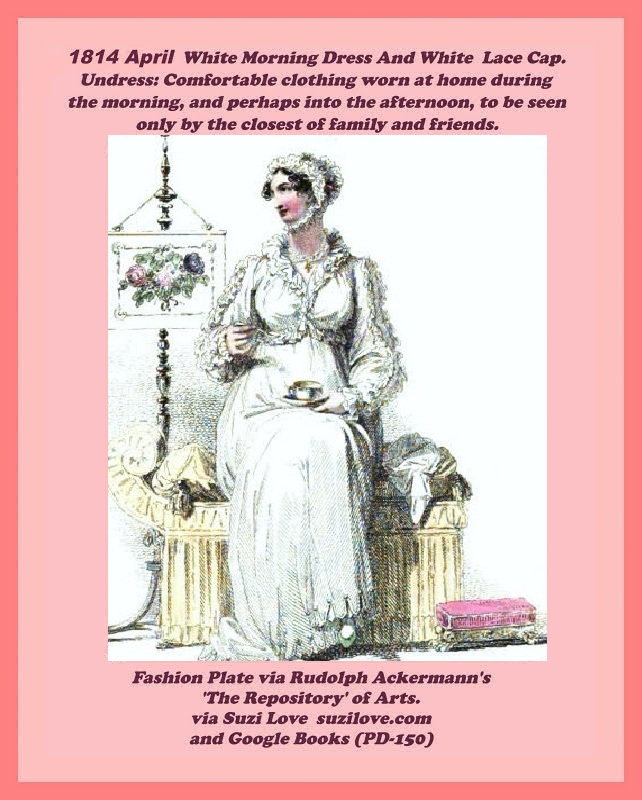
1814 April Morning Dress and Lace Cap. ‘”A petticoat and bodice of fine jaconet muslin, finished round the bottom in vandykes and small buttons. The Rochelle spencer composed of the same material, appliqued with footing lace down the sleeve, and trimmed at each edge with a narrow but full border of muslin. Double fan frill of muslin round the neck, very full, continuing round the bottom of the waist, where it is gathered on a beading of needle-work. Bourdeaux mob cap, composed of lace, with treble full borders, narrowed under the chin. A small flower placed backward, on the left side. Hair much divided in front, and in full waved curls on each side. Necklace of twisted gold and pearl, with pendant cross in the center. Spring Green kid slippers and gloves of the same.” “This dress is from Mrs. Gill, of Cork-street, to whose taste and invention this work as well as the world of fashion, are under continued obligations.” Fashion Plate via Rudolph Ackermann’s ‘The Repository of Arts’. https://books2read.com/SuziLoveFashion1810-1814
Definition Van Dyke Points: V-shaped lace and trims named after a 17th Century Flemish painter, Sir Anthony Van Dyck, known for painting V-shaped lace collars and scalloped edges on sitters.
Definition Jaconet: Cotton fabric of medium thickness made in England, lighter than shirting and heavier than mull.
Definition Muslin: Thin fabric said to take its name from Mosul or Moosul, a large town in Turkish Asia where it was first made.

Petunia and the Pearl Diver: A hot Regency romance. Petunia needs money to save her aristocratic family. The pearl diver needs a woman to save him, body and soul. Their night together at a London brothel could solve both problems. But can their relationship survive in the real world?Because walking away becomes impossible when one night leaves them craving more…and more.
Book Hook: When the captain stepped towards Petunia, she planted her feet and stifled her desire to flinch and run. Control, or the portrayal of it, mattered. If she followed Madame’s instructions to the letter, the man should bend to her will, because Madame had assured her that men came here to play games and one of those romps was being dominated by a woman. Most of them were wealthy noblemen who were used to giving orders and being unquestioningly obeyed, so in this sexual arena they enjoyed reversing the roles and serving a strong woman.
The diver had what she needed, the means to earn money, and fast. She only had one goal. Win the pearls, so her siblings would have the money they needed before they realized there had been any problem. Gripping the whip’s tail against the flexible handle, she pointed the furled end towards the man.
“Stop right there, or I’ll leave and my assistants will take care of you. John and Jim like to play games, and they’ll handle your pretty body a lot rougher than I would.” She cracked the whip again and saw her assistants silently approve of her new prowess. “Truthfully, my men prefer patrons who resist our methods, because they enjoy hearing the upper classes beg for mercy.”
The captain eyed her two guards, shrugged, and grinned. “Do your worst. I’m beyond caring.”
Petunia felt the sorrow in his words to the depths of her soul, though her purpose here wasn’t to feel compassion for a soldier wounded in defense of his country, but to dominate a paying customer.
She waved the whip towards the bed. “Take off your trousers and lie on the bed.”
He gave another couldn’t-give-a-damn shrug, before opening the sole button still holding his trousers in place. They dropped to the floor and he kicked them aside, careless of his nudity. His deep all-over tan showed that he’d worked unclothed in the South Pacific.
Her eyes widened and she barely smothered her shocked gasp. As a widow who’d enjoyed intimacy with only her late husband, she’d seen a man’s penis plenty of times, but the size of this one took her by surprise. She’d never imagined that men varied so much beneath their trousers.
1845-1865 ca. Cream Silk Evening Slippers, British. Cream evening shoes with ankle ties and lace trim. Trim is unusual because mid 19th Century ladies’ shoes were often plain as only toes showed beneath fashionable long skirts. Designed By Hobbs, famous London shoemaker, and with a label attached to lining with a regal crest to show maker’s royal patronage. via Metropolitan Museum, NYC, U.S.A. metmuseum.org

