1810-1815 ca. Salmon Taffeta dress with ruched fabric at shoulders gathers at wrists and on bodice. The type of dress worn across Europe in the early 1800s. This sort of high-waisted dress would have been worn by Jane Austen and her contemporaries in England. via Gemeentemuseum Den Haag, Amsterdam.
The Empire waist gown defined women’s fashion during the Regency Era. ‘Empire’ is the name given in France to the period when Napoleon built his French Empire. High-waisted, loose gowns were adopted by the aristocracy as a symbol of turning away from the fussy, elaborate and expensive clothing worn in the 1700s. Jean-Jaques Rousseau advocated copying peasants and returning to a simpler life and more natural fashions. Unrestricting clothing was part of the new Democracy in France and these simpler and flowing fashions were adopted all over Europe, including Britain and despite the continual wars being fought against France during the early 1800s. Not even war stopped fashions from being copied everywhere.
The Star of Bethlehem, or Christmas Star appears in nativity story of Gospel of Matthew where wise men from the East, or Magi, follow the star and travel to Jerusalem. The Three Wise Men brought gold, frankincense and myrrh to the newborn king. Myrrh being commonly used as an anointing oil, frankincense as a perfume, and gold as a valuable.
Three Kings came riding from far away,
Melchior and Gaspar and Baltasar;
Three Wise Men out of the East were they,
And they travelled by night and they slept by day,
For their guide was a beautiful, wonderful star.
The Three Kings by Henry Wadsworth Longfellow
Gold, Frankincense and Myrrh were the three presents brought by the Wise Men to the Infant Christ, lying in the manger stall, at Bethlehem. Gold to Christ means that all the affluence of the world surrendered to Him and Gold paid the way for Joseph and Mary and the divine fugitive into Egypt. The gold for Christ, the silver for Christ, the jewels for Christ. The bright, round, beautiful jewel of a world set like a solitaire on the bosom of Christ. The wise men shook myrrh out of their sacks and the cattle snuffed at it but didn’t eat it because it was bitter. This pungent gum resin of Abyssinia was brought to the feet of Christ to show bitter betrayal, persecution, days of suffering and bitter nights. Myrrh was put into His cup when He was dying and put under His head in the wilderness and Myrrh was used on His from the cattle-pen in Bethlehem to the mausoleum. Frankincense means worship and was brought to temples, sprinkled over the living coals, and when they were ready to worship, the cover was lifted and perfumed smoke arose and filled the places of worship and altars.
In modern times, gifts are given on December 25th, or Christmas Day, in most countries but in others it is December 6th, or Saint Nicholas Day, and January 6th, or Epiphany. European countries generally follow the custom of giving each other presents on Christmas Eve.
The origin of Santa Claus begins in the 3rd or 4th century with Saint Nicholas, Bishop of Myra, an area in present day Turkey. By all accounts St. Nicholas was a generous man, particularly devoted to children.Thousands of churches across Europe were dedicated to him and some time around the 12th century an official church holiday was created in his honor. The Feast of St. Nicholas was celebrated December 6 and the day was marked by gift-giving and charity.
After the Reformation, European followers of St. Nicholas dwindled, but the legend was kept alive in Holland where the Dutch spelling of his name Sint Nikolaas was eventually transformed to Sinterklaas, and then Santa Claus. After his death around 340 A.D., he was buried in Myra, but in 1087 Italian sailors purportedly stole his remains and removed them to Bari, Italy, greatly increasing St. Nicholas’ popularity throughout Europe. His kindness and reputation for generosity gave rise to claims he that he could perform miracles and devotion to him increased. St. Nicholas became the patron saint of Russia, where he was known by his red cape, flowing white beard, and bishop’s mitre.
In Greece, he is the patron saint of sailors. In France, the patron of lawyers. In Belgium, the patron of children and travelers. Thousands of churches across Europe were dedicated to him and some time around the 12th century an official church holiday was created in his honor. The Feast of St. Nicholas was celebrated December 6 and the day was marked by gift-giving and charity.
After the Reformation, European followers of St. Nicholas dwindled, but the legend was kept alive in Holland where the Dutch spelling of his name Sint Nikolaas was eventually transformed to Sinterklaas, and then Santa Claus. Dutch children would leave their wooden shoes by the fireplace, and Sinterklaas would reward good children. hence Santa Claus bringing gifts to children who have been good.
The word ‘carol’ comes from the old French ‘carole’ for a song written and played as a courtly dancing song. Carols then took on a more popular form, telling stories and celebrating religious themes for all seasons until the late 19th century when they became associated with Christmas.
Carols took the place of Psalms in all churches on Christmas Day and, as the whole congregation could join in, were greeted with huge approval. Carols were passed on orally from place to place, often with different words or tunes. The published carols included songs still popular today, including The First Noël, I Saw Three Ships, and God Rest Ye Merry Gentlemen. This collection was followed by compilations of carols from other scholars such as William Sandy’s works in 1833 and 1852.
Because wild boar was the most feared animal, serving it at a meal represented the victory of good over evil. During the 17th century, wild boar became extinct in Britain so a pig’s head was used instead. The head was often presented on a decorated platter with an apple in its mouth and carried in by bearers in a dramatic manner. The tradition of serving ham for Christmas lunch or dinner probably came from the idea of serving boar’s head or roasted boar joints to guests at Christmas.
To say nothing of the roast beef and plum-pudding, Christmas pies, furmity, and snap-dragons, the Yule-log and the mistletoe have not finally abdicated, while the boar’s head, decorated with rosemary or prickly holly, maintains its place at the English Christmas dinner, and is still served up in great state at the royal Christmas table. At Oxford, U.K., the boar’s head was carried in by the strongest of the guardsmen, singing a Christmas carol, and preceded by a forester, a huntsman, and a couple of pages dressed in silk and carrying the mustard which was regarded as a great luxury and an infallible digester.
The following celebrated carol of the Boar’s Head is found in the book of ‘Christmasse Carolles’ published in 1521 by Wynkyn de Warde:
The boar’s head in bande bring I,
With garlandes gay and rosemary,
I pray you all synge merely,
Qui estis in convivio.
“The bore’s head, I understande,
Is the chefe servyce in this lande.
Loke wherever it be fande,
Servite cum cantico.
“Be gladde, lordes, both more and lasse,
For this bath ordayned our stewarde,
To chere you all this Christmasse,
The bore’s head with mustarde.”
At Oxford, U.K., the boar’s head was carried in by the strongest of the guardsmen, singing a Christmas carol, and preceded by a forester, a huntsman, and a couple of pages dressed in silk and carrying the mustard which was regarded as a great luxury and an infallible digester. A similar custom appears to have prevailed in Genoa in the times of the Dorias when a boar decorated with branches of laurel and accompanied by trumpeters was annually presented to the Doria family by the Abbot of San Antonio at Pré at midday on the 24th of December.
Another Christmas Tradition is kisisng under the Mistletoe. So have fun this Christmas and find someone to kiss. The problem in hotter climates is to find the Mistletoe, of course. Darn!
Mistletoe was used by Druid priests 200 years before the birth of Christ in their winter celebrations. They revered the plant since it had no roots yet remained green during the cold months of winter. The ancient Celtics believed mistletoe to have magical healing powers and used it as an antidote for poison, infertility, and to ward of evil spirits. The plant was also seen as a symbol of peace, and it is said that among Romans, enemies who met under mistletoe would lay down their weapons and embrace.
Scandanavians associated the plant with Frigga, their goddess of love, and it may be from this that we derive the custom of kissing under the mistletoe. Those who kissed under the mistletoe had the promise of happiness and good luck in the following year. Mistletoe was associated with Christmas as both a decoration under which lovers kiss, as well as a protection from witches and demons. Sounds romantic, although mistletoe is actually a parasitic plant that grows on other trees or plants and comes in many varieties.
In Britain, mistletoe was mainly found in the western and southwestern parts, so the custom wasn’t even followed in all parts of England. But where the mistletoe custom was followed, it was hung in doorways and the greenery was watched by young gentlemen in hopes of catching a pretty girl to kiss, usually on the cheek.
Traditionally, a man was allowed to kiss a woman who was standing underneath mistletoe and bad luck would befall any woman who refused. In some places, it was the custom to pick a berry for each kiss and when all the berries were gone, no more kisses could be taken.
Christmas: Wassail Bowl History #Christmas #holidays #Traditions #Customs
The term wasseling refers to the jovial revelry and carousing that went on in historic England when all classes of society would gather around a common banquet-table and the wassail bowl and indulge in the most unrestrained joviality and merriment around.
Wassail Bowl: Most great houses had a wassel-bowl, or cup, frequently of massy silver. Toasts were “Drine heil,” or “Was hail,” from which the howl derives its name but were replaced around the nineteenth century by “Come, here’s to you,” or “I’ll pledge you.” Now, we toast with the simplified version of ‘Here’s to you’. As the hour of twelve approached, carol-singers would prepare and bell-ringers would place themselves at their post to usher in the morning of the Nativity with lots of rejoicing and with bands of music parading the towns.
In some parishes in the West of England, carol-singers adjourn to the church to sing in Christmas-day, a remnant probably of popery, as in Catholic countries there were frequently church-services held at this time. In the 16th century, Tusser prescribed for Christmas: good drink, a good fire in the hall, brawn, pudding, and mustard withall, capon, or turkey, cheese, apples, nuts, and jolly carols. In rich houses, a wassail cup would be filled with rich wine, sweet and spicy, and with roasted apples bobbing on the surface. In poorer houses, the cup would hold ale with nutmeg, sugar, ginger, and roasted crab apples.
At the end of the winter term, schoolmasters would set their pupils to work on Christmas Pieces, samplers of writing on superior paper with engraved borders, to show parents how they had progressed during the year. By about 1820, the engraved borders were enhanced with color and the children’s pieces became more decorative.
However, the custom of sending cards at Christmas was started in the United Kingdom in 1843 by Sir Henry Cole. Postage had been standardized three years earlier and Cole was a civil servant who had played a key role in initiating Uniform Penny Post. He wanted ordinary people to become more interested in the new ‘Public Post Office’. With his artist friend John Horsley, they designed the first card which was issued from a periodical, Felix Summerley’s Home Treasury, and were sold for 1 shilling each.
The card was lithographed, hand-colored, had three panels and was in a rustic frame of carved wood and ivy. The outer two panels showed people caring for the hungry and the naked. The centre panel showed a family of three generations having Christmas dinner, although the temperate classes strongly objected to the idea of a child being given a glass of wine with dinner.
New railways carried more post, and a lot faster, than a horse and carriage so the Post Office offered a Penny stamp. Cards became even more popular when they could be posted in an unsealed envelope for one halfpenny. Christmas cards became truly popular when printing improved and cards could be produced in large numbers, around 1860. By the early 1900s, the custom had spread over Europe and especially in Germany.
Early cards usually pictured Nativity scenes, but in the late Victorian times, robins and snow-scenes became popular because the postmen wore red uniforms and were nicknamed ‘Robin Postmen’. Snow-scenes were also popular because they were a reminder of the very bad winter of 1836.
Snow scenes reflected the snowy and often harsh northern hemisphere winters when opening and reading Christmas cards was an enjoyable family experience. In 1860, Charles Goodall & Son, a British publisher of visiting cards, began mass producing cards to be used for visits during the Christmas period. These Christmas and New Year’s visiting cards were decorated with simple designs such as a twig of holly or flowers.
Sales of cards grew and designs and sizes changed. The first cards were meant to appeal to the masses and encourage them to send large numbers by post, so rather than focus on religious images, they showed sentimental or humorous images of family and children, fanciful designs of flowers, fairies, or reminders of the approach of spring. Religious themes of nativity scenes, children looking at the manger, or angels and candles remain popular to the modern day.
Cards could be shaped like bells, a fan, a crescent, a circle, or a diamond and were folding, decorated with jewels, iridescent, embossed, and carried either simple Christmas and New Year greetings or had verses and carols written in them. The next year, Mr W.C.T. Dobson produced a sketch symbolizing the ‘Spirit of Christmas’ which sold many more than the previous thousand and the novelty caught on.
Many artists became famous for their annual illustrations that became postcards and cards. Printing technology became more advanced in the age of industrialisation and the price of card production dropped. With the introduction of the halfpenny postage rate, the Christmas card industry industry increased until in 1880 11.5 million cards were produced.
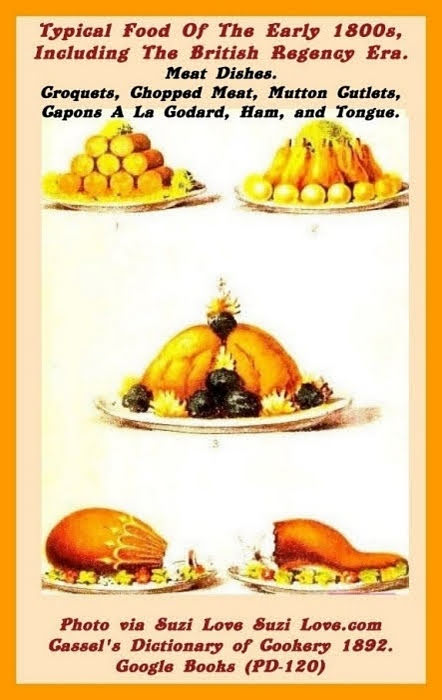
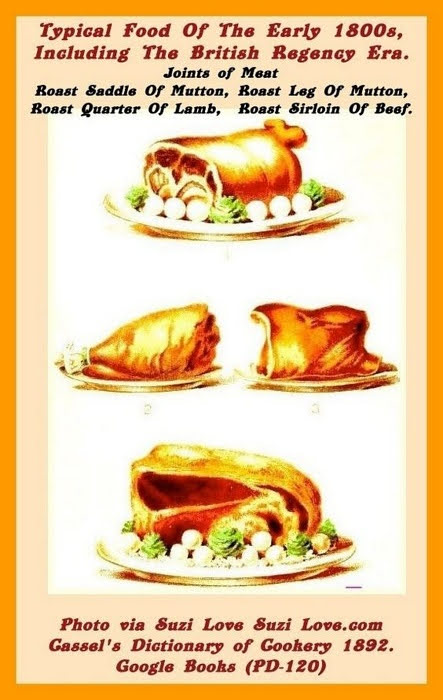
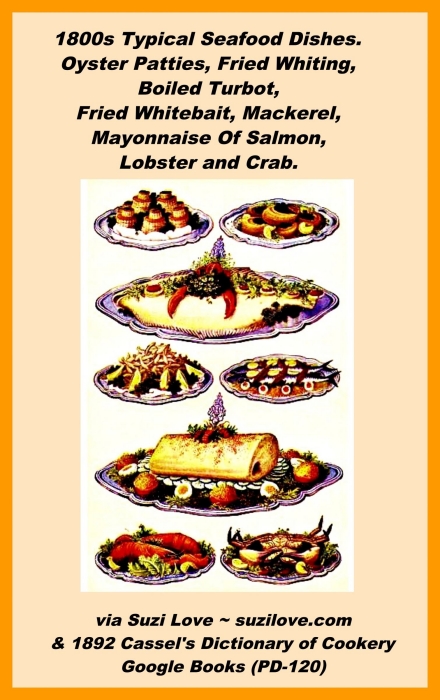
Christmas: Typical Christmas Food Eaten By the Bridgerton and Jane Austen Families. #Christmas #Food #JaneAusten #Bridgerton
On the Christmas menu was generally mince pies and perhaps a goose or a piece of beef, depending on the family’s wealth and status. Mince pies were not made of fruit mince as we do now, but of offal or meat such as bullock’s tongue cooked with spices, orange peel, and wine and then used to fill pastry cases.
Another Christmas specialty was a Yorkshire Christmas pie which would be filled with turkey, goose, a hen, or perhaps woodcocks, partridge, or pigeons. And after the main courses, came the Plum Pudding, mixed on Stir-Up Sunday according to each family’s recipe and then boiled in a cloth.