↓
 

Suzi Love

Making history fun, one year at a time.

Header_
  • Home
  • Newsletter
  • Pre order form
  • Shop
    • Cart
    • Checkout
    • My account
    • Refund and Returns Policy
  • Blog
  • BOOKS
    • History Events
    • Kelly’s Justice
    • Irresistible Aristocrats
    • History Notes
    • Scandalous Siblings
    • Love After Waterloo
    • Regency Life Series
  • Privacy Policy
  • EVENTS
Home » dancing 1 2 >>

Tag Archives: dancing

Post navigation

← Previous Post

18th-20th Centuries The Bath Assembly Rooms in Jane Austen and Bridgerton years. #bridgerton #JaneAusten #RegencyEra #Bath

Suzi Love Posted on April 19, 2026 by Suzi LoveFebruary 27, 2026

The Assembly Rooms in Bath, UK. One of my favorite places to visit.

Bath had two assembly rooms in the lower part of the town but they weren’t large enough for the rapidly increasing population so on the 30th September, 1771, New Rooms were opened on the north east of the Circus, between Bennett and Alfred Streets. These Upper Rooms were designed by the architect, John Wood, and were in a better part of town so they became much more fashionable. They were called the New, or Upper Rooms, to distinguish them from the older Assembly Rooms in the lower part of the town.

They were a set of public rooms purpose-built for the 18th century form of entertainment called an ‘assembly‘, where a large number of people came together to dance, drink tea, play cards, listen to music, or parade around the rooms and talk and flirt. The four rooms are the Ball Room, the Tea Room or Concert Room, the Octagon Room, and a Card Room. The Upper Rooms held two balls a week, a dress ball on Monday evenings and a fancy ball on Thursdays during the Bath season which was from October to early June. These balls were so popular they attracted between 800 and 1,200 guests at a time.

John Wood raised the money for the New Rooms by a “tontine” subscription, which was like a lottery. By April 1769,  £14,000 was raised amongst 53 people. When a subscriber died, their shares were added to the holdings of the other subscribers, which meant that the last surviving subscriber inherited everything.

The exterior of the Upper Assembly Room looks typically Georgian, but the interior is very grand and the high ceilings gave good ventilation on crowded ball nights and windows set at a high level prevented outsiders from looking in. Two long rectangular rooms flank the entrance hall and are linked by an octagonal room at the far end to form a U-shape.

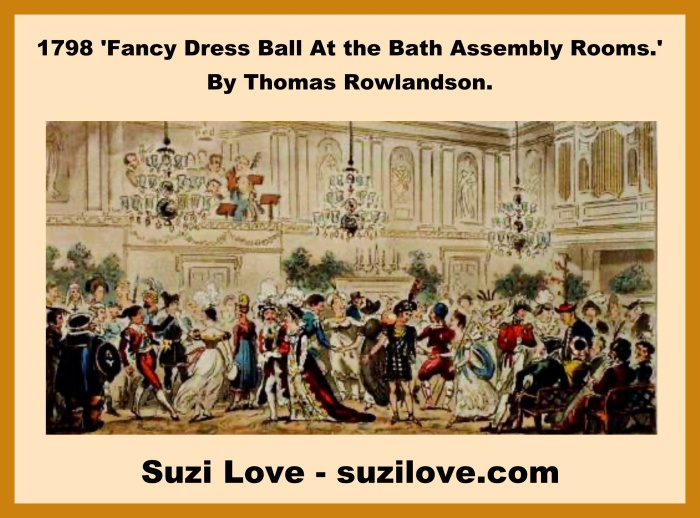
1798 Fancy Dress Ball at the Bath Assembly Rooms.' By Thomas Rowlandson.
1798 Fancy Dress Ball at the Bath Assembly Rooms.’ By Thomas Rowlandson.
Bath-Interior of Assembly Rooms, Bath.
Interior of Assembly Rooms, Bath.
Entrance to Assembly Rooms, Now Fashion Museum. Bath, U.K.
Bath_Entrance to Assembly Rooms, Now Fashion Museum. Bath, U.K.
Entrance to Assembly Rooms, Now Fashion Museum. Bath, U.K.
Bath_1805 Interior of Concert Room, Bath. By John Claude Nattes 'Bath Illustrated by a Series of Views.' Via Suzi Love - suzilove.com & Wikimedia Commons commons.wikimedia.org
1805 Interior of Concert Room, Bath. By John Claude Nattes ‘Bath Illustrated by a Series of Views.’ Via Suzi Love – suzilove.com & Wikimedia Commons commons.wikimedia.org
Bath_1799 Richard Nash Esq. Master of Ceremonies, Assembly Rooms, Bath From- 1799 The New Bath Guide Printed by R. Cruttwell.
1799 Richard Nash Esq. Master of Ceremonies, Assembly Rooms, Bath From- 1799 The New Bath Guide Printed by R. Cruttwell.
Bath_1771 The New Assembly Rooms Opened, Between Bennet and Alfred streets, Bath, U.K. via Suzi Love - suzilove.com & 1835 The Historical and Local New Bath Guide Published By C. Duffield.
1771 The New Assembly Rooms Opened, Between Bennet and Alfred streets, Bath, U.K. via Suzi Love – suzilove.com & 1835 The Historical and Local New Bath Guide Published By C. Duffield.

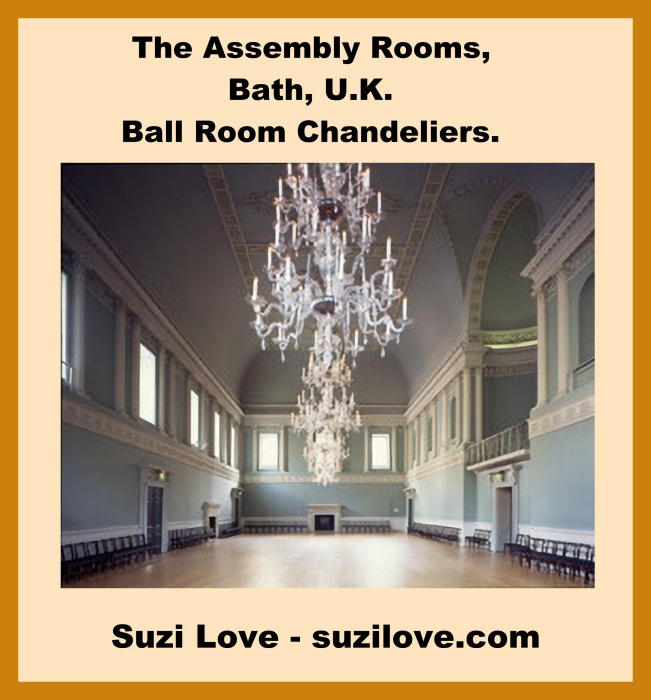
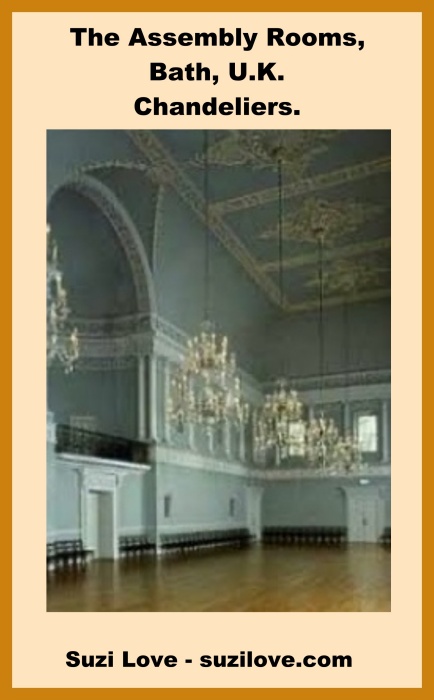
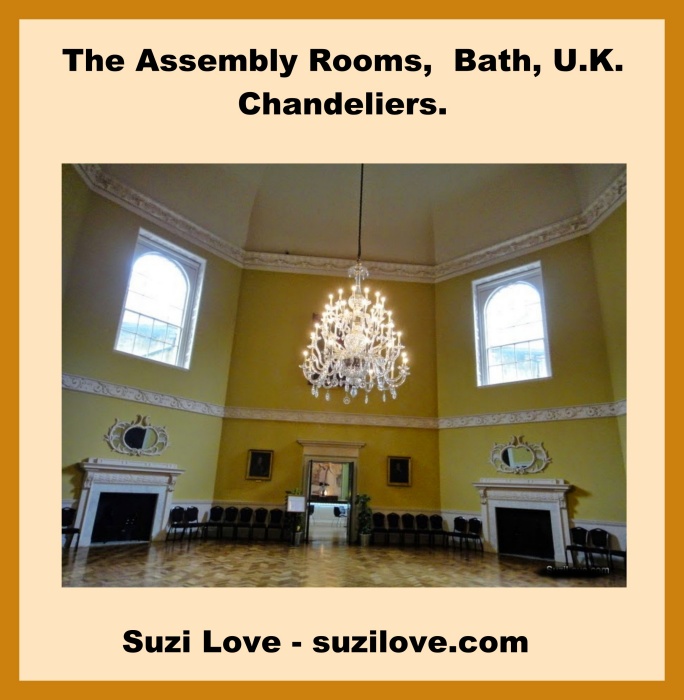
The Assembly Rooms are lit by a set of nine chandeliers, made for the building in 1771. Jonathan Collett of London originally provided a set of five chandeliers for the Ball Room when it opened in September 1771. Shortly afterwards the arm of one of the chandeliers fell off – narrowly missing the artist, Thomas Gainsborough, who lived nearby at the time. The Ball Room chandeliers were taken down and a new set was ordered from William Parker of London. Parker had already supplied three chandeliers for the Tea Room. It was agreed that Jonathan Collett should salvage the rejected set of Ball Room chandeliers and make one large chandelier to hang in the Octagon Room. The chandeliers in the three rooms had an average height of eight feet and they were made of Whitefriars crystal from the Whitefriars Glassworks in London and were originally lit by candles. The Ball Room and Tea Room chandeliers each had 40 lights and the Octagon chandelier had 48 lights.

During the 19th century, they were fitted for gas and were later converted to electric light. At the start of the Second World War, the chandeliers were put into storage and escaped destruction when the Assembly Rooms were bombed in 1942. During the extensive refurbishment of the building in 1988-1991, the chandeliers were restored by R. Wilkinson & Sons of London. The Bath Season ran from October to June. As the Season spanned the winter months and many activities took place in the evening it was essential to provide good artificial lighting.

The ball room is the largest of the three main rooms and is over 105 feet long and 42 feet wide and 42 feet high. It runs the whole length of the north side of the building and covers two storeys. The paint is called Ballroom Blue and was first created by David Mlinaric in the 1970s from an original colour swatch. “It is a stroke of luck that the colour sample of blue paint is still attached to the 1770s minute book of the Assembly Rooms Furnishing Committee.” said Lucy Powell, Assistant Archivist at Bath Record Office, “The building was bombed in 1942 so traces of the paint would never have survived otherwise.”  From: Fashion Museum, Bath.

On the other side, the tea room is 70 feet long and 27 feet wide and all the rooms had huge chandeliers to give light. In 1777, a card room was added to the Octagonal Room. Before the Card Room was added, the Octagon Room became famous for card playing, the favorite leisure activity from the Georgian Era through to the Regency, as the Upper Rooms were open for card games every day except Sunday. The Octagon Room is dominated by Gainsborough’s portrait of the first Master of Ceremonies at the Upper Rooms, Captain William Wade. Bath’s most famous Master of Ceremonies, Richard “Beau” Nash, never knew this building as he died in 1761.

Bath_The Assembly Rooms, Bath, U.K. Chandeliers.
Bath_Octagon Room, The Assembly Rooms, Bath, U.K. Chandeliers.
Bath_The Assembly Rooms, Bath, U.K. Chandeliers.
The Assembly Rooms, Bath, U.K. Ball Room Chandeliers.
Bath_The Assembly Rooms, Bath, U.K. Chandeliers.
The Assembly Rooms, Bath, U.K. Chandeliers.
Bath_The Assembly Rooms, Bath, U.K. Chandeliers.
The Assembly Rooms, Bath, U.K. Chandeliers.
Bath_The Assembly Rooms, Bath, U.K. Chandeliers.
The Assembly Rooms, Bath, U.K. Chandeliers.
Bath_The Assembly Rooms, Bath, U.K. Chandeliers.
The Assembly Rooms, Bath, U.K. Chandeliers.
Bath_The Assembly Rooms, Bath, U.K. Chandeliers.
The Assembly Rooms, Bath, U.K. Chandeliers.
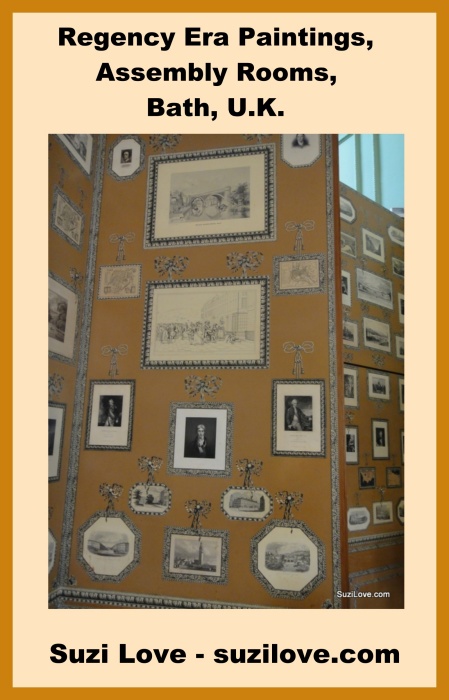
Bath_Regency Era Paintings, Assembly Rooms, Bath, U.K.
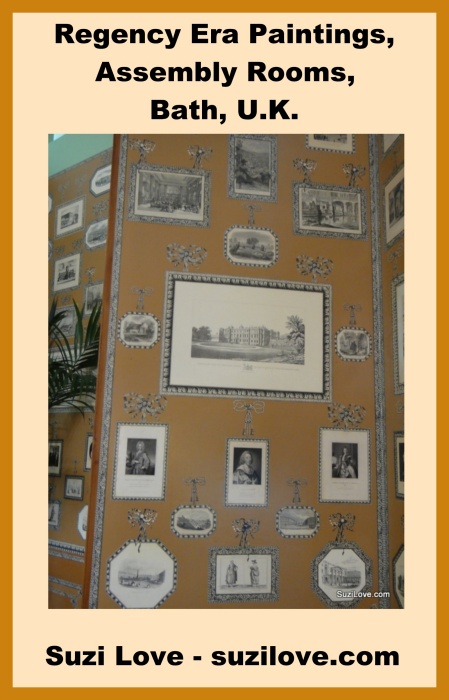
Regency Era Paintings, Assembly Rooms, Bath, U.K.
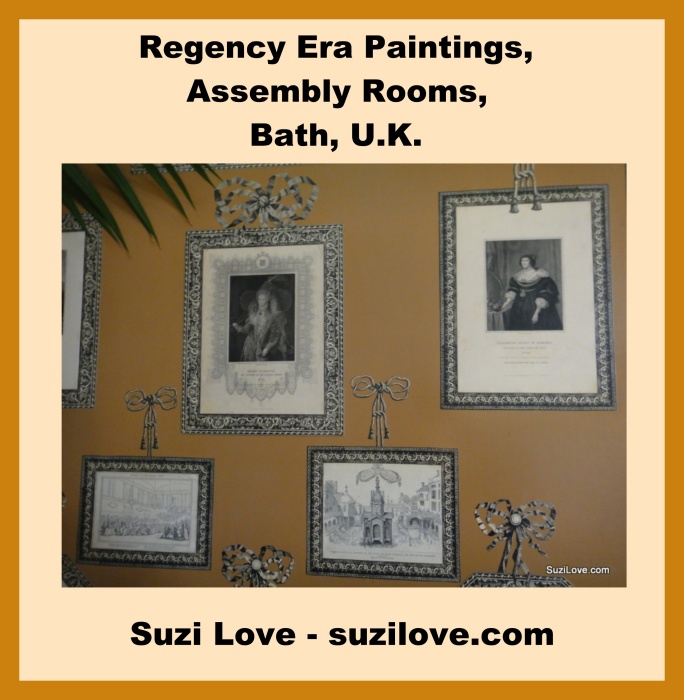
Bath_Regency Era Paintings, Assembly Rooms, Bath, U.K.
Regency Era Paintings, Assembly Rooms, Bath, U.K.
Bath_Regency Era Paintings, Assembly Rooms, Bath, U.K.
Regency Era Paintings, Assembly Rooms, Bath, U.K.
Bath_Regency Era Paintings, Assembly Rooms, Bath, U.K.
Regency Era Paintings, Assembly Rooms, Bath, U.K.

The tea room was used for refreshments, with tea generally served weak and black or perhaps with arrack and lemon, and on Wednesday nights during the Season concerts were held there. Fashionable visitors to Bath could also hold breakfasts there for their friends.

Many famous people visited the Assembly Rooms in the 18th and 19th centuries. Jane Austen and Charles Dickens both mention the Assembly Rooms in their novels and the diarist, Francis Kilvert, described a reception there in 1873. Subscription concerts were popular and many well-known musicians also visited, the most distinguished being Joseph Haydn, Johann Strauss the Elder, and Franz Liszt.

Today, the Octagon Room, the Tea Room, and the Cloak room Landings all showcase beautiful paintings and prints as the Upper Rooms were given to the National Trust in 1931. You can see paintings by Thomas Gainsborough and John Simmons as well as an Original ticket to the Thirteenth Dress Ball at the Assembly Rooms, 24 January 1803.

 Since 1963, the Upper Assembly Rooms have also housed the amazing Fashion Museum. The building is owned by the National Trust and is leased by Bath & North East Somerset Council.

18th-20th Centuries The Bath Assembly Rooms in Jane Austen and Bridgerton years. #bridgerton #JaneAusten #RegencyEra #Bath books2read.com/suziloveROver Share on X
RL_1_D2D_Regency Overview RetailerLinks
https://books2read.com/suziloveROver
RL_1_D2D_Regency Overview RetailerLinks https://books2read.com/suziloveROver
Posted in 1700s, 1800s, art, Bath, Bridgerton, cartoon, Jane Austen, Regency Era, Suzi Love Images | Tagged 1700s Or Georgian Era, 1800s Or 19th Century, architecture, art, Bath, Cartoons, Customs and Traditions, dancing, England, Jane Austen, music, Regency Era, Regency Life, Regency People | Leave a reply

19th Century Mid. Dance Card or Aide de Memoire With Timepiece. #RomanticEra #VictorianEra #Dance #writingtool #antique

Suzi Love Posted on March 7, 2026 by Suzi LoveJanuary 28, 2026

19th Century Mid Dance Card or Aide de Memoire. Jeweled and enameled gold dance card with concealed timepiece. Lid with a blue enamel with rose-cut diamonds floral wreath, opening to compartment with watch dial, pencil, and notebook. via Sotheby’s Auctions. sothebys.com

19th Century Mid Dance Card or Aide de Memoire. Jeweled and enameled gold dance card with concealed timepiece. Lid with a blue enamel with rose-cut diamonds floral wreath, opening to compartment with watch dial, pencil, and notebook. via Sotheby’s Auctions. sothebys.com
19th Century Mid. Dance Card or Aide de Memoire With Timepiece. #RomanticEra #VictorianEra #Dance #writingtool #antique books2read.com/SuziLoveWritingTools Share on X
HN_13_D2D_Writing Tools books2read.com/SuziLoveWritingTools
Posted in 1800s, Box Or Container, dancing, Decorative Item, Europe, History, household, Pastimes, Regency Era, Romantic Era, Suzi Love Images, Victorian Era, Writing Tools | Tagged 1800s women's fashion, antiques, Box Or Container, British history, dancing, Sothebys Auctions, watch, Writing Tools

1815-1825 ca. Bridgerton and Jane Austen Style Dark Green Leather Woman’s Slippers, French But Worn in America. #Bridgerton #RegencyFashion #Shoes #JaneAusten

Suzi Love Posted on February 26, 2026 by Suzi LoveJanuary 25, 2026

1815-1825 ca. Dark Green Leather Woman’s Slippers, French. The type of shoes worn by Jane Austen and her female friends and family. Made in France and worn in Boston, Massachusetts, USA. Worn by Mehetable Stoddard Sumner (Welles), American, 1784-1826. Green silk bows, lapped side seams, green silk bindings, black silk ribbon ties, plain linen drawstring at fronts, white leather insoles, white linen vamp linings; leather soles. Written in ink on insole was ‘Droit’, meaning right side, although both shoes may have been the same. via Museum of Fine Arts, Boston. mfa.org.

Shoes in the early 1800s were flat or low heeled and occasionally decorated with a bow or floral embellishments and it wasn’t until the 1820s that square, rather than rounded, toes became fashionable.  Typical Regency Era women’s footwear were shoes that had low heels, slightly rounded toes, embellished with a bow and with ribbon ties for the ankles. Made of soft kid or cloth, these delicate shoes were flimsy and wore out quickly.  Slippers were often bought in multiples at a time and with no difference between left or right foot so when one slipper had a hole it was easily replaced.

1815-1825 ca. Dark Green Leather Woman's Slippers, French. Made in France and worn in Boston, Massachusetts, USA. Worn by Mehetable Stoddard Sumner (Welles), American, 1784?1826. Green silk bows, lapped side seams, green silk bindings, black silk ribbon ties, plain linen drawstring at fronts, white leather insoles, white linen vamp linings; leather soles. Written in ink on insole: "Droit" ca. Dark Green Leather Slippers, French. via suzilove.com & Museum of Fine Arts, Boston. mfa.org

1815-1825 ca. Bridgerton and Jane Austen Style Dark Green Leather Woman's Slippers, French But Worn in America. #Bridgerton #RegencyFashion #Shoes #JaneAusten https://books2read.com/SuziLoveFashionWomen1815-1819 Share on X
HN_28_D2D_Fashion Women 1815-1819
https://books2read.com/SuziLoveFashionWomen1815-1819
Fashion Women 1815-1819 History Notes Book 28 What did Jane Austen wear? . D2D_HN_28_https://books2read.com/SuziLoveFashionWomen1815-1819
Posted in 1800s, 1800s women's fashion, Bridgerton, England, Europe, France, Jane Austen, Regency Era, Regency Fashion, Romantic Era, shoes, Suzi Love Images, U.S.A | Tagged 1800s women's fashion, Bridgerton, dancing, France, Jane Austen, Museum Of Fine Arts, Regency Fashion, Romantic Era Fashion, Shoes, USA

1826 Cartoon: The Cyprian’s Ball At the Argyll Rooms. From A Regency Gentleman’s Life. #RegencyEra #Cartoon #BritishHistory

Suzi Love Posted on February 13, 2026 by Suzi LoveJanuary 25, 2026

1826 The Cyprian’s Ball At the Argyll Rooms. A Regency Gentleman’s Life. From The English Spy By Robert Cruikshank.

Cyprians: High-class prostitutes who dressed well and were interesting and entertaining. They were often under the protection of a wealthy gentleman for a time and were gifted clothing, jewelry and temporary housing. Called a multitude of names, none of which were flattering. Ladybird, lady of easy virtue, impure, fashionable impure, soiled doves, Covent Garden nun, Drury Lane vestal, left-handed wife, short-heeled wench, three-penny upright, woman of pleasure.

1826 The Cyprian's Ball At the Argyll Rooms. A Regency Gentleman's Life. From The English Spy By Robert Cruikshank.
1826 The Cyprian’s Ball At the Argyll Rooms. A Regency Gentleman’s Life. From The English Spy By Robert Cruikshank.
1826 The Cyprian's Ball At the Argyll Rooms. #2 A Regency Gentleman's Life. From The English Spy By Robert Cruikshank.
1826 The Cyprian’s Ball At the Argyll Rooms. #2 A Regency Gentleman’s Life. From The English Spy By Robert Cruikshank.
1826 Cartoon: The Cyprian's Ball At the Argyll Rooms. From A Regency Gentleman's Life. #RegencyEra #BritishHistory #Cartoon #England books2read.com/suziloveYGD Share on X
RL_2_D2D_RetailerBuyLink_RL_2
RL_2_D2D_RetailerBuyLink_RL_2 https://books2read.com/suziloveYGD

Posted in 1800s, 1800s Mens Fashions, 1800s women's fashion, cartoon, Customs & Manners, dancing, England, Google Books, London, Music, peerage, Regency Era, Suzi Love Images | Tagged 1800s men fashion, 1800s women's fashion, British history, Cartoons, dancing, drink, England, Food, google books, Regency Fashion, Regency London, Regency Men

1811-1820 Snippets of Regency Life By Captain Gronow. #RegencyEra #Almack’s #PrinceRegent

Suzi Love Posted on January 16, 2026 by Suzi LoveJanuary 16, 2026

I love these snippets from Captain Gronow’s Recollections 1864. Even though they were written after the Regency, they give us fun bits of information about Almack’s Assembly Rooms, the Prince Regent or later King George IV.

“Good society at the period to which I refer was, to use a familiar expression, wonderfully “select.” At the present time one can hardly conceive the importance which was attached to getting admission to Almack’s, the seventh heaven of the fashionable world. Of the three hundred officers of the Foot Guards, not more than half a dozen were honoured with vouchers of admission to this exclusive temple of the beau monde; the gates of which were guarded by lady patronesses, whose smiles or frowns consigned men and women to happiness or despair. These lady patronesses were the Ladies Castlereagh, Jersey, Cowper, and Sefton, Mrs Drummond Burrell, now Lady Willoughby, the Princess Esterhazy, and the Countess Lieven.

Almack’s: Exclusive temple of the beau monde. The gates of which were guarded by the lady patronesses, The Ladies Castlereagh, Jersey, Cowper, Sefton, Willoughby, Princess Esterhazy, and Countess Lieven.

                    From Captain Gronow’s Recollections 1864.  

The most popular amongst these grandes dames was unquestionably Lady Cowper, now Lady Palmerston. Lady Jersey’s bearing, on the contrary, was that of a theatrical tragedy queen; and whilst attempting the sublime, she frequently made herself simply ridiculous, being inconceivably rude, and in her manner often ill-bred. Lady Sefton was kind and amiable, Madame de Lieven haughty and exclusive, Princess Esterhazy was a hon enfant, Lady Castlereagh and Mrs Burrell de tres grandes dames.

Many diplomatic arts, much finesse, and a host of intrigues, were set in motion to get an invitation to Almack’s. Very often persons whose rank and fortunes entitled them to the entree anywhere, were excluded by the cliqueism of the lady patronesses; for the female government of Almack’s was a pure despotism, and subject to all the caprices of despotic rule: it is needless to add that, like every other despotism, it was not innocent of abuses.

Almack’s

The fair ladies who ruled supreme over this little dancing and gossiping world, issued a solemn proclamation that no gentleman should appear at the assemblies without being dressed in knee-breeches, white cravat, and chapeau bras.

                From Captain Gronow’s Recollections 1864. 

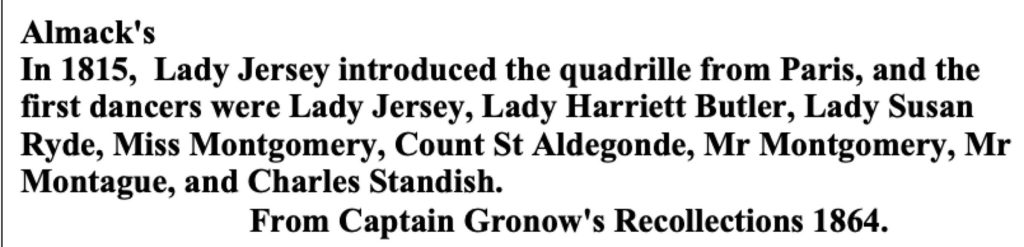
1815 The First Quadrille at Almack’s Assembly Rooms, London. Left to Right: Marquis of Worcester, Lady Jersey, Clanronald MacDonald and Lady Worcester. “It was not until 1815 that Lady Jersey introduced from Paris the favourite quadrille, which has so long remained popular. I recollect the persons who formed the very first quadrille that was ever danced at Almack’s: they were Lady Jersey, Lady Harriett Butler, Lady Susan Ryde, and Miss Montgomery; the men being the Count St Aldegonde, Mr Montgomery, Mr Montague, and Charles Standish.” From The Reminiscences of Captain Gronow 1810-1860.
1811-1820 Snippets of Regency Life By Captain Gronow. #RegencyEra #Almack's #PrinceRegent https://books2read.com/suziloveROver Share on X
RL_1_D2D_Regency Overview RetailerLinks
https://books2read.com/suziloveROver
RL_1_D2D_Regency Overview RetailerLinks https://books2read.com/suziloveROver
Posted in 1800s, 1800s Mens Fashions, 1800s women's fashion, cartoon, Celebrity, Couple, Customs & Manners, dancing, England, Google Books, History, Jane Austen, London, Music, Pastimes, peerage, Quotations, Regency Era, Regency Fashion, Royalty, Suzi Love Images | Tagged 1800s women's fashion, Almack's Assembly Rooms, Cartoons, dancing, fashion accessories, google books, Jane Austen, King George IV, peerage, Prince Regent, Quotations, Regency Fashion, Regency Life Series, Regency London

Fan of the Bridgerton Series? Jane Austen Lover? Writer Or Reader Of Regency Era? What did they wear in early 1800s? #bridgerton #RegencyFashion #JaneAusten #HistoricalFashion

Suzi Love Posted on January 5, 2026 by Suzi LoveJanuary 25, 2026
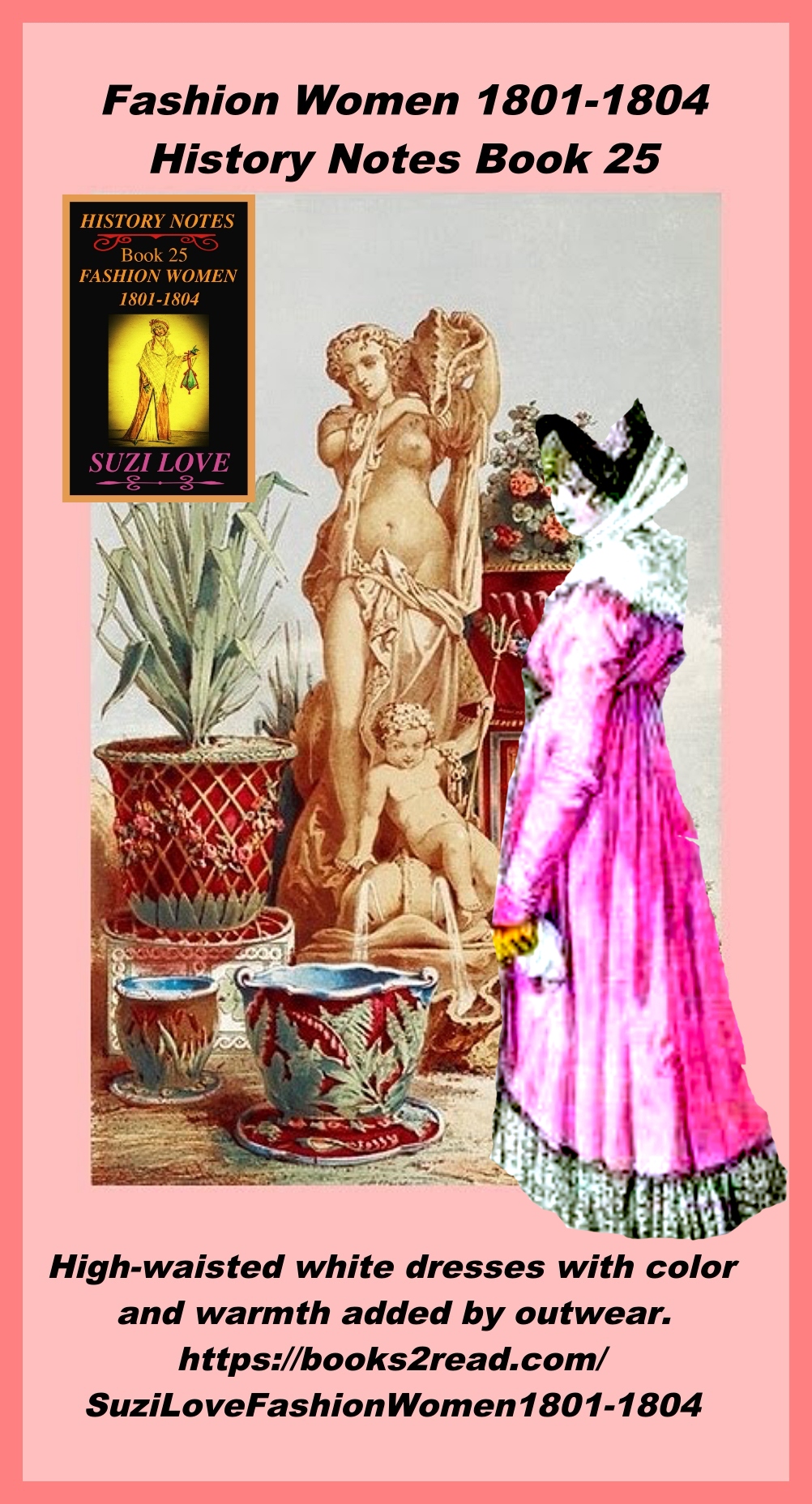
HN_25_ Fashion Women 1801-1804 History Notes Book 25 This book looks at the changes to women's clothing in the early 1800s and the move away from complicated styles and heavy fabrics. The new silhouette copied the simplistic styles of the Greeks and Romans. White dresses were high-waisted and skirts were flowing, with color and warmth added by outwear and accessories. https://books2read.com/SuziLoveFashionWomen1801-1804

Writer Or Reader Of Regency Era?What did Jane Austen and friends wear? Women’s clothing changed dramatically in early 1800s. New silhouette copied simplistic styles of Greeks and Romans. High-waisted white dresses and flowing skirts with color and warmth added by outerwear and accessories. Fashion Women 1801-1804 History Notes Book 25 https://books2read.com/SuziLoveFashionWomen1801-1804

Definition Empire Style Dress: High-waisted white gowns defined women’s fashion during the Regency Era. ‘Empire’ is the name given to the period when Napoleon Bonaparte built his French Empire. High-waisted, loose gowns were adopted by the aristocracy as a symbol of turning away from the elaborate clothing worn in the 1700s. This sort of high-waisted dress would have been worn by Jane Austen and her contemporaries in England.

Definition Shawls: The shawl started off in India as a fine wool garment for men that could be worn as a scarf, turban or as a mantle: the word comes from the Persian shäl. Originally imported from the East, European Kashmir shawls were made first in Norwich and Edinburgh in Britain in the late 18th century. Shawls were an essential item in the early 1800s to cover the thin gowns women wore. They were made of muslin, gauze, silk, wool, and velvet, though cashmere shawls were the softest and most prized.

Fan of the Bridgerton Series? Jane Austen Lover? Writer Or Reader Of Regency Era? What did they wear in early 1800s? #christmas #bridgerton #RegencyFashion #JaneAusten #HistoricalFashion https://books2read.com/SuziLoveFashionWomen1801-1804 Share on X
HN_25_Fashion Women 1801-1804
https://books2read.com/SuziLoveFashionWomen1801-1804
Posted in 1800s, 1800s women's fashion, Australia, bedroom fashion, Bridgerton, Canada, cartoon, Chatelaine, Coat or Pelisse Or Redingote, Corset, Customs & Manners, dancing, Decorative Item, Dress Or Robe, England, Europe, fashion accessories, France, Google Books, hats, History, History Notes, Jane Austen, London, mourning, Quotations, Regency Era, Regency Fashion, Reticule or Bag, riding, Russia, sewing, shoes, Spencer, Suzi Love Books, Suzi Love Images, U.S.A, underclothing, weddings | Tagged 1800s women's fashion, Book 25, Bridgerton, Corset, dancing, Dress Or Gown, fashion accessories, Fashion Plate, Fashions Of London and Paris, google books, Hats And Hair, History Notes, Jane Austen, jewelry, Journal des Dames et des Modes, La Belle Assemblee, mourning, Napoleon Bonaparte, Regency Fashion, riding, shawls, Shoes, Spencer, Suzi Love Books, The Lady's Monthly Museum, The Repository Of Arts, underclothing, weddings

Christmas: Mistletoe and its long history. #Christmas #Holidays #Customs #BritishHistory

Suzi Love Posted on December 14, 2025 by Suzi LoveDecember 14, 2025

Another Christmas Tradition is kisisng under the Mistletoe. So have fun this Christmas and find someone to kiss. The problem in hotter climates is to find the Mistletoe, of course. Darn!

Mistletoe was used by Druid priests 200 years before the birth of Christ in their winter celebrations. They revered the plant since it had no roots yet remained green during the cold months of winter. The ancient Celtics believed mistletoe to have magical healing powers and used it as an antidote for poison, infertility, and to ward of evil spirits. The plant was also seen as a symbol of peace, and it is said that among Romans, enemies who met under mistletoe would lay down their weapons and embrace.

Scandanavians associated the plant with Frigga, their goddess of love, and it may be from this that we derive the custom of kissing under the mistletoe. Those who kissed under the mistletoe had the promise of happiness and good luck in the following year. Mistletoe was associated with Christmas as both a decoration under which lovers kiss, as well as a protection from witches and demons. Sounds romantic, although mistletoe is actually a parasitic plant that grows on other trees or plants and comes in many varieties.  

In Britain, mistletoe was mainly found in the western and southwestern parts, so the custom wasn’t even followed in all parts of England. But where the mistletoe custom was followed, it was hung in doorways and the greenery was watched by young gentlemen in hopes of catching a pretty girl to kiss, usually on the cheek.      

Traditionally, a man was allowed to kiss a woman who was standing underneath mistletoe and bad luck would befall any woman who refused. In some places, it was the custom to pick a berry for each kiss and when all the berries were gone, no more kisses could be taken.

Xmas_Mistletoe
Xmas_Mistletoe
Xmas_Mistletoe
cropped to image, recto, unframed
Xmas_Mistletoe
Xmas_Mistletoe
Christmas: Mistletoe and its long history. #Christmas #Holidays #Customs #BritishHistory https://books2read.com/suziloveHOCP Share on X
Posted in 1700s, 1800s, Australia, Christmas, Customs & Manners, dancing, England, Europe, Georgian Era, History Of Christmases Past, household, Regency Era, Romantic Era, Suzi Love Images, U.S.A, Victorian Era | Tagged British history, Christmas, Customs and Traditions, dancing, europe, Georgian era, History Of Christmases Past, Regency Era

19th Century Mother Of Pearl Carnet De Bal Or Dance Card, as used at balls in the years of Jane Austen and the Bridgertons. #janeausten #bridgerton #Dancing #Antiques

Suzi Love Posted on August 26, 2025 by Suzi LoveAugust 26, 2025

19th Century Mother Of Pearl Carnet De Bal Or Dance Card, French. via Ruby Lane Antiques.

19th Century Mother Of Pearl Carnet De Bal Or Dan

19th Century Mother Of Pearl Carnet De Bal Or Dance Card, as used at balls in the years of Jane Austen and the Bridgertons. #janeausten #bridgerton #Dancing #Antiques… Share on X
HN_13_D2D_Writing Tools books2read.com/SuziLoveWritingTools

Posted in 1800s, Bridgerton, dancing, Decorative Item, Europe, France, History, household, Jane Austen, Pastimes, Regency Era, Suzi Love, Suzi Love Images, Writing Tools | Tagged antiques, Bridgerton, dancing, decorative, fashion accessories, France, household, Jane Austen, Regency Era, Romantic Era, Ruby Lane Antiques

1817 April Ladies’ Voucher for Almack’s Assembly Rooms, London, in the time of Jane Austen and the Bridgertons. #bridgerton #JaneAusten #RegencyLondon

Suzi Love Posted on August 14, 2025 by Suzi LoveAugust 9, 2025

1817 April Ladies’ Voucher for all the Wednesday balls at Almack’s Assembly Rooms, London, U.K. in April 1817. The voucher is for the Marchioness of Buckingham to attend the balls at Almack’s “on the Wednesdays in April 1817.” There are initials in the lower right hand corner marked, “MD”. These initials might be for Mary Marchioness of Downshire who may briefly have been a patroness ca. 1816-1817. The red wax seal is also intact on the front. “Pall Mall” is written on the back of the card.Via Huntington Museum, California, U.S.A. https://hdl.huntington.org/digital/collection/p15150coll7/id/10672/

Subscribers to Almack’s were allowed to bring a guest to a Ball, if they were approved first. They called at the Rooms in person and were either granted a Strangers Ticket of admission or were banned. Rooms were open for supper, gaming dancing lasting the night. At eleven o’clock, doors were closed and no one, not even celebrities were admitted. Once a young lady making her debut during the London Season had been granted a ticket to Almack’s, her social standing was assured. The Patronesses introduced the debutante to people of importance and selected her dance partners.

1817 April Ladies' Voucher for all the Wednesday balls at Almack's Assembly Rooms in April 1817. Via Huntington Museum, California, U.S.A.
1817 April Ladies' Voucher for Almack's Assembly Rooms, London, in the time of Jane Austen and the Bridgertons. #bridgerton #JaneAusten #RegencyLondon https://books2read.com/suziloveYLD Share on X
D2D_RL_4_YLD_Young Lady's Day Regency Life Series Book 4 by Suzi Love. A light-hearted look at the longer Regency years and an easy to read view of what a young lady did, wore, and lived. https://books2read.com/suziloveYLD
Posted in 1800s, dancing, England, History, Jane Austen, London, Pastimes, Regency Era, Suzi Love Images | Tagged 1800s Or 19th Century, Almack's Assembly Rooms, Bridgerton, British history, dancing, Jane Austen, peerage, Regency Era, Regency Life, Regency London, Regency Women

1811 Fan Of The Bridgertons? Love Jane Austen? Five Positions Of Dancing In the early 1800s. #Bridgerton #RegencyEra #Dancing #JaneAusten

Suzi Love Posted on July 29, 2025 by Suzi LoveJuly 12, 2025

1811 The Five Positions Of Dancing. An analysis of Country Dancing and all the figures ever used in country dances, etc. By Thomas Wilson, London. The figures show the positions of the Larner and the feet of a finished Dancer during the early 1800s, or the years of the Bridgerton family, or during Jane Austen’s writing years in England. Via British Library, London, UK. www.bl.uk

1811 The Five Positions Of Dancing. An analysis of Country Dancing_all figures ever used in country dances, etc. By Thomas Wilson, London. Via British Library, London, UK. www.bl.uk
1811 Fan Of The Bridgertons? Love Jane Austen? Five Positions Of Dancing In the early 1800s. #Bridgertons #RegencyEra #Dancing #JaneAusten https://books2read.com/suziloveROver Share on X
RL_1_D2D_Regency Overview RetailerLinks
https://books2read.com/suziloveROver
RL_1_D2D_Regency Overview RetailerLinks https://books2read.com/suziloveROver
Posted in 1800s Mens Fashions, 1800s women's fashion, Bridgerton, cartoon, dancing, England, fashion accessories, Jane Austen, Regency Era, Regency Fashion, shoes, Suzi Love Images | Tagged 1800s men fashion, 1800s Or 19th Century, 1800s women's fashion, British Library, dancing, Jane Austen, Regency London

Post navigation

← Previous Post

SUBSCRIBE TO SUZI LOVE'S NEWSLETTER.

Recent Posts

  • 1802 Bridgerton and Jane Austen Style Dress Bodices and Two Cute Bonnets. #Bridgertons#Regency #Hats #JaneAusten
  • Love After Waterloo: There’d been nowhere safe to hide a lady and her son at Waterloo. #HistoricalEroticRomance #MilitaryRomance #Waterloo #RegencyRomance #ReadARegency
  • “There is a stubbornness about me that never can bear to be frightened at the will of others. My courage always rises at every attempt to intimidate me.” Jane Austen Pride and Prejudice (1813) #JaneAusten #RegencyEra #Quote
  • 1780-1820 ca. Brown Leather Boots, British, As Worn In Bridgerton and Jane Austen Times. #Bridgerton #JaneAusten #GeorgianEra #RegencyEra #Shoes
  • 1756-1762 ca. Gold and Enamel Étui, French. #GeorgianEra #France #Antiques #WritingToools

Recent Comments

  1. Suzi Love on Book Hooks: Earl of Winchester has no time for mad scientist Lady Jamison yet when he’s with her, desire explodes. #HistoricalMystery #RomCom #VictorianRomance #RegencyRomance
  2. Suzi Love on Book Hooks: Earl of Winchester has no time for mad scientist Lady Jamison yet when he’s with her, desire explodes. #HistoricalMystery #RomCom #VictorianRomance #RegencyRomance
  3. Maggie Blackbird on Book Hooks: Earl of Winchester has no time for mad scientist Lady Jamison yet when he’s with her, desire explodes. #HistoricalMystery #RomCom #VictorianRomance #RegencyRomance
  4. Suzi Love on Book Hooks: Earl of Winchester has no time for mad scientist Lady Jamison yet when he’s with her, desire explodes. #HistoricalMystery #RomCom #VictorianRomance #RegencyRomance
  5. Jana Richards on Book Hooks: Earl of Winchester has no time for mad scientist Lady Jamison yet when he’s with her, desire explodes. #HistoricalMystery #RomCom #VictorianRomance #RegencyRomance

Login

  • Log in

Archives

  • April 2026
  • March 2026
  • February 2026
  • January 2026
  • December 2025
  • November 2025
  • October 2025
  • September 2025
  • August 2025
  • July 2025
  • June 2025
  • May 2025
  • April 2025
  • March 2025
  • February 2025
  • January 2025
  • December 2024
  • November 2024
  • October 2024
  • September 2024
  • August 2024
  • July 2024
  • June 2024
  • May 2024
  • April 2024
  • March 2024
  • February 2024
  • January 2024
  • November 2023
  • October 2023
  • September 2023
  • August 2023
  • July 2023
  • June 2023
  • April 2023
  • March 2023
  • February 2023
  • June 2022
  • April 2022
  • March 2022

Categories

  • 1700s
  • 1700s Mens fashion
  • 1700s Womens Fashion
  • 1800s
  • 1800s Mens Fashions
  • 1800s women's fashion
  • 1900s
  • art
  • Australia
  • Bath
  • bedroom fashion
  • Book Hooks
  • Box Or Container
  • Bridgerton
  • Bus Trips
  • Canada
  • Carriage
  • cartoon
  • Celebrity
  • Chatelaine
  • children
  • Children
  • Christmas
  • Coat or Pelisse Or Redingote
  • Contemporary
  • Corset
  • Couple
  • Customs & Manners
  • dancing
  • December Scandal
  • Decorative Item
  • Dress Or Robe
  • Easter
  • Edwardian Era
  • Embracing Scandal
  • England
  • Ester In Images
  • Europe
  • Events
  • Fashion
  • fashion accessories
  • Food and Drink
  • Four Times A Virgin
  • France
  • furniture
  • Georgian Era
  • Georgian Fashion
  • Google Books
  • Grand Tour
  • Group
  • hats
  • History
  • History Events
  • History Notes
  • History Of Christmases Past
  • household
  • Hygiene
  • Irresistible Aristocrats
  • Jane Austen
  • Keanu Reeves
  • Kellys Justice
  • Legal
  • London
  • Love After Waterloo
  • Loving Lady Katharine
  • medical
  • military
  • money
  • mourning
  • Music
  • Outback Arrival
  • pants
  • Pastimes
  • peerage
  • People
  • Petunia and Pearl Diver
  • Places
  • Pleasure House Ball
  • postal
  • Queensland
  • Quotations
  • Regency Era
  • Regency Fashion
  • Regency Life Series
  • Reticule or Bag
  • riding
  • Romantic Era
  • Royalty
  • Russia
  • Scandalous Siblings Series
  • Scenting Scandal
  • Self Publishing
  • sewing
  • Shirt
  • shoes
  • South Pacific
  • Spencer
  • sports
  • Suit
  • Sunday Snippet
  • Suzi Love
  • Suzi Love Books
  • Suzi Love Images
  • Suzi Love Writing
  • Swain Cove
  • THe Viscount's Pleasure House
  • travel
  • U.S.A
  • underclothing
  • Vest or Waistcoat
  • Victorian Era
  • Victorian Fashion
  • weapons
  • weddings
  • Writing Tools

1800s men fashion 1800s women's fashion antiques Bridgerton British history Cartoons Corset cravat decorative Dress Or Gown England europe fashion accessories Fashion Plate France Georgian era Georgian Fashion gloves google books Hats And Hair historical romance History Notes household Jane Austen jewelry Journal des Dames et des Modes London Metropolitan Museum NYC pants Redingote Or Pelisse Or Coat Regency Era Regency Fashion Regency London reticule or bag riding sewing shawls Shoes Suzi Love Books Suzi Love Images Tailcoat The Repository Of Arts underclothing Vest or Waistcoat Writing Tools

©2026 - Suzi Love - Weaver Xtreme Theme Privacy Policy
↑