↓
 

Suzi Love

Making history fun, one year at a time.

Header_
  • Home
  • Newsletter
  • Pre order form
  • Shop
    • Cart
    • Checkout
    • My account
    • Refund and Returns Policy
  • Blog
  • BOOKS
    • History Events
    • Kelly’s Justice
    • Outback Arrival
    • Irresistible Aristocrats
    • History Notes
    • Scandalous Siblings
    • Love After Waterloo
    • Regency Life Series
  • Privacy Policy
  • EVENTS
Home » British history » Page 11 << 1 2 … 9 10 11 12 13 >>

Tag Archives: British history

Post navigation

← Previous Post
Next Post→

1700s Late Pair of Pattens, Or Strap On Undershoes, As Used On Rainy Days in Jane Austen and Bridgerton Times. #Bridgerton #JaneAusten #Shoes #BritishHistory #History

Suzi Love Posted on September 8, 2024 by Suzi LoveSeptember 8, 2024

1700s Late Pair of Pattens, English. Iron supports underneath leather and wood. Pattens: Under shoes that strapped onto shoes and worn outdoors and to lift shoes and dresses out the mud. People in Jane Austen’s lifetime would have used these to protect the hems of dresses and legs of men’s pants, plus protect delicate shoes. via Victoria and Albert Museum, London, UK. collections.vam.ac.uk.

1700s Late Pair of Pattens, English. Iron supports underneath leather and wood. Pattens: Under shoes that strapped onto shoes and worn outdoors and to lift shoes and dresses out the mud. via Victoria and Albert Museum, London, UK. collections.vam.ac.uk.
1700s Late Pair of Pattens, Or Strap On Undershoes, As Used On Rainy Days in Jane Austen and Bridgerton Times. #Bridgerton #JaneAusten #Shoes #BritishHistory #History https://www.books2read.com/suziloveFashWomen1700s Share on X
HN_1_D2D_Fashion Women 1700s
books2read.com/suziloveFashWomen1700s
HN_1 Fashion Women Late 1700s History Notes Book 1 by Suzi Love. What was fashionable for women in the late 1700s? Extravagant colors and fabrics and outrageous styles were all seen in these flamboyant fashions. books2read.com/suziloveFashWomen1700s
Posted in 1700s, 1700s Mens fashion, 1700s Womens Fashion, Bridgerton, Customs & Manners, England, Georgian Era, History, Jane Austen, Regency Era, shoes, Suzi Love Images | Tagged 1700s Mens Fashion, 1700s Or Georgian Era, 1700s Women's Fashion, Bridgerton, British history, Georgian era, Georgian Fashion, Jane Austen, Shoes, Victoria and Albert Museum | Leave a reply

What did Jane Austen and friends wear? Early 1800s fashions were elegant and pretty. #RegencyFashion #JaneAusten #HistoricalFashion #nonfiction

Suzi Love Posted on September 5, 2024 by Suzi LoveAugust 19, 2024

What did Jane Austen and friends wear? Early 1800s fashions were elegant and pretty with high waists and fabrics that were almost transparent. These Empire style gowns, named after Napoleon’s first Empress, became popular throughout Europe, and were then copied around the world. Colorful outwear was added to make an ensemble more attractive and warmer. History Notes Book 26 Fashion Women 1805-1809.
https://books2read.com/SuziLoveFashionWomen1805-1809

What did Jane Austen and friends wear? Early 1800s fashions were elegant and pretty with high waists and fabrics that were almost transparent. These Empire style gowns, named after Napoleon's first Empress, became popular throughout Europe, and were then copied around the world. Colorful outwear was added to make an ensemble more attractive and warmer. https://books2read.com/SuziLoveFashionWomen1805-1809
What did Jane Austen and friends wear? Early 1800s fashions were elegant and pretty. #RegencyFashion #JaneAusten #HistoricalFashion #nonfiction https://books2read.com/SuziLoveFashionWomen1805-1809 Share on X
HN_26_D2D_FsshionWomen1805-1809 
https://books2read.com/SuziLoveFashionWomen1805-1809
HN_26_D2D_FsshionWomen1805-1809
Posted in 1800s, 1800s women's fashion, Australia, bedroom fashion, Canada, cartoon, Chatelaine, Coat or Pelisse Or Redingote, Corset, dancing, Dress Or Robe, England, Europe, fashion accessories, France, hats, History, History Notes, Jane Austen, London, mourning, Regency Era, Regency Fashion, Reticule or Bag, riding, Russia, sewing, shoes, Spencer, Suzi Love Books, Suzi Love Images, U.S.A, underclothing | Tagged 1800s women's fashion, British history, Corset, Dress Or Gown, fashion accessories, Fashion Plate, Fashions Of London and Paris, gloves, google books, Hats And Hair, History Notes, Jane Austen, jewelry, Journal des Dames et des Modes, La Belle Assemblee, mourning, Napoleon Bonaparte, Redingote Or Pelisse Or Coat, Regency Fashion, riding, shawls, Shoes, Spencer, Suzi Love Books, The Lady's Monthly Museum, The Repository Of Arts, underclothing, weddings | Leave a reply

1620-1635 ca. Pin For Fastening Clothing, England. #BritishHistory #Sewing

Suzi Love Posted on August 4, 2024 by Suzi LoveAugust 3, 2024

1620-1635 ca. Pin For Fastening Clothing, Made In Gloucestershire, England, U.K. Pins were a necessity for the fastening of clothing and the arrangement of dress accessories in the 16th and 17th centuries. Their importance for women as a personal requirement and expense is reflected in the term pin-money, the sum originally allocated to meet this essential cost. Ordinary people would have a small number of pins, the wealthy thousands.Pins were carefully looked after and sharpened periodically. They were extracted after use so as not to tarnish the fabric and placed in a pincushion.

. Victoria and Albert Museum, London, U.K.

1620-1635 ca.  Pin For Fastening Clothing, Made In Gloucestershire, England, U.K. Pins were a necessity for the fastening of clothing and the arrangement of dress accessories in the 16th and 17th centuries. Their importance for women as a personal requirement and expense is reflected in the term pin-money, the sum originally allocated to meet this essential cost. via Victoria and Albert Museum, London, U.K.

Places
Before the mid-16th century the finest pins were imported from France, but their manufacture in England was encouraged under Henry VIII, and an Act for the True Making of Pynnes was passed in 1543, controlling their quality and price. Gloucestershire and London became the main centres of the pin-making industry.

Materials & Making
As the industry developed in the 16th century the major advance in the manufacture of pins came with the use of a steel draw-plate with a graduated series of holes. Wire, which was usually brass, could be drawn through this to any gauge, permitting standardisation of the size of the pins. The heads were made from fine coils of wire that were soldered in place.

Enormous quantities of pins were used for the fastening of clothing. Elizabeth I was supplied with 24,000 ‘pynnes of diverse sorts’ just for her coronation. Pins secured the petticoat in a ruffle above the farthingale (hoops that supported a skirt), and held the curves of the ruff in place around the neck. Several dozen might be used for one ensemble. Such a quantity required large pincushions. These pins were found in written documents that were dated between 1620 and 1635.

1620-1635 ca. Pin For Fastening Clothing, England. #BritishHistory #Sewing http://books2read.com/suziloveFashWomen1700s Share on X
HN_1_D2D_Fashion Women 1700s
books2read.com/suziloveFashWomen1700s
HN_1 Fashion Women Late 1700s History Notes Book 1 by Suzi Love. What was fashionable for women in the late 1700s? Extravagant colors and fabrics and outrageous styles were all seen in these flamboyant fashions. books2read.com/suziloveFashWomen1700s
Posted in fashion accessories | Tagged British history, fashion accessories, History, sewing, Suzi Love Images, Victoria and Albert Museum | Leave a reply

1800 Young Dandy’s Morning Outfit Of Brown Double-Breasted Cutaway Coat and Striped Pants, French. #JaneAusten #RegencyEra #Men #Fashion

Suzi Love Posted on June 29, 2024 by Suzi LoveJune 27, 2024

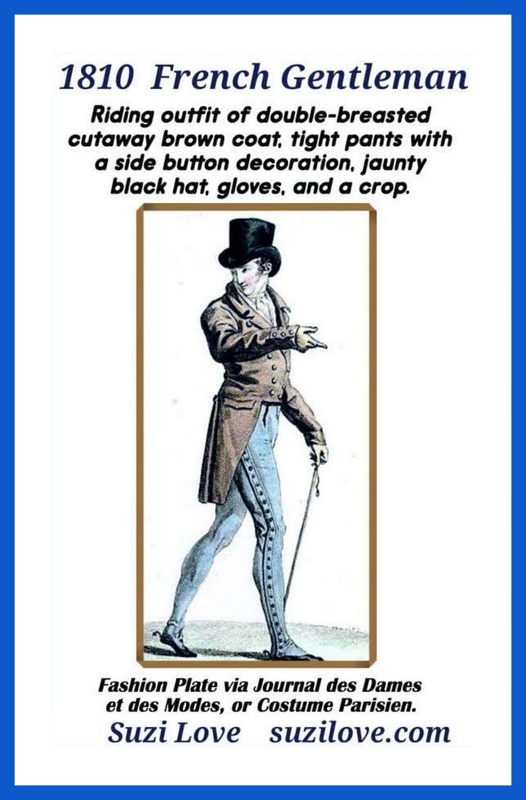
1800 Young Dandy’s Morning Outfit, French. Brown, doublebreated, cutaway coat, striped trousers tucked into high black boots with tassels, gloves, small jaunty hat and a walking stick. Fashion Plate via Journal des Dames et des Modes, or Costume Parisien.

1800 Young Dandy's Morning Outfit, French. Brown, doublebreated, cutaway coat, striped trousers tucked into high black boots with tassels, gloves, small jaunty hat and a walking stick. Fashion Plate via Journal des Dames et des Modes, or Costume Parisien.
1800 Young Dandy’s Morning Outfit, French. Brown, doublebreated, cutaway coat, striped trousers tucked into high black boots with tassels, gloves, small jaunty hat and a walking stick. Fashion Plate via Journal des Dames et des Modes, or Costume Parisien.
1800 Young Dandy's Morning Outfit Of Brown Double-Breasted Cutaway Coat and Striped Pants, French. #JaneAusten #RegencyEra #Men #Fashion https://books2read.com/SuziLoveFashionMen1800-1819 Share on X

From the finish of the 18th century until 1820, men’s fashions in European and European-influenced countries moved away from the formal wear of brocades, lace, wigs and powder to more informal and relaxed styles. Focus was on undress rather than formal dress. Typical menswear in the early 1800s included a tailcoat, a vest or waistcoat, either breeches, pants, or the newer trousers, stockings, shoes or boots, all worn with an overcoat and hat. This basic ensemble was accessorized with some form of neckcloth or cravat, gloves, walking stick, cane or riding crop, handkerchief, fobs, watch and perhaps a quizzing glass or eye glass. 

Skirted coats were replaced with short-fronted, or cutaway, tailcoats worn over fitted waistcoats and plain, white linen shirts. Knee breeches were gradually replaced by tight-fitting pantaloons and later trousers, decorative shoes with buckles were replaced with a variety of boot styles, and fussy and ruffled neckwear gave way to intricately tied, white linen neck cloths. A Regency Era, or early 1800s, gentleman was outfitted in more practical fabrics, such as wool, cotton and buckskin rather than the fussy brocades and silks of the late 1700s. 

1804 Men's Fashions In The Time Of Jane Austen. #Regency #Fashion #JaneAusten Share on X
HN_23_D2D_Fashion Men 1800-1819
Posted in 1800s, 1800s Mens Fashions, Coat or Pelisse Or Redingote, Europe, fashion accessories, France, hats, Jane Austen, pants, Regency Era, Regency Fashion, riding, shoes, Suit, Suzi Love Images, Vest or Waistcoat | Tagged 1800s men fashion, boots, breeches, British history, dandy, europe, fashion accessories, Fashion Plate, France, gloves, Hats And Hair, Jane Austen, Journal des Dames et des Modes, pants, Regency Fashion, riding, Shoes, Vest or Waistcoat

1820-1835 ca. Bridgerton and Jane Austen Style Woman’s Underwear Combination, English. #JaneAusten #RegencyFashion #Bridgerton #Underwear. #HistoricalFashion

Suzi Love Posted on June 19, 2024 by Suzi LoveJune 18, 2024

1820-1835 ca. Woman’s Underwear Combination, English. Petticoat: 1820-1829 ca. Cotton with double row of piping round hem. Frontless with looped shoulder pieces. Corset: 1835: Cotton reinforced with whalebone and cording, hand-sewn. Shift Or Chemise:1830s Worn under corset. Drawers: Sheer clinging fabrics needed drawers underneath for modesty. via Victoria and Albert Museum, London, UK.
collections.vam.ac.uk.

1820-1835 ca. Woman's Underwear Combination, English. Petticoat: 1820-1829 ca. Cotton with double row of piping round hem. Frontless with looped shoulder pieces. Corset: 1835: Cotton reinforced with whalebone and cording, hand-sewn. Shift Or Chemise:1830s Worn under corset. Drawers: Sheer clinging fabrics needed drawers underneath for modesty. via Suzi Love suzilove.com Victoria and Albert Museum, London, UK. collections.vam.ac.uk.
1820-1835 ca. Woman’s Underwear Combination, English. Petticoat: 1820-1829 ca. Cotton with double row of piping round hem. Frontless with looped shoulder pieces.
1820-1835 ca. Bridgerton and Jane Austen Style Woman's Underwear Combination, English. #JaneAusten #RegencyFashion #Bridgerton #Underwear. #HistoricalFashion https://books2read.com/SuziLoveFashionWomen1815-1819 Share on X
HN_28_D2D_Fashion Women 1815-1819
https://books2read.com/SuziLoveFashionWomen1815-1819
Fashion Women 1815-1819 History Notes Book 28 https://books2read.com/SuziLoveFashionWomen1815-1819
Posted in 1800s, 1800s women's fashion, Bridgerton, Corset, Jane Austen, Suzi Love, underclothing | Tagged 1800s women's fashion, British history, chemise, Corset, petticoat, Regency Fashion, Romantic Era Fashion, Suzi Love Images, underclothing, Victoria and Albert Museum

1815 How Did Jane Austen and the Bridgertons Travel? Did they travel by Stage Coach? #Bridgerton #RegencyEra #BritishHistory #JaneAusten

Suzi Love Posted on June 17, 2024 by Suzi LoveJune 16, 2024

How did Jane Austen and her family? Did they go by stagecoach? The dreadful condition of British roads caused great apprehension to all classes of travelers. Making a journey anywhere in the country was a big undertaking and often a gentleman composed his last will and testament before his departure.  Traveling in vehicles was only possible during the day or on the nights with very bright moonlight with few vehicles attempting road travel in winter and any travel on a Sunday was frowned upon.

Description of Stage Coach Travel in England.  via 1815 Journal Tour of Great Britain. “The gentlemen coachmen, with half-a dozen great coats about them, immense capes, a large nosegay at the button-hole, high mounted on an elevated seat, with squared elbows, a prodigious whip, beautiful horses, four in hand, drive in a file to Salthill, a place about twenty miles from London, and return, stopping in the way at the several public-houses and gin-shops where stage-coachmen are in the habit of stopping for a dram, and for parcels and passengers on the top of the others as many as seventeen persons. These carriages are not suspended, but rest on steel springs, of a flattened oval shape, less easy than the old mode of leathern braces on springs. Some of these stage coaches carry their baggage below the level of the axletree.”

Coach Carriage Line Drawing. Photo Editing by Suzi Love ~ suzilove.com via Pearson Scott Foresman donation to Wikimedia Commons.
1805 January 1st Worcester and London Royal Mail Coach. Publisher: William Miller, Albermarle Street, London, U.K. Hand colored print. Coach is grey and purple with red wheels and drawn by four white horses. Below the mail guard it is printed, 'N.17'. Via Suzi Love suzilove.com British Postal Museum, London, U.K. postalmuseum.org
1805 January 1st Worcester and London Royal Mail Coach. Publisher: William Miller, Albermarle Street, London, U.K. Hand colored print. Coach is grey and purple with red wheels and drawn by four white horses. Below the mail guard it is printed, ‘N.17’. Via Suzi Love suzilove.com British Postal Museum, London, U.K. postalmuseum.org
1815 How Did Jane Austen and the Bridgertons Travel? Did they travel by Stage Coach? #Bridgerton #RegencyEra #BritishHistory #JaneAusten https://books2read.com/SuziLoveTravel Share on X
HN_10_D2D_RetailerBuyLink
books2read.com/SuziLoveTravel
Posted in 1800s, Bridgerton, Carriage, England, Google Books, History, Jane Austen, London, Regency Era, Suzi Love Images, travel | Tagged Bridgerton, British history, British Postal Museum, carriages, google books, Jane Austen, Pearson Scott Foresman, postal, Regency Era, travel, WikiMedia Commons

1810 ca. Muslin Bodiced Petticoat With Sleeves, British. #RegencyFashion #JaneAusten #underclothing

Suzi Love Posted on June 12, 2024 by Suzi LoveJune 10, 2024

1810 ca. Muslin, or Cotton, Bodiced Petticoat With Sleeves, British.The sort of petticoat Jane Austen wore beneath her dresses, for both modesty and warmth. via Killerton House. National Trust, U.K. nationaltrustcollections.org.uk

In Jane Austen’s years of the early nineteenth century, women often wore light-weight dresses under which was worn a range of underclothing to stop gowns appearing transparent and sticking to a lady’s body. To preserve modesty, underclothing included a chemise next to the skin, then a corset, and then petticoats to give shape to a dress and to keep it away from her body.

1810 ca. Muslin, or Cotton, Bodiced Petticoat With sleeves, British. via Killerton House. National Trust, U.K. nationaltrustcollections.org.uk
1810 ca. Muslin Bodiced Petticoat With Sleeves, British. #RegencyEra #JaneAusten #underclothing https://books2read.com/SuziLoveFashion1810-1814 Share on X
HN_27_D2D_fashwomen1810-1814
https://books2read.com/SuziLoveFashion1810-1814
HN_27_D2D_fashwomen1810-1814 https://books2read.com/SuziLoveFashion1810-1814
Posted in 1800s, 1800s women's fashion, England, Jane Austen, London, Regency Era, Regency Fashion, Suzi Love Images, underclothing | Tagged 1800s women's fashion, British history, England, Jane Austen, National Trust U.K., petticoat, Regency Fashion, underclothing

18th-19th Century Sedan Chair Travel In Jane Austen’s Times. #JaneAusten #BritishHistory #Travel #GeorgianEra

Suzi Love Posted on May 25, 2024 by Suzi LoveMay 25, 2024

A sedan chair is a portable enclosed chair for a single passenger. It was generally carried by two “chairmen” holding poles attached to either side of the chair. Sedan chairs were fashionable in England and Europe during the 17th, 18th and early 19th centuries and were an important part of the social life of the times. They were very useful for negotiating crowded, unsafe, narrow, winding and often filthy streets and were particularly used by “invalids, ladies and party goers”. Sedan chairs had the advantage of being able to be carried up and down stairs and could deliver the passenger from inside their own home to inside their destination without having to step outside.

1784 Sedan Chair. ‘The return from a masquerade. A morning scene.’ A young lady dressed as shepherdess with staff slumps in a sedan chair. Asleep or drunk her head and shoulders hang outside window. Two porters smile and dwarf chimney sweep carries a mask.’ By Robert Dighton and Cari.

1784 Sedan Chair. ‘The return from a masquerade. A morning scene.' A young lady dressed as shepherdess with staff slumps in a sedan chair. Asleep or drunk her head and shoulders hang outside window. Two porters smile and dwarf chimney sweep carries a mask.’ By Robert Dighton and Cari.
1784 Sedan Chair. ‘The return from a masquerade. A morning scene.’ A young lady dressed as shepherdess with staff slumps in a sedan chair. Asleep or drunk her head and shoulders hang outside window. Two porters smile and dwarf chimney sweep carries a mask.’ By Robert Dighton and Cari.

The 19th century English author, Elizabeth Gaskell, described the use and function of the sedan perfectly in her novel “Wives and Daughters” when she reminisced how the Browning sisters chose to be transported to a ball by sedan chair, which ‘came into the parlor, and got full of the warm air, and nipped you up, and carried you tight and cosy into another warm room, where you could walk out without having to show your legs by going up steps, or down steps.’

The Bath Chair was invented in Bath, England, in the mid 18th Century to transport the wealthy and the sick around the city.  It could be steered by the passenger and rivaled and then outdid the Sedan Chair as only one chairman was needed to operate it. The last Bath Chairman retired in 1949. 

Typical 1700s, or Eighteenth Century Sedan Chair. Portable enclosed chair for single passenger usually carried by two chairmen holding poles attached to either side of chair. Fashionable during 17th, 18th and early 19th centuries when needed to negotiate crowded, unsafe, narrow, and dirty streets. Used by invalids, ladies and party goers. The sedan chair comprises a small kiosk with a curved timber roof which is covered with leather and studded with brass nails. The front and side panels are painted in green with floral decorations of cherubs and flowers. The back panel is of plain timber. Access to the chair was via a hinged door at the front. Inside, the chair is upholstered in silk and features padded upholstered arm rests. The windows have raw silk curtains which are gathered with tassels. The present brackets and poles are reproductions made in 1986 prior to display in the Transport exhibition. The total length of the new poles are 80 inches. The sedan chair door lock features the initials “V.F.” and a set of crossed keys with the wording “PARIS” and the number “34”. Via Powerhouse Museum, Sydney, Australia.

Typical 1700s, or Eighteenth Century Sedan Chair. Portable enclosed chair for single passenger usually carried by two chairmen holding poles attached to either side of chair. Fashionable during 17th, 18th and early 19th centuries when needed to negotiate crowded, unsafe, narrow, and dirty streets. Used by invalids, ladies and party goers. The sedan chair comprises a small kiosk with a curved timber roof which is covered with leather and studded with brass nails. The front and side panels are painted in green with floral decorations of cherubs and flowers. The back panel is of plain timber. Access to the chair was via a hinged door at the front. Inside, the chair is upholstered in silk and features padded upholstered arm rests. The windows have raw silk curtains which are gathered with tassels. The present brackets and poles are reproductions made in 1986 prior to display in the Transport exhibition. The total length of the new poles are 80 inches. The sedan chair door lock features the initials "V.F." and a set of crossed keys with the wording "PARIS" and the number "34". Via Powerhouse Museum, Sydney, Australia.
Typical 1700s, or Eighteenth Century Sedan Chair. Portable enclosed chair for single passenger usually carried by two chairmen holding poles attached to either side of chair. Fashionable during 17th, 18th and early 19th centuries when needed to negotiate crowded, unsafe, narrow, and dirty streets. Used by invalids, ladies and party goers. The sedan chair comprises a small kiosk with a curved timber roof which is covered with leather and studded with brass nails. The front and side panels are painted in green with floral decorations of cherubs and flowers. The back panel is of plain timber. Access to the chair was via a hinged door at the front. Inside, the chair is upholstered in silk and features padded upholstered arm rests. The windows have raw silk curtains which are gathered with tassels. The present brackets and poles are reproductions made in 1986 prior to display in the Transport exhibition. The total length of the new poles are 80 inches. The sedan chair door lock features the initials “V.F.” and a set of crossed keys with the wording “PARIS” and the number “34”. Via Powerhouse Museum, Sydney, Australia.

Typical 1700s, or Eighteenth Century Sedan Chair. Portable enclosed chair for single passenger usually carried by two chairmen holding poles attached to either side of chair. Fashionable during 17th, 18th and early 19th centuries when needed to negotiate crowded, unsafe, narrow, and dirty streets. Used by invalids, ladies and party goers. The sedan chair comprises a small kiosk with a curved timber roof which is covered with leather and studded with brass nails. The front and side panels are painted in green with floral decorations of cherubs and flowers. The back panel is of plain timber. Access to the chair was via a hinged door at the front. Inside, the chair is upholstered in silk and features padded upholstered arm rests. The windows have raw silk curtains which are gathered with tassels. The present brackets and poles are reproductions made in 1986 prior to display in the Transport exhibition. The total length of the new poles are 80 inches. The sedan chair door lock features the initials “V.F.” and a set of crossed keys with the wording “PARIS” and the number “34”. Via Powerhouse Museum, Sydney, Australia. 

The longest journey recorded in a sedan chair was made by Princess Amelia, youngest daughter of King George III, who in 1728 was carried by 8 chairmen working in reliefs from London to Bath, a distance of 172 kms (107 miles). This sedan chair door lock features the initials “V.F.” and a set of crossed keys with the wording “PARIS” and the number “34”.

18th-19th Century Sedan Chair Travel In Jane Austen's Times. #JaneAusten #BritishHistory #Travel #GeorgianEra books2read.com/SuziLoveTravel Share on X
HN_10_D2D_RetailerBuyLink

books2read.com/SuziLoveTravel
HN_10_D2D_RetailerBuyLink_ History Notes Book 10 books2read.com/SuziLoveTravel
Posted in 1700s, 1700s Mens fashion, 1700s Womens Fashion, 1800s, Box Or Container, Carriage, cartoon, Customs & Manners, England, Europe, fashion accessories, France, Georgian Era, Georgian Fashion, hats, History, Jane Austen, London, Regency Era, Romantic Era, Suzi Love Books, Suzi Love Images, travel, U.S.A | Tagged 1700s Mens Fashion, 1700s Women's Fashion, British history, carriages, Customs and Traditions, europe, Georgian era, Georgian Fashion, google books, Jane Austen, Regency Era, travel

1812-1814 ca. White Muslin Peignoir Or Dressing Gown. #Regency #JaneAusten #Fashion

Suzi Love Posted on April 3, 2024 by Suzi LoveApril 29, 2024

1812-1814 Ca. White Muslin Peignoir Or Dressing Gown, British. The sort of robe Jane Austen would have worn. Fabric made in India, Garment made in Britain. Wrap-over gown with round, slightly raised collar, gathered trimmings, narrow shoulder frills, excessively long sleeves with wristbands. Muslin dyed in the ikat technique, Malay term for complex tie-resist dyeing where warp threads dyed to form pattern before weaving. White with blue and red blurred warp.

via Victoria & Albert Museum, London, UK. collections.vam.ac.uk Credit: Given by Messrs Harrods Ltd.

1812-1814 Ca. White Muslin Peignoir Or Dressing Gown. Fabric made in India, Garment made in Britain. Wrap-over gown with round, slightly raised collar, gathered trimmings, narrow shoulder frills, excessively long sleeves with wristbands. Muslin dyed in the ikat technique, Malay term for complex tie-resist dyeing.
1812-1814 ca. White Muslin Peignoir Or Dressing Gown. #RegencyFashion #JaneAusten #HistoricalFashion https://books2read.com/SuziLoveFashion1810-1814 Share on X
HN_27_D2D_fashwomen1810-1814
https://books2read.com/SuziLoveFashion1810-1814
HN_27_D2D_fashwomen1810-1814 https://books2read.com/SuziLoveFashion1810-1814
Posted in 1800s, 1800s women's fashion, bedroom fashion, England, Regency Era, Regency Fashion, sewing, Suzi Love Images | Tagged 1800s women's fashion, bedroom fashion, British history, Jane Austen, Regency Fashion, sewing, Victoria and Albert Museum

1802-1812 ca. Dancing Carricature Series. Four women being instructed in dancing by a master playing a violin. #Cartoon #Dancing #RegencyEra

Suzi Love Posted on March 3, 2024 by Suzi LoveFebruary 15, 2024

1802-1812 ca. Dancing Or La Dansomanie Series. Four women being instructed in dancing before a mirror by a master playing a violin. Le Bon Genre Description Plate 12. Via British Museum, London, UK. britishmuseum.org (PD-Art)

1802-1812 ca. Dancing Or La Dansomanie Series. Four women being instructed in dancing before a mirror by a master playing a violin. Le Bon Genre Description Plate 12. Via British Museum, London, UK. britishmuseum.org (PD-Art)
1802-1812 ca. Dancing Caricature Series. Four women being instructed in dancing by a master playing a violin. #Cartoon #Dancing #RegencyEra https://books2read.com/suziloveYLD Share on X
D2D_RL_4_YLD_Young Lady's Day Regency Life Series Book 4 by Suzi Love. A light-hearted look at the longer Regency years and an easy to read view of what a young lady did, wore, and lived. https://books2read.com/suziloveYLD
Posted in 1800s, 1800s Mens Fashions, cartoon, Coat or Pelisse Or Redingote, Dress Or Robe, England, Europe, France, London, pants, Regency Era, Suit, Suzi Love Images, Vest or Waistcoat | Tagged 1800s men fashion, 1800s women's fashion, British history, British Museum, Cartoons, Corset, cravat, dancing, dandy, Dress Or Gown, fashion accessories, Jane Austen, Regency Fashion, Shoes

Post navigation

← Previous Post
Next Post→

SUBSCRIBE TO SUZI LOVE'S NEWSLETTER.

Recent Posts

  • 1811 January Velvet Pelisse, Walking Boots, Quizzing Glass and Slouch Hat in Jane Austen style. #RegencyFashion #JaneAusten #HistoricalFashion
  • 1812 Green Riding Habit, English As Worn in the Times Of Jane Austen. #RegencyFashion #JaneAusten #HistoricalFashion
  • 18th – 19th Century Jane Austen or Bridgerton Style Wax Seals For Letters and Posting. #JaneAusten #Bridgerton #RegencyEra #BritishHistory #Antiques
  • 1806 April Two Ladies In Full Dress, English. #RegencyFashion #JaneAusten #FashionHistory
  • 1800s White Evening Dress With Long Train As Jane Austen Would Have Worn. #RegencyFashion #BritishHistory #JaneAusten

Recent Comments

  1. Suzi Love on Book Hooks: “Why didn’t you leave the army, but stay around?” Grant asked Kelly. “Australia or Vanuatu.” #MilitarySuspense #ContemporaryRomance #kellysjustice #SouthPacific #Vanuatu
  2. Suzi Love on Book Hooks: “Why didn’t you leave the army, but stay around?” Grant asked Kelly. “Australia or Vanuatu.” #MilitarySuspense #ContemporaryRomance #kellysjustice #SouthPacific #Vanuatu
  3. Suzi Love on Book Hooks: “Why didn’t you leave the army, but stay around?” Grant asked Kelly. “Australia or Vanuatu.” #MilitarySuspense #ContemporaryRomance #kellysjustice #SouthPacific #Vanuatu
  4. Suzi Love on Book Hooks: “Why didn’t you leave the army, but stay around?” Grant asked Kelly. “Australia or Vanuatu.” #MilitarySuspense #ContemporaryRomance #kellysjustice #SouthPacific #Vanuatu
  5. Suzi Love on Book Hooks: “Why didn’t you leave the army, but stay around?” Grant asked Kelly. “Australia or Vanuatu.” #MilitarySuspense #ContemporaryRomance #kellysjustice #SouthPacific #Vanuatu

Login

  • Log in

Archives

  • June 2026
  • May 2026
  • April 2026
  • March 2026
  • February 2026
  • January 2026
  • December 2025
  • November 2025
  • October 2025
  • September 2025
  • August 2025
  • July 2025
  • June 2025
  • May 2025
  • April 2025
  • March 2025
  • February 2025
  • January 2025
  • December 2024
  • November 2024
  • October 2024
  • September 2024
  • August 2024
  • July 2024
  • June 2024
  • May 2024
  • April 2024
  • March 2024
  • February 2024
  • January 2024
  • November 2023
  • October 2023
  • September 2023
  • August 2023
  • July 2023
  • June 2023
  • April 2023
  • March 2023
  • February 2023
  • June 2022
  • April 2022
  • March 2022

Categories

  • 1700s
  • 1700s Mens fashion
  • 1700s Womens Fashion
  • 1800s
  • 1800s Mens Fashions
  • 1800s women's fashion
  • 1900s
  • art
  • Australia
  • Bath
  • bedroom fashion
  • Book Hooks
  • Box Or Container
  • Bridgerton
  • Bus Trips
  • Canada
  • Carriage
  • cartoon
  • Celebrity
  • Chatelaine
  • children
  • Children
  • Christmas
  • Coat or Pelisse Or Redingote
  • Contemporary
  • Corset
  • Couple
  • Customs & Manners
  • dancing
  • December Scandal
  • Decorative Item
  • Dress Or Robe
  • Easter
  • Edwardian Era
  • Embracing Scandal
  • England
  • Ester In Images
  • Europe
  • Events
  • Fashion
  • fashion accessories
  • Food and Drink
  • Four Times A Virgin
  • France
  • furniture
  • Georgian Era
  • Georgian Fashion
  • Google Books
  • Grand Tour
  • Group
  • hats
  • History
  • History Events
  • History Notes
  • History Of Christmases Past
  • household
  • Hygiene
  • Irresistible Aristocrats
  • Jane Austen
  • Keanu Reeves
  • Kellys Justice
  • Legal
  • London
  • Love After Waterloo
  • Loving Lady Katharine
  • medical
  • military
  • money
  • mourning
  • Music
  • Outback Arrival
  • pants
  • Pastimes
  • peerage
  • People
  • Petunia and Pearl Diver
  • Places
  • Pleasure House Ball
  • postal
  • Queensland
  • Quotations
  • Regency Era
  • Regency Fashion
  • Regency Life Series
  • Reticule or Bag
  • riding
  • Romantic Era
  • Royalty
  • Russia
  • Scandalous Siblings Series
  • Scenting Scandal
  • Self Publishing
  • sewing
  • Shirt
  • shoes
  • Shopping
  • South Pacific
  • Spencer
  • sports
  • Suit
  • Sunday Snippet
  • Suzi Love
  • Suzi Love Books
  • Suzi Love Images
  • Suzi Love Writing
  • Swain Cove
  • THe Viscount's Pleasure House
  • travel
  • U.S.A
  • underclothing
  • Vest or Waistcoat
  • Victorian Era
  • Victorian Fashion
  • weapons
  • weddings
  • Writing Tools

1800s men fashion 1800s women's fashion antiques Bridgerton British history Cartoons Corset cravat decorative Dress Or Gown England europe fashion accessories Fashion Plate France Georgian era Georgian Fashion gloves google books Hats And Hair historical romance History Notes household Jane Austen jewelry Journal des Dames et des Modes London Metropolitan Museum NYC pants Redingote Or Pelisse Or Coat Regency Era Regency Fashion Regency London Regency Men reticule or bag riding sewing shawls Shoes Suzi Love Books Suzi Love Images Tailcoat The Repository Of Arts underclothing Vest or Waistcoat

©2026 - Suzi Love - Weaver Xtreme Theme Privacy Policy
↑