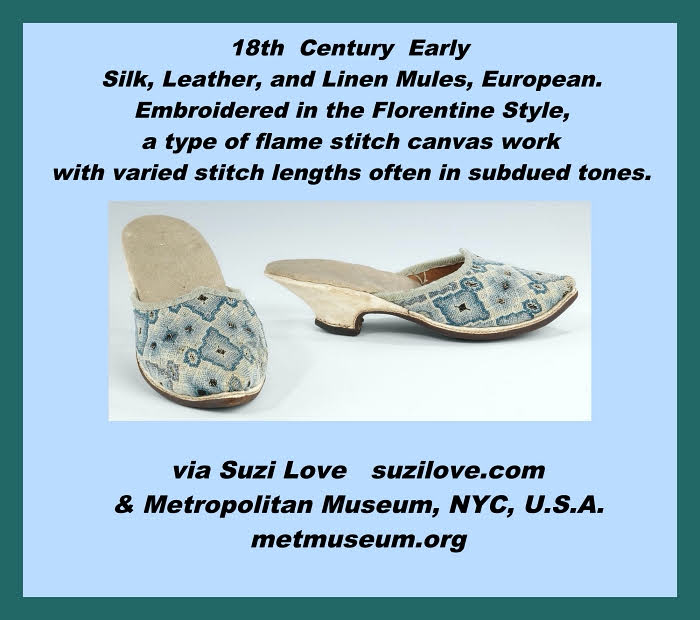
18th Century Early. Silk, Leather, and Linen Mules, European. Embroidered in the Florentine Style, a type of flame stitch canvas work with varied stitch lengths often in subdued tones. via Metropolitan Museum, NYC, U.S.A.
shoes_18th Century Early. Silk, Leather, and Linen Mules, European. Embroidered in the Florentine Style, a type of flame stitch canvas work with varied stitch lengths often in subdued tones. via Metropolitan Museum, NYC, U.S.A.
18th Century Early. Silk, Leather, and Linen Mules (shoes), European, and embroidered in Florentine Style. #shoes #georgianfashion #europe https://books2read.com/suziloveFashWomen1700s
HN_1 Fashion Women Late 1700s History Notes Book 1 by Suzi Love.
What was fashionable for women in the late 1700s? Extravagant colors and fabrics and outrageous styles were all seen in these flamboyant fashions.
books2read.com/suziloveFashWomen1700s
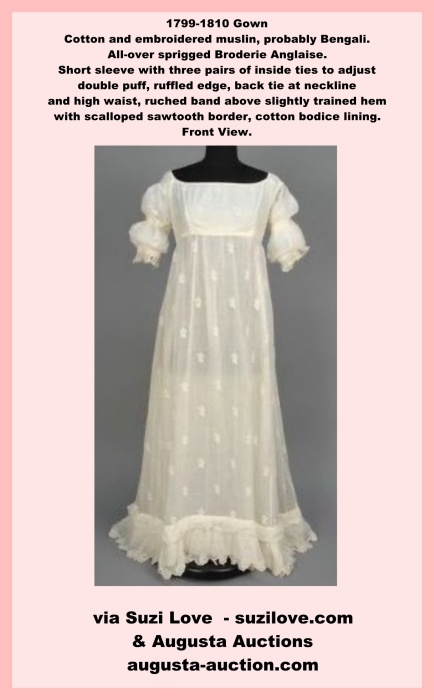
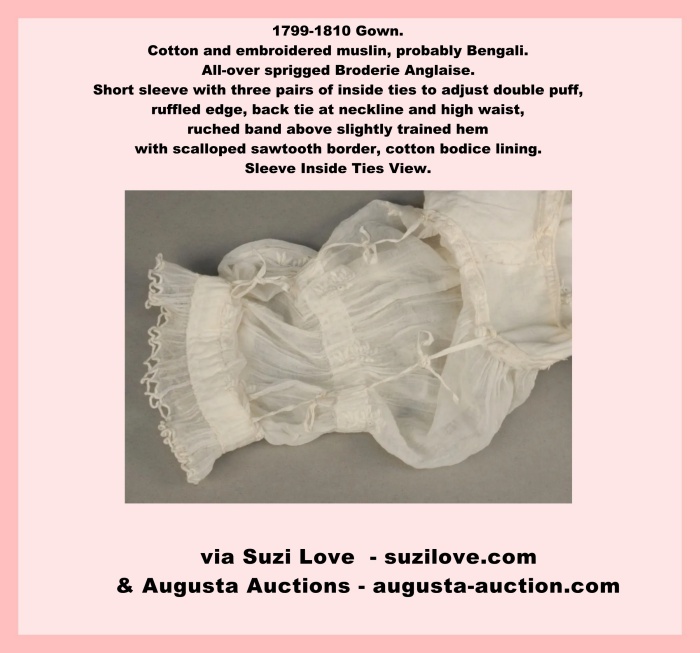
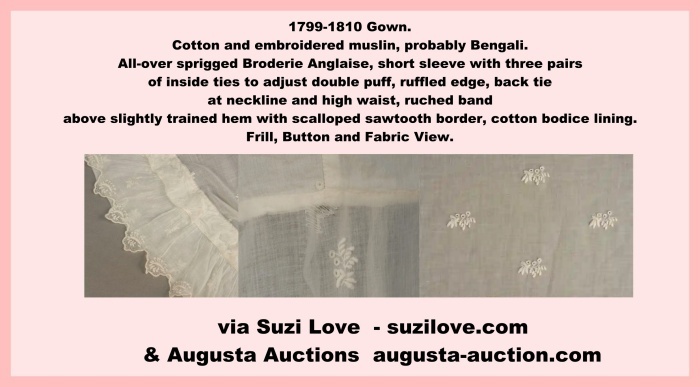
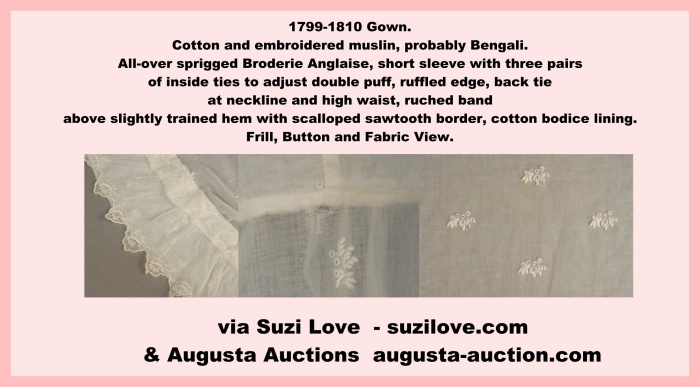
1799-1810 ca. Cotton Muslin Gown, Probably American. White cotton embroidered muslin, probably Bengal, all over sprigged broderie anglaise decoration,short sleeve with three pairs of inside ties to adjust the double-puff, ruffled edge, back tie at neckline and waist, ruched band above the slightly trained hem with scalloped sawtooth border and with cotton bodice lining. via whitakerauction.smugmug.com
These lightweight white cotton dresses were fashionable in Jane Austen’s times, but they were certainly not warm when a lady was out walking or when riding in a carriage. Numerous outer layers could be added for warmth and to brighten and personalize an outfit. These might be an overdress, pelisse or redingote, hat, shawl, gloves, or large fur muff.
The Empire dress which evolved in the late 1790s began as a chemise shift gathered under the breasts and at the neck. Named after the First Empire in France, by 1800 Empire dresses had a very low décolleté, or neckline and a short narrow backed bodice attached to a separate skirt. Skirts started directly under the bust and flowed into the classical relaxed wide styles of Greece and Rome. This style of dress is associated with Jane Austen and her contemporaries as a simple cotton high-waisted dress was worn most days and accessorized according to the importance of the occasion.
1799-1810 ca. Jane Austen Style White Cotton Muslin Dress With Sprigged Broderie Anglaise. #RegencyFashion #JaneAusten #GeorgianFashion books2read.com/SuziLoveFashionWomen1800
Spencers Or Regency Jackets By Suzi Love. History Notes Book 4. What was fashionable for outer wear in past centuries? Call them what you like: Spencers, short jackets, or Regency jackets were very popular. Take a look at the jackets being worn by women in the early 1800s or the times of Jane Austen. books2read.com/suziloveSpencers
Definition: Spencer – Short, bodice hugging, usually long sleeved, outer jacket. For warmth and for fashion.
Definition Caroline Spencer: Worn during the Directoire and First Empire (1790-1815 C.E.). Spencer with pelerine cape that was made of white kerseymere and trimmed with light blue satin cut on bias.
Spencers were short jackets cut to match the high waistlines of Empire dresses. They often copied military styling, such as braiding, shoulder decoration, buttons and loop fasteners, and wrist adornments. They were generally of complex construction, often with a diamond shaped piece in the back.
Take a Look at Spencers, or Jackets Worn By Women In Bridgerton and Jane Austen’s Times, or Early 1800s. #Bridgerton#RegencyFashion #HistoricalFashion #History books2read.com/suziloveSpencers
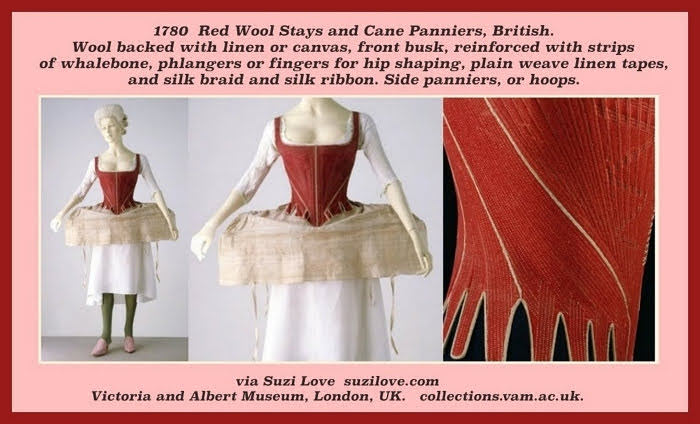
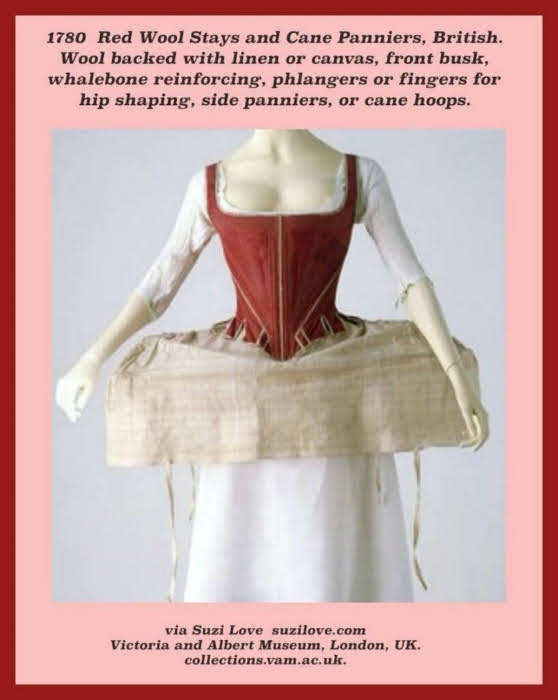
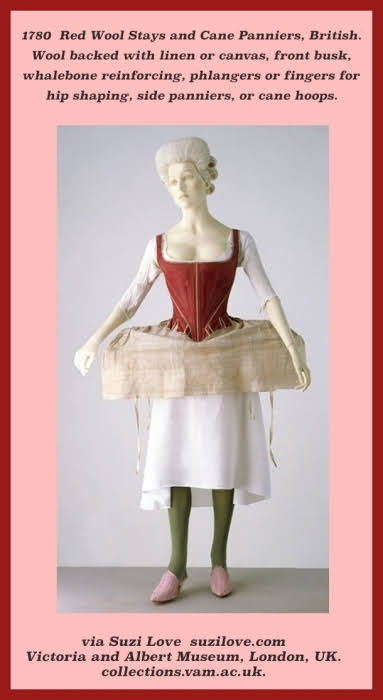
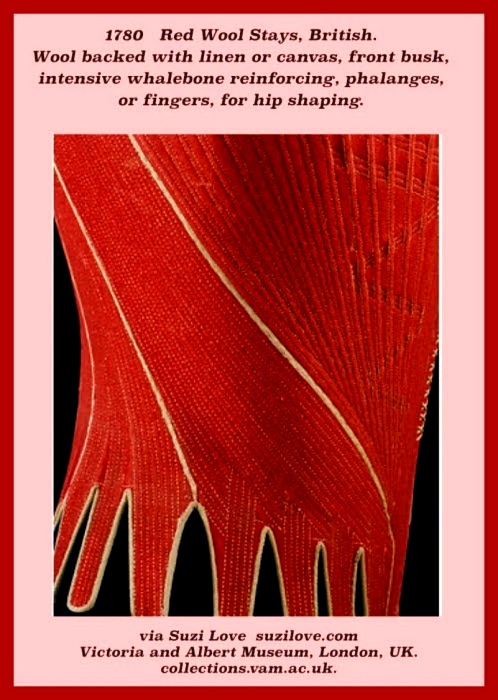
1780 Red Wool Stays, or corset, and Panniers, British. Wool backed with linen or canvas, stitched with linen thread reinforced with strips of whalebone, lined with glazed linen, bound with linen twill tape, fastened with plain weave linen tapes and decorated with silk braid and silk ribbon. Phalanges, or fingers, spread over the hips to give support. Side panniers, or hoops, are made of cane. via Victoria and Albert Museum, London, U.K.
Back-lacing stays with a high narrow back with a wide curving decolletage and V-point in front, about 5 cm below the waistline. Decorative white lacing and white silk braids on centre front which is wide at the top and narrow at the bottom. Below the waist there are 19 tabs, or phalanges, or fingers. Laced through 13 eyelets at back. Compartments for the strips of whalebone are 4 – 5 mm wide, running vertically and diagonally. Centre busk of whalebone about 2 cm wide. Shoulder straps have an eyelet and extend from the front and fasten with tape at each shoulder back.
Stays were an essential item of underwear for women during the 18th century. By the 1780s, the fashionable torso consisted of an inverted cone shape. Achieving smoothness of profile and firmness of contour were the primary function of 18th-century stays, rather than emphasising the bust or constricting the waist. Although custom-made and very intricately designed, stays were usually very plain. On these stays a simple silk ribbon and linen tape serve as decoration and functional finishings.
The narrow rows of very fine, even hand stitching form the compartments into which thin strips of whalebone were inserted. Although the stays appear very rigid, whalebone was quite flexible. It had the added advantage of softening with the heat of the wearer’s body, allowing the stays to mold to her shape. When worn, the shaped and boned tabs at the lower edge would splay over the wearer’s hips, giving further fullness to the petticoat tied at the waist over the stays.
Love the charming chatelaines and chains women wore in Jane Austen’s and Bridgerton’s times? Check out this fascinating read! #bridgerton #janeausten #chatelaine #suzilovebooks books2read.com:SuziLoveChatelaines
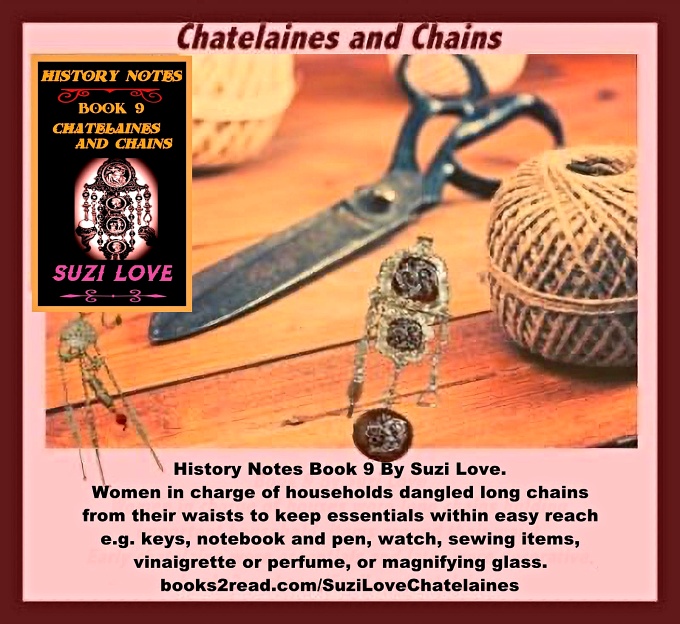
The Bridgerton women and Jane Austen and contemporaries carried keys, writing tools, sewing items and other personal necessities on their person by long chains, or a chatelaine, that hung from their waist. Early chatelaines were simple essentials but later chatelaines were decorative and expensive. http://books2read.com/SuziLoveChatelaines
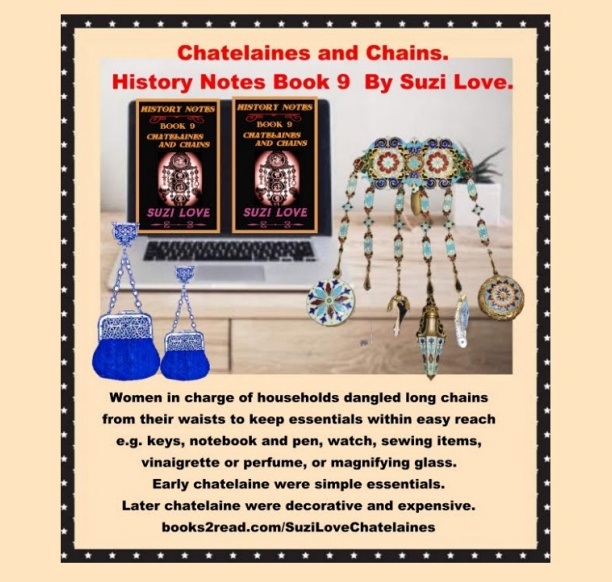
Definition Chatelaine: The word Chatelaine is French and means the keeper of the keys. Chatelaine” derives from the Latin word for castle. In Medieval times, the chatelaine was in charge of the day-to-day running of the castle. Women in charge of households dangled long chains from their waists to keep essentials within easy reach e.g. keys, notebook and pen, watch, sewing items, vinaigrette or perfume, or magnifying glass. Early chatelaine were simple essentials. Later chatelaine were decorative and expensive.books2read.com/SuziLoveChatelaines
What did a chatelaine do? Most important task was keeper of the keys. Also ordered supplies, did bookkeeping, supervised servants, taught castle children, and organized guests.
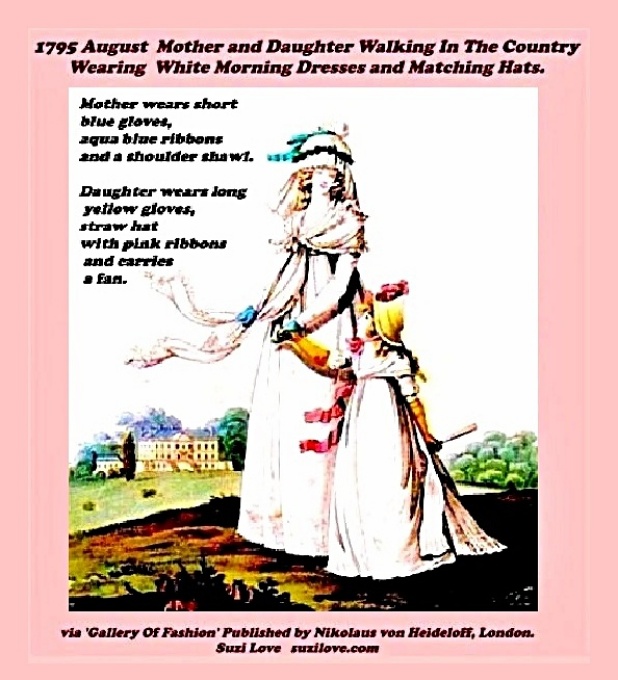
1795 August Mother and Daughter walking in the country wearing white morning dresses and matching hats. Mother wears short blue gloves, aqua blue ribbons and a shoulder shawl, or fichu. Daughter wears long yellow gloves, a straw hat with pink ribbons and carries a fan. via Nikolaus Heideloff’s Gallery of Fashion.
HN_1 Fashion Women Late 1700s History Notes Book 1 by Suzi Love.
What was fashionable for women in the late 1700s? Extravagant colors and fabrics and outrageous styles were all seen in these flamboyant fashions.
books2read.com/suziloveFashWomen1700s
Jane Austen’s and the Bridgerton ladies personal necessities, keys, or chatelaines was a set of useful items hung from waist by decorative chain. Chatelaines and Chains. History Notes Book 9 By Suzi Love. Women in charge of households dangled long chains from their waists to keep essentials within easy reach e.g. keys, notebook and pen, watch, sewing items, vinaigrette or perfume, or magnifying glass. Early chatelaine were simple essentials. Later chatelaine were decorative and expensive. http://books2read.com/SuziLoveChatelaines
Definition Chatelaine: The word Chatelaine is French and means the keeper of the keys. Chatelaine” derives from the Latin word for castle. In Medieval times, the chatelaine was in charge of the day-to-day running of the castle. Women in charge of households dangled long chains from their waists to keep essentials within easy reach e.g. keys, notebook and pen, watch, sewing items, vinaigrette or perfume, or magnifying glass. Early chatelaine were simple essentials. Later chatelaine were decorative and expensive.books2read.com/SuziLoveChatelaines
What did a chatelaine do? Most important task was keeper of the keys. Also ordered supplies, did bookkeeping, supervised servants, taught castle children, and organized guests.
Chatelaines and Chains History Notes Book 9 By Suzi Love. What do you know about Chatelaines and Chains worn in Jane Austen’s and Bridgerton times? Women in charge of households carried important items with them. History Notes Book 9 Chatelaines and Chains. books2read.com/SuziLoveChatelaines
Personal Necessities, keys, or chatelaines was a set of useful items hung from waist by decorative chain. Chatelaines and Chains. History Notes Book 9 By Suzi Love. Women in charge of households dangled long chains from their waists to keep essentials within easy reach e.g. keys, notebook and pen, watch, sewing items, vinaigrette or perfume, or magnifying glass. Early chatelaine were simple essentials. Later chatelaine were decorative and expensive. http://books2read.com/SuziLoveChatelaines
Definition Chatelaine: The word Chatelaine is French and means the keeper of the keys. Chatelaine” derives from the Latin word for castle. In Medieval times, the chatelaine was in charge of the day-to-day running of the castle. Women in charge of households dangled long chains from their waists to keep essentials within easy reach e.g. keys, notebook and pen, watch, sewing items, vinaigrette or perfume, or magnifying glass. Early chatelaine were simple essentials. Later chatelaine were decorative and expensive.books2read.com/SuziLoveChatelaines
What did a chatelaine do? Most important task was keeper of the keys. Also ordered supplies, did bookkeeping, supervised servants, taught castle children, and organized guests.
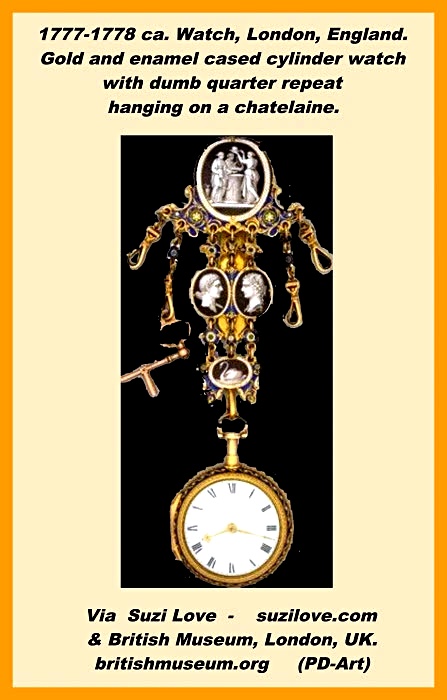
1777-1778 ca. Gold and enamel Cased Cylinder Watch with dumb quarter- repeat and en-suite Chatelaine, London, England. Via British Museum, London, UK. britishmuseum.org books2read.com/SuziLoveChatelaines
D2D_RetailerBuyLink_HN_9. Chatelaines and Chains History Notes Book 9 By Suzi Love. #regency Women in charge of houses wore long chains holding important household items around their waist e.g. keys, pen, notebook, sewing. books2read.com/SuziLoveChatelaines
18th Century Late – 19th Century Early Gloves as worn by women in Jane Austen’s and Bridgerton’s years, French. Silk embroidered with silk. via Museum of Fine Arts, Boston. mfa.org