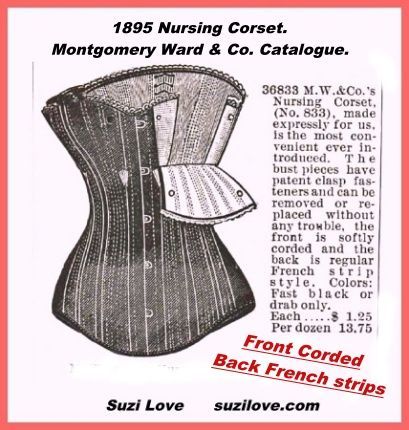
1895 Nursing Corset, French. via Montgomery Ward and co. Catalogue. Boned, soft and pliable busts, French sateen covered strips.
Definition Montgomery Ward: World first American mail order business and later a department store chain that operated between 1872 and 2001.
Corsets 1880-1900 History Notes Book 20 This book shows how a fashionable silhouette became of paramount importance and how a well-fitted corset became a fashion essential. As well as a decorative fashion item, tight lacing gave a narrow waist and the desired feminine form under clothing. https://books2read.com/SuziLoveCorsetBook20
1895-Nursing-Corset.Montgomery-Ward-Co.-Catalogue.-Front-Corded-Back-French-Strips.HN_20_D2D_Corsets 1880-1900
History Notes Book 20
https://books2read.com/SuziLoveCorsetBook20
1805-1810 ca. Red Shoes With Laces. via Museum of Fine Arts, Boston. mfa.org
In Jane Austen’s years, she and her contemporaries spent a lot of time walking outdoors. People were encouraged to partake in outdoor pursuits to maintain good health. Fragile slippers were worn for balls and evening events but for walking sturdier shoes were needed, In the early 1800s, these were typically made of leather, had a very small heel, slightly rounded toes and were laced up on the top.
1805-1810 ca. Red Shoes With Laces. via suzilove.com and Museum of Fine Arts, Boston. mfa.org Fashion Women 1805-1809 History Notes Book 26 What did Jane Austen and friends wear? https://books2read.com/SuziLoveFashionWomen1805-1809
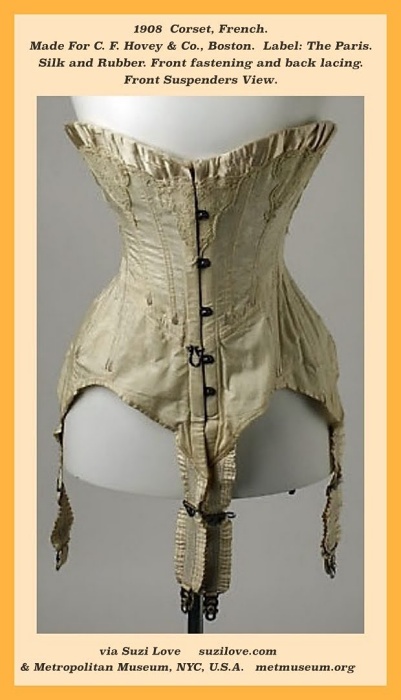
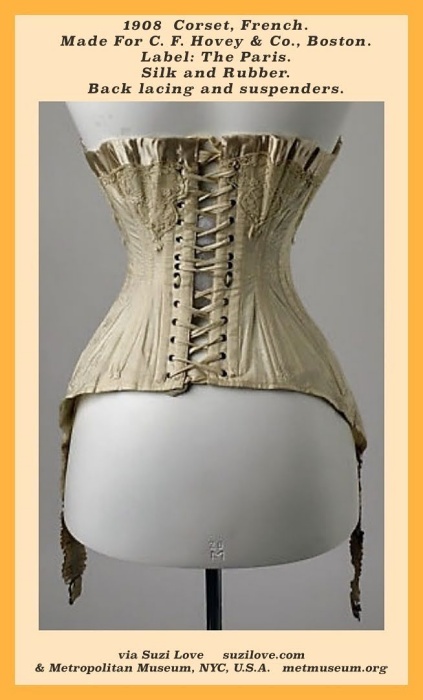
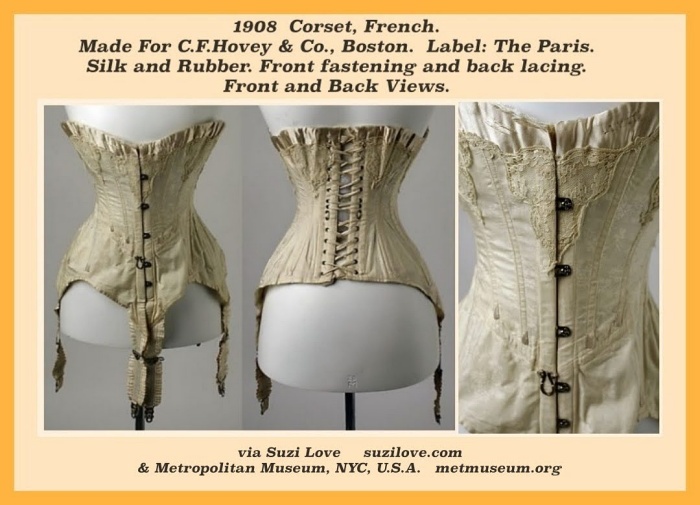
1908 Silk and Rubber Corset, French. Front fastening, front suspenders, and back lacing. Made For C. F. Hovey & Co., Boston. Label: The Paris. Marking: label “7.50, Made in France, Véritable Baleine, Brévété S.G.D.G., Best Whalebone THE PARIS, Made in France, expressly or C.F. Hovey and Co., Boston.” stamped on bone lining of corset]; “Corset de Paris” paper label via Metropolitan Museum, NYC, USA Credit Line: Gift of Mrs. Earl Rowe, 1951 Accession Number: C.I.51.15.25a, b
1908 Front Fastening View Of Corset, French. Made For C. F. Hovey & Co., Boston. Label: The Paris. Silk and Rubber. Front fastening and back lacing. via Suzi Love suzilove.com & Metropolitan Museum, NYC, U.S.A. metmuseum.org1908 Front Fastening View Of Corset, French. Made For C. F. Hovey & Co., Boston. Label: The Paris. Silk and Rubber. Front fastening and back lacing. via Suzi Love suzilove.com & Metropolitan Museum, NYC, U.S.A. metmuseum.org1908 Back Lacing Of Corset, French. Made For C. F. Hovey & Co., Boston. Label: The Paris. Silk and Rubber. Front fastening and back lacing. via Metropolitan Museum, NYC, U.S.A. metmuseum.org1908 Label For Front Fastening and Back Lacing Silk and Rubber Corset, French. Front fastening and back lacing. Made For C. F. Hovey & Co., Boston.1908 Front Suspenders and Back Lacing Silk and Rubber Corset, French. Front fastening and back lacing. Made For C. F. Hovey & Co., Boston.1908 Front Suspenders and Fastenings and Back Lacing Silk and Rubber Corset, French. Front fastening and back lacing. Made For C. F. Hovey & Co., Boston.Corsets 1900s History Notes Book 21
Corsets during early 1900s when a fashionable
silhouette became of paramount importance
and a well-fitted corset a fashion essential.
books2read.com/SuziLoveCorsetBook21
1840s Woman’s Shoes or Slippers, Probably United States. Square toes, silk satin, sueded leather, linen, and kid leather. via Los Angeles County Museum of Art, California, USA. collections.lacma.org Shoes in the early 1800s were flat or low heeled and occasionally decorated with a bow or floral embellishments. From the 1820s onwards, square toes became fashionable.
1840s Woman’s Shoes or Slippers, Probably United States. Square toes, silk satin, sueded leather, linen, and kid leather. via Suzi Love suzilove.com
& Los Angeles County Museum of Art, California, USA.
collections.lacma.org
1810–1850 ca. Corset, American or European. Front lacing, extra wide straps for under a square neckline dress. via Metropolitan Museum, N.Y.C., U.S.A. metmuseum.org
Surviving stays, or corsets as they became to be called in the nineteenth century, show that both longline and shorter corsets were worn and that they were made of cotton, silk and sateen. A lot of these corsets were front fastening, plus many were laced at both the front and the back so our aristocratic fictional heroines could indeed dress and undress themselves without the assistance of a maid.
Corsets 1810-1830 History Notes Book 17 This book shows how corsets changed to fit well under clothing, give maximum support and comfort. Corsets pushed up breasts and showed off the bust line beneath a square-cut and low-cut neckline as in the early 1800s, or Regency years. Jane Austen and her female and friends wore these corsets. https://books2read.com/SuziLoveCorsetBook17
1800 ca. Brown Striped Trousers, American or European. Button front waistband, small drop down flap, or fall, pockets, and with extra fullness in the back for ease of movement. via Metropolitan Museum, N.Y.C., U.S.A. The style of men’s pants that replaced breeches as the fashionable pants item for men in Jane Austen’ times.
pants_1800 Collage View. Brown Striped Trousers, American or European. via metmuseum 1800 Brown Striped Trousers, American or European. via metmuseum_Waistband_Sml1800 Brown Striped Trousers, American or European. via metmuseum. Back View.1800 Brown Striped Trousers, American or European. via metmuseum. Front View.23_d2d_fashionmen1800-1819https://books2read.com/SuziLoveFashionMen1800-1819
1820-1840 ca. Hand-Embroidered Wedding Corset, Connecticut, USA. Ivory cotton covered with hand embroidery, including love birds on hearts, front pocket for busk, eyelets for back lacing. Trapunto (to embroider) cording decorates and shapes corset. The back closure has ivory eyelets for the lacing. The center-front has a pocket panel for inserting a busk. Trapunto (to embroider) shapes the corset by outlining the design with two or more rows of running stitches and then padding from the underside which gives a raised effect.The technique was always considered very elegant. Trapunto first appeared in 14th century Sicily and was widely adopted for clothing in Tudor England, and then brought to America by the new settlers. In addition to the cording, the corset is totally covered with hand-embroidered flowers and there are two embroidered love birds on hearts at the center-front. Above the birds is a section of trapunto work. via Vintage Textiles
1790-1810 ca. Woman’s Black Wool Shoes. Pointed toe and low wedge heel covered in same fabric, black tape binding, leather straight or symmetrical sole, linen insole and lining. Wool satin with wool twill tape binding, plain weave linen lining, and leather sole. Place of Use: Lexington, Massachusetts, United States. Place of Manufacture: possibly Massachusetts, United States Provenance: Worn by a member of the Robbins family; inherited by Ellen A. Stone; gift to MFA, 1899. Credit Line Gift of Miss Ellen A. Stone via Museum of Fine Arts, Boston, U. S.A.
In Jane Austen’s years, she and her contemporaries spent a lot of time outdoors. Fragile slippers were worn for balls and evening events but for walking sturdier shoes were needed, In the early 1800s, these were typically made of leather and were flat or had a very small heel.
19th Century Early Reticule, Or Bag, New England, England or U.S.A. Septagonal, or four sided, with embroidery and silk tassels. White satin embroidered with polychrome silks, silver threads, silver sequins. On front, in center of wreath of roses tied with blue bow, is written VALUE THE TRIFLE. On back, in similar wreath, is FRIENDSHIP. On sides are floral motifs, one of sweetpeas and the other of pansies. On all sides a border of silver threads in chain motif entwined with curling brown vine. Primarily worked in satin stitch. Thirteen silk tassels attached. White ribbon ties. via Museum of Fine Arts, Boston, U.S.A. mfa.org
Definition Reticule Or Ridicule Or Bag or Purse: Often with a drawstring to pull closed and usually made of cloth or covered cardboard and often decorated with beading or embroidery. A reticule, or purse, or handbag, was usually carried by a woman during the Regency period to carry all their daily necessities. Earlier, women used pockets that tied at the waistline and were hidden in the folds of their skirts. Empire style, or early 1800s, high-waisted dresses made it impossible to either sewn in a pocket or to tie on a pocket. So women began carrying small, decorated bags called Reticules, or ridicules, which generally pulled close at the top with a drawstring.