I'm an Australian author of contemporary and historical romances, plus history non-fiction.
My books range from sexy to erotic, late 1700s to the mid 1800s, and with a dash of Australia thrown into the mix. My heroes and heroines challenge tradition and my stories often expose the seamier levels of life.
I now live in a sunny part of Australia after spending many years in developing countries in the South Pacific. My greatest loves are traveling, anywhere and everywhere, meeting crazy characters, and visiting the Australian outback.
I hope my books bring history alive and you have fun adventuring with my roguish heroes and feisty heroines.
1808 Orange Redingote, or Pelisse, French. Walking dress with white vertical front trim and wearing a blue hat with three rows of lace trim hanging down to cover the face. Fashion Plate via Journal des Dames et des Modes, Costume Parisien. Jane Austen and her female contemporaries wore coats like these when outdoors because they needed the warmth over the fashionable light muslin dresses that all women wore. Redingotes could be both comfortable and decorative. They often had military elements in support of the thousands of men involved in ongoing wars.
Definition Redingote Or Pelisse Or Walking Dress Or Coat: Long fitted outdoor coat worn over other garments for warmth. Often left open at the front to show off the dress underneath. French word developed from English words, riding coat.
Fashion Women 1805-1809 History Notes Book 26 What did Jane Austen and friends wear? https://books2read.com/SuziLoveFashionWomen1805-1809
1820-1835 ca. Woman’s Underwear Combination, English. This style of underwear was worn during the Jabe Austen and Bridgerton years. Petticoat: 1820-1829 ca. Cotton with double row of piping round hem. Frontless with looped shoulder pieces. Corset: 1835: Cotton reinforced with whalebone and cording, hand-sewn. Shift Or Chemise:1830s Worn under corset. Drawers: Sheer clinging fabrics needed drawers underneath for modesty. via Victoria and Albert Museum, London, UK. collections.vam.ac.uk.
Fashion Women 1815-1819 History Notes Book 28 https://books2read.com/SuziLoveFashionWomen1815-1819
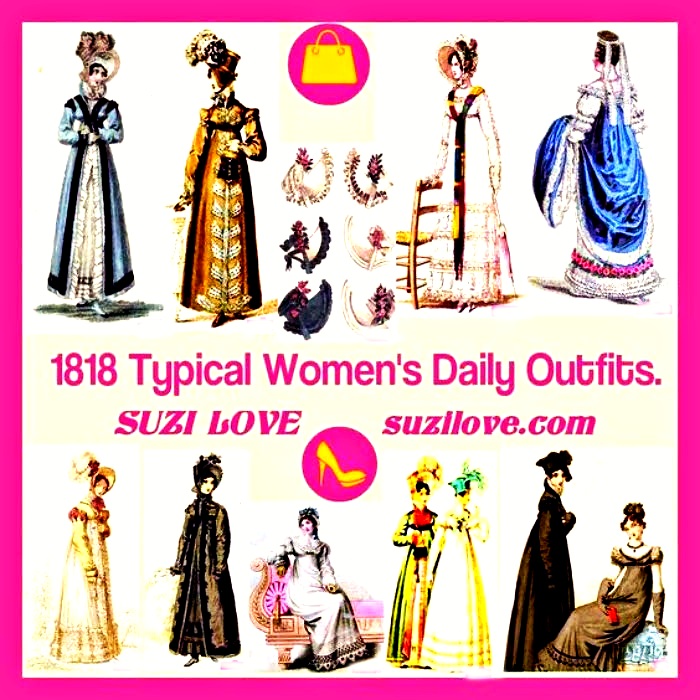
1818 Descriptions for types of ‘DRESS’ during Bridgerton’s and Jane Austen’s years. Dresses, coats or Redingotes, Spencers, shawls, fichu or shoulder cape, shoes, hats and headdresses, gloves, and Reticules or bags were displayed in various fashion magazines and copied by ladies and their modistes.
Morning Dress: Worn either at home, out shopping, or for walking in the park or country. Presentable but not overly accessorized.
Afternoon Dress: Dress made from the best fabric and beautifully decorated to see and be seen in when visiting friends, going to a museum or attending a daytime public event.
Walking Dress: Worn out shopping, walking in a city park or the country estate. Presentable and warm, more fashionable than Morning Dress but accessorized for sun protection and warmth, rather than display.
Promenade Dress: Includes gown, hat, and other accessories and more styled and fashionable than morning or walking dress. An ensemble designed to see and be seen in.
Evening Dress: Minute distinctions between ball, dinner, evening and opera gowns meant different quality of fabrics, designs, and embellishments.
Ball Dress: Gown of expensive silk fabrics, light or heavy, decorated with lace, embroidery or beading, with low-cut bodice, short or barely-there sleeves, and full skirts. Often shorter length skirt for dancing.
Mourning Dress: Mourning dress wasn’t as strict during the Regency as in Victorian era but periods of wearing black, white and grey were observed, especially for Royal deaths.
Empire Dress: Light and flowing dresses with waists just under bust worn during French Empire Period, or early 1800s.
Fashion Women 1815-1819 History Notes Book 28 What did Jane Austen wear? What was fashionable for women in Regency Era? Mourning and riding fashion, dresses, hats, shoes, reticules or bags, underclothing and fashion accessories. books2read.com/SuziLoveFashionWomen1815-1819
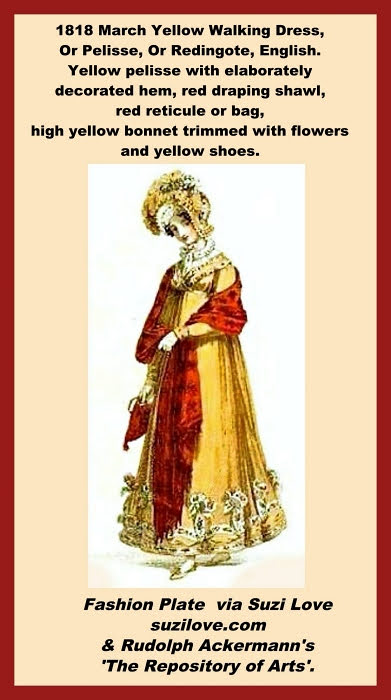
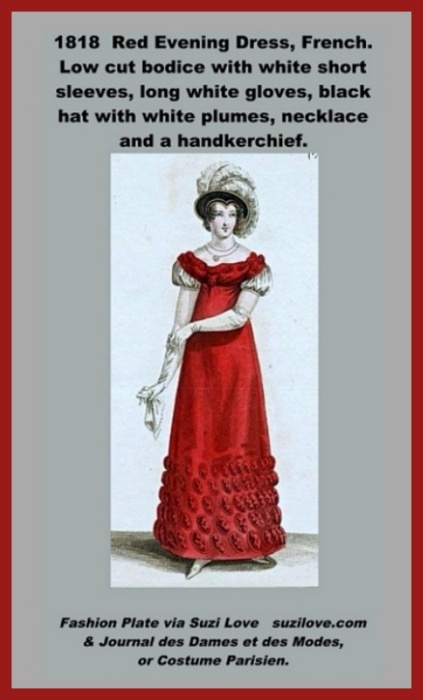
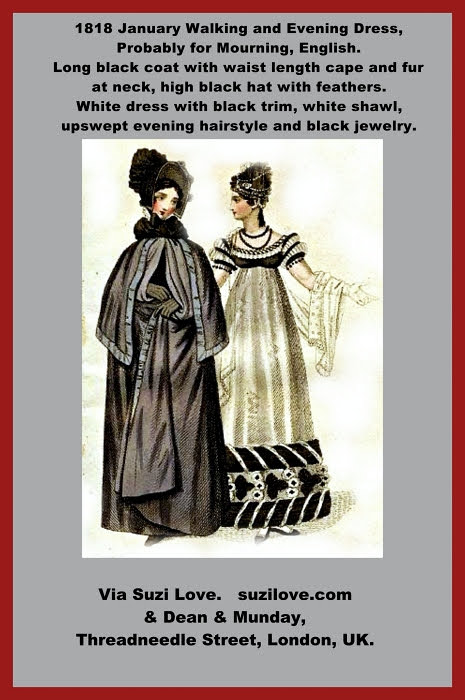
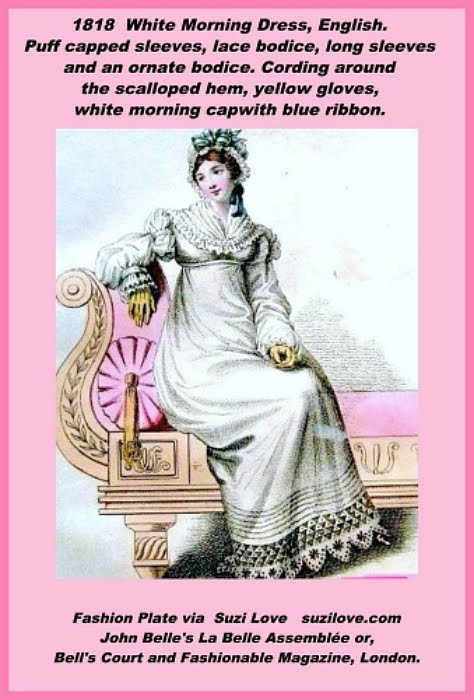
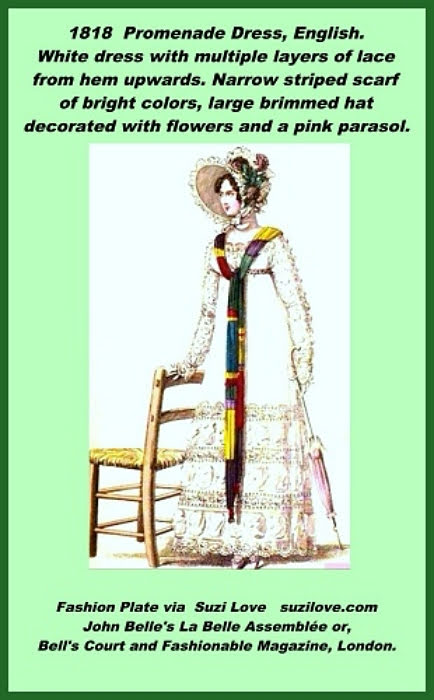
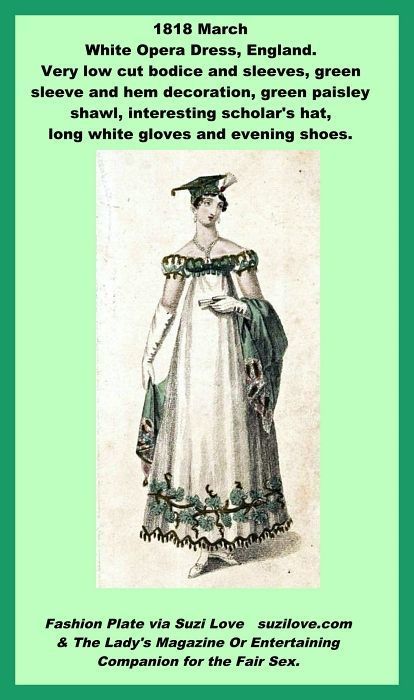
1818 March Yellow Walking Dress, Or Pelisse, Or Redingote, English. Yellow pelisse with elaborately decorated hem, red draping shawl, red reticule or bag, high yellow bonnet trimmed with flowers and yellow shoes. Fashion Plate via Rudolph Ackermann’s ‘The Repository of Arts’, London, U.K.1818 Red Evening Dress, French. Low cut bodice with white short sleeves, long white gloves, black velvet torque, or hat, with white plumes, necklace and a handkerchief. Fashion Plate via Journal des Dames et des Modes, or Costume Parisien. 1818 January Walking and Evening Dress, English. Probably for Mourning. Long black coat with waist length cape and fur at neck, high black hat with feathers. White dress with black trim, white shawl, upswept evening hairstyle and black jewelry. Via Dean & Munday, Threadneedle Street, London, UK.1818 White Morning Dress, English. Puffed capped sleeves, lace shawl like neckline, ornate bodice cording around a scalloped hem, small white hat with blue flowers, and yellow gloves. Fashion Plate via John Belle’s ‘La Belle Assemblee’, London. 1818 Promenade Dress, English. White dress with multiple layers of lace from hem upwards. Narrow striped scarf of bright colors, large brimmed hat decorated with flowers and a pink parasol. Fashion Plate via John Belle’s La Belle Assemblée or, Bell’s Court and Fashionable Magazine, London.1818 March White Opera Dress, England. Very low cut bodice and sleeves, green sleeve and hem decoration, green paisley shawl, interesting scholar’s hat, long white gloves and evening shoes. Fashion Plate via Lady’s Magazine. Fashion Women 1815-1819 History Notes Book 28 https://books2read.com/SuziLoveFashionWomen1815-1819
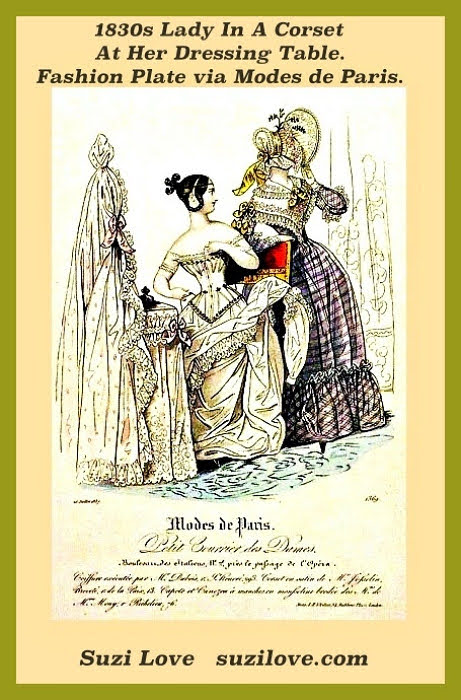
1830s Lady In A Corset At Her Dressing Table. Fashion Plate via Modes de Paris.
Romantic Era women’s corsets supported plus fitted well to give a fashionable silhouette. Becoming a fashion item, rather than simply hidden underclothing. https://books2read.com/SuziLoveCorsetBook18
Looking for a HOT Regency Era read? Love revealed at a courtesan’s ball. Brenton, Lord Mallory, attends his first courtesan’s ball in ten years to appease his concerned friends, though he’d rather stay home and read to his motherless daughters.
‘The upper rooms? Are you mad? A lady cannot go prowling around the bedrooms. There will be couples in those bedrooms having…”
Birthstones and their meanings have fascinated people far back in history.
Enjoy these few facts about them,
Suzi
As far back as 1400 BC, the Assyrians believed that rare and beautiful gemstones possessed magical properties. Some minerals were thought to possess a force or contain certain values and powers.
Tradition associates a gem with each sign of the zodiac based on a color system. Color was thought to release the power attributed to the stone.
Later, birthstones became associated with calendar months rather than the zodiac. People began selecting birthstones in colors other than the original colors.
The Roman, Arabic, Jewish, Polish, Russian and Italian lists were all different. In 1912, the American National Association of Jewelers, which later became Jewelers of America, adopted the list as we now know it.
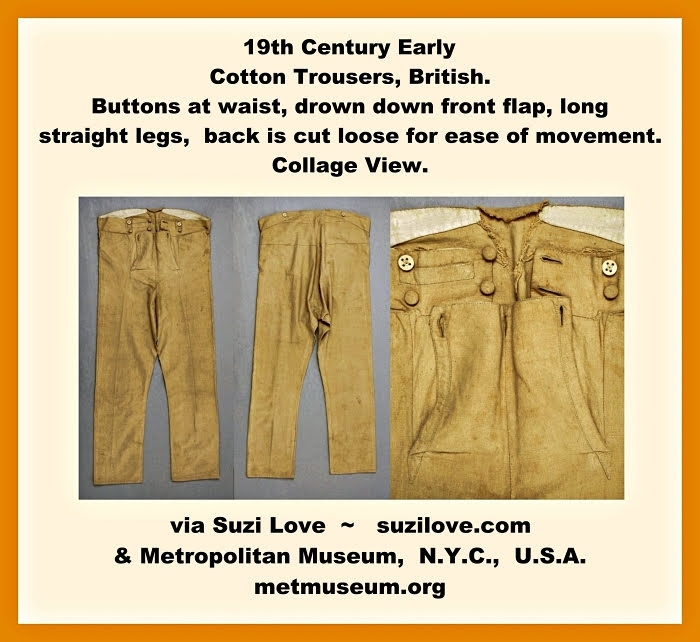
19th Century Early Cotton Trousers, British. Buttons at waist, drop down front flap with buttons and cut with excess material to allow easy movement. via Metropolitan Museum New York City, U.S.A. metmuseum.org.
Trousers: In the early 19th century, trousers were sewn with a flap in front called a fall front and was held in place by two or three buttons. Trousers were held up by tight-fitting waists which were adjusted by gusset ties in back of the waist. Seats were baggy to allow a man to rise comfortably from a sitting position.
Check out these beautiful words, and then watch for the next post on Ugly Words from Daily Writing Tips,
Indulge yourselves,
Suzi
One of the many fascinating features of our language is how often words with pleasant associations are also quite pleasing on the tongue and even to the eye, and how many words, by contrast, acoustically and visually corroborate their disagreeable nature — look no further than the heading for this post.
Enrich the poetry of your prose by applying words that provide precise connotation while also evoking emotional responses. (Note the proportion of beautiful words to ugly ones in the compilation below; it’s easier to conjure the former than the latter, though I omitted words associated with bodily functions, as well as onomatopoeic terms.)
Notice how often attractive words present themselves to define other beautiful ones, and note also how many of them are interrelated, and what kind of sensations, impressions, and emotions they have in common. Also, try enunciating beautiful words as if they were ugly, or vice versa. Are their sounds suggestive of their quality, or does their meaning wholly determine their effect on us?
Beautiful Words
Amorphous: indefinite, shapeless Beguile: deceive Caprice: impulse Cascade: steep waterfall Cashmere: fine, delicate wool Chrysalis: protective covering Cinnamon: an aromatic spice; its soft brown color Coalesce: unite, or fuse Crepuscular: dim, or twilit Crystalline: clear, or sparkling Desultory: half-hearted, meandering Diaphanous: gauzy Dulcet: sweet Ebullient: enthusiastic Effervescent: bubbly Elision: omission Enchanted: charmed Encompass: surround Enrapture: delighted Ephemeral: fleeting Epiphany: revelation Epitome: embodiment of the ideal Ethereal: celestial, unworldly, immaterial Etiquette: proper conduct Evanescent: fleeting Evocative: suggestive Exuberant: abundant, unrestrained, outsize Felicity: happiness, pleasantness Filament: thread, strand Halcyon: care-free Idyllic: contentedly pleasing Incorporeal: without form Incandescent: glowing, radiant, brilliant, zealous Ineffable: indescribable, unspeakable Inexorable: relentless Insouciance: nonchalance Iridescent: luster Languid: slow, listless Lassitude: fatigue Lilt: cheerful or buoyant song or movement Lithe: flexible, graceful Lullaby: soothing song Luminescence: dim chemical or organic light Mellifluous: smooth, sweet Mist: cloudy moisture, or similar literal or virtual obstacle Murmur: soothing sound Myriad: great number Nebulous: indistinct Opulent: ostentatious Penumbra: shade, shroud, fringe Plethora: abundance Quiescent: peaceful Quintessential: most purely representative or typical Radiant: glowing Redolent: aromatic, evocative Resonant: echoing, evocative Resplendent: shining Rhapsodic: intensely emotional Sapphire: rich, deep bluish purple Scintilla: trace Serendipitous: chance Serene: peaceful Somnolent: drowsy, sleep inducing Sonorous: loud, impressive, imposing Spherical: ball-like, globular Sublime: exalted, transcendent Succulent: juicy, tasty, rich Suffuse: flushed, full Susurration: whispering Symphony: harmonious assemblage Talisman: charm, magical device Tessellated: checkered in pattern Tranquility: peacefulness Vestige: trace Zenith: highest point
1805 White Morning Dress, French. White tunic over the dress, pink shawl with paisley patterned ends, white cap tied under her chin and slippers. Fashion Plate via Journal des Dames et des Modes, or Costume Parisien. This flowing white dress show the transition from the round dresses of the late 1700s to the Empire style dresses with the waistline high under the bust. Small trains were still worn in the early 1800s, but much more manageable than the larger and more elaborate trains of the late 1700s. Jane Austen and her friends would have worn dresses like this when at home with the family or close friends. It’s easy to picture Jane Austen wearing a dress like this while writing her manuscripts.
Definition Cashmere Shawl: Extremely fine, soft, handwoven shawl. Two-ply yarn in warp, single yarn in filling. May be embroidered, with pattern appearing on both sides, or woven in one or more colors. French shawl is woven in multicolored designs on jacquard loom with designs showing only on one side. Presumably originating in Kashmir region of India and Pakistan. These sort of cashmere shawls were a much-prized fashion accessory for all ladies who could afford them. Jane Austen and her family and friends would have been extremely fortunate to either buy one or have one gifted to them.
Definition Morning Dress: Worn either at home, out shopping, or for walking in the park or country. Presentable but not overly accessorized. Often a round gown where the bodice and skirt were made from one piece of material. Usually with a high-neck and long sleeves and made from sprigged or plain muslin, cotton, or wool.
Fashion Women 1805-1809 History Notes Book 26 What did Jane Austen and friends wear? https://books2read.com/SuziLoveFashionWomen1805-1809
Many of today’s wedding customs originate from olden day rituals.
The best man – He was chosen for being the strongest and bravest man who accompanied and protected the groom when he rode off to capture a bride.
The bride on the left side – This was so that the groom’s right hand was always free to draw his sword if they were attacked during the ceremony by jealous rivals.
The bride’s veil – These days it is only a flimsy piece of lace, but it used to be a large sheet used to wrap over the bride when she was captured and carried away by a groom. Smaller veils then became a symbol of hidden precious goods, and a symbol of complete submission to a husband.
Orange blossoms – White ones worn as a sign of virginity, but as few trees bear greater crops, orange blossoms were also worn as a prayer for the bride to bear fruit in a prolific manner like the tree.
Tying the knot – The wrists of a couple are bound together with a strip of leather or ribbon in handfasting. When their wrists were bound with an infinity knot, the couple recited their vows and the celebration commenced.