I'm an Australian author of contemporary and historical romances, plus history non-fiction.
My books range from sexy to erotic, late 1700s to the mid 1800s, and with a dash of Australia thrown into the mix. My heroes and heroines challenge tradition and my stories often expose the seamier levels of life.
I now live in a sunny part of Australia after spending many years in developing countries in the South Pacific. My greatest loves are traveling, anywhere and everywhere, meeting crazy characters, and visiting the Australian outback.
I hope my books bring history alive and you have fun adventuring with my roguish heroes and feisty heroines.
1818 December Mourning Walking Dress. Round dress of black bombazine, body tight to the shape and up to the throat but without a collar, long sleeves, with white crape weepers, skirt is finished at the bottom with a broad black crape flounce, disposed in large plaits. Over this is a very narrow flounce, which is also plaited to correspond; a little above this is a third flounce, which is quilled in the middle to correspond, and the whole is surmounted by a broad band of bias crape. The spencer worn with this dress is composed of black clothing; it is cut without a seam, and ornamented with a fullness of black crape, disposed in large plaits at the bottom of the waist: a high standing collar rounded in front, made to stand out from the neck, and edged with a light trimming of black crape: long loose sleeves, finished at the hands with black crape trimming, and surmounted by epaulettes draperied with black cord and ornamented with small tassels. Head-dress, a bonnet of black crape of a moderate size; the edge of the brim is finished with a row of large hollow plaits; the crown is trimmed to correspond. A white crape frill stands up round the throat. Gloves and shoes black shamois leather. Fashion Plate via Rudolph Ackermann’s ‘The Repository of Arts’, London, U.K.
1780 Red Wool Stays, or corset, and Panniers, British. Wool backed with linen or canvas, stitched with linen thread reinforced with strips of whalebone, lined with glazed linen, bound with linen twill tape, fastened with plain weave linen tapes and decorated with silk braid and silk ribbon. Phalanges, or fingers, spread over the hips to give support. Side panniers, or hoops, are made of cane. via Victoria and Albert Museum, London, U.K.
Back-lacing stays with a high narrow back with a wide curving decolletage and V-point in front, about 5 cm below the waistline. Decorative white lacing and white silk braids on centre front which is wide at the top and narrow at the bottom. Below the waist there are 19 tabs, or phalanges, or fingers. Laced through 13 eyelets at back. Compartments for the strips of whalebone are 4 – 5 mm wide, running vertically and diagonally. Centre busk of whalebone about 2 cm wide. Shoulder straps have an eyelet and extend from the front and fasten with tape at each shoulder back.
Stays were an essential item of underwear for women during the 18th century. By the 1780s, the fashionable torso consisted of an inverted cone shape. Achieving smoothness of profile and firmness of contour were the primary function of 18th-century stays, rather than emphasising the bust or constricting the waist. Although custom-made and very intricately designed, stays were usually very plain. On these stays a simple silk ribbon and linen tape serve as decoration and functional finishings.
The narrow rows of very fine, even hand stitching form the compartments into which thin strips of whalebone were inserted. Although the stays appear very rigid, whalebone was quite flexible. It had the added advantage of softening with the heat of the wearer’s body, allowing the stays to mold to her shape. When worn, the shaped and boned tabs at the lower edge would splay over the wearer’s hips, giving further fullness to the petticoat tied at the waist over the stays.
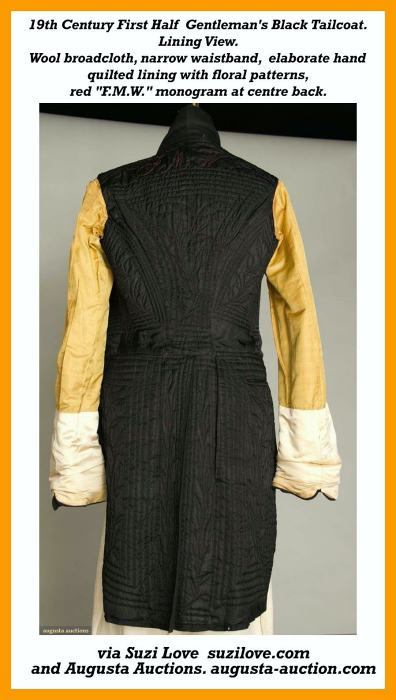
1800-1817 ca. Black Wool Suit, British. An ensemble made from black wool has been the uniform of the middle-class professional – doctor, lawyer, clergyman, academic, merchant, businessmen – since the late 16th century. This tradition continued through the 19th century and well into the 20th. The sombre color of this suit befits the sober profession of its wearer, Thomas Coutts (1735-1822), the founder of Coutts Bank. The notched collar and cut-away front of the coat reflect early-19th-century fashions. via Victoria and Albert Museum, London, UK. collections.vam.ac.uk. https://books2read.com/SuziLoveFashionMen1800-1819
This is the sort of suit that professional men in Jane Austen’s times would have worn, doctors, lawyers and clergymen. https://books2read.com/SuziLoveFashionMen1800-1819
1800s Typical Game Bird Dishes Served during the 1800s. These are the sort of dishes Jane Austen’s family would have eaten on a regular basis. Banded Partridges, Roast Partridges, Roast Surrey Fowl, Larded Guinea Fowl, Roast Plovers, Stuffed Capons, Roast Gosling and Roast Pigeons. From: 1850s- 1860s Mrs. Beeton’s Books of Household Management. via Google Books (PD-150)
1811 White Dress, French. Dress with scalloped hem, pink Redingote, green paisley shawl and white hat. Fashion Plate via Journal des Dames et des Modes, or Costume Parisien.
Definition Redingote Or Pelisse Or Walking Dress Or Coat: Long fitted outdoor coat worn over other garments for warmth. Often left open at the front to show off the dress underneath. French word developed from English words, riding coat. Jane Austen and her contemporaries wore long coats like these to keep warm when out and about, visiting, shopping etc. The thin muslin dresses worn in the early 1800s were little protection against European winters.
Kelly’s Justice. I lived in Vanuatu, South Pacific, for 9 years and loved setting my book there.
Blurb: Kelly normally needs no help solving international security problems, but when someone from her past damages her reputation and threatens her life, she needs assistance. Joining forces with her old friend from the Australian army, now an expert on South Pacific politics, they destroy an island drug cartel and rescue kidnapped teenagers. https://books2read.com/SuziLoveKellysJustice
Excerpt
Kelly and Grant went into the kidnappers compound first, as they both spoke a reasonable amount of Bislama, the local Pidgin, plus conversational French. Before independence, Vanuatu had been a condominium, shared by both Britain and France. The locals referred to it as pandemonium as both languages were spoken and street signage was in both languages and most locals spoke a variety of languages. Foreigners who didn’t speak any of languages stood out. Luckily, Kelly and Grant could competently converse with most of the people they encountered.
When Grant threw an arm across her shoulders, she stiffened, but he grinned. “Gotta look the part, sweetlips. Think we’re being watched.”
She fake smiled while she poked him in the ribs. “Yes, Pookie. Two either side of the shed. One on left armed. Can’t see weapons on others.”
Grant squeezed her shoulder. “Play tourist as long as we can. Then you take right and I’ll go left.”
“Big generator on left. Too big for normal farm.” She looked up at him adoringly and gave him another sickly-sweet smile while sliding her hand to the pistol in her holster. The loose peasant blouse she’d worn over her training singlet hid the bullet proof vest and her Glock. She turned slightly towards Grant, giving him time to slide out his own pistol and hold it behind his back.
As they took more steps towards the shed, the men standing guard in front straightened and went on alert. Kelly lifted a hand, gave a friendly smile, and said in English, “Hi, guys. Our car broke down and we wanted to use your telephone.”
Their expressions didn’t change so English wasn’t their first language. She greeted them again in Bislama, but still no reaction. Grant tried French. The men shifted on their feet, their expressions wary but, apart from the man on the far left, the men didn’t appear to have weapons. By their appearance, she guessed they were from Asia, possibly Indonesia.
Kelly made the universal sign by holding an invisible phone to her ear. “Phone,” she said.
“No phone.” He pointed down the dirt road. “You go.”
1811 January Walking Dress, or Pelisse, English. Jane Austen and her contemporaries wore long coats like these to keep warm when out and about, visiting, shopping etc. Their thin muslin dresses worn in the early 1800s were little protection against European winters.
Round high morning robe of cambric with deep full-trimmed collar. Swedish coat of velvet, trimmed with swansdown or blue fox fur. Spanish pelerine of the same, fastened in front of the throat with a mother-of-pearl brooch, clasps to correspond for the bottom of the waist. Traveller’s, or slouch, hat of velvet turned up with shell ornament, half-boots of grey cloth, laced and bound with black velvet. Chinese ridicule, or reticule, or bag, of grey satin, embellished with black medallions and tassels. Gold chain and eye-glass, or quizzing glass.. Fashion Plate via Rudolph Ackermann’s ‘The Repository’ of Arts.
Definition Redingote Or Coat Or Pelisse Or Walking Dress: Long fitted outdoor coat worn over other garments for warmth. French word developed from English words, riding coat. French fashion plates call these coats a Redingote and English plates call them a Pelisse, Or Walking Dress, or Carriage Costume. For more of these, try my book on Pelisses, History Notes Book 5 . books2read.com/suzilovePelisse
Definition Swansdown: Fine down of a swan, used for trimmings on clothing and for making powder puffs.
Definition Velvet or Velour: Silk with short, dense and smooth pile produced by pile warp raised in loops above ground weave through introduction of rods during the weaving.
Definition Ridicule, Reticule, Indispensable, or Handbag: From the late 1700s, pockets could no longer be sewn into gowns nor could separate pockets be tied around their waists and accessed by slits in the gown and petticoats, as skirts fell from just under the bust and were full and flowing. Instead, women began carrying small bags, known at first as ridicules and later as reticules, to keep necessary items on their person e.g. handkerchiefs, coins, vinaigrettes, calling cards, glasses etc. For more on reticules, try my History Notes book 3 http://books2read.com/suziloveReticules
1812 June Green Riding Dress, English. Fashion Plate via Rudolph Ackermann’s ‘The Repository of Arts’. This riding habit was probably made in two pieces. It has a vertical front decoration and is embroidered with black at the cuffs à la militaire. The small riding hat from black beaver is adorned with gold cordon and tassels and with a long ostrich feather of green in the front, or a green hat with black tassels and black feather. Black half boots, laced and fringed with green, York tan gloves, and riding crop. When this dress is worn as a carriage or walking costume, it is made as a pelisse without the riding jacket, and confined round the waist by a fancy belt of black and green. This habit was made by Mr. S. Clark, 37 Golden Square.” Riding habits and accessories were generally the only ladies’ clothing made by tailors rather than dressmakers.
18th – 19th Century Seals For Letters and Posting. Used to seal hand written letters in the 18th and 19th centuries.
Definition: Wax Seals: Pressed onto a letter or envelope to show that a document is unopened or to verify the sender’s identity. A signet ring or was seal is pressed into a dollop of hot wax to seal a letter or envelope closed.
1806 April Two Ladies In Full Dress, English. Loose pink robe of undressed crepe over a dress of white satin, or sarsnet, embroidered with silver, sleeves plain and embroidered to correspond with dress. Round dress of fine muslin over white sarsnet. Broad lace let in down front and bottom. Bosom plain, trimmed with quilling of lace, ornamented with medallion or brooch. Long silk shawl, ends embroidered in colors. Tiara of silver or steel, adorned with gems. Fashion Plate via Fashions of London and Paris, Published By Richard Phillips, St. Paul’s Church Yard, London, UK.
Dress Full Dress: The most formal and complete ensemble, worn for day or night events, and includes the fullest range of accessories that could be added to the outfit to make the most impressive display.
Fabric Sarsnet: Also spelled ‘sarcenet’, is a lightweight silk that was often woven with small-scale decorative designs.