19th Century Set of Damascened Calligrapher’s Tools, Turkey. via Sotheby’s Auctions. sothebys.com
books2read.com/SuziLoveWritingTools




I'm an Australian author of contemporary and historical romances, plus history non-fiction. My books range from sexy to erotic, late 1700s to the mid 1800s, and with a dash of Australia thrown into the mix. My heroes and heroines challenge tradition and my stories often expose the seamier levels of life. I now live in a sunny part of Australia after spending many years in developing countries in the South Pacific. My greatest loves are traveling, anywhere and everywhere, meeting crazy characters, and visiting the Australian outback. I hope my books bring history alive and you have fun adventuring with my roguish heroes and feisty heroines.
19th Century Set of Damascened Calligrapher’s Tools, Turkey. via Sotheby’s Auctions. sothebys.com
books2read.com/SuziLoveWritingTools
1814 Long Dark Green Coat, Or Redingote, French. Horizontal front pockets, high white cravat, black top hat and high black boots. Fashion Plate via Journal des Dames et des Modes, or Costume Parisien.
Definition Redingote Or Coat: French word developed from English words, riding coat. Long fitted outdoor coat worn over other garments for warmth. Originally made with several capes and trimmed with large buttons. For women, the coat was often cut away in the front or left open to show off the dress underneath. French fashion plates call these coats Redingotes and they were worn by men, women, and children. English fashion plates call the coats a Pelisse, a walking dress, Promenade dress, or Carriage dress.


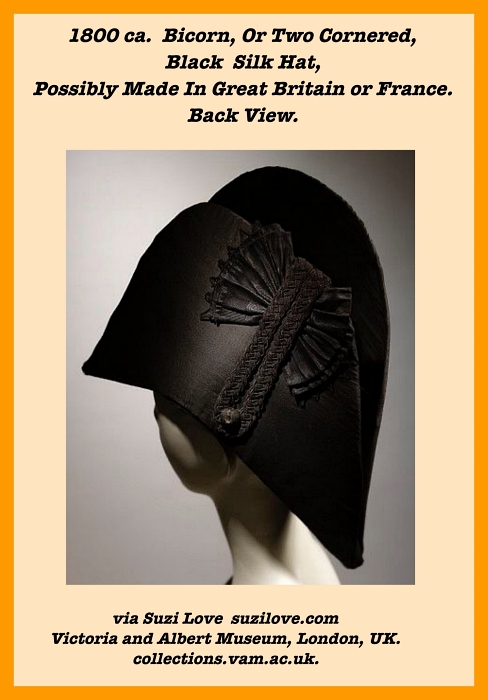
1800 ca. Bicorn, Or Two Cornered, Black Silk Hat, Possibly Made In Great Britain or France. via Victoria and Albert Museum, London, UK. collections.vam.ac.uk. The type of hats worn by the men in Jane Austen’s family around the turn of the century.
Definition: Bicorn Or Bicorne: Two cornered, or pointed, hats often worn by military men because the rain would drain off either side of the hat and away from the body. They could also be easily flattened to carry under arm.

Looking for a new holiday read? The Duke of Sherwyn to Lady Rebecca Jamison. “Did you just say you’ve been shot? Before tonight.” #HolidayRomance #HistoricalRomance #mystery https://books2read.com/suziloveES
Continue reading →Looking For A Fun Historical Romance? Lady Laura Jamison to the earl: “For the sake of propriety, I was ensuring your garments were intact.” #HistoricalMystery #VictorianRomance #RomCom https://books2read.com/suziloveSS
Continue reading →After the French Revolution, the fussy styles previously affordable only by the very wealthy were replaced with ideas of simplicity in dress, behavior, and decorating. The neoclassic style was adopted and carried through the Napoleonic War years, partly because of Napoleon Bonaparte’s love of anything Greco-Roman. The Empire silhouette copied the chiton worn by the Greeks and Romans. The chiton was a tubular garment draped from the shoulders and sometimes belted beneath the bust and this style of garment was completely different to the rectangular panniered skirts of the 18th century.
1802 Mother and Child, French. Mother wears a long green cape over a loose and flowing white dress. The child wears a similarly flowing pink dress. Both wear fitted hats. Fashion Plate via Journal des Modes et des Dames, or Costume Parisienne. suzilove.com
The Empire style of clothing began as children’s wear made from fine white cotton. Women adopted the same fabrics in England and turned them into light and airy tubular dressed with skirts gathered under the bust and often with more fullness at the back to allow women to walk and move freely.
1807 Empire style, or high-waisted, white walking dress, French. Worn with a red draping shawl and long white gloves. Fashion Plate via Journal des Modes et des Dames, or Costume Parisienne. suzilove.com
Empire style dresses were high waisted and were worn almost exclusively by women from 1800 until around 1820.
In the 1820’s, waists began to drop from under the bust and skirts went from tubular to bell shaped by flattening the front and adding fullness at the centre back.
By the 1830s, waists were almost back down to their natural waistline and they stayed at a woman’s natural waist as skirts widened even more until they became the conical hoop skirts of the later 19th century.
During the Empire years in France, fine Indian muslin was manufactured and embroidered in India and then exported to Europe and America. French women wore the finest and most sheer cottons and dresses became more an more daring as bodices were cut lower and lower and gowns became transparent.
1805-1815 ca. Three Women’s Empire Style Dresses. landeskunde-online.de suzilove.com
Naturally, English women copied this French trend. Some supposedly ‘damped down’ the skirts of their gowns with water to make them even more see through, and therefor even more enticing to the gentlemen. As the Prince Regent, George IV, was a known connoisseur of women, the boldest of ladies wanted to catch his eye, and perhaps become of one of his mistresses.
1805-1810 ca. Lemon Dress, Regency style, Light and Floaty Dress. via Manchester Galleries manchestergalleries.org suzilove.com
This trend to sheer fabrics, which would have been freezing in winter in England or Europe, also led to the creation of other fashion items that women needed to stay warm.
Long draping shawls were worn over these sheer Empire style gowns, as were Spencers and Pelisses, or Redingotes. Tunics were often added to give gowns an appearance of decency, especially from the back.
1809 Women’s Fashions: Dresses, Shawls, Hats and Jewelry from various fashion magazines. Typical of the outfits worn by Jane Austen and her contemporaries for daytime and evening activities. An Empire style, or high-waisted white cotton dress worn under a Spencer or short jacket, a Redingote, or coat, for warmth and with pretty hats, shawls and shoes.


1810 Cotton And Silk Dress With An Embroidered Hem, American. #Regency #Fashion
1810 Dress, American. Cotton and silk Empire style, high-waisted, dress. Short puffed sleeves and with a two layer frilled and embroidered hem.
This dress shows the typical Empire silhouette of a tubular garment draped from the shoulders and sometimes belted, or tied with a ribbon, beneath the bust.
The Empire period fell between the 18th Century and the rectangular shaped panniered skirts and the 19th Century and conical hoop skirts.
From the Metropolitan Museum: “The neoclassic style was adopted in all forms of decoration after the French Revolution and was upheld during the Napoleonic Wars partly due to Napoleon Bonaparte’s (1769-1821) alliance with Greco-Roman principles.
In fashion, the style began as children’s wear made from fine white cotton, but was adopted by women in the form of a tubular dress with skirts that were gathered under the bust with some fullness over a pad at the back.
As the style progressed the skirts began to flatten at the front and solely gather from the bodice at the center back. The style persisted until the 1820s when the waist slowly lowered and the skirts became more bell shaped.”

1810 Dress, American. Cotton and silk with a two layer frilled and embroidered hem. Hem Fabric View. via Metropolitan Museum New York City, U.S.A. metmuseum.org suzilove.com

1800 White Muslin Dress, European. Empire style, high-waisted dress of light weight cotton, with softly falling gathered long skirt and with a train. via Los Angeles County Museum of Art, California, USA. collections.lacma.org
The type of dress worn across Europe in the early 1800s. This sort of high-waisted dress would have been worn by Jane Austen and her contemporaries in England. The Empire waist gown defined women’s fashion during the Regency Era. ‘Empire’ is the name given in France to the period when Napoleon built his French Empire. High-waisted, loose gowns were adopted by the aristocracy as a symbol of turning away from the fussy, elaborate and expensive clothing worn in the 1700s.


The first wedding rings can be traced back to the Ancient Egyptians when they exchanged rings made from braided reeds and hemp. The tradition of exchanging rings dates back 3,000 years. The first diamond wedding ring was recorded in the will of a widow who died in 1417. The ancient Egyptians believed in the vena amoris, literally the “vein of love” that runs directly from the heart to the fourth finger on the left hand. For the Ancient Greeks, the engagement ring was symbolized with a plain gold band worn on the left hand and at the marriage the same band was shifted to the right hand.
An engagement ring is given at a proposal or when a couple decides to get married whereas a wedding ring is exchanged at the wedding ceremony and represents the official bond of marriage and the binding pledge between spouses. Wedding rings symbolise eternal love and commitment within a relationship and are worn to show the world they are married. During the wedding service, the couple will say their vows to each other while exchanging rings.
Is a wedding ring biblical? : The use of wedding ring is not commanded in the Bible, and there is no indication that it was ever practised in the New Testament. The use of finger ring in the Bible was as a symbol of authority.
Betrothal ring: An old Roman custom confirming that the marriage contract would be carried out. It was the first part of a dowry given, and meant the woman was no longer for sale as the first part of the monetary settlement had been paid. The first betrothal, or engagement, rings were given because there was often a long time between betrothals and weddings. These were usually simple bands of gold, silver, or iron as on royalty or very wealthy people could afford gemstones and diamonds. In 1477, Archduke Maximillian of Austria commissioned the very first diamond engagement ring for his betrothed, Mary of Burgundy, and many of the European aristocracy and nobility followed his lead.
Wedding ring: Many primitive peoples who believed in magic used a rope around the waist or the hand and feet, and later a ring, to symbolise that the bride was captured and spoken for, and also to ward off any evil spirits hovering around the bride and ensure marital bliss.
The ring hand: A symbol of the humiliating tradition of the man as the master – the right hand of the family – and the woman being the slave . The right hand stood for power and authority while the left hand expressed submission and serfdom.
The ring finger : Ancient Greek and Roman anatomists believed a vein, the vena amoris or the “vein of love”, or a nerve led from the heart to the third finger, the healing finger , so they romantically linked this finger to the heart. Now we know that this is not true and there is no vein that runs from our ring fingers to our hearts. There are also some more practical reasons the third finger continues to be used. It’s the most prominent for displaying a ring and it cannot be extended to its full length on its own and usually remains slightly bent, preventing the ring slipping off.
The Wedding Ring: Also goes on the left ring finger because it is the only finger with a vein that connects to the heart although some countries, such as India, Germany, Spain, Norway, and Russia traditionally wear their wedding rings on their right hand.
Viking Wedding Rings: These were mostly made of silver and bronze and rarely of gold with the designs inspired by Norse Gods, geometric shapes, runes, and animal totems
Gimmel Rings: In the 16th and 17th centuries, European husbands gave their bride a gimmel ring with two interlocking bands. The bride and groom both wore one after their engagement and during the wedding ceremony the rings were joined and the wife wore the ring.
World Wars: During the first World War, many men on the front began wearing wedding rings as a remembrance of their wives and families at home. That custom carried through to World War Two so in the 1950s wedding rings for men became common practice.
Tri-Gold Rings: Gold is the traditional ring metal but some people prefer a mix of colors. Yellow gold represents fidelity, rose gold romantic love, and white gold friendship, so a tri-gold ring symbolizes your shared past, present, and future path. ding ring to symbolize all three, as well as your shared past, present, and future path.
Black Wedding Rings: Some couples choose black wedding bands because they represent everlasting commitment and the color can also mean power, strength and sophistication.
Anniversary or Push Ring: Given on the birth of a first child or an anniversary, usually an important one such as the first, five-year or 10-year anniversary.
Wedding ring customs that originated in long ago history. #weddings #Customs #history Share on X