I'm an Australian author of contemporary and historical romances, plus history non-fiction.
My books range from sexy to erotic, late 1700s to the mid 1800s, and with a dash of Australia thrown into the mix. My heroes and heroines challenge tradition and my stories often expose the seamier levels of life.
I now live in a sunny part of Australia after spending many years in developing countries in the South Pacific. My greatest loves are traveling, anywhere and everywhere, meeting crazy characters, and visiting the Australian outback.
I hope my books bring history alive and you have fun adventuring with my roguish heroes and feisty heroines.
1809 June Evening Full Dress, English. Lemon dress with white underskirt, short sleeves, braid decorated bodice, zig-zag hem, long white gloves, plumed headdress, full Parure of necklace, bracelet and earrings, evening slippers and a fan. Fashion Plate via John Belle’s La Belle Assemblée or, Bell’s Court and Fashionable Magazine, London.
Definition Full Evening Dress – Ball, dinner, evening and opera gowns but with every possible accessory added to make the most impressive display possible, such as adding a Grand Parure, or full jewelry set and including headpieces as with the feathered headdress above.
Fashion Women 1805-1809 History Notes Book 26 What did Jane Austen and friends wear? https://books2read.com/SuziLoveFashionWomen1805-1809
1810-1815 ca. Salmon Taffeta dress with ruched fabric at shoulders gathers at wrists and on bodice. The type of dress worn across Europe in the early 1800s. This sort of high-waisted dress would have been worn by Jane Austen and her contemporaries in England. via Gemeentemuseum Den Haag, Amsterdam.
The Empire waist gown defined women’s fashion during the Regency Era. ‘Empire’ is the name given in France to the period when Napoleon built his French Empire. High-waisted, loose gowns were adopted by the aristocracy as a symbol of turning away from the fussy, elaborate and expensive clothing worn in the 1700s. Jean-Jaques Rousseau advocated copying peasants and returning to a simpler life and more natural fashions. Unrestricting clothing was part of the new Democracy in France and these simpler and flowing fashions were adopted all over Europe, including Britain and despite the continual wars being fought against France during the early 1800s. Not even war stopped fashions from being copied everywhere.
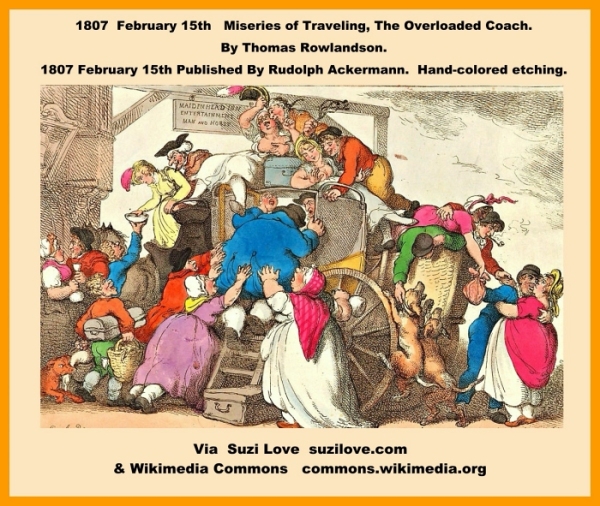
1807 February 15th ‘Miseries of Travelling’ in Jane Austen’s times. The Overloaded Coach Series By Thomas Rowlandson. Publisher Rudolph Ackermann, London (active 1794–1829). Hand colored etching.
1790-1810 ca. Jane Austen Style White Linen Shift Or Chemise, American. #RegencyEra #JaneAusten #underclothing https://books2read.com/SuziLoveFashionWomen1801-1804
1800s Early Tattersall’s Horse Auctions, London, U.K.. Top sporting venue for Regency Life in London. ‘A mixture of persons of nearly all ranks’. By Pierce Egan. Via Wikimedia Commons (PD-ART)
In Jane Austen’s and Bridgerton times, or the Regency Era, horse riding was a vital mode of transport and Tattersall’s was the best place to buy and sell horses. Tattersall’s was established in 1773 near Hyde Park Corner for the sale by auction of horses, carriages, hounds and harnesses. Sales during the winter months were every Monday and Thursday, and on Mondays only during the spring and summer. On the mornings when there was no sale, Tattersall’s was a meeting place for fashionable sporting gentlemen.
Pierce Egan’s Description of Tattersall’s
A masquerade could scarcely exhibit more motley groups than the attendants of this place of fashionable resort. There were Peers, Baronets, Members of Parliament, Turf gentlemen and Turf-servants, Jockies, Grooms, Horse-dealers, Gamblers, &c. There you might see the oldest and some of the best blood in England, disguised like coachmen.
From: 1820 Sporting Anecdotes by Pierce Egan via Google Books (PD-150)
Lover of Jane Austen and the Regency Era fashions? History Notes Book 25. #JaneAusten #RegencyFashion #HistoricalFashion books2read.com/SuziLoveFashionWomen1801-1804
1826 Cartoon: A squeeze at Carlton Palace in Bridgerton and Jane Austen times. From Regency Social Life. #JaneAusten #Bridgerton #Cartoon #England https://books2read.com/suziloveYGD
1800-1870 ca. Stocking Purses, British. Beaded stocking purses crocheted in silk and steel beads, with steel rings with tassels and fringes. via Victoria and Albert Museum, London, UK. collections.vam.ac.uk.
Definition Miser or Long or Stocking or Ring Purses: Long, narrow, tubular shape, often wider at ends and narrow in middle, which had a short slit opening. Popular in England and France from the mid-18th century through the early 20th century.
From the Curator Victoria and Albert Museum, London: Stocking purses are also known as misers’ or wallet purses. The majority were netted, but some were knitted or crocheted, like this one. Once worked, the elongated tube was put on an expandable purse stretcher to shape it. It was then sewn up, leaving a central opening, and squeezed through a pair of rings known as sliders, which were used to secure and separate the different coins stored at either end. It could be carried in the hand, bag or pocket, or tucked over a belt. Many stocking purses were made as presents, and were thought a suitable object to give to a gentleman. Crochet is a type of needlework with an open, lacy appearance, which is formed with a hook and single length of thread making a series of loops, chains and knots. The technique developed out of ‘tambouring’, a type of embroidery, after the tambour hook began to be used to create series of loops, free from a ground fabric. This could then be used as a separate trimming, like lace, or made to form items like this purse. Crochet was thus added to the varieties of fancy needlework available to ladies, and instructions for making it can be found in manuals from the 1820s onwards.
1800-1870 ca. Beaded Stocking Purses, British #RegencyFashion #RomanticEra #HistoricFashion books2read.com/suziloveReticules
1562-1575 ca. Wine Cooler With a Pageant Battle with Elephants, Italian. Maiolica, or tin-glazed earthenware, from the workshop of the Fontana family. 1553-1580. Coolers were set near the table on a credenza or sideboard, visible to diners and within easy reach of servants. They are designed to be viewed from any side, but especially from above when empty. When not in use, coolers remained in place to convey the owner’s refined taste and, due to the relatively inexpensive medium, personal modesty. via Metropolitan Museum New York City, U.S.A. metmuseum.org
1816 August. Morning Dress in Bridgerton or Jane Austen style, English. White high-waisted dress worn with a blue striped spencer, blue boots, and a white hat white blue trim. Fashion Plate via Lady’s Magazine.
Description Spencer: Short jackets worn for warmth over the high-waisted Empire style gowns that were popular after the French Revolution, where there was a shift away from opulence and decadence to simpler fashion. This jacket with very short bodice and long sleeves was known as a Spencer and was named after the male coat made famous by the Earl Spencer and said to have originated in accident to Lord Spencer in hunting when coat tails torn off and a cropped jacket was invented. The dresses in the early 1800s therefore became looser, lighter, and flowing and women became cold due to their very low cut and short bodices. Short fitted jackets that went easily over the dresses and provided extra modesty and some warmth. As Europe and many other parts of the world were deep in wars in the late 1700s and early 1800s, men in uniform were found everywhere. In support of these military men, fashions leaned towards military style shoulder paddings, shoulder embellishments, loops, buttons, and braids.
Fashion Women 1815-1819 History Notes Book 28 What did Jane Austen wear? . D2D_HN_28_https://books2read.com/SuziLoveFashionWomen1815-1819