19th Century Mother Of Pearl Carnet De Bal Or Dance Card, French. via Ruby Lane Antiques.



19th Century Mother Of Pearl Carnet De Bal Or Dance Card, French. via Ruby Lane Antiques.
1863 Traveler’s Chest, French. Sewing Tools, Ruby Perfume, Aide de Memoire or Notebook, etc. Inside lid with theatre curtains. via Ruby Lane Antiques. rubylane.com


1817 April Ladies’ Voucher for all the Wednesday balls at Almack’s Assembly Rooms, London, U.K. in April 1817. The voucher is for the Marchioness of Buckingham to attend the balls at Almack’s “on the Wednesdays in April 1817.” There are initials in the lower right hand corner marked, “MD”. These initials might be for Mary Marchioness of Downshire who may briefly have been a patroness ca. 1816-1817. The red wax seal is also intact on the front. “Pall Mall” is written on the back of the card.Via Huntington Museum, California, U.S.A. https://hdl.huntington.org/digital/collection/p15150coll7/id/10672/
Subscribers to Almack’s were allowed to bring a guest to a Ball, if they were approved first. They called at the Rooms in person and were either granted a Strangers Ticket of admission or were banned. Rooms were open for supper, gaming dancing lasting the night. At eleven o’clock, doors were closed and no one, not even celebrities were admitted. Once a young lady making her debut during the London Season had been granted a ticket to Almack’s, her social standing was assured. The Patronesses introduced the debutante to people of importance and selected her dance partners.


1808 Lady In A High-Waisted White Dress Reading A Book Outdoors, French. Dress has short puffed sleeves and is worn under a frilled Pelerine, or shoulder cape, long tan gloves, walking shoes and a white country style hat with a blue bow. The lady is leaning on a post and reading a book. Fashion Plate via Journal des Dames et des Modes, Costume Parisien.
Empire Style Dress: Named after the First Empire in France. Empire dresses had a low neckline and skirts started directly under the bust and flowed into the classical relaxed wide styles of Greece and Rome. This style of dress is associated with Jane Austen and her contemporaries as a high-waisted dress was worn most days. Cotton, silk or taffeta were the popular fabrics.
Definition Pelerine: Tippet or shoulder cape, usually waist-length, with long, pointed ends in front. Popular in England and colonial America.


Fan of Regency London in the times of Jane Austen and Bridgertons? Regency Overview Book 1 Regency Life Series #JaneAusten #RegencyEra #Bridgerton #Nonfiction #amwriting https://books2read.com/ROver
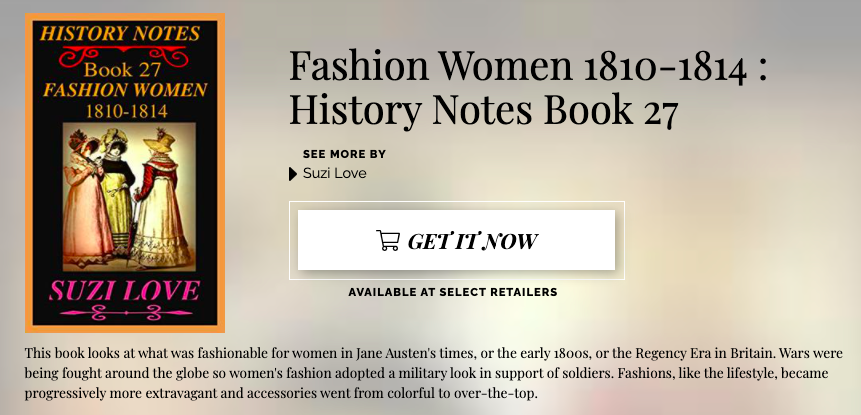
Continue reading →Are you a reader or writer of Regency Romance? Love Jane Austen’s books? Want to know more about the mourning, riding, underclothing and other Regency Era women’s fashions in Regency romances? What was fashionable for women in Jane Austen’s times? Mourning, riding, daytime, evening clothing, plus underclothing, corsets and accessories. This book looks at what was fashionable for women in Jane Austen’s times, or the early 1800s, or the Regency Era in Britain. Wars were being fought around the globe so women’s fashion adopted a military look in support of soldiers. Fashions, like the lifestyle, became progressively more extravagant and accessories went from colorful to over-the-top. https://books2read.com/SuziLoveFashion1810-1814

1801 November 9th Playing Cards. Men and women play cards at round table. Supreme Bon Ton Plate 2. Published by S W Fores. Men and women play cards at round table. Man and woman talk to players. Woman sleeps in upright chair, two others, one with parasol and other fan, walk off arm-in-arm.Men: High-waisted coats, high collars, huge neck-cloths, with pumps or Hessian boots. Women: High-waisted dresses, short sleeves, long trains, very low necklines, short ringlets, two in caps. Via British Museum, London, UK. britishmuseum.org (PD-Art)
In Jane Austen’s times, cartoons posted in the windows of shops were one of the main ways people found news. Common people couldn’t afford newspapers so cartoonists ridiculed the people and the places with cartoons of the daily events happening in London and other cities. The ridiculous fashion trends of the late 1700s and early 1800s were easy targets for satirical cartoons as was the addiction to gambling by women and men alike.


1818 September 18th Le Palais Royal de Paris. ‘A Peep at the French Monstrosities’. Two English tourists dressed as dandies walk arm-in-arm under the arcade of the Palais Royal, interested in the promenading courtesans. Their dress is rather similar to that of the Englishmen, but the latter wear bell-shaped top-hats, while the Frenchmen have flower-pot shaped hats. By George Cruikshank. Via British Museum, London, UK. britishmuseum.org (PD-Art)


Easy to read overview of what an older lady did, wore, and how she lived in Jane Austen and Bridgerton’s time. Information for history buffs and pictures for readers and writers of historical fiction. Older Lady’s Day Regency Life Series Book 5 by Suzi Love books2read.com/suziloveOLD

1819 Gardens of the Tuileries Near the Rue de Rivoli, Paris, France. Woman in a red walking dress, or Redingote, or Pelisse, modeled after British riding dresses and worn with a high white bonnet with feathers, or plumes. The skirt remains fairly narrow and the waist is fairly low, indicating the transition into 1820 styles. In the background are women walking with children. From Illustrations by François Courboin from Octave Uzanne’s Les Modes de Paris.
Variations du goût et de l’esthétique de la femme, 1797-1897, L. Henry May, Paris, 1898, or from the English translation of the same work: Fashion in Paris : the various phases of feminine taste and aesthetics from 1797 to 1897, William Heinemann, London, 1898.

