Chatelaines and Chains History Notes Book 9 By Suzi Love. What do you know about Chatelaines and Chains worn in Jane Austen’s and Bridgerton times? Women in charge of households carried important items with them. History Notes Book 9 Chatelaines and Chains. books2read.com/SuziLoveChatelaines
Personal Necessities, keys, or chatelaines was a set of useful items hung from waist by decorative chain. Chatelaines and Chains. History Notes Book 9 By Suzi Love. Women in charge of households dangled long chains from their waists to keep essentials within easy reach e.g. keys, notebook and pen, watch, sewing items, vinaigrette or perfume, or magnifying glass. Early chatelaine were simple essentials. Later chatelaine were decorative and expensive. http://books2read.com/SuziLoveChatelaines
Definition Chatelaine: The word Chatelaine is French and means the keeper of the keys. Chatelaine” derives from the Latin word for castle. In Medieval times, the chatelaine was in charge of the day-to-day running of the castle. Women in charge of households dangled long chains from their waists to keep essentials within easy reach e.g. keys, notebook and pen, watch, sewing items, vinaigrette or perfume, or magnifying glass. Early chatelaine were simple essentials. Later chatelaine were decorative and expensive.books2read.com/SuziLoveChatelaines
What did a chatelaine do? Most important task was keeper of the keys. Also ordered supplies, did bookkeeping, supervised servants, taught castle children, and organized guests.
1790-1820 ca. Fichus, Or Shoulder Shawls. Short and Long. Embroidered Cream Net Fichus as worn by ladies in the times of Jane Austen. via Whitaker Auction whitakerauction.smugmug.com
Definition Fichu: Triangular piece of lace, muslin, or other cloth worn about the neck and cleavage to fill in a low bodice or neckline and preserve a lady’s modesty. From the French ‘thrown over’. The Bridgerton family and Jane Austen and her female family and friends would have worn a Fichu over a light muslin dress for both warmth and modesty.
18th Century Late – 19th Century Early Gloves as worn by women in Jane Austen’s and Bridgerton’s years, French. Silk embroidered with silk. via Museum of Fine Arts, Boston. mfa.org
What shoes did the Bridgertons and Jane Austen wear? Gray Slippers, American, with long ankle ties.
Typical Regency Era women’s footwear as worn by Jane Austen and her contemporaries and by the Bridgerton family were shoes that had low heels, slightly rounded toes, embellished with a bow and with ribbon ties for the ankles. Shoe styles and shapes were generally very plain but then shoes began to be made in bright colors to match the colorful Empire style, or high-waisted, gowns. Plus, as gowns were lighter and floatier, glimpses could be had of these new pretty shoes. Ribbons, rosettes and other decorative. embellishments allowed ladies to personalize shoes.
shoes_19th Century Early. Flat Slippers, American. Gray silk with long ankle ties. via Metropolitan Museum New York City, U.S.A.shoes_19th Century Early. Flat Slippers, American. Gray silk with long ankle ties. via Metropolitan Museum New York City, U.S.A.shoes_19th Century Early. Flat Slippers, American. Gray silk with long ankle ties. via Metropolitan Museum New York City, U.S.A.HN_25_D2D_fashwomen1801-1804 https://books2read.com/SuziLoveFashionWomen1801-1804
1813 April Carriage Dress, English. Green coat over white Empire style dress of jaconet or cambric muslin, plaited bodice, long sleeve, deep frill, with a vandyke of needle-work. Russian mantle is made of Pomona or spring green sasnet, lined with white satin, trimmed with a rich frog fringe and closed with a cord or tassel. Close-fitting cottage slouch bonnet of the same material and edged with scalloped lace, tied on the left under the chin with ribbon, and decorated with a small cluster of spring flowers. Reticule, or bag, of the sam fabric, slippers of green kid, and gloves of primrose kid. Fashion Plate via Rudolph Ackermann’s ‘The Repository of Arts’.
The Assembly Rooms in Bath, UK. One of my favorite places to visit.
Bath had two assembly rooms in the lower part of the town but they weren’t large enough for the rapidly increasing population so on the 30th September, 1771, New Rooms were opened on the north east of the Circus, between Bennett and Alfred Streets. These Upper Rooms were designed by the architect, John Wood, and were in a better part of town so they became much more fashionable. They were called the New, or Upper Rooms, to distinguish them from the older Assembly Rooms in the lower part of the town.
They were a set of public rooms purpose-built for the 18th century form of entertainment called an ‘assembly‘, where a large number of people came together to dance, drink tea, play cards, listen to music, or parade around the rooms and talk and flirt. The four rooms are the Ball Room, the Tea Room or Concert Room, the Octagon Room, and a Card Room. The Upper Rooms held two balls a week, a dress ball on Monday evenings and a fancy ball on Thursdays during the Bath season which was from October to early June. These balls were so popular they attracted between 800 and 1,200 guests at a time.
John Wood raised the money for the New Rooms by a “tontine” subscription, which was like a lottery. By April 1769, £14,000 was raised amongst 53 people. When a subscriber died, their shares were added to the holdings of the other subscribers, which meant that the last surviving subscriber inherited everything.
The exterior of the Upper Assembly Room looks typically Georgian, but the interior is very grand and the high ceilings gave good ventilation on crowded ball nights and windows set at a high level prevented outsiders from looking in. Two long rectangular rooms flank the entrance hall and are linked by an octagonal room at the far end to form a U-shape.
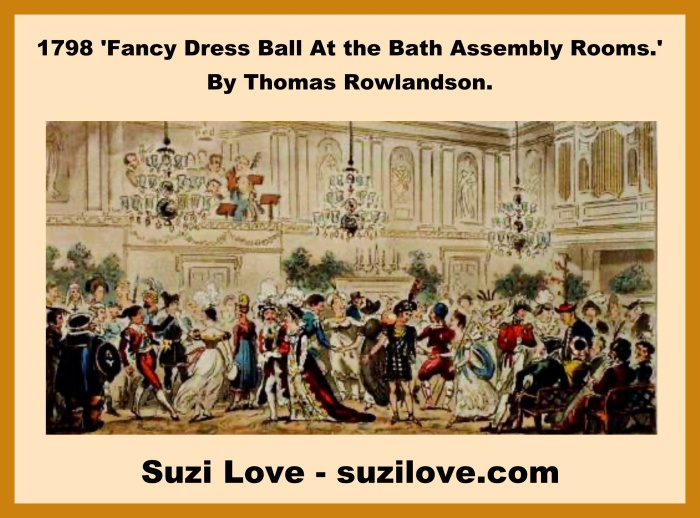
1798 Fancy Dress Ball at the Bath Assembly Rooms.’
By Thomas Rowlandson.Interior of Assembly Rooms, Bath.Entrance to Assembly Rooms,
Now Fashion Museum.
Bath, U.K.Entrance to Assembly Rooms,
Now Fashion Museum.
Bath, U.K.1805 Interior of Concert Room, Bath. By John Claude Nattes
‘Bath Illustrated by a Series of Views.’
Via Suzi Love – suzilove.com
& Wikimedia Commons commons.wikimedia.org1799 Richard Nash Esq. Master of Ceremonies, Assembly Rooms, Bath From- 1799 The New Bath Guide Printed by R. Cruttwell.1771 The New Assembly Rooms Opened,
Between Bennet and Alfred streets,
Bath, U.K.
via Suzi Love – suzilove.com
& 1835 The Historical and Local New Bath Guide
Published By C. Duffield.
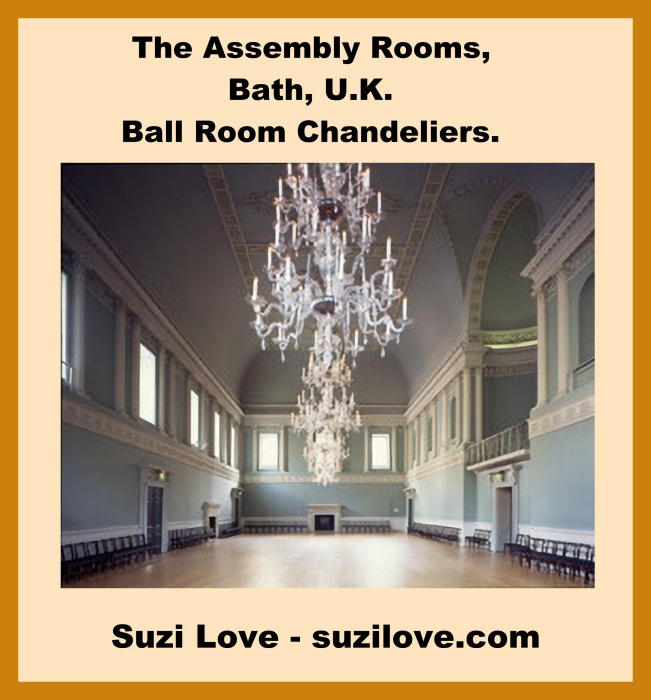
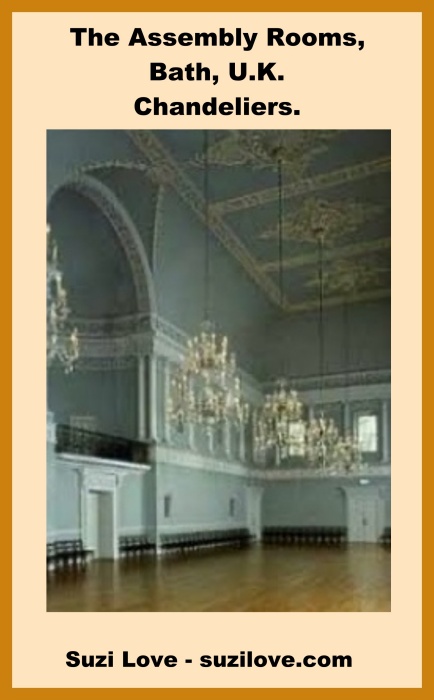
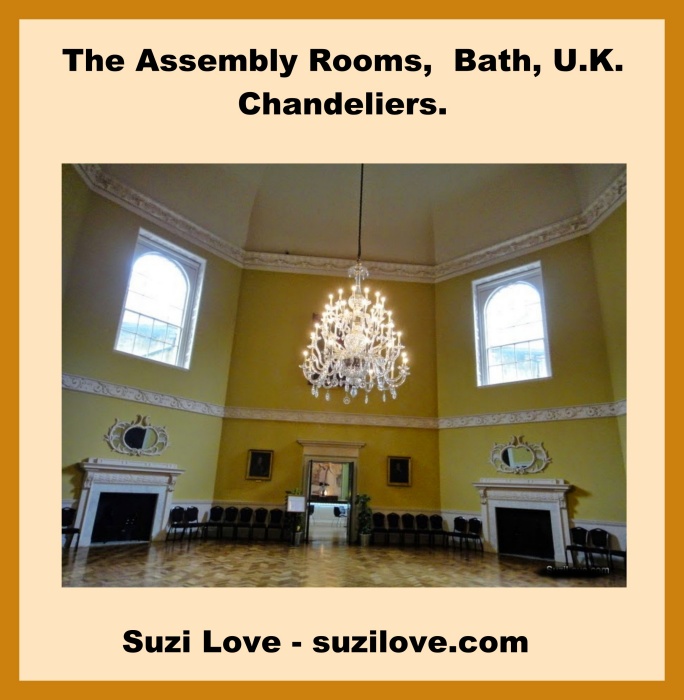
The Assembly Rooms are lit by a set of nine chandeliers, made for the building in 1771. Jonathan Collett of London originally provided a set of five chandeliers for the Ball Room when it opened in September 1771. Shortly afterwards the arm of one of the chandeliers fell off – narrowly missing the artist, Thomas Gainsborough, who lived nearby at the time. The Ball Room chandeliers were taken down and a new set was ordered from William Parker of London. Parker had already supplied three chandeliers for the Tea Room. It was agreed that Jonathan Collett should salvage the rejected set of Ball Room chandeliers and make one large chandelier to hang in the Octagon Room. The chandeliers in the three rooms had an average height of eight feet and they were made of Whitefriars crystal from the Whitefriars Glassworks in London and were originally lit by candles. The Ball Room and Tea Room chandeliers each had 40 lights and the Octagon chandelier had 48 lights.
During the 19th century, they were fitted for gas and were later converted to electric light. At the start of the Second World War, the chandeliers were put into storage and escaped destruction when the Assembly Rooms were bombed in 1942. During the extensive refurbishment of the building in 1988-1991, the chandeliers were restored by R. Wilkinson & Sons of London. The Bath Season ran from October to June. As the Season spanned the winter months and many activities took place in the evening it was essential to provide good artificial lighting.
The ball room is the largest of the three main rooms and is over 105 feet long and 42 feet wide and 42 feet high. It runs the whole length of the north side of the building and covers two storeys. The paint is called Ballroom Blue and was first created by David Mlinaric in the 1970s from an original colour swatch. “It is a stroke of luck that the colour sample of blue paint is still attached to the 1770s minute book of the Assembly Rooms Furnishing Committee.” said Lucy Powell, Assistant Archivist at Bath Record Office, “The building was bombed in 1942 so traces of the paint would never have survived otherwise.” From: Fashion Museum, Bath.
On the other side, the tea room is 70 feet long and 27 feet wide and all the rooms had huge chandeliers to give light. In 1777, a card room was added to the Octagonal Room. Before the Card Room was added, the Octagon Room became famous for card playing, the favorite leisure activity from the Georgian Era through to the Regency, as the Upper Rooms were open for card games every day except Sunday. The Octagon Room is dominated by Gainsborough’s portrait of the first Master of Ceremonies at the Upper Rooms, Captain William Wade. Bath’s most famous Master of Ceremonies, Richard “Beau” Nash, never knew this building as he died in 1761.
Bath_Octagon Room, The Assembly Rooms, Bath, U.K. Chandeliers. The Assembly Rooms,
Bath, U.K.
Ball Room Chandeliers. The Assembly Rooms,
Bath, U.K.
Chandeliers. The Assembly Rooms,
Bath, U.K.
Chandeliers. The Assembly Rooms,
Bath, U.K.
Chandeliers. The Assembly Rooms,
Bath, U.K.
Chandeliers. The Assembly Rooms,
Bath, U.K.
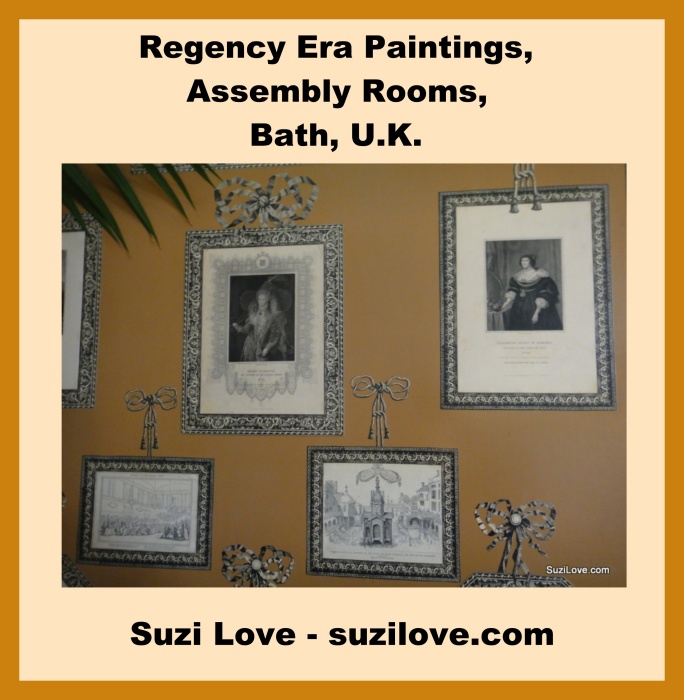
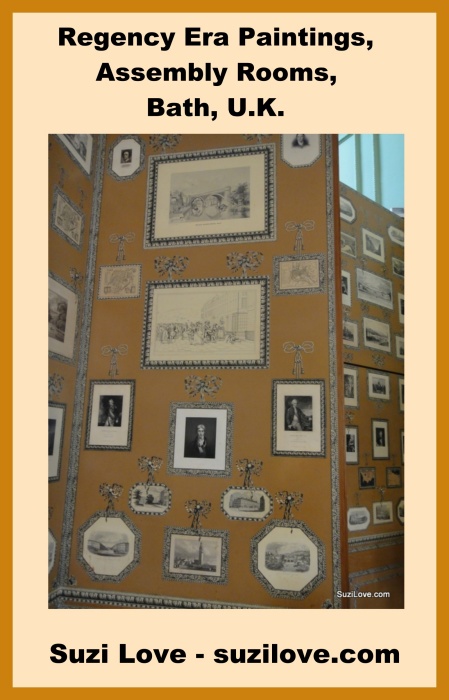
Chandeliers. Regency Era Paintings,
Assembly Rooms,
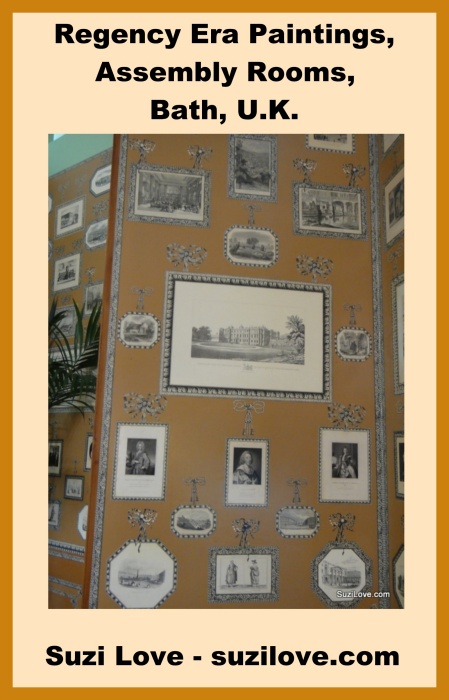
Bath, U.K.Regency Era Paintings,
Assembly Rooms,
Bath, U.K.Regency Era Paintings,
Assembly Rooms,
Bath, U.K.Regency Era Paintings,
Assembly Rooms,
Bath, U.K.
The tea room was used for refreshments, with tea generally served weak and black or perhaps with arrack and lemon, and on Wednesday nights during the Season concerts were held there. Fashionable visitors to Bath could also hold breakfasts there for their friends.
Many famous people visited the Assembly Rooms in the 18th and 19th centuries. Jane Austen and Charles Dickens both mention the Assembly Rooms in their novels and the diarist, Francis Kilvert, described a reception there in 1873. Subscription concerts were popular and many well-known musicians also visited, the most distinguished being Joseph Haydn, Johann Strauss the Elder, and Franz Liszt.
Today, the Octagon Room, the Tea Room, and the Cloak room Landings all showcase beautiful paintings and prints as the Upper Rooms were given to the National Trust in 1931. You can see paintings by Thomas Gainsborough and John Simmons as well as an Original ticket to the Thirteenth Dress Ball at the Assembly Rooms, 24 January 1803.
Since 1963, the Upper Assembly Rooms have also housed the amazing Fashion Museum. The building is owned by the National Trust and is leased by Bath & North East Somerset Council.
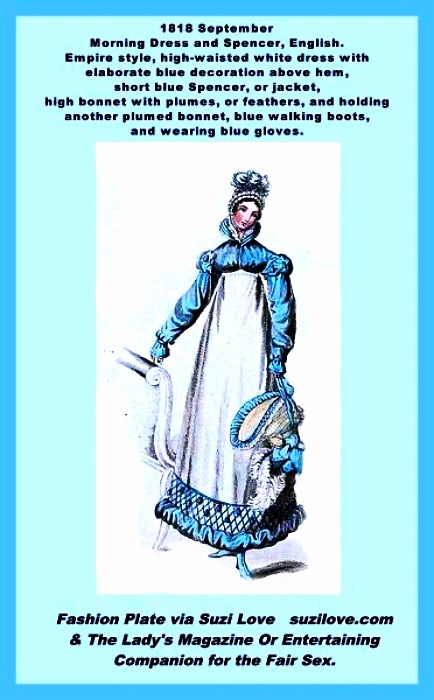
1818 September Morning Dress and Spencer, English. Empire style, high-waisted white dress with elaborate blue decoration above hem, short blue Spencer, or jacket, with puffs at the shoulders and straight sleeves, cap with plumes, or feathers, tied under her chin and holding another plumed bonnet, blue walking boots, and wearing blue gloves. Fashion Plate via Ladies Magazine.
Definition Empire Style Dress: High-waisted white gown defined women’s fashion during the Regency Era. ‘Empire’ is the name given to the period when Napoleon Bonaparte built his French Empire. High-waisted, loose gowns were adopted by the aristocracy as a symbol of turning away from the fussy, elaborate and expensive clothing worn in the 1700s.
Definition Spencer: Short jacket, cropped at the waist, worn over a dress, or gown. These close-fitting, tight sleeved, waist length jackets were modeled on a gentleman’s riding coat, but without tails. Delicate and regency dresses provided so little protection from the cold, so over garments were essential for warmth, modesty and good health.
Fashion Women 1815-1819 History Notes Book 28 https://books2read.com/SuziLoveFashionWomen1815-1819
Light-hearted look at Young Lady in Jane Austen’s times, or early 1800s. A glimpse into both the frivolous and more serious occupations filling a young lady’s day in the lifetime of Jane Austen, or the Regency Era, or the early 19th Century. Historic images and historical information show her fashions and frolics. https://books2read.com/suziloveYLD
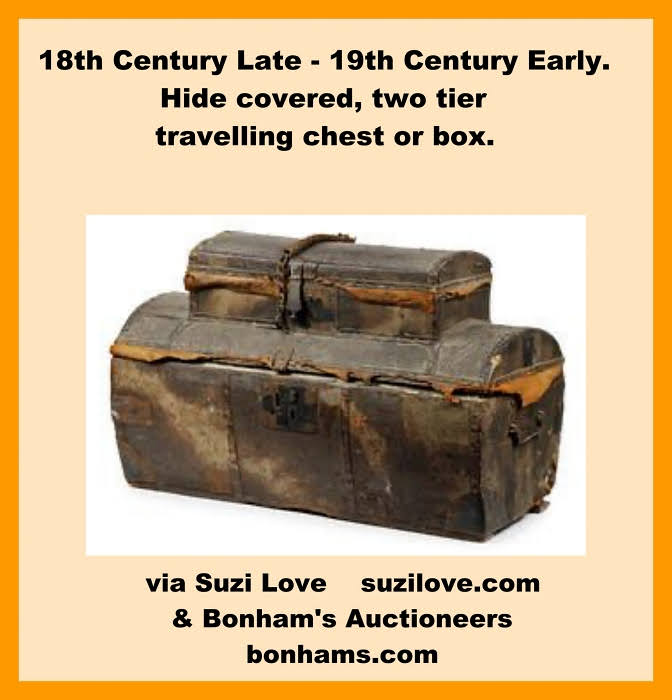
1930-1939 ca. Louis Vuitton Wardrobe Trunk. Monogrammed coat hangers, leather handle.1930-19391930-1939 ca. Louis Vuitton Steamer Trunk.18th Century Late – 19th Century Early. Hide covered, two tier traveling chest or box. Via Bonham’s Auctions.17th Century Iron Trunk With Locking Mechanism. 1900s Early Bags and Suitcases.
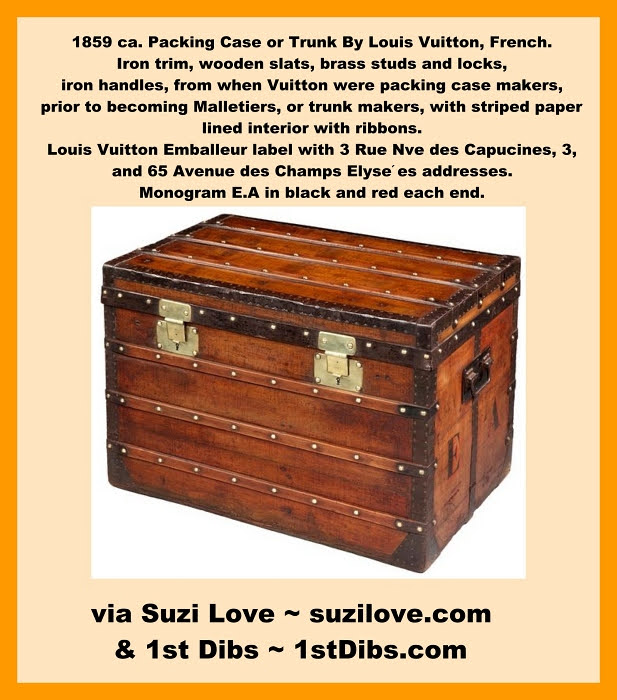
1st Dibs Auctions. 1859 ca. Packing Case or Trunk By Louis Vuitton, French. Iron trim, wooden slats, brass studs and locks.HN_10_D2D_RetailerBuyLink_ History Notes Book 10 books2read.com/SuziLoveTravel
What did the Bridgerton ladies and Jane Austen use to carry her personal items? Ridicule, Reticule, Or Handbag? Call them what you like: purses, bags, handbags, reticules, ridicules, clutches, or pocket replacements. They all did the same job and they changed greatly with the prevailing fashions of time. books2read.com/suziloveReticules
Definition Of A Reticule; Bag or purse, often with a drawstring to pull closed and usually made of cloth or covered cardboard and often decorated with beading or embroidery. A reticule, or purse, or handbag, was usually carried by a woman during the Regency period to carry all their daily necessities. Earlier, women used pockets that tied at the waistline and were hidden in the folds of their skirts. Empire style, or early 1800s, high-waisted dresses made it impossible to either sewn in a pocket or to tie on a pocket, so women began carrying small, decorated bags called Reticules, or ridicules, which generally pulled close at the top with a drawstring. These Reticules, or bags, were the forerunners of our modern day purses.
The term ‘ridicule’ derived from the Latin ‘ridiculum’ and first used in France during the 17th century and meant subjecting something or someone to mockery. As women’s tiny bags were mocked, or ridiculed, for being a useless fashion accessory carried outside when they were first used in the late 1700s, it’s likely this is how the name ‘ridicule’ started. The later term ‘reticule’ derived from the Latin reticulum, meaning ‘netted bag’ and was applied when bags became larger and often made from netting. In the late 1700s and early 1800s, they were also known as indispensables as they carried all the personal items a lady needed upon her person every day. They were easily made by ladies, easy to carry and became an indispensable fashion accessory.
In the early nineteenth century, reticules started to look like future handbags as they were often made from rigid card or molded mâché or card into a variety of shapes. Early bags were circular and with a drawstring but as women wanted their reticules to look individual they could be made with two halves and a hinged metal closure or with concertina sides. Materials varied from silk, cotton and string and shapes were round, hexagonal or lozenge shapes with shell shaped bags becoming very popular during the Regency and Romantic Eras.
1800s magazines were written for well bred women who could read, so they gave plenty of ideas for how ladies could make and embellish reticules for their own use and as pretty gifts. Needlework was highly encouraged as a pastime for a lady so bags were frequently embroidered or decorated with beading. By the 1820s, reticules became more like our modern handbags using soft leather gathered at the top or hard leather with a rigid fastener and metal chain for carrying.