George Bryan “Beau” Brummell (June 7th 1778 – March 30th 1840) Arbiter of men’s fashion and friend of the Prince Regent, the future King George IV. Established mode of dress for men that rejected overly ornate fashions for understated but perfectly fitted and tailored clothing. Look based on dark coats, full-length trousers rather than knee breeches and stockings, with immaculate shirt linen and an elaborately knotted cravat. 1855 Engraving of Beau Brummell from an article in Harper’s New Monthly Magazine.
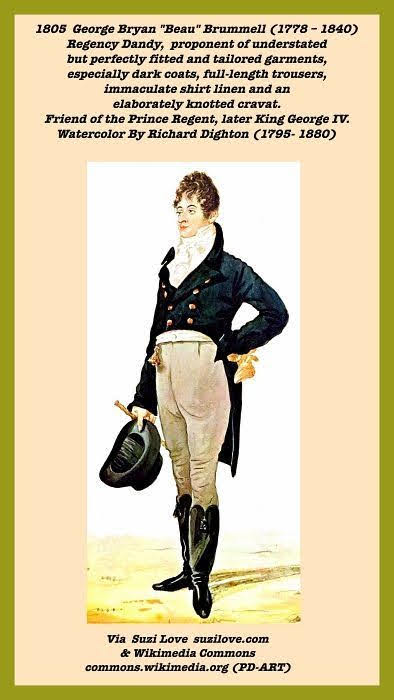
1805 Beau Brummell (1778-1840) Regency Dandy, proponent of understated but perfectly fitted and tailored garments, especially dark coats, full-length trousers, immaculate shirt linen and an elaborately knotted cravat. Friend of the Prince Regent, later King George IV. Watercolor By Richard Dighton (1795- 1880) Via Wikimedia Commons commons.wikimedia.org (PD-ART) https://books2read.com/SuziLoveFashionMen1800-1819
1807 Game of Billiards By Louis Leopold Boilly, French. Ladies playing billiards as they did in Jane Austen’s time. via Heritage Museum, Russia ~ heritagemuseum.org
Fashion Women 1805-1809 History Notes Book 26 What did Jane Austen and friends wear? https://books2read.com/SuziLoveFashionWomen1805-1809
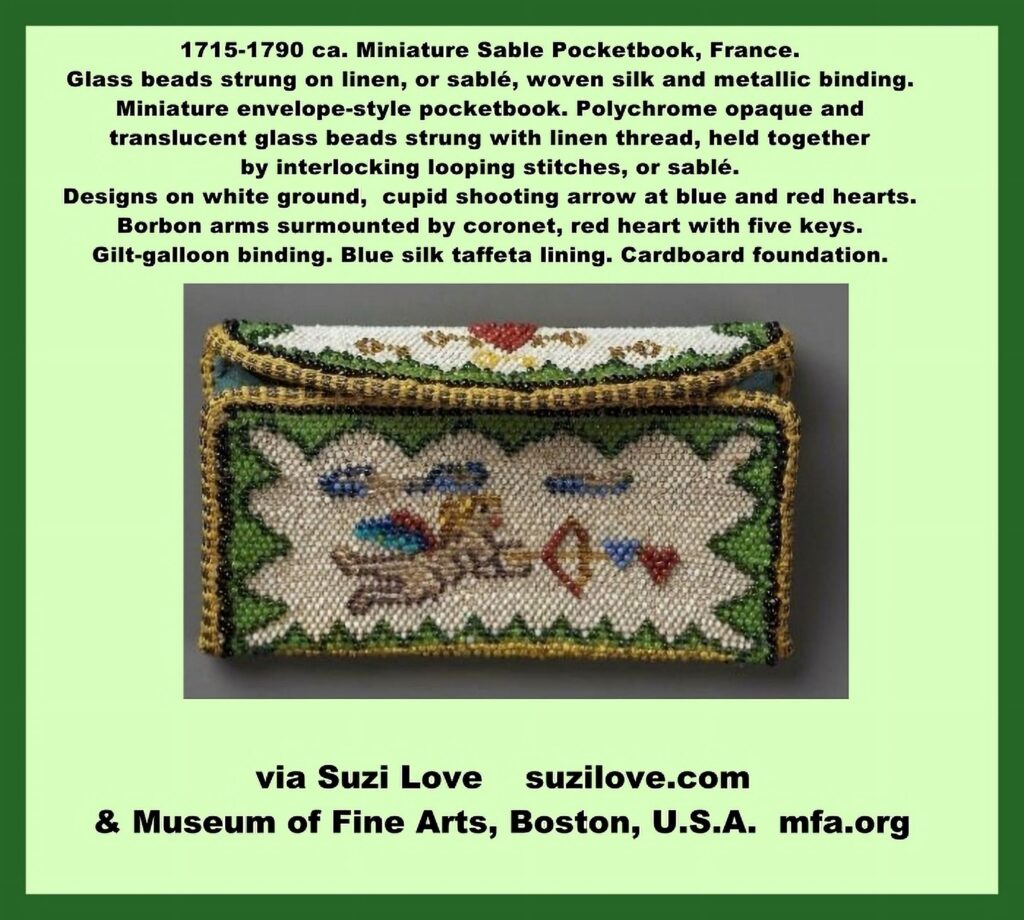
1715-1790 ca. Miniature Sable Pocketbook, France. Glass beads strung on linen, or sablé, woven silk and metallic binding. Miniature envelope-style pocketbook. Polychrome opaque and translucent glass beads strung with linen thread, held together by interlocking looping stitches, or sablé. Designs on white ground, cupid shooting arrow at blue and red hearts. Borbon arms surmounted by coronet, red heart with five keys. Gilt-galloon binding. Blue silk taffeta lining. Cardboard foundation. via Museum of Fine Arts, Boston. mfa.org
1823 Couple In Walking Dress, French, as worn in Europe and England in the Regency Era. Redingote, or Coat, with matching hat, neck frill of Gros de Nice lace. Gentleman in tailcoat, short length brown trousers, yellow vest, high white cravat, top hat and black shoes. via Modes Françaises L’Indiscret, France.
1818 ca. Lemon Dress, England. High-waisted, or Empire style, as worn in the times of Jane Austen, or Regency Era. Linen and lace dress with short puffed sleeves. via Los Angeles County Museum of Art, California, USA. collections.lacma.org. https://books2read.com/SuziLoveFashionWomen1815-1819
Fashion Women 1815-1819 History Notes Book 28 https://books2read.com/SuziLoveFashionWomen1815-1819
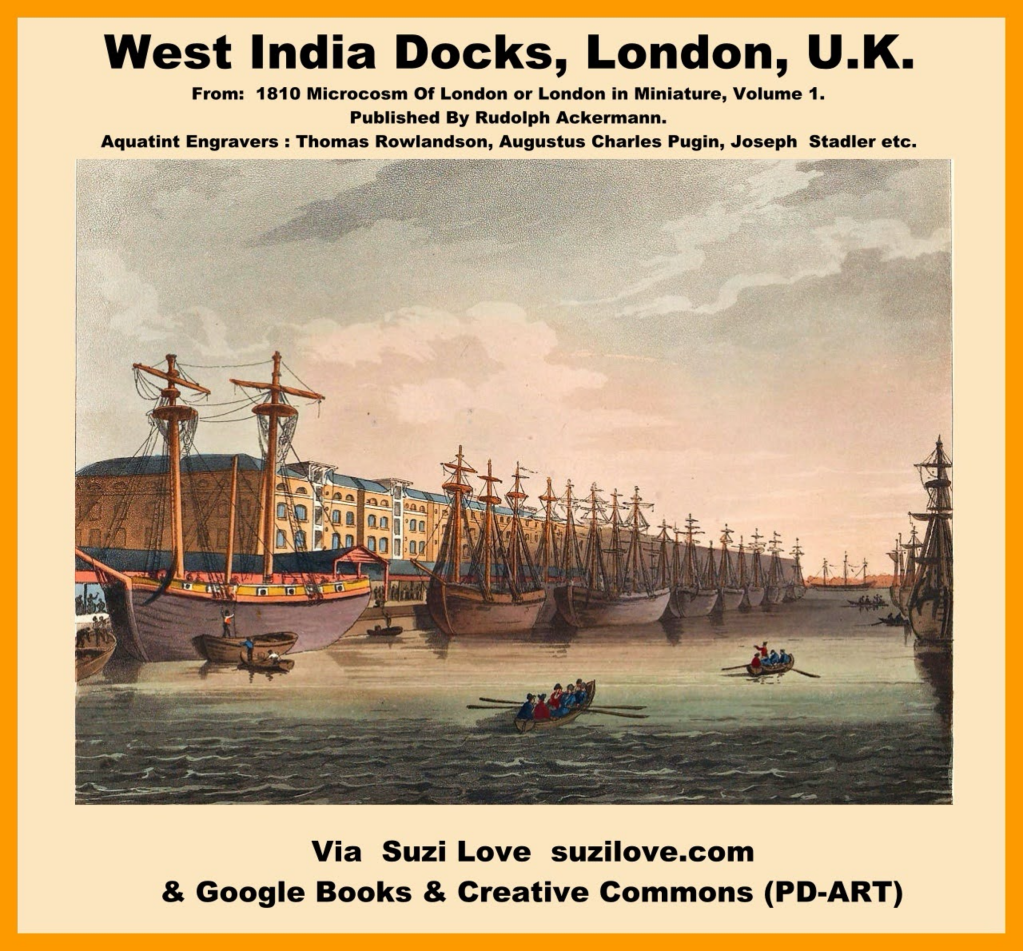
1810 January 1st. West India Docks, London. By Thomas Rowlandson and Augustus Charles Pugin. Printed in 1810 By Rudolph Ackermann in Microcosm Of London, or London In Miniature. Volume 1. Aquatint showing warehouses at quayside and several West Indiamen moored alongside. Warehouses held thousands of tons of cargo, including sugar, rum, molasses, coffee, spices and hardwood. Docks were constructed by powerful group of businessmen led by Robert Milligan, wealthy merchant and ship-owner outraged at losses suffered due to theft and delay at riverside wharves. via National Maritime Museum, Greenwich, London, U.K. ~ collections.rmg.co.uk
West India Docks, London, U.K. From: 1810 Microcosm of London or London in Miniature Published By Rudolph Ackermann. Via Google Books & Creative Commons (PD-ART)RL_1_D2D_Regency Overview RetailerLinks
https://books2read.com/suziloveROver
1787 December Yellow striped dress, red hat with a white feather and a large fur muff, French. via Magasin des Modes.
HN_1 Fashion Women Late 1700s History Notes Book 1 by Suzi Love.
What was fashionable for women in the late 1700s? Extravagant colors and fabrics and outrageous styles were all seen in these flamboyant fashions.
books2read.com/suziloveFashWomen1700s
1815 Arundel Fete Dress and Baronial Helmet, English. White dress with purple bodice and hem with matching shawl and plumed headdress. Skirt of white crape over white satin, a double row of novel and elegant trimmings on the bottom, two falls of the crape, set on full, are edged with silk. Body comes high on each side of the bosom and is shaped so as to display the neck and shoulders, and both body and sleeves are formed and trimmed in the most exquisitely tasteful manner. A superb cord and tassels confines the waist and ties in front. The Baronial Helmet is striking and made of white sarsnet or satin and white lace and superbly ornamented with feathers. Jewelry set, or Grand Parure, of necklace, bracelets. ear-rings, and small French locket of pearl. White kid slippers and gloves. Full Dress for evening would most likely be a dress of silk or satin, perhaps with a transparent overlay of netting, tulle etc., embellished with taffeta, ruffles and ribbons, and with a full range of accessories including a Grand Parure of tiara and other matching jewelry. https://books2read.com/SuziLoveFashionWomen1815-1819
La Belle Assemblee: Fashion Plate via John Belle’s La Belle Assemblée or, Bell’s Court and Fashionable Magazine, London. Many of the fashion plates seen in La Belle Assemblée and The Repository of Arts were designed by Mrs. Bell who had her dressmaking showroom in Bedford Square, London, and was related to John Bell who published La Belle Assemblée. It seems that she designed for at least two fashion magazines and so there is a cross-over of designs in different magazines.
Grand Parure: A Parure is a matched set of jewelry, including a necklace, bracelet, earrings, pin etc. and a Grand Parure often includes a tiara or other headdress.
Fashion Women 1815-1819 History Notes Book 28 https://books2read.com/SuziLoveFashionWomen1815-1819
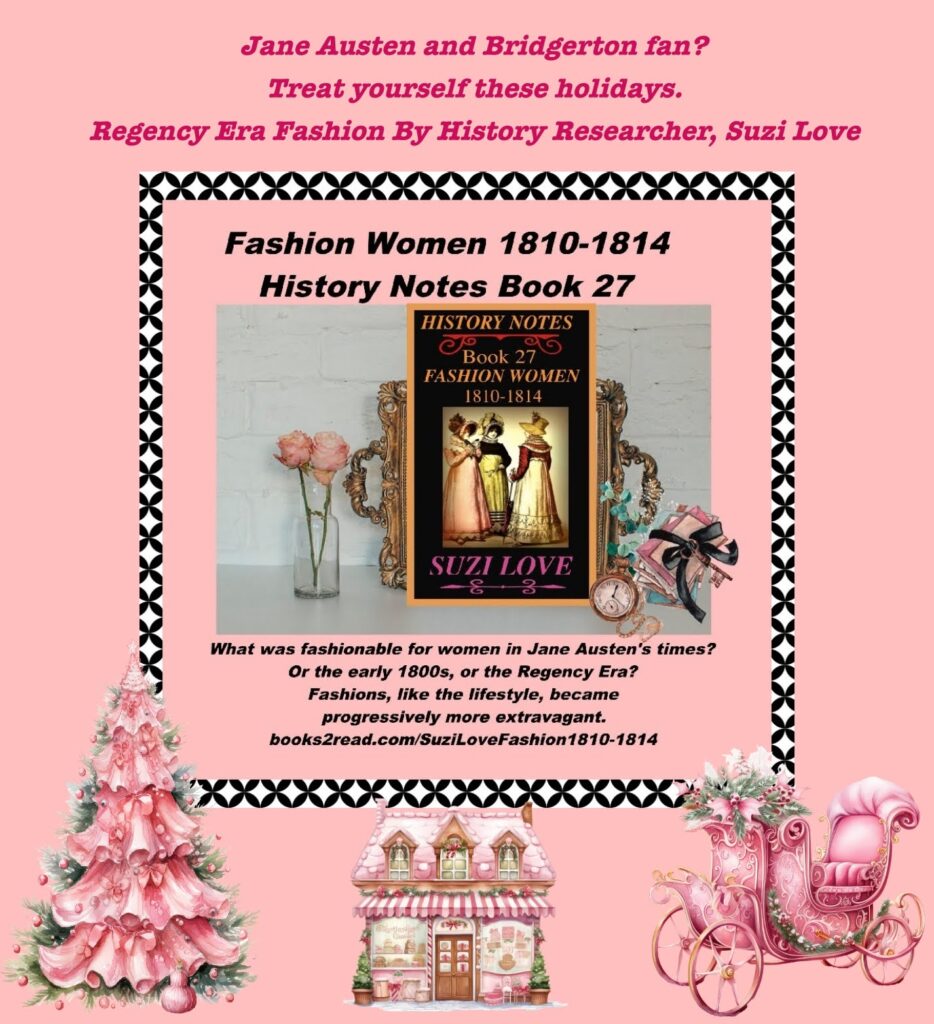
What was fashionable for women in Jane Austen’s times? Mourning, riding, daytime, evening clothing, plus underclothing, corsets and accessories. Fashion Women 1810-1814 History Notes Book 27 This book looks at what was fashionable for women in Jane Austen’s times, or the early 1800s, or the Regency Era in Britain. Wars were being fought around the globe so women’s fashion adopted a military look in support of soldiers. Fashions, like the lifestyle, became progressively more extravagant and accessories went from colorful to over-the-top. https://books2read.com/SuziLoveFashion1810-1814
The Lady’s Magazine said of the basis of women’s fashion that was popular for the first twenty years of the 1800s, ‘White is still the prevailing color for robes. For morning dresses, linen gowns, in large diamonds or squares, are fashionable. Indian muslins, plain or embroidered, are preferred to Florence and satins. The designs of embroidery for shawls are of infinite variety. Long gloves, which reach above the elbow, are not yet laid aside. Medallions are hung around the neck from crossed chains and some of these medallions are shaped like the bags, called ridicules. These reticules are of the lozenge or hexagon shape, with a small tassel at each angle. Reticules, or ridicules, are in lozenge or hexagon shapes with a small tassel at each angle. In capotes, or hats, and ribbands, the violet and dark green prevail over jonquil. Bracelets in hair, pear-shaped ear-rings, medallions on square plates, saltiers of colored stones, are still in fashion.’