1812 Military Pelisse, Or Shoulder Cape, British. Charles Stewart in hussar uniform with a military pelisse slung over his shoulder. By Thomas Lawrence.
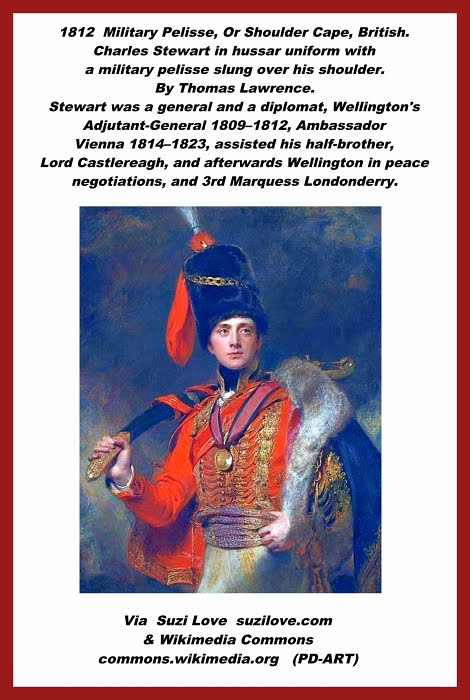


1812 Military Pelisse, Or Shoulder Cape, British. Charles Stewart in hussar uniform with a military pelisse slung over his shoulder. By Thomas Lawrence.
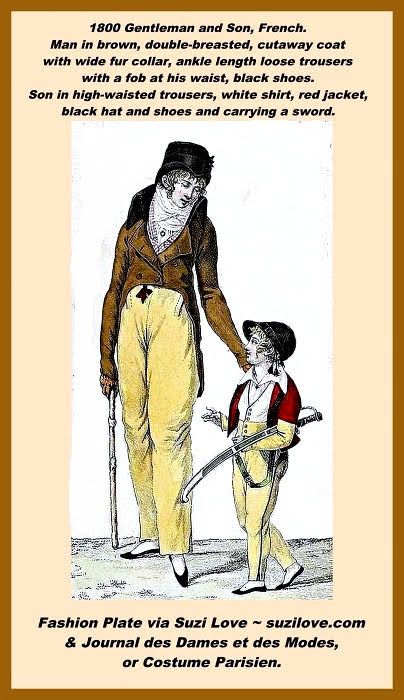
During the early 1800s skirted coats were replaced with short-fronted, or cutaway, tailcoats worn over fitted waistcoats and plain, white linen shirts. Knee breeches were gradually replaced by tight-fitting pantaloons and later trousers, decorative shoes were replaced with boot, such as the tan topped boots worn here, and fussy neckwear gave way to intricately tied, white linen neck cloths.
A Regency Era, or early 1800s, gentleman was outfitted in more practical fabrics, such as wool, cotton and buckskin rather than the fussy brocades and silks of the late 1700s. The men in Jane Austen’s life would have worn an elegant outdoor ensemble like this for everyday excursions around the countryside.
Historic images, historical information, and funny anecdotes give an overview of life in the early 1800s. Information for history readers and writers of the Regency Years, for Jane Austen fans and all history buffs. Pictures help visualize the people and places of the long Regency period. https://books2read.com/suziloveROver Regency Overview Regency Life Series Book 1 by Suzi Love.
The Regency Life Series By Suzi Love depicts the ups and downs of life in the early 1800’s, or Jane Austen’s years, or the Regency Era. Fun pictures, historical information, and funny anecdotes show how people fill their days, where they go and with whom they spend their time. These light-hearted looks at the longer Regency years are an easy to read overview of what people did and wore, and where they worked and played. Plenty of information for history buffs and lots of pictures help readers and writers of historical fiction visualize the last years of the 18th Century until Queen Victoria took the throne.


1809 October A fine cambric or Indian muslin high-gown, with long sleeves and falling collar, ornamented at the feet and around the neck with appliquéd lace or needle work. Deep amber broach or gold filigree buckle, confining the dress at the throat and waist, with bracelets to match. Gold chain and opera glass. The woodland hat of fine plaited straw or chip, with ostrich feather falling on one side. A French cloak of bright purple sarsnet or velvet, lined with amber or rose, and trimmed entirely round with black lace and beading. Parasol, with deep amber awning. Shoes and gloves of buff kid. Fashion Plate via Rudolph Ackermann’s ‘The Repository of Arts’.


1808 April Trio of Two Men and a Woman in Full and Half Dress in the Directoire and Empire period, or the Regency Era, or the times of Jane Austen. Two varieties of men’s pants, one knee breeches and stockings and one long pants worn inside high boots. One wearing a Bicorn hat and the other holding a top hat and both with yellow gloves. Woman wearing a pink pelisse, or coat, over a white walking gown with a train and holding a parasol. via Le Beau Monde, or Literary and Fashionable Magazine, London, U.K.

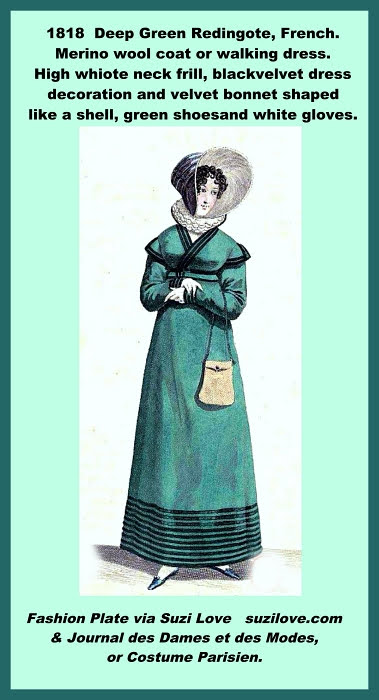
1818 Deep Green Redingote, French. Merino wool coat or walking dress. High white neck frill, black velvet dress decoration and velvet bonnet shaped like a shell, green shoes and white gloves. Fashion Plate via Journal des Dames et des Modes, or Costume Parisien. The type of outfit young Regency Era ladies, such as Jane Austen and her family and the Bridgerton women would have worn if they were out shopping on Bond Street, walking in a park, or taking a carriage ride through Hyde Park.
Definition Redingote Or Pelisse Or Walking Dress Or Coat: French word developed from English words, riding coat. Long fitted outdoor coat worn over other garments for warmth. Often left open at the front to show off the dress underneath. Sometimes cut away in front. Originally made with several capes and trimmed with large buttons. French fashion plates call these coats Redingotes and they are designed for women, men and children. English fashion plates call them a Pelisse, a walking dress, Promenade dress, or Carriage dress.

1810-1812 ca. Embroidery on Dress, Probably Spanish. Made of Embroidered cloth with Pina, or pineapple motifs. In Jane Austen’s times, pineapples were very much a luxury item. It became popular to sew items in pineapple shapes or to embroider pineapples onto articles. via Metropolitan Museum New York City, U.S.A. metmuseum.org




1808 Walk in the Tuileries Gardens. A dandy of the Year VIII. According to Baudelaire, a dandy was, “no profession other than elegance…no other status but that of cultivating the idea of beauty in their own persons….The dandy must aspire to be sublime without interruption; he must live and sleep before a mirror.” Dandies tried to imitate the aristocracy in manner and appearance. This man wears short breeches, usually worn by the aristocracy, that were out of fashion and had been replaced by the ‘more-democratic’ ankle-length pants. His outfit and manners are a throwback to a pre-Revolutionary era. llustrations by François Courboin from Octave Uzanne’s Les Modes de Paris. Fashion in Paris : the various phases of feminine taste and aesthetics from 1797 to 1897, William Heinemann, London, 1898. (PD-Art) via Brown University Library.

18th Century Late. Inkstand, Sheffield, England. Square, resting on four ball feet, the top pierced with four circular holes into which fit two inkwells, a pounce box and a box for wafers. Silver inkstands appeared in Britain in 17th century and included pot, or well, for ink, plus another pot with pierced cover held ‘pounce’ or sand, which writers scattered over paper to fix ink. Wafers to seal finished letter and tray to hold pens or quills. collections.vam.ac.uk


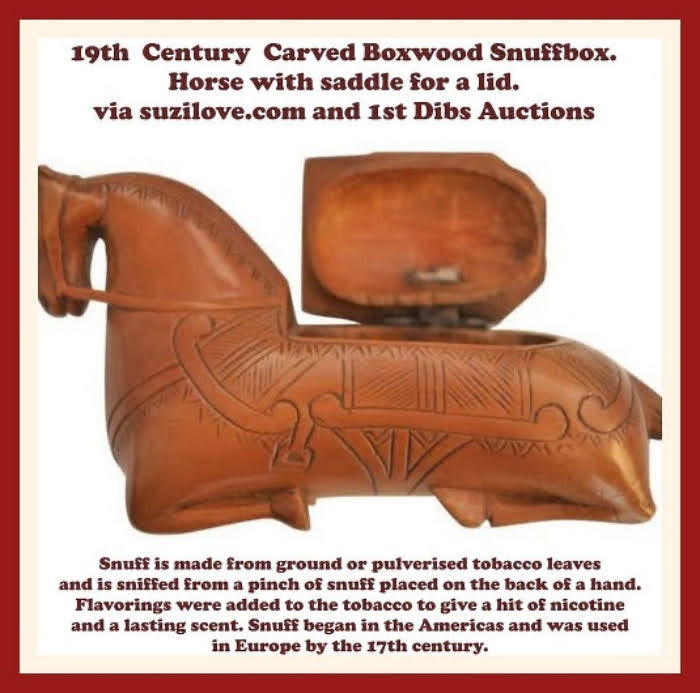
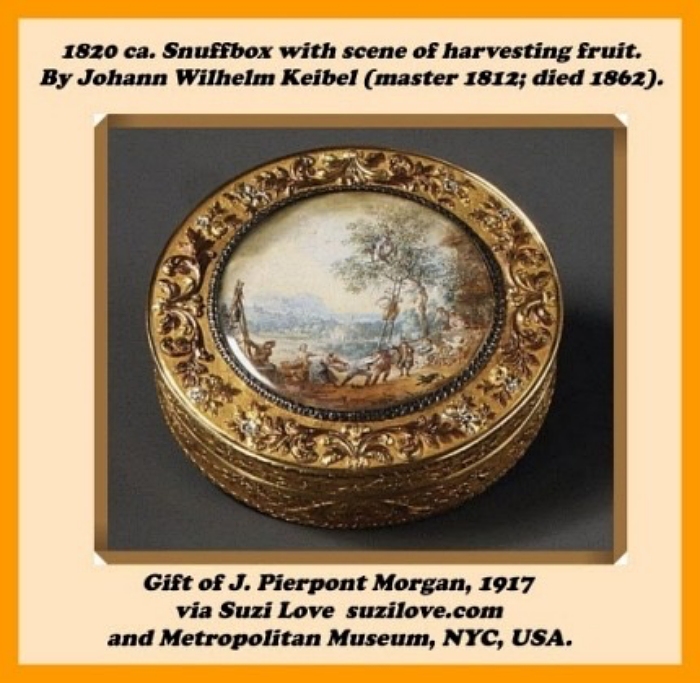
19th Century Snuff Boxes. Not only were boxes made to serve a purpose, but decorative boxes of all types were prized, especially in the 18th-19th Centuries when everything decorative and extravagant was in vogue and taking a pinch of snuff was fashionable. Snuff is made from ground or pulverized tobacco leaves and is sniffed from a pinch of snuff placed on the back of the hand.Flavorings were added to the tobacco to give a fast hit of nicotine and a lasting scent. Snuff began in the Americas and was used in Europe by the 17th Century.
Snuff became popular from the mid 1600s to the mid 1800s and was more popular than smoking. Inhaling snuff, or snuffing, was first seen by a European missionary in 1493 in Christopher Columbus’s new world within Haiti’s indigenous Taino. Until then, tobacco had been unknown to Europeans, but its use spread quickly throughout Europe during the 1500s. By the second half of the 17th century, ornate boxes started being produced to keep the precious powder dry and an entire industry making accessories blossomed around the fashion of taking snuff. Noblemen, and some women, carried extravagantly decorated snuff boxes with them at all times and would offer a pinch of their own particular blend to friends and family. Therefore, these boxes were always on display and so it became a competition to see who could have the most bejeweled or expensive box possible. By the mid 1800s, snuff taking was no longer popular so these exquisite and expensive snuff boxes became decorative, rather than functional.