1800-1820 ca. Small Pieces Of Drawing Room Furniture as would have been used in houses where Jane Austen lived. Side tables, book tables, chest and foot stool. Collage by Suzi Love.
1800-1820 ca. Small Pieces Of Drawing Room Furniture as Jane Austen and the Bridgertons would have used. #bridgerton #janeausten #RegencyEra #Furniture https://books2read.com/suziloveOLD
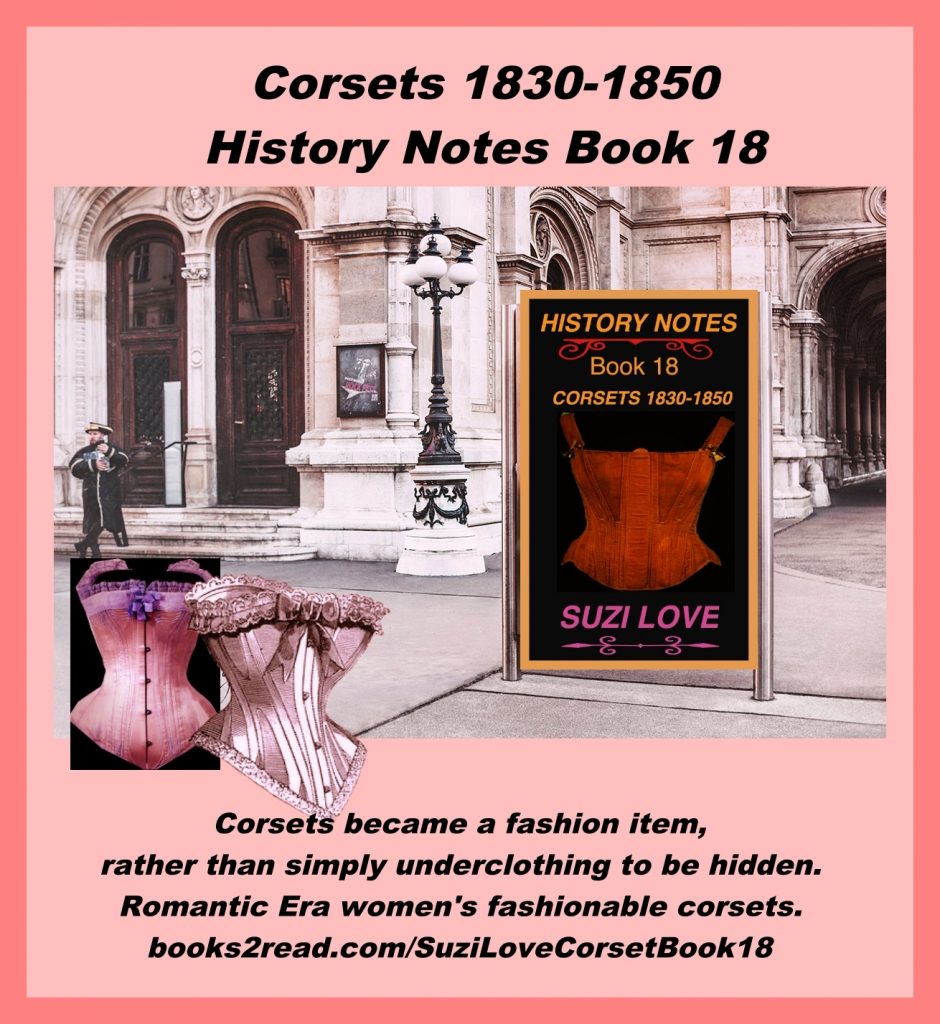
History Notes Book 18 Corsets 1830-1850This book shows how corsets changed to both provide support and also fit well under clothing to give a fashionable silhouette. Corsets started being a fashion item, rather than simply underclothing to be hidden. Romantic Era women’s fashionable corsets. Corsets worn from 1830-1850, or the Romantic Era of fashion. https://books2read.com/SuziLoveCorsetBook18
Information or drawings on corsets through both the Regency and Romantic Eras is difficult as underwear wasn’t shown in British publications for modesty sake, and only occasionally seen in French magazines. Therefore, most of our knowledge about corsets from the Regency and Romantic Eras is through actual garments, especially those donated to museums. Surviving corsets show that shorter corsets weren’t as common and corsets were generally of a longer length. Many of these corsets were still front fastening, plus many were laced at both the front and the back so our aristocratic fictional heroines could indeed dress and undress themselves without the assistance of a maid.
Corset makers became more skilled and cut garments much better, so the body was controlled and shaped by the cut and grain of the fabric. They developed long corded corsets to suit the classical gowns of the period. A wooden busk was created to help keep the undergarment garment lay flat and to lift and separate the breasts. Busks stopped women from bending at the waist, which encouraged good posture.
1830-1850 Romantic Era Corsets Provided Support and Gave Fashionable Silhouette. History Notes Book 18 #Corsets #RomanticEra #HistoricalFashion https://books2read.com/SuziLoveCorsetBook18
1810 ca. Cotton Dress Ensemble With Train, French. Cut out in back, lace shawl with sequins can be added to cover shoulders, small low cut bodice, all over embroidery and very short decorative sleeves. Front, Back and Side Views. via Metropolitan Museum New York City, U.S.A. metmuseum.org
1810 ca. Cotton Dress Ensemble With Train in Jane Austen style. #RegencyFashion #JaneAusten #historicalfashion https://books2read.com/SuziLoveFashion1810-1814
1817 March. Opera Dress, English. The sort of outfit Jane Austen and her contemporaries or the Bridgerton women would wear for an evening at the opera or theatre. Fashion Plate via Rudolph Ackermann’s ‘The Repository of Arts’.
A blue crape dress over a white satin slip; the dress trimmed round the skirt with a deep blond lace, which is headed with a light and novel trimming, composed of white floss silk and small pearl beads: this trimming is surmounted with a beautiful deep embroidery of lilies, surrounded by leaves. The body and sleeves of this dress, as our readers will perceive by our print, are extremely novel. Head-dress, toque à la Berri; it is a crown of a novel form, tastefully ornamented round the top with lilies to correspond with the trimming of the skirt, and a plume of white feathers, which droop over the face. Ear-rings, necklace, and bracelets, sapphire mixed with pearl. The hair dressed in loose light ringlets on the forehead, and disposed in full curls in the back of the neck. White kid gloves, and white satin slippers.
1798 Gentleman’s Outfit, French. Long green overcoat with yellow buttons, tan gloves, black boots topped with yellow band, gloves with three seams across the back of the hand, high white cravat, black hat, fob at his waist and holding a cane. Fashion Plate via Journal des Dames et des Modes, or Costume Parisien.
1798 Gentleman’s Outfit Of Long Green Overcoat With Yellow Buttons, Tan Gloves, and Black Boots, French. #GeorgianEra #France #FashionPlate https://books2read.com/suziloveFashMen1700s
1823 Hackney Cab, London, U.K. This small cabriolet was built by coach builder, David Davies, and licensed for public convenience. Name ‘hackney’ derived from village of Hackney, Middlesex, famous for horse drawn carriages. French word cabriolet was shortened to cab, hence ‘Hackney Cab’. In 1813, there were 1100 hackney coaches for hire in London. Designs changed constantly and in 1834 Joseph Hansom registered his design for a cabriolet named ‘Hansom Cab’.
1823 Hackney Cab, London, U.K. This small cabriolet was built by coach builder, David Davies, and licensed for public convenience. Name ‘hackney’ derived from village of Hackney, Middlesex, famous for horse drawn carriages. French word cabriolet was shortened to cab, hence ‘Hackney Cab’.
1823 Hackney Cab, London, built by coach builder, David Davies. #Regency #London #Carriage https://books2read.com/SuziLoveTravel
Lapdesk, English. Exterior covered in metal with a lacquer finish and edged with stamped and gold lacquered brass strips. Interior veneered in kingwood with plush velvet writing surface. walpoleantiques.com
1820 Lapdesk, English. Exterior covered in metal with a lacquer finish and edged with stamped and gold lacquered brass strips. Interior veneered in kingwood with plush velvet writing surface. walpoleantiques.com
1820 Metal Exterior Travel Lap Desk from Bridgerton years. #bridgerton #RegencyEra #Travel #BritishHistory books2read.com/SuziLoveWritingTools
1816 December. Promenade Dress, or Pelisse, English, also called a Redingote in France. High cambric muslin dress trimmed at the bottom with a single flounce of work, shaped without any fulness to fit the body, plain long sleeve finished by a triple fall of narrow lace. Over this is the Angouleme pelisse of crimson velvet, lined with white Sarsnet, and trimmed with a single Welt of crimson satin, a shade lighter than the pelisse. Shaped the to the body and without much fullness, confined at the short waist with narrow velvet band, edged to match. Small stand-up collar, supports a rich lace ruff, which is worn open in front of the throat. Sleeve has little fullness and is confined at the wrist by three narrow bands of puckered satin. Bonnet of white satin a la Royale with a large bunch of flowers and tied under the chin with satin ribbon and finished in front with a full quilling of tulle. Black silk ridicule, exquisitely worked in imitation of the ends of an India shawl and trimmed with black silk fringe. White kid gloves and black walking shoes. Fashion plate, hand-colored engraving on paper. Published in Rudolph Ackermann’s ‘The Repository of Arts’, London.
Promenade Dress, Pelisse, Redingote, Or Walking Dress. Jane Austen and her contemporaries wore long coats like these to keep warm when out and about, visiting, shopping etc. The thin muslin dresses worn in the early 1800s were little protection against European winters.
1816 December. Promenade Dress, or Pelisse, English, called Redingote in France. High cambric muslin dress trimmed at the bottom, plain long sleeve finished by a triple fall of narrow lace. Over this is the Angouleme pelisse of crimson velvet, lined with white Sarsnet, and trimmed with a single Welt of crimson satin, a shade lighter than the pelisse. Bonnet of white satin a la Royale with a large bunch of flowers and tied under the chin with satin ribbon. White kid gloves and black walking shoes. Fashion Plate in Rudolph Ackermann’s ‘The Repository of Arts’, London.1816 December Red Promenade Dress Or Pelisse With Black Reticule, English. #Bridgerton #RegencyFashion #JaneAusten https://books2read.com/SuziLoveFashionWomen1815-1819 Share on X Fashion Women 1815-1819 History Notes Book 28 https://books2read.com/SuziLoveFashionWomen1815-1819
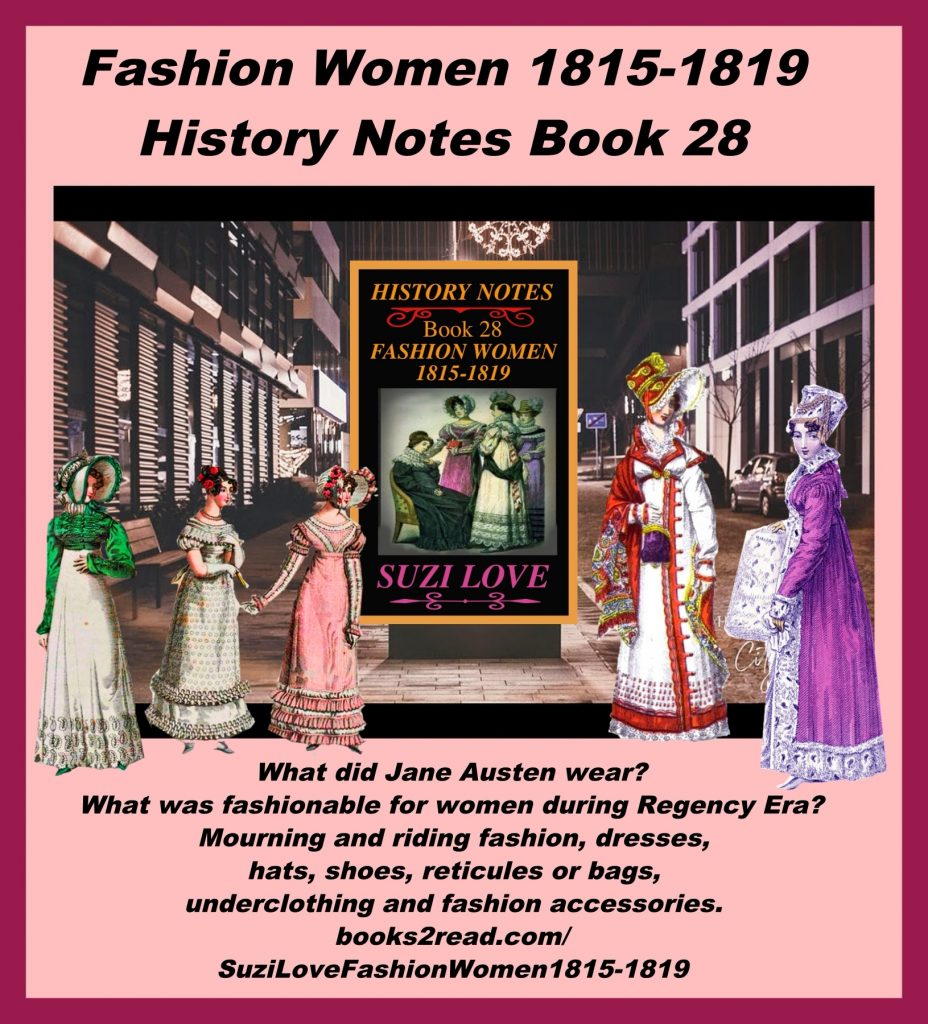
Love the Bridgerton family and Jane Austen? Reader Or Writer of Regency Era stories? Mourning and riding fashion, dresses, hats, shoes, reticules or bags, underclothing and fashion accessories. books2read.com/SuziLoveFashionWomen1815-1819
History Notes 28 Fashion Women 1815-1819: This book looks at what was fashionable for women in the Georgian Era and at the end of the Regency Era in Britain and the reconstruction in Europe after the wars. Lifestyles were freer and fashions expressed this by becoming the focus of most women’s lives. A wardrobe full of opulent accessories was requisite. Includes mourning and riding fashion, dresses, hats, shoes, reticules or bags, underclothing, and fashion accessories.
Are you a reader or writer of the Regency Era? Lover of the Bridgertons and Jane Austen? Mourning and riding fashion,underclothing and corsets. #Bridgerton #JaneAusten #RegencyFashion #mourningFashion https://books2read.com/SuziLoveFashionWomen1815-1819
Fashion Women 1815-1819 History Notes Book 28 What did Jane Austen wear? This book looks at what was fashionable for women in the Georgian Era and at the end of the Regency Era in Britain and the reconstruction in Europe after the wars. Lifestyles were freer and fashions expressed this by becoming the focus of most women’s lives. A wardrobe full of opulent accessories was requisite. Includes mourning and riding fashion, dresses, hats, shoes, reticules or bags, underclothing, and fashion accessories.
1823 Couple In Evening Costumes, French. Short length dancing dress of white gauze, short sleeves, pink ribbon trim, flowers, parure, or jewelry set, dancing shoes and hair in a bandeau. Man in half dress of black tailcoat, yellow vest, short length white trousers, high white cravat, blue fob, and curled hair style. via Modes Francaises L’Indiscreet, France.
From the finish of the 18th century until 1820, men’s fashions in European and European-influenced countries moved away from the formal wear of brocades, lace, wigs and powder to more informal and relaxed styles. Focus was on undress rather than formal dress. Typical menswear in the early 1800s included a tailcoat, a vest or waistcoat, either breeches, pants, or the newer trousers, stockings, shoes or boots, all worn with an overcoat and hat. This basic ensemble was accessorized with some form of neckcloth or cravat, gloves, walking stick, cane or riding crop, handkerchief, fobs, watch and perhaps a quizzing glass or eye glass.
Skirted coats were replaced with short-fronted, or cutaway, tailcoats worn over fitted waistcoats and plain, white linen shirts. Knee breeches were gradually replaced by tight-fitting pantaloons and later trousers, decorative shoes with buckles were replaced with a variety of boot styles, and fussy and ruffled neckwear gave way to intricately tied, white linen neck cloths. A Regency Era, or early 1800s, gentleman was outfitted in more practical fabrics, such as wool, cotton and buckskin rather than the fussy brocades and silks of the late 1700s.