↓
 

Suzi Love

Making history fun, one year at a time.

Header_
  • Home
  • Newsletter
  • Pre order form
  • Shop
    • Cart
    • Checkout
    • My account
    • Refund and Returns Policy
  • Blog
  • BOOKS
    • History Events
    • Kelly’s Justice
    • Outback Arrival
    • Irresistible Aristocrats
    • History Notes
    • Scandalous Siblings
    • Love After Waterloo
    • Regency Life Series
  • Privacy Policy
  • EVENTS
Home » Suzi Love Images 1 2 3 … 73 74 >>

Category Archives: Suzi Love Images

Post navigation

← Previous Post

1800s Omnibus History, France and England. #RomanticEra #VictorianEra #BritishHistory #Travel

Suzi Love Posted on November 11, 2026 by Suzi LoveNovember 7, 2026

‘Omnibuses, under the name of carrosses a cinq sous, were started in Paris in 1662. Seven vehicles to carry eight passengers each, all inside, were built, and on March 18th, 1662, they began running. The first one was timed to start at seven o’clock in the morning, but an hour or two earlier a huge crowd had assembled to witness the inauguration ceremony, which was performed l)y two Commissaires of the Chatelet, attired in their official robes. Accompanying them were four guards of the Grand Prevot, twenty men of the City Archers, and a troop of cavalry. ‘

In 1828, George Shillibeer, a London coach builder, visited Paris where he was impressed by the efficiency of the new horse-drawn bus service. The following year, he started a single horse-drawn omnibus connecting Paddington and Regent’s Park to the City of London. Passengers were picked up and set down anywhere along the route and fares were paid on board, in contrast to short-stage coaches which had to be booked in advance. 

This new omnibus was pulled by three horses and carried 22 passengers who sat inside and were protected from the weather. Fares were sixpence and one shilling, less than a hackney cab or short-stage coach, but still too expensive for the lower classes. 

1829 July 4th George Shillibeer's Omnibus, London, U.K. First Omnibus between Paddington and the Bank of
1829 July 4th George Shillibeer Omnibus, London, U.K. First Omnibus between Paddington and Bank of England via the New Road, now Marylebone Rd., Somers Town and City Rd. Via Wikimedia Commons.

In 1832, the London City monopoly of hackney carriages was removed, so horse buses expanded and within two years there were 620 licensed horse buses in London. By the Great Exhibition in 1851, London’s increase in visitors meant this number doubled and the number of routes increased to 150.  By 1856, several bus operators were taken over by the new London General Omnibus Company until, with 600 omnibuses, they were the largest bus company in the world.  In 1833, the first real steam omnibuses, the ‘Era’ and ‘Autopsy’ were invented by Walter Hancock, of Stratford, and started on the London roads. The ‘Era’ was the better omnibus of the two, and the most flattering things were said and predicted of it. Enthusiasts declared that omnibuses of this type would enable passengers to be carried at a cheaper rate and greater speed. The ‘Era’ ran from Paddington to the Bank, the same route as the horse-drawn omnibuses, and carried fourteen passengers, the fare being sixpence all the way. It travelled at the rate of ten miles an hour. Travel on these roads was also dangerous as highwaymen stopped and robbed anyone who came along. Male or female made no difference to highwaymen in Britain, nor to the bushrangers in Australia or the gangs on American roads, as they robbed indiscriminately and often with violence.   

By the end of the 18th Century, however, travel as a pleasurable pursuit came into vogue and numerous guides were written for traveling all over the British Isles as well as on the continent. The 1812  ‘Tour Of Dr. Syntax’ was an ironic look at the new obsession of travel and travel guides. Before he set off for the Lake District, Dr. Syntax said to his wife, “You well know what my pen can do, and I’ll employ my pencil too: I’ll ride and write, and sketch and print and thus create a real mint: I’ll prose it here, I’ll verse it there and picturesque it everywhere. I’ll do what all have done before; I think I shall and somewhat more.”  Georgian and Regency travelers were envious of aristocrats, even if they were of the nobility themselves, and loved to view all the British Great Houses. 

A gentleman and his wife would even drive up to the front door of a mansion house and demand to be given a tour of the house.  If they weren’t admitted, they would write in their journals of the inhospitable nature of the people on a particular estate. Thomas Pennant, William Mavor, and others, loved to write about these bad experiences and have them published.  Paterson’s British Itinerary, a travel guide had 17 editions between 1785-1832 – it outlined the roads used by the stage and mail coaches, the tolls, the bridges, etc.   This new touring craze created an industry of hospitality that encompassed more than simple mail coach trips from place to place, and more than a noble family traveling from their country seat to the Metropolis of London for parliamentary sittings. Inns had to improve the quality of the linens and meals if they wanted to attract the wealthier traveling class. Before that, many travelers carried their own linen, crockery, glasses, and utensils, as they didn’t trust the hygiene or standards of country inns.

Travel became something written about by poets with many sonnets written to the beauty of places like the Lake District in England, or the pyramids in Egypt. Inns became cleaner and more respectable so they could welcome travelers of the upper classes. This also meant that women could travel more as roads were slowly improved from rutted tracks that were only suitable for horse riding to roads that family coaches could travel along, though these roads were still narrow and subject to extremes of weather, such as flooding.  The race was on to travel from places like London to Edinburgh in the fastest possible time.

HN_10_D2D_RetailerBuyLink

books2read.com/SuziLoveTravel
HN_10_D2D_RetailerBuyLink_ History Notes Book 10 books2read.com/SuziLoveTravel
Posted in 1800s, England, Europe, France, History, London, Quotations, Regency Era, Romantic Era, Suzi Love Images, travel, Victorian Era | Tagged British history, europe, google books, History Notes, Regency London, Romantic Era, travel, Victorian Era

1800-1850 ca. Brown Reticule, Or Bag With Monogram and Drawstring, of the Sort Used by the Bridgertons and Jane Austen. #Bridgerton #RegencyFashion #JaneAusten

Suzi Love Posted on November 10, 2026 by Suzi LoveNovember 4, 2026

1800-1850 ca. Reticule, Or Bag. Brown bag with monogram and drawstring, British. The Bridgerton family and Jane Austen and their female contemporaries would have sewn, gifted and used a bag similar to this. via Snowshill Manor, National Trust, U.K. nationaltrustimages.org.uk

Definition Reticule: Bag or purse, often with a drawstring to pull closed and usually made of cloth or covered cardboard and often decorated with beading or embroidery. A reticule, or purse, or handbag, was usually carried by a woman during the Regency period to carry all their daily necessities. Earlier, women used pockets that tied at the waistline and were hidden in the folds of their skirts. Empire style, or early 1800s, high-waisted dresses made it impossible to either sewn in a pocket or to tie on a pocket. So women began carrying small, decorated bags called Reticules, or ridicules, which generally pulled close at the top with a drawstring.

1800-1850 ca. Reticule, Or Bag. Brown bag with monogram and drawstring. via Suzi Love ~ suzilove.com & Snowshill Manor, National Trust, U.K. nationaltrustimages.org.uk
HN _3_D2D_RetailerBuyLink
http://books2read.com/suziloveReticules
HN _3_D2D_RetailerBuyLink_HN_3
Posted in 1800s, 1800s women's fashion, Australia, Decorative Item, England, fashion accessories, History, Regency Era, Regency Fashion, Reticule or Bag, Romantic Era, Suzi Love Images | Tagged 1800s women's fashion, Bridgerton, British history, fashion accessories, Jane Austen, National Trust U.K., Regency Fashion, reticule or bag, Romantic Era Fashion, sewing, Victorian fashion

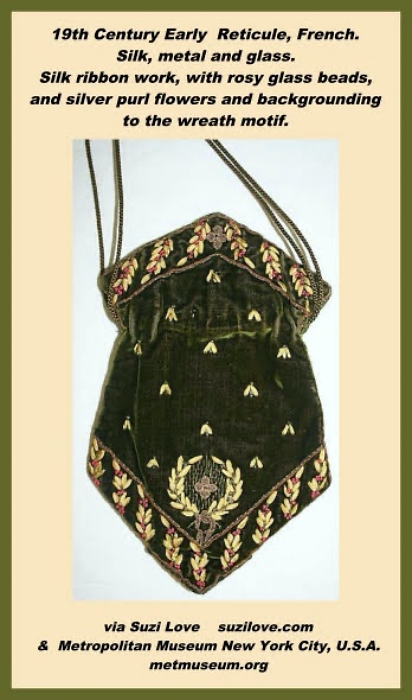
19th Century Early Bridgerton and Jane Austen Style Silk and Glass Reticule, Or Bag, French. #Bridgerton #JaneAusten #RegencyFashion #Reticule

Suzi Love Posted on November 10, 2026 by Suzi LoveNovember 8, 2026

19th cent. Early. Reticule, or Bag, of silk, metal and glass, French, as carried in Jane Austen’s times. Silk ribbon work, with rosy glass beads, and silver purl flowers and backgrounding to the wreath motif. via Metropolitan Museum, N.Y.C., U.S.A. metmuseum.org

Definition Reticule: Bag or purse, often with a drawstring to pull closed and usually made of cloth or covered cardboard and often decorated with beading or embroidery. A reticule, or purse, or handbag, was usually carried by a woman during the Regency period to carry all their daily necessities. Earlier, women used pockets that tied at the waistline and were hidden in the folds of their skirts. Empire style, or early 1800s, high-waisted dresses made it impossible to either sewn in a pocket or to tie on a pocket. So women began carrying small, decorated bags called Reticules, or ridicules, which generally pulled close at the top with a drawstring.

19th cent. Early. Reticule. Silk, metal and glass. French. Silk ribbon work, with rosy glass beads, and silver purl flowers and backgrounding to the wreath motif. metmuseum.org
HN _3_D2D_RetailerBuyLink
http://books2read.com/suziloveReticules
HN _3_D2D_RetailerBuyLink_HN_3

Posted in 1800s, 1800s women's fashion, Bridgerton, Decorative Item, Europe, fashion accessories, France, History, Jane Austen, Regency Era, Regency Fashion, Reticule or Bag, sewing, Suzi Love Images | Tagged 1800s women's fashion, Bridgerton, decorative, fashion accessories, Jane Austen, Metropolitan Museum NYC, Regency Fashion, reticule or bag, sewing

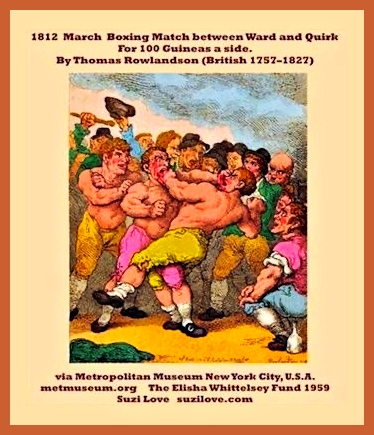
1812 March 1st Boxing Match between Ward and Quirk In Bridgerton and Jane Austen years. #bridgerton #JaneAusten #RegencyEra #Boxing #BritishHistory

Suzi Love Posted on November 9, 2026 by Suzi LoveOctober 21, 2026

1812 March 1st Boxing Match between Ward and Quirk for 100 Guineas a side. By Thomas Rowlandson, British. via The Metropolitan Museum, New York City, U.S.A. metmuseum.org

1812 March 1st Boxing Match between Ward and Quirk for 100 Guineas a side. By Thomas Rowlandson, British. via The Metropolitan Museum, New York City, U.S.A. metmuseum.org
RL_2_D2D_RetailerBuyLink_RL_2
RL_2_D2D_RetailerBuyLink_RL_2 https://books2read.com/suziloveYGD
Posted in cartoon, History, London, Regency Era, sports, Suzi Love Images | Tagged boxing, British history, Cartoons, England, Metropolitan Museum NYC, Regency Life, Regency Men, sports

1802 Gentlemen’s Full Dress Of Blue Court Suit, French. #RegencyEra #JaneAusten #HistoricalFashion

Suzi Love Posted on November 9, 2026 by Suzi LoveNovember 7, 2026

1802 Full Dress of Blue Court Suit, French. Man’s grand parure, or full dress, with white lace on the tailcoat and ruffles on the shirt, jewels, white stockings, black dress shoes, sword and a bicorn hat under his arm. Fashion Plate via Journal des Dames et des Modes, Costume Parisien. Typical menswear for court in most parts of Europe in the early 1800s, or Regency Era, or Jane Austen’s times, included a tailcoat, a vest or waistcoat, breeches, stockings, dress shoes, and hat.

1802 Full Dress of Blue Court Suit, French. Man’s grand parure, or full dress, with white lace on the tailcoat and ruffles on the shirt, jewels, white stockings, black dress shoes, sword and a bicorn hat under his arm. Fashion Plate via Journal des Dames et des Modes, Costume Parisien. Typical menswear for court in most parts of Europe in the early 1800s, or Regency Era, or Jane Austen’s times, included a tailcoat, a vest or waistcoat, breeches, stockings, dress shoes, and hat.
HN_23_D2D_Fashion Men 1800-1819
https://books2read.com/SuziLoveFashionMen1800-1819
Posted in 1800s, 1800s Mens Fashions, bedroom fashion, Coat or Pelisse Or Redingote, Customs & Manners, fashion accessories, France, hats, Jane Austen, pants, Regency Era, Regency Fashion, shoes, Suit, Suzi Love Images, Vest or Waistcoat | Tagged 1800s men fashion, court clothing, fashion accessories, Fashion Plate, France, Hats And Hair, Jane Austen, jewelry, Journal des Dames et des Modes, Regency Fashion, Shoes, stockings, Suit, Tailcoat, Vest or Waistcoat, weapons

1819 February Pink Ball Dress In Bridgerton Or Jane Austen Style With Low Neckline and White Underskirt, English. #Bridgerton #RegencyEra #JaneAusten #HistoricalFashion #BritishHistory

Suzi Love Posted on November 9, 2026 by Suzi LoveNovember 4, 2026

1819 February Pink Ball Dress, English. Underskirt with white lace hem, pink layer with intricate decoration, short puffed sleeves, low décolletage, or neckline, white shawl and white hat with pink feather. Fashion Plate via John Belle’s La Belle Assemblée or, Bell’s Court and Fashionable Magazine, London. Women’s clothing came in the late 1810s came in a wide range of styles to suit every season and occasion. When attending assemblies or balls, ladies in Jane Austen’s times women wore Empire style dresses which were usually made of light fabric and floaty in style and often of a shorter length suitable for dancing. https://books2read.com/SuziLoveFashionWomen1815-1819

Definition Ball Dress: At the end of the 1810s, ball or dancing dresses had higher hemlines that rose several inches above the ankle so ladies wouldn’t trip on their hens or flounces and make a spectacle of themselves. 

Definition Aigret, aigrette, egret: Plume of feathers or jeweled ornament in shape of feathers worn on head or hats. During the early 19th century, or Jane Austen’s lifetime, or during the years of the Bridgerton series, the favorite feathers were osprey and heron.

1819 February Pink Ball Dress, English. Underskirt with white lace hem, pink layer with intricate decoration, short puffed sleeves, low décolletage, or neckline, white shawl and white hat with pink feather. Fashion Plate via John Belle's La Belle Assemblée or, Bell's Court and Fashionable Magazine, London.
HN_28_D2D_FashionWomen 1815-1819
https://books2read.com/SuziLoveFashionWomen1815-1819
Posted in 1800s, 1800s women's fashion, Bridgerton, dancing, Dress Or Robe, England, fashion accessories, hats, Jane Austen, London, Regency Era, Regency Fashion, shoes, Suzi Love Images | Tagged 1800s women's fashion, Bridgerton, dancing, Dress Or Gown, fashion accessories, Fashion Plate, Hats And Hair, Jane Austen, La Belle Assemblee, magazines, Regency Fashion, sewing, shawls, Shoes, Suzi Love Images

1806 White bodice and red scarf in Jane Austen style. Hats, bonnets and evening headdress. #Regencyfashion #JaneAusten #Hats

Suzi Love Posted on November 9, 2026 by Suzi LoveNovember 8, 2026

1806 White Bodice and Red Scarf. Various Hats, Bonnets and an evening headdress. Fashion Plate via Journal des Dames et des Modes, or Costume Parisien.


French fashions like this were copied by English magazines so these styles of hats would have been worn by Jane Austen and her contemporaries. https://books2read.com/SuziLoveFashionWomen1805-1809

1806 White Bodice and Red Scarf. Various Hats and Bonnets. Fashion Plate via Journal des Dames et des Modes, or Costume Parisien.


.

HN_26_D2D_FsshionWomen1805-1809.  https://books2read.com/SuziLoveFashionWomen1805-1809
HN_26_D2D_FsshionWomen1805-1809

Posted in 1800s, 1800s women's fashion, Coat or Pelisse Or Redingote, Dress Or Robe, England, Europe, fashion accessories, France, hats, Regency Era, Regency Fashion, Suzi Love Images | Tagged 1800s women's fashion, Dress Or Gown, fashion accessories, Fashion Plate, Hats And Hair, Jane Austen, Journal des Dames et des Modes, Regency Fashion

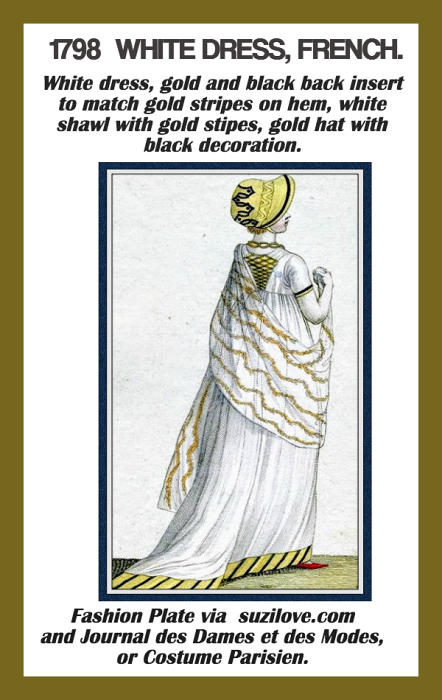
1798 White dress, shawl and hat with gold and black decoration, French. #GeorgianFashion #France #HistoricalDress

Suzi Love Posted on November 8, 2026 by Suzi LoveNovember 8, 2026

1798 White Dress, French. Gold and black back insert to match gold stripes on the hem, white shawl with gold stripes, gold hat with black decoration. Via Journal des Dames et des Modes or Costume Parisien.

Definition: 18th Century Late Women’s Fashions: A conical body shape was still fashionable while the shape of the skirts changed. The wide panniers which held the skirts out at the sides mostly disappeared by 1780 for all but the most formal court functions and false rumps, or bum-pads or hip-pads were worn for a time. A low-necked gown, usually called in French a robe, was worn over a petticoat and most gowns had skirts that opened in front to show the petticoat worn beneath. As part of the general simplification of dress, the open bodice with a separate stomacher was replaced by a bodice with edges that met center front. Strapless stays which still were cut high at the armpit, to encourage a woman to stand with her shoulders slightly back, a fashionable posture. The fashionable shape was a rather conical torso, with large hips. The waist was not particularly small. Stays were usually laced snugly, but comfortably. Shoes had high, curved heels (the origin of modern “louis heels”) and were made of fabric or leather. Shoe buckles remained fashionable until they were abandoned along with high-heeled footwear and other aristocratic fashions in the years after the French Revolution.

Fashion Women Late 1700s History Notes Book 1.
What was fashionable for women in the late 1700s? Extravagant colors and fabrics and outrageous styles were all seen in these flamboyant fashions. Take a look at their dresses, suits, hats, shoes and bedroom fashions. books2read.com/suziloveFashWomen1700s

1798 White Dress, French. Gold and black back insert to match gold stripes on the hem, white shawl with gold stripes, gold hat with black decoration. Via Journal des Dames et des Modes or Costume Parisien.
What was fashionable for women in the late 1700s? Extravagant colors and fabrics and outrageous styles were all seen in these flamboyant fashions. #Georgian #nonfiction #amwriting books2read.com/suziloveFashWomen1700s

Posted in 1700s, 1700s Womens Fashion, Dress Or Robe, fashion accessories, France, Georgian Era, Georgian Fashion, hats, sewing, Suzi Love Images | Tagged 1700s Women's Fashion, Dress Or Gown, fashion accessories, Georgian Fashion, Hats And Hair, Journal des Dames et des Modes, sewing, shawls, Shoes

1805-1808 ca. Man’s Three Piece Court Suit As Worn In Jane Austen’s Years: Coat, Waistcoat, Breeches, French. #JaneAusten #RegencyEra #HistoricalFashion #Breeches

Suzi Love Posted on November 8, 2026 by Suzi LoveNovember 4, 2026

1805-1808 ca. Man’s three-part court suit of coat, waistcoat, and breeches, French. Wool broadcloth embroidered with silk and metallic threads, spangles, and glass. Plum colored broadcloth embroidered with plum colored and white silk and chenille, silver thread, spangles and brilliants. Supposed to have been worn by the Hon. James Bowdoin, U.S. Minister to Spain, 1805-1808, at a ball given by Napoleon at the Tuileries. Worn with 01.110 and 01.111. Said to have been worn by the Hon. James Bowdoin, U.S. Minister to Spain from 1805-1808; to his grand-nephew, James Bowdoin Winthrop by inheritance; to James Bowdoin Winthrop’s nephew, Robert C. Winthrop, Jr. by inheritance; gift of Robert C. Winthrop, Jr. to MFA, February 1, 1901.

DIMENSIONS Coat: center back (collar to bottom of coat): 106 cm (41 3/4 in.)
Waistcoat: center front: 55.2 cm (21.75 in.)
Breeches: center front: 67.9 cm (26.75 in.)

via Museum Of Fine Arts, Boston, U.S.A.

1805-1808 ca. Man's three-part court suit (coat, waistcoat, and breeches) Plum colored broadcloth embroidered with plum colored and white silk and chenille, silver thread, spangles and brilliants. Supposed to have been worn by the Hon. James Bowdoin, U.S. Minister to Spain, 1805-1808, at a ball given by Napoleon at the Tuileries.  via mfa.org

HN_23_D2D_Fashion Men 1800-1819
https://books2read.com/SuziLoveFashionMen1800-1819

Posted in 1800s, 1800s Mens Fashions, Coat or Pelisse Or Redingote, France, Jane Austen, pants, Regency Era, Regency Fashion, Royalty, sewing, Suit, Suzi Love Images, Vest or Waistcoat | Tagged 1800s men fashion, breeches, court clothing, France, Jane Austen, Museum Of Fine Arts, pants, Regency Fashion, sewing, Suit, Tailcoat, Vest or Waistcoat

1815 Pink Cashmere Dress With Diamond Pointed Hem as worn by Jane Austen and Bridgerton women. #Bridgerton #RegencyFashion #JaneAusten

Suzi Love Posted on November 8, 2026 by Suzi LoveNovember 7, 2026

1815 Pink Dress, French. Cashmere dress with white underdress showing the sleeves, decorated hem, turban of tulle and satin, diamond pointed hem, slippers and shawl. Fashion Plate via Journal des Dames et des Modes, or Costume Parisien. https://books2read.com/SuziLoveFashionWomen1815-1819

 Definition Aigret, aigrette, egret: Plume of feathers or jeweled ornament in shape of feathers worn on head or hats. During the early 19th century., or Jane Austen’s lifetime, the favorite feathers were osprey and heron.

Definition Empire Style:  Named after the First Empire in France, by 1800 Empire dresses had a very low décolleté, or neckline and a short narrow backed bodice attached to a separate skirt. Skirts started directly under the bust and flowed into the classical relaxed wide styles of Greece and Rome. This style of dress is associated with Jane Austen and her contemporaries as a simple cotton high-waisted dress was worn most days and accessorized according to the importance of the occasion.

1815 Pink Dress, French. Cashmere dress, white sleeves, decorated hem, turban of tulle and satin, diamond pointed hem, slippers and shawl. Fashion Plate via Journal des Dames et des Modes, or Costume Parisien.
HN_28_D2D_Fashion Women 1815-1819
https://books2read.com/SuziLoveFashionWomen1815-1819
Fashion Women 1815-1819 History Notes Book 28 What did Jane Austen wear? . D2D_HN_28_https://books2read.com/SuziLoveFashionWomen1815-1819
Posted in 1800s, 1800s women's fashion, Bridgerton, Dress Or Robe, France, hats, Jane Austen, Regency Era, Regency Fashion, shoes, Suzi Love Images | Tagged 1800s women's fashion, Bridgerton, Dress Or Gown, fashion accessories, Fashion Plate, gloves, Hats And Hair, Jane Austen, Journal des Dames et des Modes, Regency Fashion, shawls, Shoes

Post navigation

← Previous Post

SUBSCRIBE TO SUZI LOVE'S NEWSLETTER.

Recent Posts

  • 1800s Omnibus History, France and England. #RomanticEra #VictorianEra #BritishHistory #Travel
  • 1800-1850 ca. Brown Reticule, Or Bag With Monogram and Drawstring, of the Sort Used by the Bridgertons and Jane Austen. #Bridgerton #RegencyFashion #JaneAusten
  • Pleasure House Ball: Lord Mallory attends his first courtesan’s ball in ten years to appease his concerned friends. #RegencyRomance #Historicalmystery #EroticRomance
  • 19th Century Early Bridgerton and Jane Austen Style Silk and Glass Reticule, Or Bag, French. #Bridgerton #JaneAusten #RegencyFashion #Reticule
  • 1812 March 1st Boxing Match between Ward and Quirk In Bridgerton and Jane Austen years. #bridgerton #JaneAusten #RegencyEra #Boxing #BritishHistory

Recent Comments

  1. Suzi Love on Book Hooks: Petunia and the Pearl Diver. Petunia was too well spoken for a brothel worker. #Regencyromance #historicalromance #London #mfrw
  2. Bianca White on Book Hooks: Petunia and the Pearl Diver. Petunia was too well spoken for a brothel worker. #Regencyromance #historicalromance #London #mfrw
  3. Suzi Love on Book Hooks: Petunia and the Pearl Diver. Petunia was too well spoken for a brothel worker. #Regencyromance #historicalromance #London #mfrw
  4. Suzi Love on Book Hooks: Petunia and the Pearl Diver. Petunia was too well spoken for a brothel worker. #Regencyromance #historicalromance #London #mfrw
  5. Suzi Love on Book Hooks: Petunia and the Pearl Diver. Petunia was too well spoken for a brothel worker. #Regencyromance #historicalromance #London #mfrw

Login

  • Log in

Archives

  • November 2026
  • October 2026
  • September 2026
  • August 2026
  • July 2026
  • June 2026
  • May 2026
  • April 2026
  • March 2026
  • February 2026
  • January 2026
  • December 2025
  • November 2025
  • October 2025
  • September 2025
  • August 2025
  • July 2025
  • June 2025
  • May 2025
  • April 2025
  • March 2025
  • February 2025
  • January 2025
  • December 2024
  • November 2024
  • October 2024
  • September 2024
  • August 2024
  • July 2024
  • June 2024
  • May 2024
  • April 2024
  • March 2024
  • February 2024
  • January 2024
  • November 2023
  • October 2023
  • September 2023
  • August 2023
  • June 2022
  • April 2022

Categories

  • 1700s
  • 1700s Mens fashion
  • 1700s Womens Fashion
  • 1800s
  • 1800s Mens Fashions
  • 1800s women's fashion
  • 1900s
  • art
  • Australia
  • Bath
  • bedroom fashion
  • Book Hooks
  • Box Or Container
  • Bridgerton
  • Bus Trips
  • Canada
  • Carriage
  • cartoon
  • Celebrity
  • Chatelaine
  • children
  • Children
  • Christmas
  • Coat or Pelisse Or Redingote
  • Contemporary
  • Corset
  • Couple
  • Customs & Manners
  • dancing
  • December Scandal
  • Decorative Item
  • Dress Or Robe
  • Easter
  • Edwardian Era
  • Embracing Scandal
  • England
  • Ester In Images
  • Europe
  • Events
  • Fashion
  • fashion accessories
  • Food and Drink
  • Four Times A Virgin
  • France
  • furniture
  • Georgian Era
  • Georgian Fashion
  • Google Books
  • Grand Tour
  • Group
  • hats
  • History
  • History Events
  • History Notes
  • History Of Christmases Past
  • household
  • Hygiene
  • Irresistible Aristocrats
  • Jane Austen
  • Keanu Reeves
  • Kellys Justice
  • Legal
  • London
  • Love After Waterloo
  • Loving Lady Katharine
  • medical
  • military
  • money
  • mourning
  • Music
  • Outback Arrival
  • pants
  • Pastimes
  • peerage
  • People
  • Petunia and Pearl Diver
  • Places
  • Pleasure House Ball
  • postal
  • Queensland
  • Quotations
  • Regency Era
  • Regency Fashion
  • Regency Life Series
  • Reticule or Bag
  • riding
  • Romantic Era
  • Royalty
  • Russia
  • Scandalous Siblings Series
  • Scenting Scandal
  • Self Publishing
  • sewing
  • Shirt
  • shoes
  • Shopping
  • South Pacific
  • Spencer
  • sports
  • Suit
  • Sunday Snippet
  • Suzi Love
  • Suzi Love Books
  • Suzi Love Images
  • Suzi Love Writing
  • Swain Cove
  • THe Viscount's Pleasure House
  • travel
  • U.S.A
  • underclothing
  • Vest or Waistcoat
  • Victorian Era
  • Victorian Fashion
  • weapons
  • weddings
  • Writing Tools

1800s men fashion 1800s women's fashion antiques Bridgerton British history Cartoons Corset cravat decorative Dress Or Gown England europe fashion accessories Fashion Plate France Georgian era Georgian Fashion gloves google books Hats And Hair historical romance History Notes household Jane Austen jewelry Journal des Dames et des Modes London Metropolitan Museum NYC pants Redingote Or Pelisse Or Coat Regency Era Regency Fashion Regency London reticule or bag riding Romantic Era sewing shawls Shoes Suzi Love Books Suzi Love Images Tailcoat The Repository Of Arts underclothing Vest or Waistcoat

©2026 - Suzi Love - Weaver Xtreme Theme Privacy Policy
↑