1810 January 1st. West India Docks, London. By Thomas Rowlandson and Augustus Charles Pugin. Printed in 1810 By Rudolph Ackermann in Microcosm Of London, or London In Miniature. Volume 1. Aquatint showing warehouses at quayside and several West Indiamen moored alongside. Warehouses held thousands of tons of cargo, including sugar, rum, molasses, coffee, spices and hardwood. Docks were constructed by powerful group of businessmen led by Robert Milligan, wealthy merchant and ship-owner outraged at losses suffered due to theft and delay at riverside wharves. via National Maritime Museum, Greenwich, London, U.K. ~ collections.rmg.co.uk
West India Docks, London, U.K. From: 1810 Microcosm of London or London in Miniature Published By Rudolph Ackermann. Via Google Books & Creative Commons (PD-ART)RL_1_D2D_Regency Overview RetailerLinks
https://books2read.com/suziloveROver
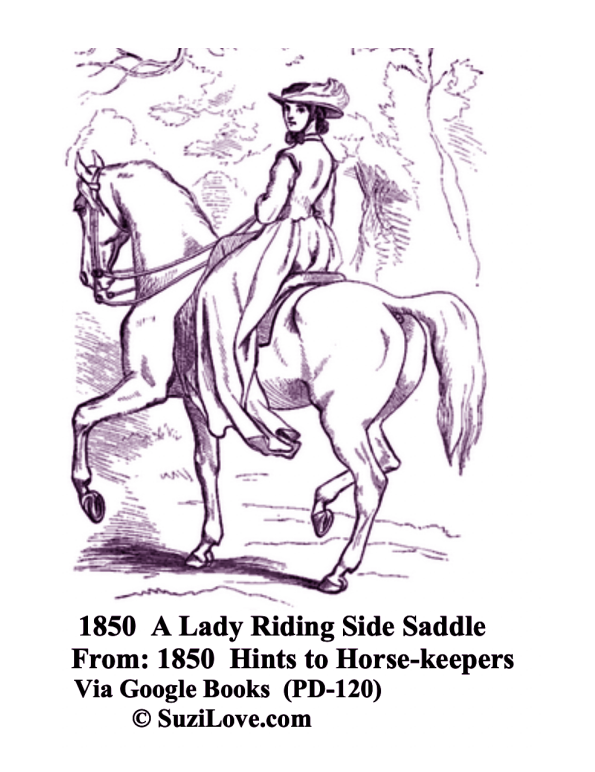
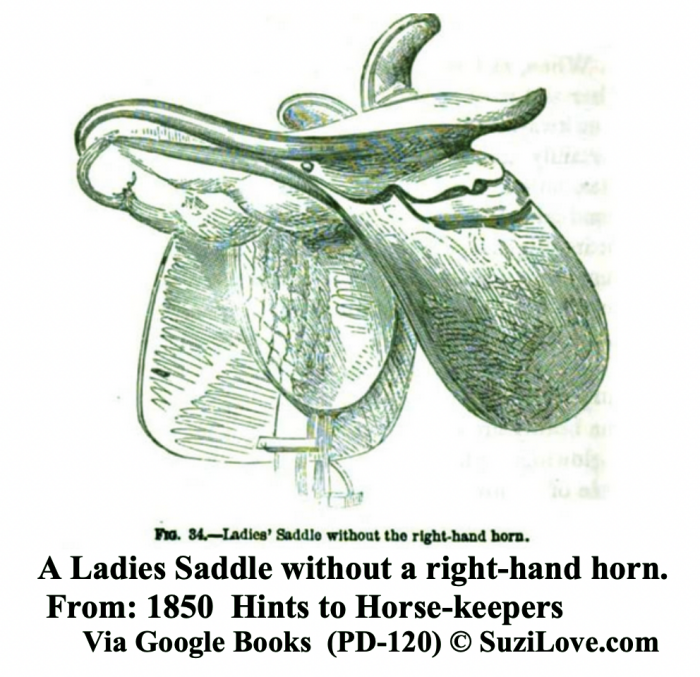
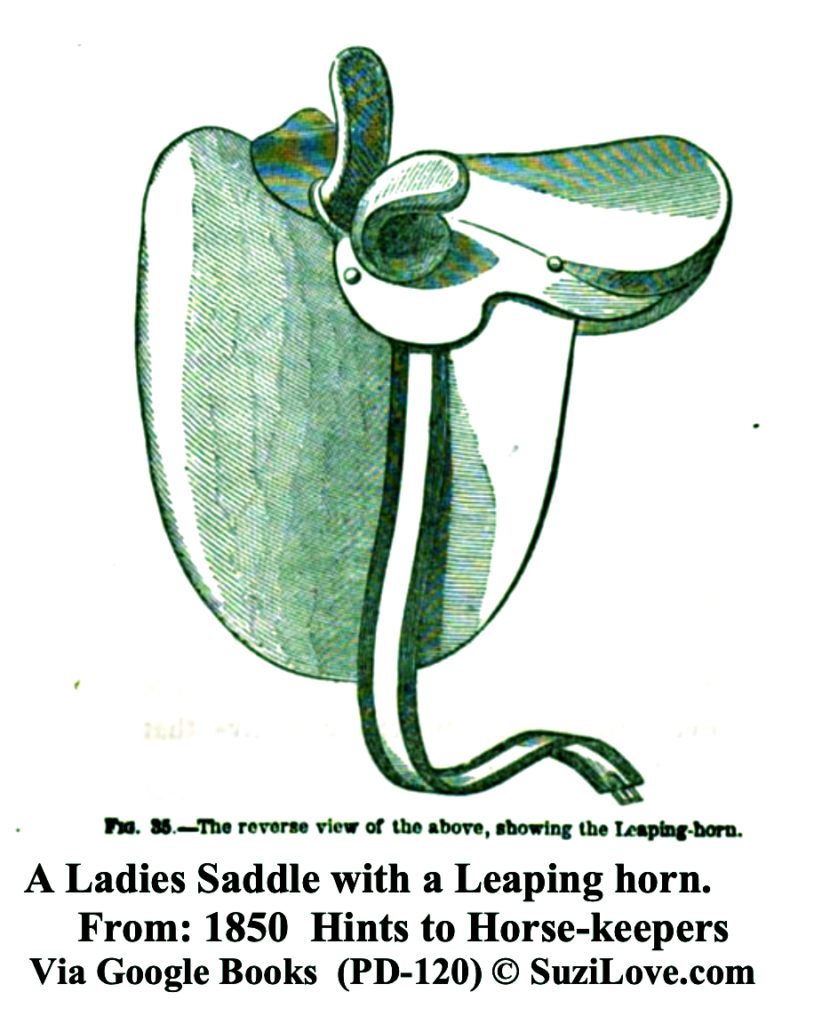
Riding For Ladies During the Regency and Early Victorian years. How did they ride sidesaddle? What did their saddles look like? What did they wear?
From 1850 Hints To Horsekeepers By Henry William Herbert via Google Books (PD150)
Why Every Lady should learn to ride: EVERY lady should learn to ride; not at a mature age, when her frame has become exhausted by a sedentary life and consequent ill health; nor even when, her school-days being over, she is thought to have leisure for wholesome exercise; but in childhood, when her will is strong and her body obedient to it. Particularly in our large cities, too little care is given to the physical culture of young girls. Their minds are engaged, not often with energetic mental work, but with idle thought for dress and show, while no other exercise is taken than a measured daily walk, and occasional dancing and waltzing.
‘Where household labor is disdained, and no opportunity can be afforded for floriculture or any other agreeable out-door occupation, there is no substitute so good as horseback riding. But for the country girl it becomes indispensable. Not her health, perhaps, but her happiness demands it. No woman ever rides so well as one who from childhood has loved her pet colt. She has chased him, perhaps, for hours around a ‘ten-acre lot:’ and when, his frisky mood over, she has been able to take him coaxingly by the inane and lead him to a mounting place, great was the triumph of her wild ride. And no training or care can give the freedom and skill of this youthful practise.
RIDING CLOTHING
Few ladies know how to dress for horse exercise. A head dress should shade form the sun but fit well enough that it needs no adjustment, as the hands are needed for the reins. The Whip, an essential element of the lady’s riding outfit, should be stiff and substantial, without being heavy.
The hair should be arranged in the firmest manner possible. If suited to the style of the lady, it may be plaited at the back and looped across, in a manner which will support the hat and present a very comely appearance. Or it may be found pleasanter to turn all of the back hair to the top of the head, where a high hat is used. All loose arrangements of the hair, except short curb, when they are natural, should be avoided. But few hair-pins should be used, and those long and firmly woven into the hair. The recent fashions of wearing the plumes or feathers of the ostrich, the cock, the pheasant, the peacock, and the kingfisher, in the riding hats of young ladies, are highly to be commended.
Ladies habits are usually made too long and become cumbersome. A foot longer than an ordinary skirt will be sufficient if the material is suitable. Light Cloth will be found the most appropriate for the skirt, if the color be becoming and sufficiently dark. The fashion of a waistcoat of light material for summer, revived from the fashion of the last century, is a decided improvement, and so is the over-jacket, of cloth or seal-skin, for rough weather. It is the duty of every woman to dress in as becoming and attractive a manner as possible; there is no reason why pretty young girls should not indulge in picturesque riding costume so long as it is appropriate.
Many ladies entirely spoil the set of the skirts by retaining the usual impedimenta of petticoats. The best dressed horsewomen wear nothing more than a flannel chemise with long, colored sleeves, under their trousers. If ladies prefer, a quilted skirt, not too full, may be worn. It should be lined with silk or glazed muslin, and will be found no impediment. Long boots are a great comfort and protection in riding long distances.
All ladies who desire that riding should be to them a healthful exercise, must take great care that their dress be perfectly easy in every part, particularly over the chest and around the ribs. Let the boots be easy, and their gloves, which should be leather gauntlets, large and soft, and all elastic bands very loose.
Ladies’ trousers should be of the same material and color as the habit, and if full, flowing like a Turk’s and fastened with an elastic band round the ankle, they will not be distinguished from the skirt. In this costume, which may be made amply warm by the folds of the trousers, plaited like a highlander’s kilt, fastened with an elastic band at the waist, a lady can sit down in a manner impossible for one encumbered by two or three short petticoats. It is the chest and back which require double folds of protection during, and after, strong exercise.
LADY MOUNTING A HORSE
The lady in mounting should be assisted by two persons, one to hold the horse, standing directly in front of him, and holding by the check pieces of the bridle, above the bit, and the other to assist her to her seat.
Having taken the reins and whip in the right hand, she will stand with her face towards the horse’s head, and with her right hand on the left pommel or the saddle. In the left hand she will hold her skirt, in such a manner as to enable her to raise it clear of the ground. The gentleman will stand, facing her, and opposite to the horse’s shoulder, with his left hand holding by his mane, this steadies the horse when the lady springs. The gentleman will now stoop and take the lady’s left foot, which has been raised fifteen inches from the ground, in his right hand, clasping it firmly under the instep. The skirt having been raised to clear the foot, is now dropped, and the lady places her left hand on the gentleman’s right shoulder, giving a spring to straighten the left knee.
During this spring the gentleman will simply keep his hand still, supporting the lady’s weight, but not raising her until the knee is fairly straightened, when he may lift her to the required height, but without trying to push her over on to the saddle. She will find her seat more easily without such assistance, which would often tend to throw her over the horse, rather than on his back. Being seated with her right hand still on the pommel, the lady will, with her left hand, adjust the folds of her skirt. She will then remove her hand from the pommel, and place her right knee over it; when the gentleman will place her foot in the stirrup, and then aid her in taking proper hold of the reins and whip. When this is accomplished, the attendant at the horse’s head steps out of the way, and the lady assumes the control. Fortunately, the operation is less tedious than its description.
LADY DISMOUNTING A HORSE
A lady dismounts with perfect ease. After the groom has taken his place in front of the horse and secured him, by releasing her hold upon the bridle and stirrup and lifting her right leg over the pommel, which she now holds with the right hand, while the left, on the shoulder, or in the hand of her gallant, affords her sufficient support in slipping to the ground.
THE SEAT IN THE SIDESADDLE.
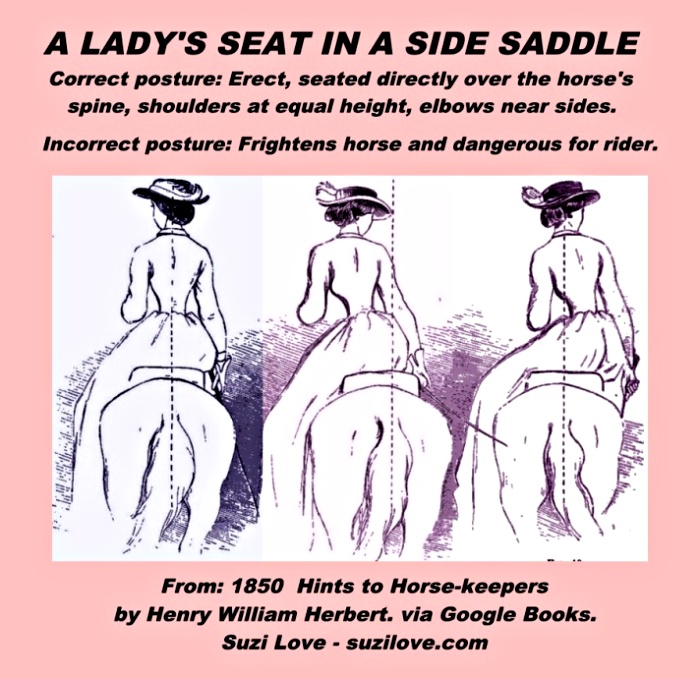
The lady should, by exercises similar to those recommended for gentlemen, endeavor to acquire a perfect independence of the rein-hold in the security of her seat She should be able to lean far to the right or to the left, or lie back on the horse’s haunches, or forward on his neck, and to regain her position without disturbing her seat in the saddle, and without holding by the reins. With the use of the leaping-horn it will be more easy for her to attain perfection, in this respect, than it will be for the man, who must depend in a great measure on the clip of his legs. The rider should be erect, directly over the horse’s spine, the shoulders at an equal height. and the elbows near the sides.
Ladies, particularly those with very small hands, will often find it burdensome to hold their reins both in one hand, as is universally taught in our riding-schools. The best way for a lady is, if her hand be light, to knot up the snaffle and let it rest within her reach, in case of accident to the other rein. Or, if her touch be not delicate enough for the curb, let her hold it lightly and depend on the snaffle. The Whip and the Left Heel are valuable aids to a lady in the saddle. By a proper use of them she is enabled to retain a much freer hold upon her reins. Particularly in stopping and turning they are invaluable. Also, in starting.
ACCIDENTS.
Ladies, of course, should never ride horses which are in any manner vicious. But the best animals are not faultless, nor the most sure-footed always reliable. The lady should therefore be prepared for critical situations. Remember that with a long skirt about her feet, and with little experience in such exercise, it is always unsafe for lady to leap from her saddle. She may disengage herself quickly, but carefully. In a runaway, her place is close down in the saddle, holding the four reins low on either side, and giving an alternate tension to the curb and snaffle, steadying her horse in the road and saving her strength to force him to run long after he would gladly stop.
How many dukes were there in England in 1804? The number varied from year to year, depending on which titles became extinct etc. From: 1804 Kearsley’s Complete Peerage via Google Books (PD-200)
1804 Nine Princes of the Royal Blood, some of whom are Dukes.
Prince of Wales, Duke of York, Duke of Clarence, Duke of Kent, Duke of Cumberland,
Duke of Sussex, Duke of Cambridge, Duke of Gloucester, Prince William.
1804 Eighteen English Dukes, excluding the Prince Royals holding the title of ‘Duke’.
Norfolk, Somerset, Richmond, Grafton, Beaufort, St. Albans, Leeds,
Regency Life Series: Images, information, funny anecdotes give overview of Jane Austen’s and Bridgerton times. #bridgerton #RegencyEra #JaneAusten #BritishHistory https://books2read.com/suziloveROver
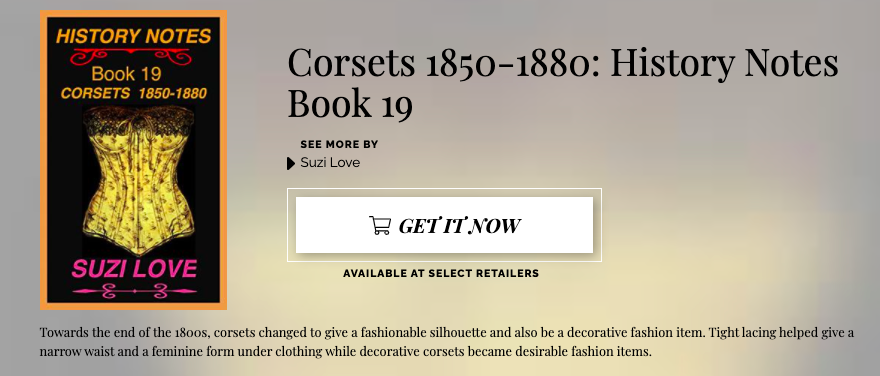
1879-1885 ca. Linen Riding Corset, English. https://books2read.com/SuziLoveCorsetBook19 Woven linen corset, weighs 0.14kg, and worn for riding. Made on a loom with pockets for bones and busk, woven corsets were lightweight, flexible, washable and patented in France in 1832 by Jean Werly. Stitched corsets made from seamed pattern pieces provided more support when on horseback. Manufacturer: Charles Bayer. via Victoria and Albert Museum, London, UK.
Are you a Bridgerton fan? Love Jane Austen? Love history? Take a look at a Young Gentleman’s Day in early 1800s. Young Gentleman’s Day Regency Life Series Books 2 by Suzi Love. Easy to read books on what a young gentleman did, wore, and lived during the early 1800s, or the Regency Era when King George 3rd was mad and his son, Prince George, was the Regent in Britain. #Regency #JaneAusten #amwriting books2read.com/suziloveYGD
What did an older lady do and wear in the Regency Era? Information & pictures for readers and writers of early 1800s history, nonfiction and fiction. books2read.com/suziloveOLD
The older lady’s day usually started with her toilette in her bedroom, where her maid helped her dress for the day and styled her hair. After that, she would join her family downstairs for breakfast unless she preferred a tray with either tea or hot chocolate in her bedroom as she prepared for her busy day. Her day would be made up of speaking with the housekeeper and the cook about the week’s menus, assuring that the servants were all available that day and no one was ill, and checking the list of foods needed. She would also enquire if the laundry was up to date and that they had enough good linen to make up all the beds before extended family members and guests arrived. If she was in the country and hosting a weekend house party, she would assign rooms to the guests on her lists and query that all was in readiness for their arrival.
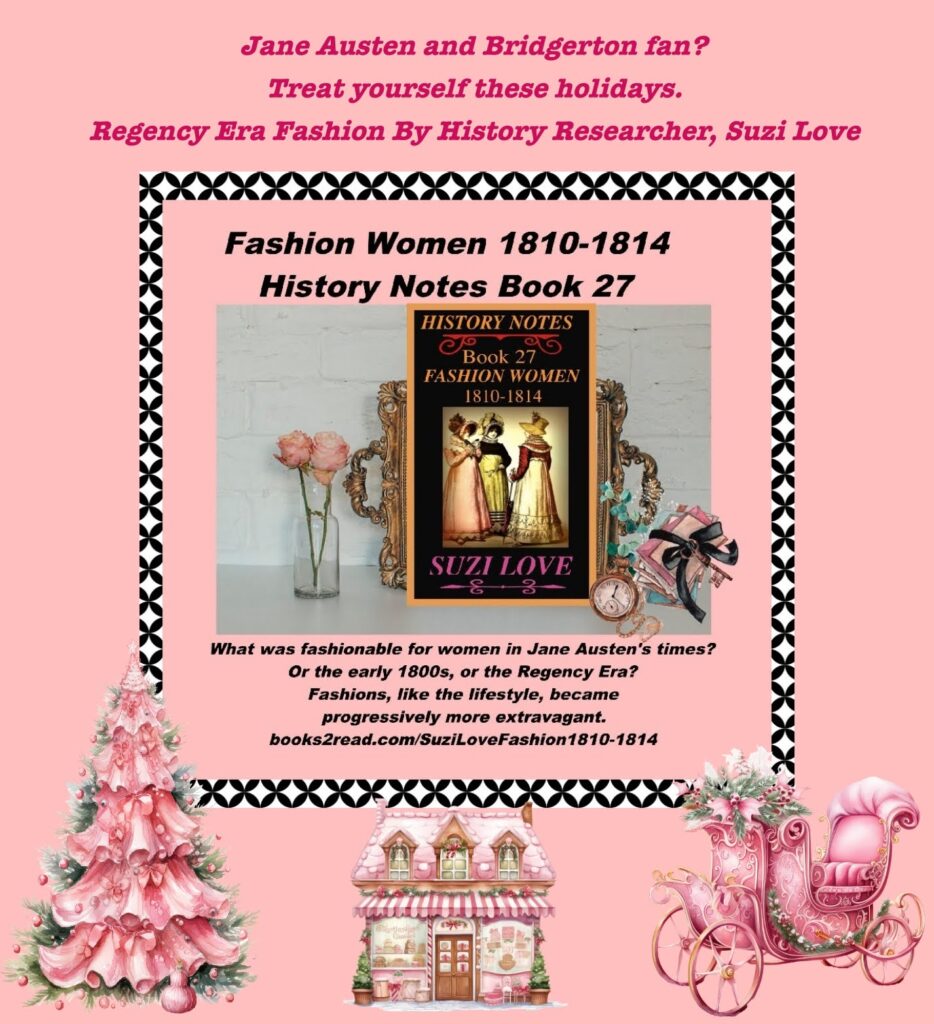
What was fashionable for women in Jane Austen’s times? Mourning, riding, daytime, evening clothing, plus underclothing, corsets and accessories. Fashion Women 1810-1814 History Notes Book 27 This book looks at what was fashionable for women in Jane Austen’s times, or the early 1800s, or the Regency Era in Britain. Wars were being fought around the globe so women’s fashion adopted a military look in support of soldiers. Fashions, like the lifestyle, became progressively more extravagant and accessories went from colorful to over-the-top. https://books2read.com/SuziLoveFashion1810-1814
The Lady’s Magazine said of the basis of women’s fashion that was popular for the first twenty years of the 1800s, ‘White is still the prevailing color for robes. For morning dresses, linen gowns, in large diamonds or squares, are fashionable. Indian muslins, plain or embroidered, are preferred to Florence and satins. The designs of embroidery for shawls are of infinite variety. Long gloves, which reach above the elbow, are not yet laid aside. Medallions are hung around the neck from crossed chains and some of these medallions are shaped like the bags, called ridicules. These reticules are of the lozenge or hexagon shape, with a small tassel at each angle. Reticules, or ridicules, are in lozenge or hexagon shapes with a small tassel at each angle. In capotes, or hats, and ribbands, the violet and dark green prevail over jonquil. Bracelets in hair, pear-shaped ear-rings, medallions on square plates, saltiers of colored stones, are still in fashion.’
The 26th December was St. Stephen’s Day, the first Christian martyr and patron saint of horses, so Boxing Day became associated with horse racing and sports. It was also when the English churches alms boxes were opened and the contents given to the poor of the parish. In the song Good King Wenceslas, the king gave the poor man meat, wine and wood “on the feast of Stephen.” Written by John Mason Neale and first published in 1853, the lyrics celebrate the spirit of Boxing Day which was generosity. King Wenceslas watches a poor man “gath’ring winter fuel. and he then brings the peasant food and logs for his fire. In parts of Europe, St. Stephen’s Day is considered the second day of Christmas.
On the Boxing Day holiday, servants, apprentices, and the poor were presented with gifts. The origin of the holiday is unknown, but was probably first observed in the Middle Ages and the name may come from the opening of alms boxes that had been placed in churches over the holidays for distribution to the poor. It may also be because servants opened their gift boxes on the day after Christmas because on Christmas Day they were busy cooking and serving a large festive meal for their employers. December 26th is also the feast day of St. Stephen, the first Christian martyr and patron saint of horses, so Boxing Day has now become associated with horse racing and sports.
One of the earliest records of these box gifts dates from 1663. In an entry in his diary, English Parliamentarian Samuel Pepys writes that he sent a coach and messenger to his shoemaker to deliver “something to the boys’ box against Christmas” in addition to funds to cover his bill. During Queen Victoria’s reign, Boxing Day became a chance for church parishioners to deposit donations into a box that was put out for the purpose by the clergyman. The money in the boxes was given to the poor.
Some villages followed the custom of the Hunting of the Wren, where small boys captured a wren, killed it, and then mounted it on a pole and carry to every house in the village while singing a song. Money collected was used for a village dance. In London, and in many other parts of Europe, large families and establishments keep regular lists of tradesman’s servants, apprentices, and other persons, who come about making a sort of annual claim on them for a Christmas box on this day.’
‘The custom of annual donations at Christmas, and on New Year’s-day, is very ancient, being copied by the Christians from the Polytheists of Rome, at the time the public religion was changed. These presents, now-a-days, are more commonly made on the morrow of Christmas. From this circumstance the festival of St. Stephen has got the nickname of Christmas Boxing-day, and by corruption, Boxing-day.’ From:- The Lady’s Monthly Museum, Vernor & Hood: Christmas-boxes, 1824.
‘On the day after Christmas, tradespeople are visited by persons in the employment of their customers for a “Christmas-box,” and every man and boy who thinks he is qualified to ask, solicits from those on whom he calculates as likely to bestow. A writer, in 1731, describes Boxing-day at that time from his own experience. ” By that time I was up, my servants could do nothing but run to the door. Inquiring the meaning, I was answered, the people were come for their Christmas-box : this was logic to me; but I found at last, that, because I had laid out a great deal of ready-money with my brewer, baker, and other tradesmen, they kindly thought it my duty to present their servants with some money for the favor of having their goods. This provoked me a little; but being told it was ‘ he custom,’ I complied. These were followed by the watch, beadles, dustmen, and an innumerable tribe; but what vexed me the most was the clerk, who has an extraordinary place, and makes as good an appearance as most tradesmen in the parish; to see him come a boxing, alias begging, I thought was intolerable: however I found it was ‘ the custom’ too, so I gave him half-a-crown; as I was likewise obliged to do to the bellman, for breaking my rest for many nights together.’ From The Every-day book and table book by William Hone, 1839
Boxing Day is one of the many customs and traditions associated with Christmas that is featured in History of Christmases Past (Book 1 History Events) by Suzi Love.