1845-1865 ca. Black Faille Evening Slippers, French. Designed By Melnotte for Department Store J. Petit. Black slippers, which went with anything, were an essential for mid 1800s fashionable ladies. Generally made of satin so dull faille fabric is unusual so possibly for mourning. Label written largely in French of London shop, exclusive agent, plus other fashionable imported Parisian accessories. via Metropolitan Museum, NYC, U.S.A. metmuseum.org
Regency London 1820 The English Metropolis By John Corry Via Google Books (PD-180)
This great metropolis is sixty miles distant from the sea; it is built on the banks of the river Thames; is about seven miles in length, from east to west, but of an irregular breadth, being in some parts two miles, in others three, and at the broadest part four miles. Its three distinct and municipal divisions are, the city of London, the city of Westminster, and the borough of Southwark, which, with their extensive suburbs, cover a space of more than twenty miles in circumference. According to the Population Return of 1811, this metropolis then contained 149,430 houses, including those building and uninhabited; and since that period there have been but few new houses built, so that the real number is probably not more than 150,000.
In the year 1801, the population of London was ascertained to be 900,000. The number in 1811, amounted to 1,009,546. Beneath the pavement large arched sewers communicate with the houses by smaller ones, with the street by small openings covered with iron grating, and with the Thames, which contributes much to the cleanliness and health of the inhabitants of this populous place. Houses on each side of these streets are lofty, spacious, and commodious, generally four stories high, and chiefly occupied by tradesmen, whose shops present the most beautiful and perfect productions of nature and art for the general accommodation of man, There are two extensive lines of commercial streets from east to west, the principal of which begins at Mile End, and thence through Whitechapel, Aldgate,Leadenhall-street, Cornhill, Cheapside, St. Paul’s Church-yard,Ludgatehill, Fleet-street, the Strand, Pall Mall, St. James’s-street, and’ Piccadilly, to the southern side of Hyde Park. But besides these numerous storehouses of merchandise, there are also many thousand shops in various directions. Ample supplies of water afforded by the Thames And New River Water-works, are essentially conducive to the health and comfort of the inhabitants.
St. Paul’s Church is the most magnificent. It is situated near the northern bank of the Thames, and when viewed from Blackfriar’s Bridge in the vicinity, presents one of the noblest ornaments of superb architecture ever beheld by the human eye. This beautiful cathedral is built of Portland stone, in the form of a. cross, adorned in the central part by a lofty dome, on the summit of which is a light and elegant lantern, ornamented with Corinthian columns, and surrounded by a balcony. Next to St. Paul’s cathedral for magnificence, and even greater in extent, is that fine monument of gothic architecture Westminster Abbey, or the collegiate church of St. Peter.Among the modern churches that of St. Mary-le-Bone is remarkable for a spacious and stately portico composed of eight columns and two pilasters of Portland stone, in the Corinthian order. This church is built north and south, and the northern front, which is opposite the Regent’s Park.
The Tower of London, which has been the scene of many a tragic and affecting event, is the only fortress in the city. It is situated on the northern bank of the Thames, eastward of London Bridge, contains the Jewel Office, Mint, three armouries, and the royal train of artillery. The menagerie, near the west entrance, has for ages been a principal object of attraction to rustic visitors, who on their arrival considered it indispensable to see the lions.
1817 White Percale Dress, French. Dress has layers of decoration above hem, black velvet Spencer, or jacket, wide brimmed straw hat trimmed in blue, neck scarf and walking shoes. Fashion Plate via Journal des Dames et des Modes, or Costume Parisien.
Definition Spencers: Short jackets worn for warmth over the high-waisted Empire style gowns said to have originated when Earl Spencer tore the tails off his coat in a hunting accident. In support of military men fighting wars everywhere, fashions for Spencers leaned towards military style embellishments, such as loops, buttons, and braids. Puffed sleeves over long straight sleeves were also very popular. Jane Austen and her friends and family wore Spencers over their high-waisted dresses.
Definition Empire Style Dress: Named after the First Empire in France. Empire dresses had a low neckline and skirts started directly under the bust and flowed into the classical relaxed wide styles of Greece and Rome. This style of dress is associated with Jane Austen and her contemporaries as a high-waisted dress was worn most days. Cotton, silk or taffeta were the popular fabrics. Only the very wealthy could afford white dress in this style as the cottons were imported from India and had to be carefully cleaned, usually by a lady’s maid.
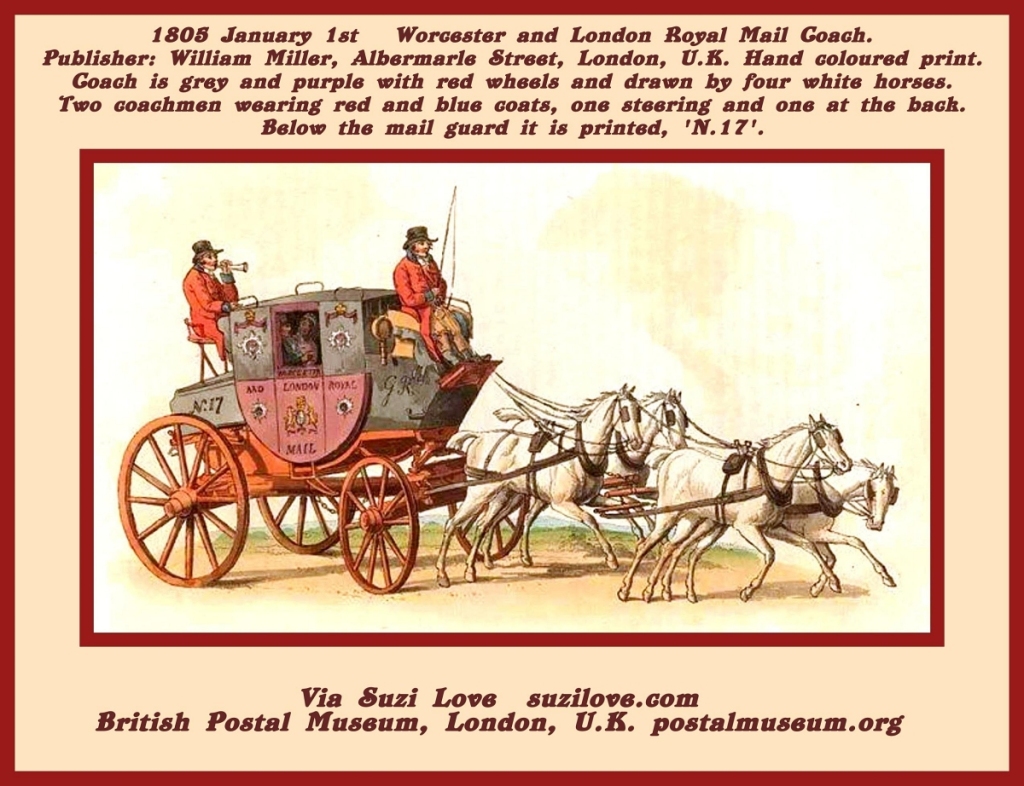
11805 January 1st Worcester and London Royal Mail Coach. The sort of mail coach that Jane Austen and famioy would have either ridden in or sent mail through. Publisher: William Miller, Albermarle Street, London, U.K. Hand colored print. Coach is grey and purple with red wheels and drawn by four white horses. Below the mail guard it is printed, ‘N.17’. Via British Postal Museum, London, U.K. postalmuseum.org
1807 June Couple In Morning Dress, English. Lady in white dress with lemon cape and an interesting white hat with a tassel. Gentleman in black tailcoat, white shirt and cravat, breeches tucked into high black boots with tan tops, fob and watch chain at his waist, black top hat and cane. via Le Beau Monde, or Literary and Fashionable Magazine, London, U.K.
Definition Morning Dress: Comfortable outfits worn either at home, out shopping, or for walking in the park or country. Presentable but not overly accessorized. For women it was often an Empire style, high-waisted, gown made from sprigged or plain muslin, cotton, or wool and either a Spencer or a coat to cover it for warmth, plus shoes and a bonnet. For men it was breeches or trousers, shirt, cravat, coat, boots and hat. This couple is dressed as a lady and gentleman of Jane Austen’s acquaintance would dress for a morning outing to a village, for shopping, or visiting friends.
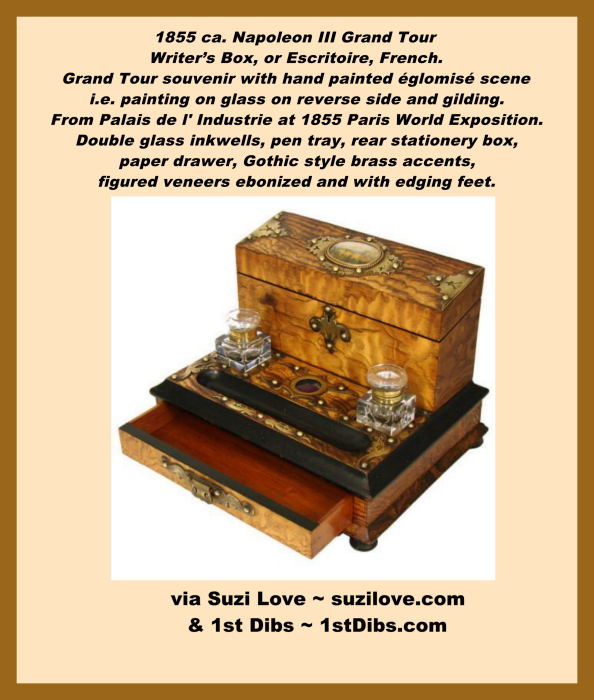
1855 ca. Napoleon III Grand Tour Influenced Travel Writer’s Box, Or Ecritoire, French. Double inkwell with rear stationery box, Gothic style brass accents and Grand Tour souvenir hand painted eglomise scene, the Palais de l’ Industrie from the 1855 Paris World Exposition! Figured veneers, ebonized edging, feet and pen tray and brass or bronze accents. via 1st Dibs 1stdibs.com
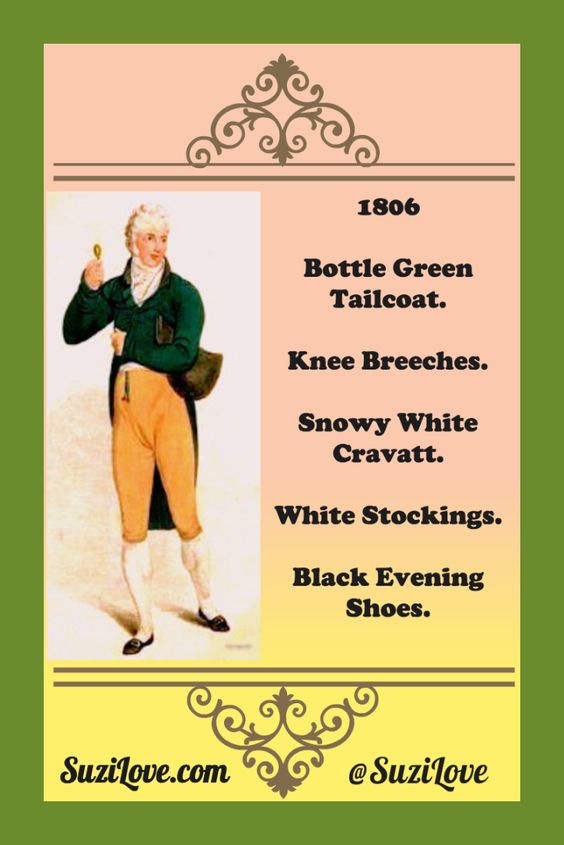
1806 Gentleman’s Daily Outfit, French. Bottle green tailcoat, knee breeches, snowy white cravat, white stockings, flat black shoes. Fashion Plate via Journal des Dames et des Modes, or Costume Parisien. French fashions and Georgian and Regency Era fashions from Great Britain were copied around the world. This is the normal daily outfit for a gentleman in the early 1800s, or in the times of Jane Austen, for daily city and country life. https://books2read.com/SuziLoveFashionMen1800-1819
1817 September Glengary Riding Habit, English, as would have been worn during Bridgerton and Jane Austen’s times. Pale blue cloth, richly ornamented with frogs and braiding, front braided on each side and fastens under the body of the habit, which slopes down on each side to define the figure. Epaulettes and jacket are braided to correspond with the front as is the bottom of the sleeve which is braided nearly half-way up the arm. Habit shirt is of cambric with a high standing collar and trimmed with lace. Cravat of soft muslin is richly worked at ends, tied in a bow, narrow lace ruffles at the wrists. Headdress is a Glengary cap of blue satin, trimmed with plaited ribbon of various shades of blue and a plume of feathers. Blue kid gloves are worn and half-boots. Fashion Plate via Rudolph Ackermann’s ‘The Repository of Arts’.
Male tailors made most women’s riding habits during the Regency years and they were constructed similarly to men’s riding outfits. Generally in two pieces, a jacket and a skirt, and with a shirt with a frilled collar or front opening underneath. The trains of a habit could be caught up for walking, usually with a button and loop, and unhooked and let down so that the skirt flowed over the woman’s legs when she rode side saddle. Due to the numerous wars during the early 1800s, it was seen as patriotic for women to add military style touches to outfits in support of military men. The shoulder and cuff trims resemble the epaulettes and coat trims of a military uniform.
1818 September 18th Le Palais Royal de Paris. ‘A Peep at the French Monstrosities’. Two English tourists dressed as dandies walk arm-in-arm under the arcade of the Palais Royal, interested in the promenading courtesans. Their dress is rather similar to that of the Englishmen, but the latter wear bell-shaped top-hats, while the Frenchmen have flower-pot shaped hats. By George Cruikshank. Via British Museum, London, UK. britishmuseum.org (PD-Art)