1800’s Flat men’s shoes, presumably part of the livrée-like Römer servant’s uniform of the type worn until 1866. via historisches-museum.frankfurt.de
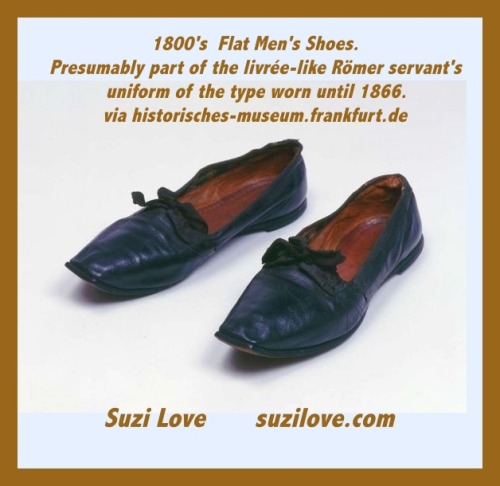


1800’s Flat men’s shoes, presumably part of the livrée-like Römer servant’s uniform of the type worn until 1866. via historisches-museum.frankfurt.de
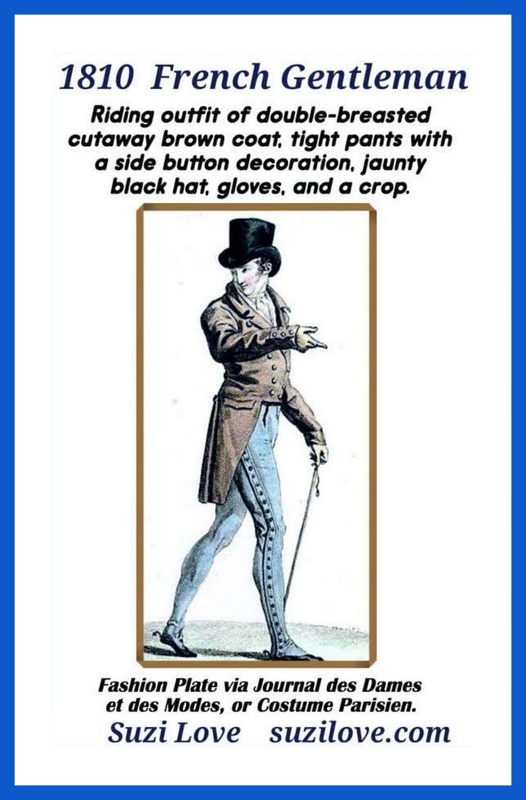
1810 French Gentleman. Riding outfit of double-breasted brown coat, tight pants with a side button decoration, jaunty black hat, gloves, and a crop. Fashion Plate via Journal des Dames et des Modes, or Costume Parisien.
In the early 1800s, men no longer wore complicated styles and extravagant fabrics. Men’s fashion simplified and became more conservative. A well cut tailcoat, vest, pantaloons and an immaculate cravat of beautiful white linen in the style of George Bryan, or Beau, Brummell. Clothes were a status symbol and indicated a man’s social position. These clothing items were the sort worn by Jane Austen’s male family and friends.


Almack’s Assembly Rooms often appear in Regency Era romances as they were a well known gathering place for those in the Ton looking for wives or husbands. 1770-1840 . Almack’s or Willis’s Rooms, King Street, St James, London, UK. Almack’s Assembly Rooms, founded by William Almack at No. 26-28, were on the site of the present Almack House. The club was originally a gaming establishment but moved from Pall Mall. The Assembly rooms were on the South side of King Street in St James’s and were opened on February 12, 1765. At the time the subscription was ten guineas for which there was a ball and supper each week for the twelve weeks of the season.
Assemblies were held on Tuesdays and Thursdays, but only four or five times a season. Dates were listed in the paper along with the names of the Patronesses. When Lady Jersey took over Almack’s around 1815, assemblies were changed to Wednesdays. Many aristocrats were reportedly offended by something that happened at Almack’s but Lord Jersey is reported to have refused to duel over any inferred slights because it would have meant he was forever involved in a duel. The other well-known Patronesses were Lady Bathurst and Lady Downshire.


1765-1840 ca. Almack’s, or Willis’s, Assembly Rooms, South Side Of King Street, St James, London. commons.wikimedia.org

1800s Early Exterior of Almack’s Assembly Rooms, London, UK.
Captain Gronow, an army officer in London around 1814, wrote about the rules of Almack’s in Captain Gronow’s Recollections and Anecdotes, 1864 , but only gives his views on a few years of Almack’s history.


1809 Wedgwood and Byerley showrooms for Wedgewood china, York Street, London, UK. Plate via Rudolph Ackermann’s Repository of Arts. The premises of master potter Josiah Wedgwood in York Street, St James’ Square, London, U.K. Wedgwood china was known for its high quality, beautiful glazes and Wedgwood trademark printed on the back of each item. The London show-room was managed by Thomas Byerley, who also held a quarter share of the business. From 1790 to 1810 the firm was known as Wedgwood and Byerley.

1816 Ball Dress, French, as worn by the Bridgertons and Jane Austen. White short length dancing dress, multiple frills above hem, black bodice with a back bow, hair braided and pinned into an upswept evening style. Fashion Plate via Journal des Dames et des Modes, or Costume Parisien.
Women’s clothing came in the late 1810s came in a wide range of styles to suit every season and occasion. When attending assemblies or balls, ladies in Jane Austen’s times women wore Empire style dresses which were usually of light fabric and floaty in style and often of a shorter length suitable for dancing.


1809 Women’s Fashions: Dresses, Shawls, Hats and Jewelry from various fashion magazines. Typical of the outfits worn by Jane Austen and her contemporaries for daytime and evening activities. An Empire style, or high-waisted white cotton dress worn under a Spencer or short jacket, a Redingote, or coat, for warmth and with pretty hats, shawls and shoes.


Custom House, London. From 1825 Views Of London. The Custom-House of London appears to much advantage in the accompanying view. Flanked by the little navy of Billingsgate, with a glimpse of the dome of St. Paul’s, the Monument, and London-Bridge in the distance, it stands forward in majestic composure on the edge of the Thames. The first stone of this building was laid on the Twenty-fifth of October, 1813, the fifty-third Anniversary of his late Majesty’s Accession, and it was opened for business on the twelfth of May, 1817; the old Custom-House in the interim (February, 1814) having been consumed by fire. It is built after a plan by David Laing, Esq. and cost in the erection 167,000 pound besides 29,300 pound paid for the property on which it stands, after deducting 12,440 pounds received for old materials. The length of the front here presented, which is executed in Portland stone, is 484 feet, 101 inches. The architectural beauties of the Custom House consist in an appropriate simplicity of style, combined with a classical adherence, throughout, to the rules of just proportion. As the Official Registry of the exports and imports of the State, where the complicated concerns of the mercantile interests of this vast Empire are reduced under a few general heads, it imparts a profound moral attraction to the scene.
1825 Custom House, London. From 1825 Views Of London. #London #BritishHistory #England https://books2read.com/suziloveROver Share on X
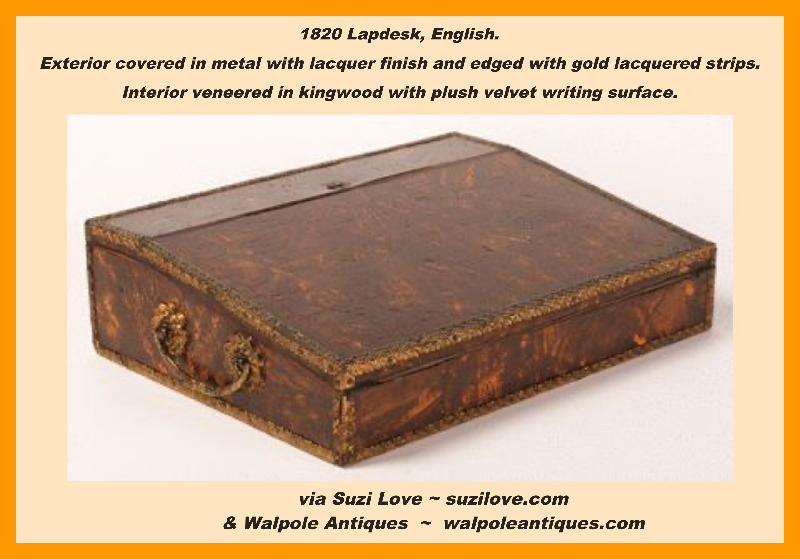
1820 Lapdesk, English. Exterior covered in metal with a lacquer finish and edged with stamped and gold lacquered brass strips. Interior veneered in kingwood with plush velvet writing surface. walpoleantiques.com

The first wedding rings can be traced back to the Ancient Egyptians when they exchanged rings made from braided reeds and hemp. The tradition of exchanging rings dates back 3,000 years. The first diamond wedding ring was recorded in the will of a widow who died in 1417. The ancient Egyptians believed in the vena amoris, literally the “vein of love” that runs directly from the heart to the fourth finger on the left hand. For the Ancient Greeks, the engagement ring was symbolized with a plain gold band worn on the left hand and at the marriage the same band was shifted to the right hand.
An engagement ring is given at a proposal or when a couple decides to get married whereas a wedding ring is exchanged at the wedding ceremony and represents the official bond of marriage and the binding pledge between spouses. Wedding rings symbolise eternal love and commitment within a relationship and are worn to show the world they are married. During the wedding service, the couple will say their vows to each other while exchanging rings.
Is a wedding ring biblical? : The use of wedding ring is not commanded in the Bible, and there is no indication that it was ever practised in the New Testament. The use of finger ring in the Bible was as a symbol of authority.
Betrothal ring: An old Roman custom confirming that the marriage contract would be carried out. It was the first part of a dowry given, and meant the woman was no longer for sale as the first part of the monetary settlement had been paid. The first betrothal, or engagement, rings were given because there was often a long time between betrothals and weddings. These were usually simple bands of gold, silver, or iron as on royalty or very wealthy people could afford gemstones and diamonds. In 1477, Archduke Maximillian of Austria commissioned the very first diamond engagement ring for his betrothed, Mary of Burgundy, and many of the European aristocracy and nobility followed his lead.
Wedding ring: Many primitive peoples who believed in magic used a rope around the waist or the hand and feet, and later a ring, to symbolise that the bride was captured and spoken for, and also to ward off any evil spirits hovering around the bride and ensure marital bliss.
The ring hand: A symbol of the humiliating tradition of the man as the master – the right hand of the family – and the woman being the slave . The right hand stood for power and authority while the left hand expressed submission and serfdom.
The ring finger : Ancient Greek and Roman anatomists believed a vein, the vena amoris or the “vein of love”, or a nerve led from the heart to the third finger, the healing finger , so they romantically linked this finger to the heart. Now we know that this is not true and there is no vein that runs from our ring fingers to our hearts. There are also some more practical reasons the third finger continues to be used. It’s the most prominent for displaying a ring and it cannot be extended to its full length on its own and usually remains slightly bent, preventing the ring slipping off.
The Wedding Ring: Also goes on the left ring finger because it is the only finger with a vein that connects to the heart although some countries, such as India, Germany, Spain, Norway, and Russia traditionally wear their wedding rings on their right hand.
Viking Wedding Rings: These were mostly made of silver and bronze and rarely of gold with the designs inspired by Norse Gods, geometric shapes, runes, and animal totems
Gimmel Rings: In the 16th and 17th centuries, European husbands gave their bride a gimmel ring with two interlocking bands. The bride and groom both wore one after their engagement and during the wedding ceremony the rings were joined and the wife wore the ring.
World Wars: During the first World War, many men on the front began wearing wedding rings as a remembrance of their wives and families at home. That custom carried through to World War Two so in the 1950s wedding rings for men became common practice.
Tri-Gold Rings: Gold is the traditional ring metal but some people prefer a mix of colors. Yellow gold represents fidelity, rose gold romantic love, and white gold friendship, so a tri-gold ring symbolizes your shared past, present, and future path. ding ring to symbolize all three, as well as your shared past, present, and future path.
Black Wedding Rings: Some couples choose black wedding bands because they represent everlasting commitment and the color can also mean power, strength and sophistication.
Anniversary or Push Ring: Given on the birth of a first child or an anniversary, usually an important one such as the first, five-year or 10-year anniversary.
Wedding ring customs that originated in long ago history. #weddings #Customs #history Share on X