1660-1700 ca. Gaming Purse, Probably French. Green velvet trimmed with copper-gilt thread. Gaming or gambling with cards popular 17th-century pastime and any gentleman or lady not playing games like Quadrille and Basset would have been considered ‘low-bred and hardly fit for conversation’ according to ‘The Compleat Gamester’, published in 1674. Typically, gaming purses had flat, circular bases with sides gathered on a drawstring. via Victoria and Albert Museum, London, UK. collections.vam.ac.uk.
1789-1790 ca. Man’s Red Riding Coat, England or France. Wool plain weave, full finish, with metallic-thread embroidery, tan breeches, black riding boots and crop. Credit: (M.2007.211.46) via Los Angeles County Museum of Art, California, USA. collections.lacma.org
Hessian Boots: In the 1790s, British Army officers wore boots called Hessians, named after German mercenaries who fought alongside the British in wars, including in the Irish Rebellion of 1798. The soldiers from the German state of Hesse were called Hessians and their boots took their name from Hesse, where they were made. The Hessian boot was made from soft, highly polished calfskin, knee high, curved top and with a V cut at the front and often had a decorative tassel.
They were shaped like a stirrup so the rider could easily insert their feet into the stirrups and the feet were kept securely in place. But tassels on Hessian boots were designed for wearing with breeches and didn’t suit tight fitting and fashionable new trousers that dandies like Beau Brummell wore in 1800s and so were replaced by Wellington Boots.
In 1823, the New Monthly Magazine had a comical story about tight pantaloons and Hessian boots being a perfect pairing. ‘…. tight pantaloons without Hessian boots were as preposterous as a haunch of venison without currant-jelly, or a leg of pork without peas-pudding.’ https://books2read.com/SuziLoveFashionMen1800-1819
1816 July Opera Dress, English. Dress of white lace worn over a rich soft white satin slip. Skirt trimmed in a style of peculiar elegance, with lace festooned at regular distances, festoons edged by plain band of byas satin and finished by pearl ornaments of a very novel and pretty shape. Lace body is cut byas and richly ornamented round the bosom with pointed lace. Plain long sleeve, very full, except towards the wrist, which is nearly tight to the arm, and elegantly finished with lace. Hair ornamented with a wreath of French roses, parted in front, and simply dressed in loose curls, which fall very low on each side. Hind hair forms a tuft at the back of the head. Necklace, ear-rings, and bracelets of pearl. White satin slippers, and white kid gloves and a blush colored French silk scarf. Fashion Plate via Rudolph Ackermann’s ‘The Repository of Arts’.
Gorgeous Regency Era clothing came in a wide range of styles to suit every season and occasion. Ladies in the Bridgerton series and in Jane Austen’s times wore Empire style dresses which were usually made of light fabric and floaty in style. By the later 1810s, stripes were very popular and lace and frills were added to make the dress more individual.
19th Century Early Reticule, Or Bag, New England, England or U.S.A. Septagonal, or four sided, with embroidery and silk tassels. White satin embroidered with polychrome silks, silver threads, silver sequins. On front, in center of wreath of roses tied with blue bow, is written VALUE THE TRIFLE. On back, in similar wreath, is FRIENDSHIP. On sides are floral motifs, one of sweetpeas and the other of pansies. On all sides a border of silver threads in chain motif entwined with curling brown vine. Primarily worked in satin stitch. Thirteen silk tassels attached. White ribbon ties. via Museum of Fine Arts, Boston, U.S.A. mfa.org
Definition Reticule Or Ridicule Or Bag or Purse: Often with a drawstring to pull closed and usually made of cloth or covered cardboard and often decorated with beading or embroidery. A reticule, or purse, or handbag, was usually carried by a woman during the Regency period to carry all their daily necessities. Earlier, women used pockets that tied at the waistline and were hidden in the folds of their skirts. Empire style, or early 1800s, high-waisted dresses made it impossible to either sewn in a pocket or to tie on a pocket. So women began carrying small, decorated bags called Reticules, or ridicules, which generally pulled close at the top with a drawstring.
1820 ca. Silk Spencer, British. Made of silk and willow. Short length, long sleeves, extensive decoration on shoulders, sleeves and wrists. Military style braiding on the spencer in support of all the soldiers fighting wars across the world. The sort of jacket worn by fashionable Regency ladies over their light and flowing Empire dresses. Credit Line:Catharine Breyer Van Bomel Foundation Fund, 1987 via Metropolitan Museum New York City, U.S.A. metmuseum.org
Definition Spencer: Short jackets cut to match the high waistlines of Empire dresses. They often copied military styling, such as braiding, shoulder decoration, buttons and loop fasteners, and wrist adornments. They were generally of complex construction, often with a diamond shaped piece in the back. Said to have originated in an accident to Lord Spencer while hunting when his coat tails were torn off and he wore it as a short jacket.
1820 ca. Spencer, British. Silk and willow. Front View.1820 ca. Spencer, British. Silk and willow. Back View. 1820 ca. Spencer, British. Silk and willow. Sleeve View. 1820 ca. Spencer, British. Silk and willow. Sleeve Decoration View. 1820 ca. Spencer, British. Silk and willow. Braiding View. 1820 ca. Spencer, British. Silk and willow. Wrist View.
1820 ca. Military Style Silk Spencer With Braiding In the Style of the Bridgertons and Jane Austen. #Bridgerton #JaneAusten #RegencyFashion #BritishHistory books2read.com/suziloveSpencers
HN_4_Spencers, Or Jackets. #Regency #Georgian #Victorian #Fashion History Notes Book 4 By Suzi Love.
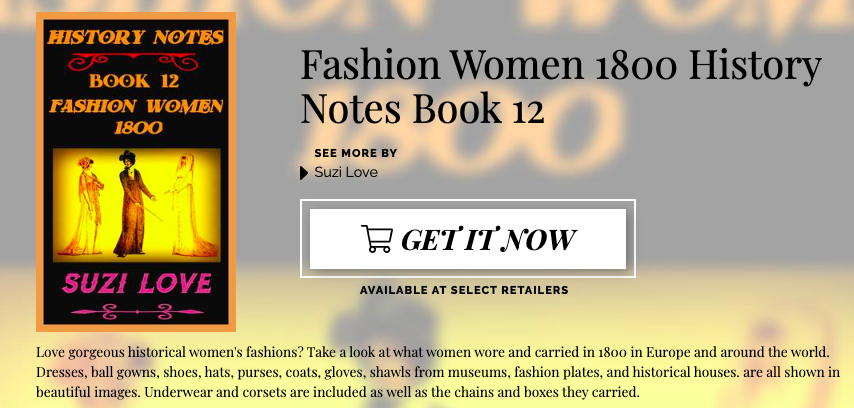
Fashion Women 1800 By Suzi Love History Notes Book 12 #Regency #Fashion Love gorgeous historical women’s fashions? Take a look at what women wore and carried in 1800 in Europe and around the world. This is the world Jane Austen lived in and the fashions she wore. books2read.com/SuziLoveFashionWomen1800
Women’s dress changed dramatically after 1785. The rich fabrics and complicated, formal shapes of the late 18th century gave way to simple, light fabrics that draped easily. These new gowns achieved something of the effect of the simple tunics shown on classical Greek and Roman statues and vases. Inspired in part by the statuary of ancient Greece and Rome, the new fashion was epitomised by light cotton gowns falling around the body in an unstructured way, held around the high waist with a simple sash and accompanied by a soft shawl draped around exposed shoulders. This style was ideal for the Indian imports like Kashmiri shawls and Bengali muslin, as used in this embroidered gown. Championed by such influential figures as Emma Hamilton in England and Madame Récamier in France, the so-called ‘Empire’ style catapulted Indian muslin into the forefront of fashion.
Empire Dress: Owes its name, physical emancipation, popularity, and even its sexiness to France. In this English example, French style is slavishly followed in the gown’s high waist and modish stripes.
Empire style, or early 1800s, high-waisted dresses made it impossible to either sewn in a pocket or to tie on a pocket. So women began carrying small, decorated bags called Reticules, or ridicules, which generally pulled close at the top with a drawstring.
Inspired in part by the statuary of ancient Greece and Rome, the new fashion was epitomised by light cotton gowns falling around the body in an unstructured way, held around the high waist with a simple sash and accompanied by a soft shawl draped around exposed shoulders. This style was ideal for the Indian imports like Kashmiri shawls and Bengali muslin, as used in this embroidered gown. Championed by such influential figures as Emma Hamilton in England and Madame Récamier in France, the so-called ‘Empire’ style catapulted Indian muslin into the forefront of fashion.
Reticule Or Bag: Purse, often with a drawstring to pull closed and usually made of cloth or covered cardboard and often decorated with beading or embroidery. Carried by a woman during the Regency period to carry all their daily necessities. in the place of pockets.
Spencer: Short jacket, cropped at the waist, worn over a dress, or gown. Delicate and regency dresses provided so little protection from the cold, so over garments were essential for warmth, modesty and good health.
Pelisse Or redingote Or Walking Dress: Coat worn over clothing of both sexes for warmth and protection from the elements.
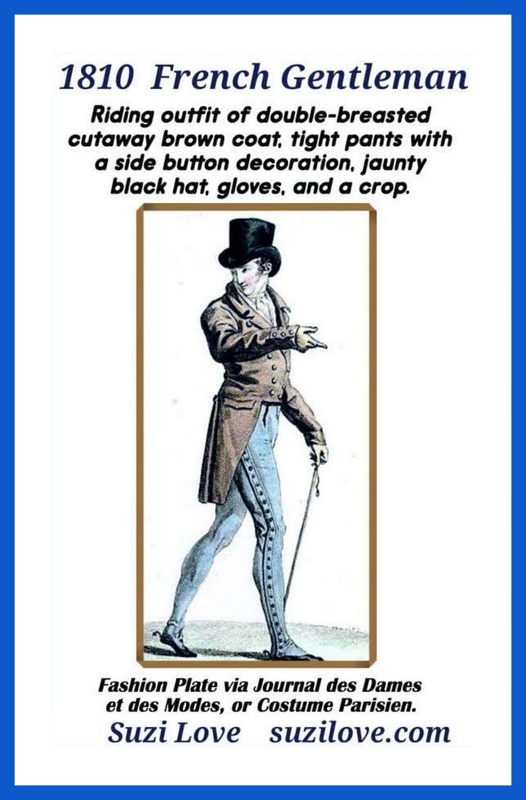
1810 French Gentleman. Riding outfit of double-breasted brown coat, tight pants with a side button decoration, jaunty black hat, gloves, and a crop. As Worn by Gentleman in the Bridgerton and Jane Austen Families. Fashion Plate via Journal des Dames et des Modes, or Costume Parisien.
Pantaloons: When tailcoats lengthened, breeches extended below the knees to accommodate the longer tails and were gradually replaced with slimmer fitting, longer pants, or pantaloons, that ended at the ankle. Pantaloons were close-fitting and sometimes buttoned all the way down the leg. To make them hug the leg tighter, knitted fabrics were used, or fabrics like nankin and kerseymere were cut on the bias.
In the early 1800s, men no longer wore complicated styles and extravagant fabrics. Men’s fashion simplified and became more conservative. A well cut tailcoat, vest, pantaloons and an immaculate cravat of beautiful white linen in the style of George Bryan, or Beau, Brummell. Clothes were a status symbol and indicated a man’s social position. These clothing items were the sort worn by Jane Austen’s male family and friends.