“The more I know of the world the more I am convinced that I shall never see a man whom I can really love. I require so much!” Jane Austen ~ Sense and Sensibility (1811)
“The more I know of the world the more I am convinced that I shall never see a man whom I can really love. I require so much!” Jane Austen ~ Sense and Sensibility
(1811)
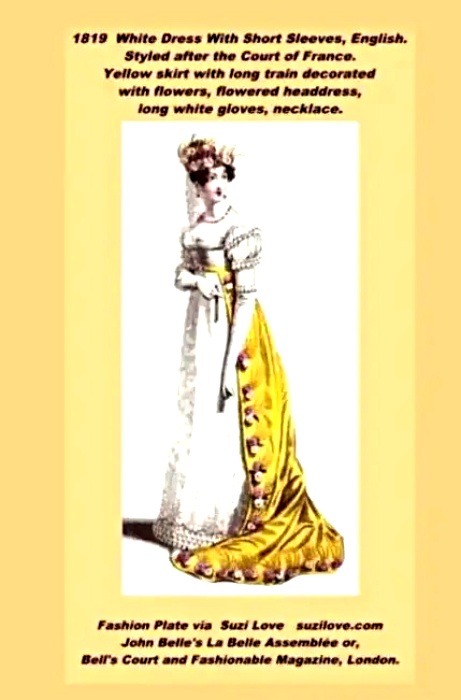
1819 White Dress With Short Sleeves, English. Styled after the Court of France. Yellow skirt with long train decorated with flowers. Flowered headdress, long white gloves, necklace.Fashion Plate via John Belle’s La Belle Assemblée or, Bell’s Court and Fashionable Magazine, London.
Fashion Women 1815-1819 History Notes Book 28 https://books2read.com/SuziLoveFashionWomen1815-1819
1804 London Hairstyles, Gorgeous Gold Hats. via Fashion Plate via Fashions of London and Paris, Published By Richard Phillips, St. Paul’s Church Yard, London, UK. These styles of hats and hairstyles would have been worn by Jane Austen and her contemporaries as hats were an essential fashion item during the Regency years.
1804 London Hairstyles, Gorgeous Gold Hats. via Fashion Plate via Fashions of London and Paris,
Published By Richard Phillips,
St. Paul’s Church Yard, London, UK.25_D2D_Corset_1790-1810
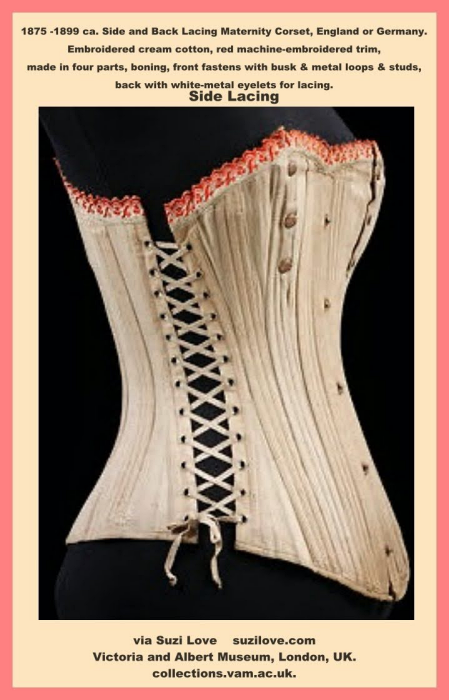
1875-1899 ca. Side Lacing Maternity Corset, Possibly England Or Germany. Embroidered cotton with metal and boning, possibly used as a maternity corset. This corset is made of cream cotton with red machine-embroidered trim and trimmed with a scallop edged tape. The corset is made in four parts and fastens at the front with a busk and with five white metal loops and studs. At the back are seventeen sets of white metal bound eyelets for threading through a lace. At each side, there are twelves sets of metal bound eyelets to fasten with elasticated laces. There is a vertical opening at the bust which fastens with three bronze gilt press studs, clamped into the fabric, and a diamond pattern impressed on the head which shows on the face of the fabric. On the reverse of the stud is a mark.
The corsets reach from the bust to the middle of the hip descending to a point at about the middle of the belly in the centre front. They are machine-stitched and seem lightly boned, encased and sewn to the face of the fabric. Bound at the top and bottom with grey tape. The breast gussets and side lacing suggest this is a maternity corset. Corsets designed for pregnancy and nursing were advertised throughout the 19th century. This maternity corset is a typical example. It is constructed like a fashionable corset, with boning and a central busk. It has side laces, to enable the wearer to adjust the corset to her changing figure. The cups can be opened for breastfeeding by releasing the press studs. via Victoria and Albert Museum, London, UK.
1875-1899 ca. Side Lacing Maternity Corset, Possibly England Or Germany. via collections.vam.ac.uk1875-1899 ca. Side Lacing Maternity Corset, Possibly England Or Germany. via collections.vam.ac.uk1875-1899 ca. Side Lacing Maternity Corset, Possibly England Or Germany. SideView. via collections.vam.ac.uk
1875-1899 ca. Side Lacing Maternity Corset, Possibly England Or Germany. #corset #maternity #victorianfashion https://books2read.com/SuziLoveCorsetBook19
Reader or Writer of Regency Era Books? Love the Bridgertons and Jane Austen? Nonfiction book, Older Gentleman’s Day, gives an overview of his daily life by Award Winning researcher and author, Suzi Love. A sometimes comical look at an older gentleman’s clothing, social life, and responsibilities in the early 1800s. Take a look at where he went, what he wore, and how he managed the family’s finances. Older Gentleman’s Day, Regency Life Series Book 3 books2read.com/suziloveOGD
Regency is the time period in England that began in 1811 when King George III had increasing bouts of madness and was finally declared mad. The Prince of Wales was officially named Regent, often referred to as “Prinny”, and the Regency period ran until 1820 when King George III died and the prince was crowned King George IV. The long Regency era is from the time of Jane Austen and the Napoleonic Wars until the time Queen Victoria ascended the throne.
RL_3_OGD_Older Man’s Day Regency Life Series Book 3 by Suzi Love #Regency #History books2read.com_suziloveOGD
Reader or Writer of the Regency Era? Love the Bridgertons and Jane Austen? Try Older Gentleman’s Day for an overview of daily life. #Bridgerton #RegencyEra #JaneAusten #nonfiction http://books2read.com/suziloveOGD
1806 Waiting For the St. Cloud Coach, Place de la Concorde, Paris. Illustrations by Francis Courboin. via Les Modes de Paris. (PD-Art) This couple is depicted waiting for the coach, which was a passenger vehicle drawn by four horses. The woman is wearing a fashionable hat or “capote” that covers her face. Her dress maintains the empire waist and has very long sleeves that also have a ‘mancheron’ or a gathered sleeve at the shoulders. The man is wearing a ‘habit du gagé’ or a coat with tails, buttoned at the waist. His hat is a ‘haut-de-forme’ or what is commonly known in English as a top hat. He wears tight, short pants tucked into large, riding boots, as was the fashion for men. Illustrations by François Courboin from Octave Uzanne‘s Les Modes de Paris. Variations du goût et de l’esthétique de la femme, 1797-1897, L. Henry May, Paris, 1898, or from the English translation of the same work: Fashion in Paris : the various phases of feminine taste and aesthetics from 1797 to 1897, William Heinemann, London, 1898. Modes de Paris VIa Brown University Library .
1790-1810 ca. Linen and Metal Corset, American Or European. Front Lacing. #Corset #RegencyEra #GeorgianEra #JaneAusten. https://books2read.com/SuziLoveCorsetBook16
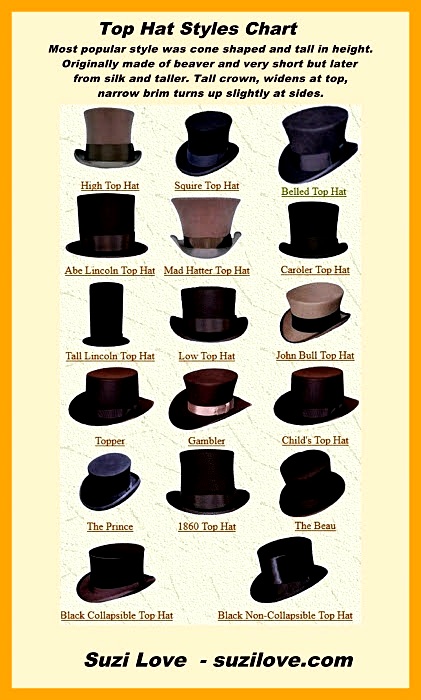
Top Hat Styles Chart during the 1800s, from the Regency Era through to the Victorian years. Most popular style was cone shaped and tall in height. Originally made of beaver and very short but later from silk and taller. Tall crown, widens at top, narrow brim turns up slightly at sides.
1800s Men’s Top Hat Styles Chart from Bridgerton and Jane Austen years. #Bridgerton #JaneAusten #RegencyFashion #Hats https://books2read.com/SuziLoveFashionMen1800-1819
1809 Blue Redingote, French. Back view of walking coat with military style trim, upstanding collar, white hat, black shoes and a handkerchief. Fashion Plate via Journal des Dames et des Modes, or Costume Parisien.
Redingotes or Pelisses were needed to cover the flimsy dresses made of lightweight fabrics of the Regency years to provide warmth and some protection from windy conditions when gowns might lift and cause modesty issues. Jane Austen and her contemporaries often walked to places and so would have needed the warmth of a Pelisse or coat in the cold British winters.
In Europe, a Redingote was a coat or robe like garment worn both indoors and out, indoors left open to reveal a dress while the outdoor version was made of heavier materials and of darker colors than the type worn indoors. The name comes from the term ‘riding coat.’
1809 Blue Redingote, French. Back view of walking coat with military style trim, white hat and holding a handkerchief. Fashion Women 1805-1809 History Notes Book 26 What did Jane Austen and friends wear? https://books2read.com/SuziLoveFashionWomen1805-1809