Looking For A Fun Historical Romance? Lady Laura Jamison to the earl: “For the sake of propriety, I was ensuring your garments were intact.” #HistoricalMystery #VictorianRomance #RomCom https://books2read.com/suziloveSS
1845-1865 ca. Cream Silk Evening Slippers, British. Cream evening shoes with ankle ties and lace trim. Trim is unusual because mid 19th Century ladies’ shoes were often plain as only toes showed beneath fashionable long skirts. Designed By Hobbs, famous London shoemaker, and with a label attached to lining with a regal crest to show maker’s royal patronage. via Metropolitan Museum, NYC, U.S.A. metmuseum.org
Fashion Women 1815-1819 History Notes Book 28 https://books2read.com/SuziLoveFashionWomen1815-1819
A sedan chair is a portable enclosed chair for a single passenger. It was generally carried by two “chairmen” holding poles attached to either side of the chair. Sedan chairs were fashionable in England and Europe during the 17th, 18th and early 19th centuries and were an important part of the social life of the times. They were very useful for negotiating crowded, unsafe, narrow, winding and often filthy streets and were particularly used by “invalids, ladies and party goers”. Sedan chairs had the advantage of being able to be carried up and down stairs and could deliver the passenger from inside their own home to inside their destination without having to step outside.
1784 Sedan Chair. ‘The return from a masquerade. A morning scene.’ A young lady dressed as shepherdess with staff slumps in a sedan chair. Asleep or drunk her head and shoulders hang outside window. Two porters smile and dwarf chimney sweep carries a mask.’ By Robert Dighton and Cari.
1784 Sedan Chair. ‘The return from a masquerade. A morning scene.’ A young lady dressed as shepherdess with staff slumps in a sedan chair. Asleep or drunk her head and shoulders hang outside window. Two porters smile and dwarf chimney sweep carries a mask.’ By Robert Dighton and Cari.
The 19th century English author, Elizabeth Gaskell, described the use and function of the sedan perfectly in her novel “Wives and Daughters” when she reminisced how the Browning sisters chose to be transported to a ball by sedan chair, which ‘came into the parlor, and got full of the warm air, and nipped you up, and carried you tight and cosy into another warm room, where you could walk out without having to show your legs by going up steps, or down steps.’
The Bath Chair was invented in Bath, England, in the mid 18th Century to transport the wealthy and the sick around the city. It could be steered by the passenger and rivaled and then outdid the Sedan Chair as only one chairman was needed to operate it. The last Bath Chairman retired in 1949.
Typical 1700s, or Eighteenth Century Sedan Chair. Portable enclosed chair for single passenger usually carried by two chairmen holding poles attached to either side of chair. Fashionable during 17th, 18th and early 19th centuries when needed to negotiate crowded, unsafe, narrow, and dirty streets. Used by invalids, ladies and party goers. The sedan chair comprises a small kiosk with a curved timber roof which is covered with leather and studded with brass nails. The front and side panels are painted in green with floral decorations of cherubs and flowers. The back panel is of plain timber. Access to the chair was via a hinged door at the front. Inside, the chair is upholstered in silk and features padded upholstered arm rests. The windows have raw silk curtains which are gathered with tassels. The present brackets and poles are reproductions made in 1986 prior to display in the Transport exhibition. The total length of the new poles are 80 inches. The sedan chair door lock features the initials “V.F.” and a set of crossed keys with the wording “PARIS” and the number “34”. Via Powerhouse Museum, Sydney, Australia.
Typical 1700s, or Eighteenth Century Sedan Chair. Portable enclosed chair for single passenger usually carried by two chairmen holding poles attached to either side of chair. Fashionable during 17th, 18th and early 19th centuries when needed to negotiate crowded, unsafe, narrow, and dirty streets. Used by invalids, ladies and party goers. The sedan chair comprises a small kiosk with a curved timber roof which is covered with leather and studded with brass nails. The front and side panels are painted in green with floral decorations of cherubs and flowers. The back panel is of plain timber. Access to the chair was via a hinged door at the front. Inside, the chair is upholstered in silk and features padded upholstered arm rests. The windows have raw silk curtains which are gathered with tassels. The present brackets and poles are reproductions made in 1986 prior to display in the Transport exhibition. The total length of the new poles are 80 inches. The sedan chair door lock features the initials “V.F.” and a set of crossed keys with the wording “PARIS” and the number “34”. Via Powerhouse Museum, Sydney, Australia.
The longest journey recorded in a sedan chair was made by Princess Amelia, youngest daughter of King George III, who in 1728 was carried by 8 chairmen working in reliefs from London to Bath, a distance of 172 kms (107 miles). This sedan chair door lock features the initials “V.F.” and a set of crossed keys with the wording “PARIS” and the number “34”.
HN_10_D2D_RetailerBuyLink_ History Notes Book 10 books2read.com/SuziLoveTravel
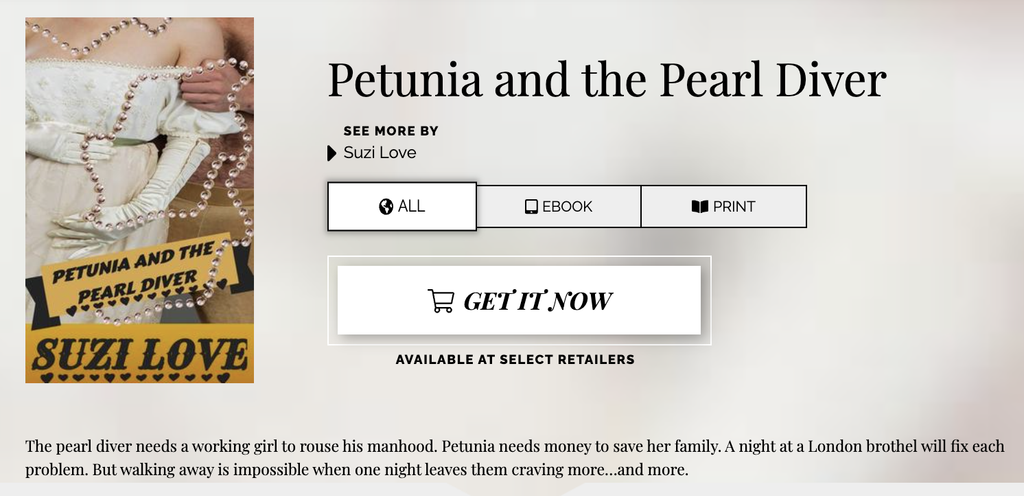
Petunia and the Pearl Diver: A hot Regency romance. Petunia needs money to save her aristocratic family. The pearl diver needs a woman to save him, body and soul. Their night together at a London brothel could solve both problems. But can their relationship survive in the real world?Because walking away becomes impossible when one night leaves them craving more…and more.
Book Hook: Petunia pointed the whip at the pearl diver a second time. “Move.” She gave him her sternest look. “Onto the bed.” The whiptail ran smoothly back and forth through her fingers, hopefully reinforcing the idea that she was an experienced mistress of punishments. “Now.”
The captain’s eyebrows shot upwards and he finally focused on her face, or as much as her sleek leather mask allowed him to see. Good. Without his full attention, Petunia had no hope of carrying out this farce. He unwound his lean length the way she imagined he’d unwind coiled rope on his pearl trawler. Slowly, carefully, and as sensually as a dancer, he straightened to his full height, putting him a good foot taller than her. Her heart thudded in her chest and her pulse raced.
If he stirred her lust merely by standing up, she’d never survive the sensual overload if they danced at a ball and he held her in his arms. She shivered. Dancing with him was one of the things that must never happen, because the close contact might trigger the memory of when her brother had introduced them. If they met at a formal social occasion, she prayed he’d never associate that well-bred lady with a girl he’d paid for in a brothel, because she’d heard that war had changed him and she didn’t know if it was for the better, or worse.
“The more I know of the world the more I am convinced that I shall never see a man whom I can really love. I require so much!” Jane Austen ~ Sense and Sensibility (1811)
“The more I know of the world the more I am convinced that I shall never see a man whom I can really love. I require so much!” Jane Austen ~ Sense and Sensibility
(1811)
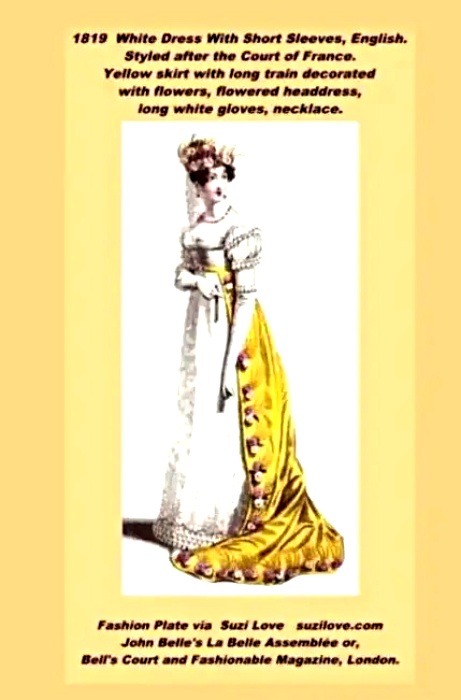
1819 White Dress With Short Sleeves, English. Styled after the Court of France. Yellow skirt with long train decorated with flowers. Flowered headdress, long white gloves, necklace.Fashion Plate via John Belle’s La Belle Assemblée or, Bell’s Court and Fashionable Magazine, London.
Fashion Women 1815-1819 History Notes Book 28 https://books2read.com/SuziLoveFashionWomen1815-1819
1804 London Hairstyles, Gorgeous Gold Hats. via Fashion Plate via Fashions of London and Paris, Published By Richard Phillips, St. Paul’s Church Yard, London, UK. These styles of hats and hairstyles would have been worn by Jane Austen and her contemporaries as hats were an essential fashion item during the Regency years.
1804 London Hairstyles, Gorgeous Gold Hats. via Fashion Plate via Fashions of London and Paris,
Published By Richard Phillips,
St. Paul’s Church Yard, London, UK.25_D2D_Corset_1790-1810
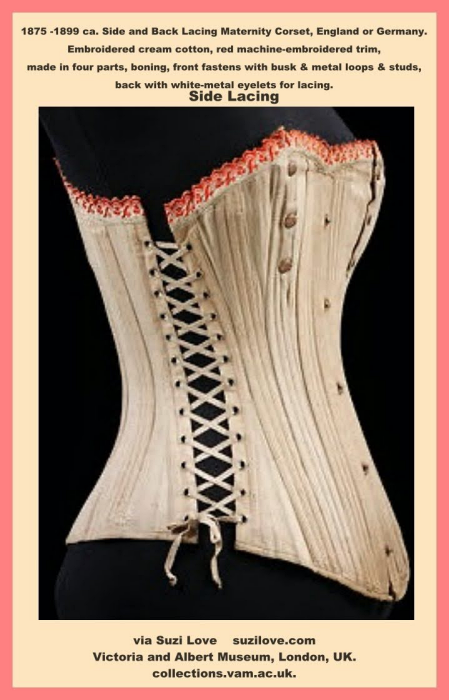
1875-1899 ca. Side Lacing Maternity Corset, Possibly England Or Germany. Embroidered cotton with metal and boning, possibly used as a maternity corset. This corset is made of cream cotton with red machine-embroidered trim and trimmed with a scallop edged tape. The corset is made in four parts and fastens at the front with a busk and with five white metal loops and studs. At the back are seventeen sets of white metal bound eyelets for threading through a lace. At each side, there are twelves sets of metal bound eyelets to fasten with elasticated laces. There is a vertical opening at the bust which fastens with three bronze gilt press studs, clamped into the fabric, and a diamond pattern impressed on the head which shows on the face of the fabric. On the reverse of the stud is a mark.
The corsets reach from the bust to the middle of the hip descending to a point at about the middle of the belly in the centre front. They are machine-stitched and seem lightly boned, encased and sewn to the face of the fabric. Bound at the top and bottom with grey tape. The breast gussets and side lacing suggest this is a maternity corset. Corsets designed for pregnancy and nursing were advertised throughout the 19th century. This maternity corset is a typical example. It is constructed like a fashionable corset, with boning and a central busk. It has side laces, to enable the wearer to adjust the corset to her changing figure. The cups can be opened for breastfeeding by releasing the press studs. via Victoria and Albert Museum, London, UK.
1875-1899 ca. Side Lacing Maternity Corset, Possibly England Or Germany. via collections.vam.ac.uk1875-1899 ca. Side Lacing Maternity Corset, Possibly England Or Germany. via collections.vam.ac.uk1875-1899 ca. Side Lacing Maternity Corset, Possibly England Or Germany. SideView. via collections.vam.ac.uk
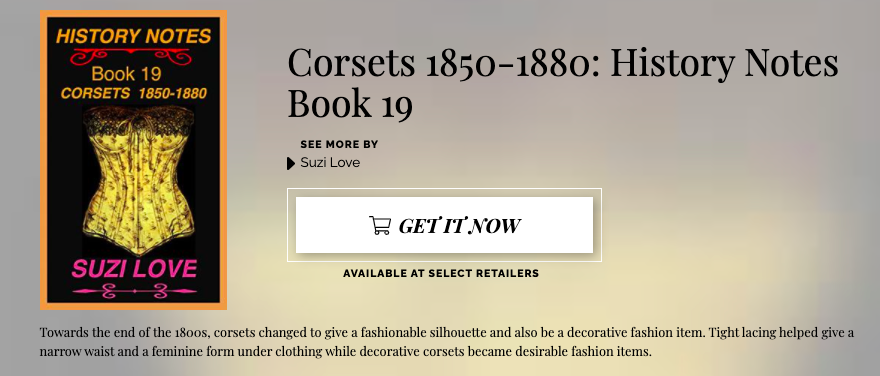
1875-1899 ca. Side Lacing Maternity Corset, Possibly England Or Germany. #corset #maternity #victorianfashion https://books2read.com/SuziLoveCorsetBook19
Reader or Writer of Regency Era Books? Love the Bridgertons and Jane Austen? Nonfiction book, Older Gentleman’s Day, gives an overview of his daily life by Award Winning researcher and author, Suzi Love. A sometimes comical look at an older gentleman’s clothing, social life, and responsibilities in the early 1800s. Take a look at where he went, what he wore, and how he managed the family’s finances. Older Gentleman’s Day, Regency Life Series Book 3 books2read.com/suziloveOGD
Regency is the time period in England that began in 1811 when King George III had increasing bouts of madness and was finally declared mad. The Prince of Wales was officially named Regent, often referred to as “Prinny”, and the Regency period ran until 1820 when King George III died and the prince was crowned King George IV. The long Regency era is from the time of Jane Austen and the Napoleonic Wars until the time Queen Victoria ascended the throne.
RL_3_OGD_Older Man’s Day Regency Life Series Book 3 by Suzi Love #Regency #History books2read.com_suziloveOGD
Reader or Writer of the Regency Era? Love the Bridgertons and Jane Austen? Try Older Gentleman’s Day for an overview of daily life. #Bridgerton #RegencyEra #JaneAusten #nonfiction http://books2read.com/suziloveOGD