Travel and Luggage By Suzi Love History Notes Book 10. How did people travel in Jane Austen’s times. In past centuries? What did they take with them to make their long journeys easier? Travel by road, ship, canal, or railway all took a long time and had dangers so people learned to prepare. And then, in the nineteenth century, road improvements, inventions, and scientific developments made travel more pleasurable. books2read.com/SuziLoveTravel
“There is nothing I would not do for those who are really my friends. I have no notion of loving people by halves, it is not my nature.” Jane Austen ~ Northanger Abbey (1817) #JaneAusten #RegencyEra #Quotation
What salads were served in Jane Austen and the Bridgerton households? Salads “Persons in health, who feel a craving for salad, may indulge in the enjoyment of it to a great extent with perfect impunity, if not with positive benefit. Oil, when mixed in salad, appears to render the raw vegetables and herbs more digestible. Vinegar likewise promotes the digestion of lettuce, celery, and beet-root.
“Endive is very wholesome, strengthening, and easy of digestion; but when strong seasoning is added to it, it becomes an epicurean sauce. — Mayo.”
Recipe for a Winter Salad, by the late Rev. Sydney Smith. Two large potatoes, passed through kitchen sieve, Unwonted softness to the salad give, Of mordent mustard add a single spoon; To add a double quantity of salt; Three times the spoon with oil of Lucca crown, And once with vinegar, procured from town. True flavor needs it, and your poet begs The pounded yellow of two well-boiled eggs. Let onion atoms lurk within the bowl, And, scarce suspected, animate the whole; And, lastly, on the flavored compound toss A magic teaspoon of anchovy sauce. Then, though green turtle fail, though venison’s tough, And ham and turkey are not boiled enough, Serenely full the Epicure may say,- Fate cannot harm me—I have dined to-day!
The Spanish proverb says four persons are wanted to make a good salad: a spendthrift for oil, a miser for vinegar, a counsellor for salt, and a madman to stir all up.
1859 Hints for the Table by John Timbs.
1800s Typical Salads: Cucumber, Beetroot and Potato, Macedone Salad, Tomato Salad, Jellied Russian and Italian Salads, Prawn Salad, Egg and Lettuce, Lobster Salad and Salad Dumas. From: Mrs. Beeton’s Book of Household Management. via Google Books (PD-150)
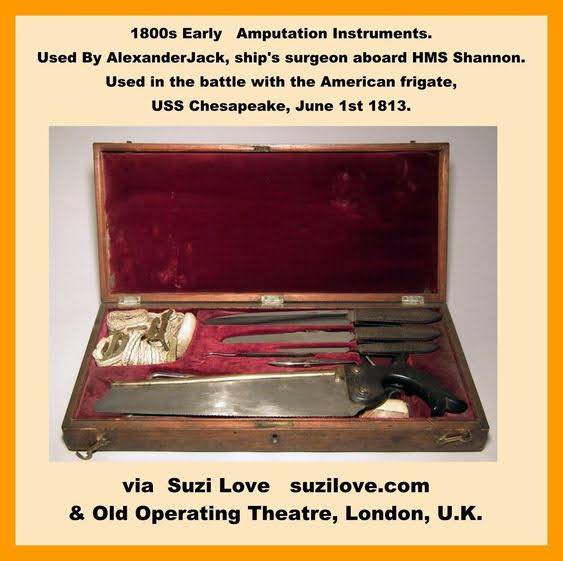
1800s Early Amputation Instruments used by Alexander Jack in Jane Austen’s times. Jack was a ship’s surgeon aboard H.M.S. Shannon and used by him in the battle between the Shannon & the American frigate the USS Chesapeake on June 1st, 1813, during the War of 1812. via Old Operating Theatre, London.
Jane Austen’s brother, Francis William Austen, was appointed Admiral of the Fleet in the British Royal Navy on 27 April, 1863. He had been a Royal Navy Captain from 1799 to 1830, age 25 to 56, Rear Admiral in 1838, age 64, Full Admiral in 1848, age 74. This is the type of medical instruments found on all of his ships.
In Jane Austen’s time, amputations were carried out frequently to prevent infections that could kill.
1817 May Pink Evening Dress, English. A white lace dress over a blush-coloured satin slip. The dress is disposed round the bottom of the skirt in festoons, which display a little of the slip; each festoon is ornamented with a bouquet of blue-belles, pinks, and rose-buds. The festoons are surmounted by a rollio of intermingled pink and white saton. We refer to our print for the form of the body, which is novel and tasteful. The sleeve is very short and full; it is finished at the bottom by quillings of blond. The hair is dressed in a plain braid across the face, and a few loose ringlets at the sides. The hind hair forms a tuft, which is concealed by the head-dress, a high wreath of fancy flowers. Pearl necklace. White kid slippers and gloves. Fashion Plate via Rudolph Ackermann’s ‘The Repository of Arts’.
19th Century Early. Ladies blue leather boots, Probably British. Side inserts and loops for pulling up. The style of boots the Bridgerton ladies and Jane Austen and her contemporaries would have worn when walking in the countryside. via Metropolitan Museum, NYC, U.S.A. metmuseum.org
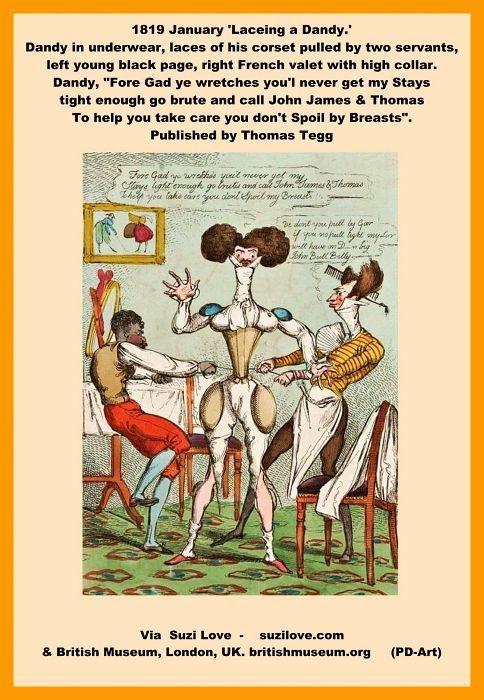
1819 January ‘Laceing a Dandy.’ Dandy in underwear, laces of his corset pulled by two servants, left young black page, right French valet with high collar. Dandy, “Fore Gad ye wretches you’ll never get my Stays tight enough go brute and call John James & Thomas, To help you take care you don’t Spoil by Breasts”. Published by: Thomas Tegg. Hand colored etching. Via British Museum, London, UK. britishmuseum.org (PD-Art)
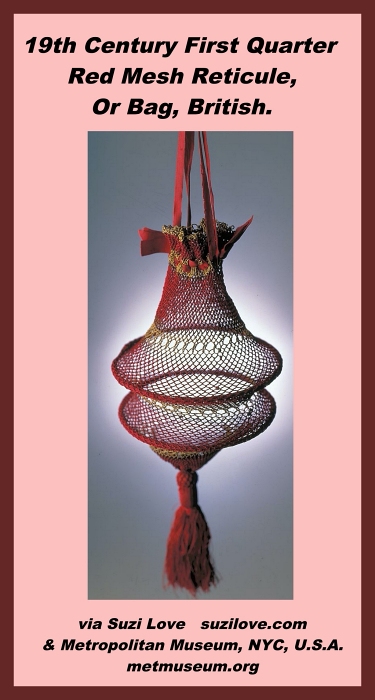
19th Century First Quarter Red Mesh Reticule, British. Small mesh bags known as reticules were the must-have “it bags” of 1800-1825. Too small for carrying much more than a few coins, reticules were often shown in satirical prints as a fashionable foible of women’s attire. Knit into an elegant lantern-like shape, this example survives with its original ribbon trim making it a particularly lovely and rare example of a short-lived fashion trend. via Metropolitan Museum, N.Y.C., U.S.A. metmuseum.org
Definition Reticule: Bag or purse, often with a drawstring to pull closed and usually made of cloth or covered cardboard and often decorated with beading or embroidery. A reticule, or purse, or handbag, was usually carried by a woman during the Regency period to carry all their daily necessities. Earlier, women used pockets that tied at the waistline and were hidden in the folds of their skirts. Empire style, or early 1800s, high-waisted dresses made it impossible to either sewn in a pocket or to tie on a pocket. So women began carrying small, decorated bags called Reticules, or ridicules, which generally pulled close at the top with a drawstring.