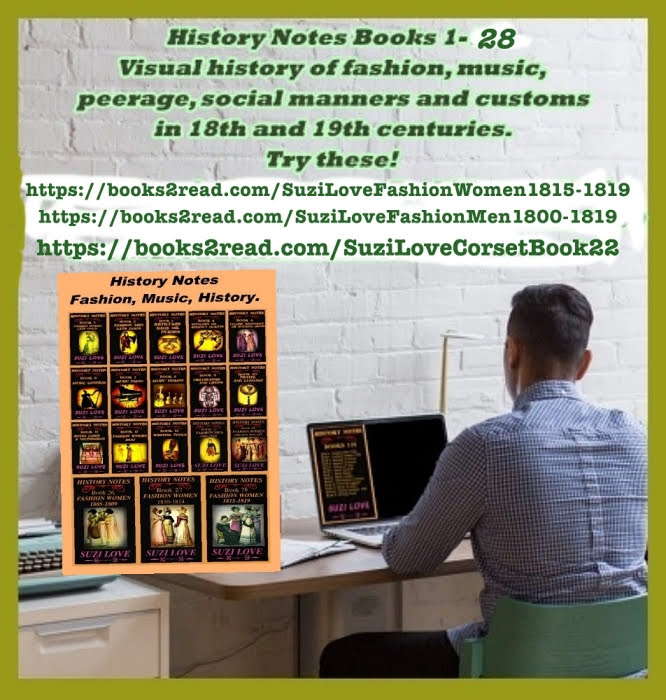
Do you need more factual and visual information for your historical fiction? Try History Notes Books 1-28. Non-fiction Series: Fashion, corsets, Regency Era, music and social manners in the 18th and 19th centuries e.g.
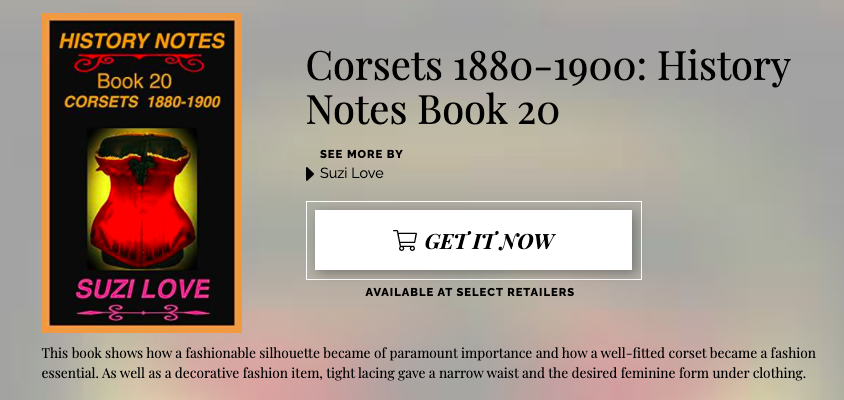
1887 Front View. Wedding Corset, American. Cotton twill, silk thread embroidery. Fully boned wedding corset with front hooks and back lacing. Every boning channel is flossed top and bottom. Via Chicago History Museum, U.S.A. digitalcollection.chicagohistory.org https://books2read.com/SuziLoveCorsetBook20
1887 Front View. 1877 Back Lacing View. 1877 Side View. 1877 Flossing View. HN_20_Corsets1880-1900 https://books2read.com/SuziLoveCorsetBook20
Are you a Bridgerton fan? Love Jane Austen? Love history? Take a look at a Young Gentleman’s Day in early 1800s. Young Gentleman’s Day Regency Life Series Books 2 by Suzi Love. Easy to read books on what a young gentleman did, wore, and lived during the early 1800s, or the Regency Era when King George 3rd was mad and his son, Prince George, was the Regent in Britain. #Regency #JaneAusten #amwriting books2read.com/suziloveYGD
1770-1790 ca. Child’s Stays, American. Linen plain weave, baleen, or whalebone, silk braided tape. Dimensions: Center Front Length: 5 3/4 inches (14.6 cm) Waist: 18 inches (45.7 cm). Made in United States of America. This pair of stays is only eighteen inches around, and might have been worn by a small child of eighteen months to two years old. Putting stays on young girls and boys was not seen as harsh, but rather as insurance that their figures would develop the correct form, with chest out and shoulders down. While boys usually wore stays only in early childhood, they were considered essential for females throughout their lives. via Philadelphia Museum of Art philamuseum.org Accession Number: 1988-15-1Credit Line: Purchased with the Bloomfield Moore Fund, 198
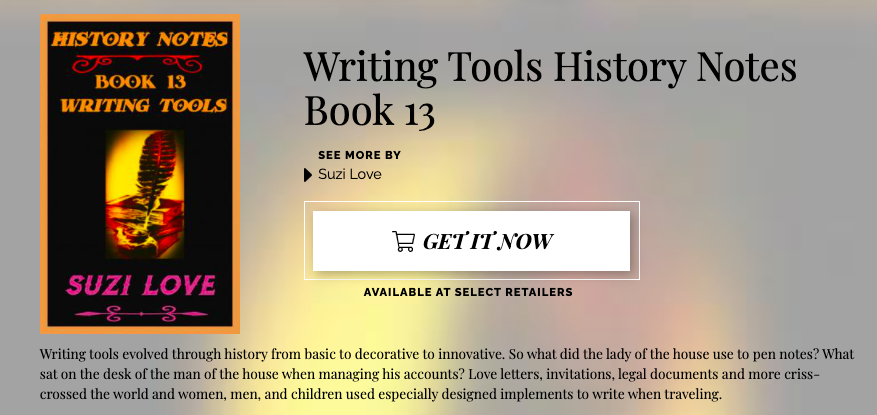
19th Century Mid-Late Five Desk Seals. L-R Carnelian seal with silver mounts set with colored stones; malachite urn seal: gilt-bronze seal with winged cherub heads: Silver-gilt seal eagle, Silver-gilt seal as eagle’s leg below a blue glass ball. via Sotheby’s Auctions. sothebys.com
In the Bridgerton family, or Jane Austen’s household, and during the Regency Era, sealing wax was not only impressed onto the back of a letter with a seal to protect against tampering, but also to identify the sender of the letter. People, especially aristocrats, kept personal and family seals to be used for many different purposes e.g. A letter to a government official would be sealed with an aristocrat’s crest or title. Personal seals for identification have been since early civilizations. The rubber stamps and embossers we use today serve the same purpose, identifying the sender.
Definition: Wax Seals: Pressed onto a letter or envelope to show that a document is unopened or to verify the sender’s identity. A signet ring or was seal is pressed into a dollop of hot wax to seal a letter or envelope closed.
1805-1815 ca. Empire Style, High-Waisted Dress, American. Typical style of dress worn in the time of Jane Austen. Long sleeves under short sleeves, square neckline, back fastening. Via Five Colleges and Historic Deerfield Museum Consortium. museums.fivecolleges.edu
Definition Empire Style Dress: High-waisted white gown defined women’s fashion during the Regency Era. ‘Empire’ is the name given to the period when Napoleon Bonaparte built his French Empire. High-waisted, loose gowns were adopted by the aristocracy as a symbol of turning away from the fussy, elaborate and expensive clothing worn in the 1700s.
Fashion Women 1805-1809 History Notes Book 26
What did Jane Austen and friends wear? This book looks at early 1800s fashions, which were elegant and pretty with high waists and fabrics that were almost transparent. These Empire style gowns, named after Napoleon’s first Empress, became popular throughout Europe, and were then copied around the world. Colorful outwear was added to make an ensemble more attractive and warmer.
https://books2read.com/SuziLoveFashionWomen1805-1809
1815-1825 ca. Pink Leather Slippers. Probably French but worn in America. via Museum of Fine Arts, Boston. mfa.org. In Jane Austen’s years, fragile slippers were worn for balls and evening events but for walking sturdier shoes were needed, In the early 1800s, slippers were made of fabric such as satin or from leather, were flat or had a very small heel, slightly rounded toes and were laced up on the top. They were usually not made in right or left but instead one shoe shape and in multiples so that when one slipper wore out, another was on hand to replace it.
Fashion Women 1815-1819 History Notes Book 28 https://books2read.com/SuziLoveFashionWomen1815-1819
1790-1810 ca. Jane Austen Style White Linen Shift Or Chemise, American. #RegencyEra #JaneAusten #underclothing https://books2read.com/SuziLoveFashionWomen1801-1804
Lover of Jane Austen and the Regency Era fashions? History Notes Book 25. #JaneAusten #RegencyFashion #HistoricalFashion books2read.com/SuziLoveFashionWomen1801-1804