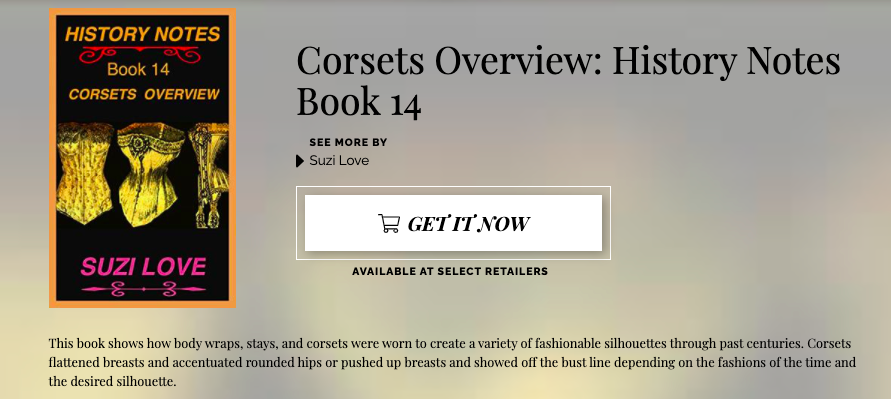
This book shows how body wraps, stays, and corsets were worn to create a variety of fashionable silhouettes through past centuries. Corsets flattened breasts and accentuated rounded hips or pushed up breasts and showed off the bust line depending on the fashions of the time and the desired silhouette. Includes corsets through the Georgian, Regency, Victorian and Edwardian Eras and Jane Austen’s lifetime. Overview of corsets through history, including the Georgian, Regency, Victorian and Edwardian Eras and Jane Austen’s lifetime. History Notes Book 14.
“I remember who you are, Lady Melton,” Captain Belling said in a cold voice, barely glancing over his shoulder at them. “The only thing I don’t know is why the hell you and that child are still anywhere near Waterloo, when all women were ordered to evacuate a week ago.”
“That child has a name, Captain. His name is Daniel, or if you are a stickler for formality, Viscount Melton.”The captain turned and frowned down at her son, who stared back at him with blatant curiosity and a small amount of animosity, as forthright as any young and intelligent child. Even at his young age, Daniel was a shrewd judge of character, and had been instructed by his uncles to be careful about trusting strangers. When the Captain turned back to the tattered maps spread over his makeshift desk, Anne ignored his unspoken dismissal and used the time to observe the infuriating man without having his condemning gaze fixed on her, as it had been a week earlier at the Duke and Duchess of Richmond’s extravagant Brussels ball. If she and Daniel were to travel with his group of wounded soldiers, Anne wanted to learn as much as possible about their leader. Her son’s survival depended on her being well informed and prepared for any eventuality.
Dust filtered down through a gaping hole in the high roof and settled in the Captain’s hair, turning it a darker brown than his normal golden yellow, though a bucketful of dust wouldn’t make any difference to the state of his stained uniform. His left pants’ leg had been sliced open to the knee, the two sides pinned clear of the large bandage winding down most of his leg, while a spindly wooden crutch was propped against the table.
His large physique had attracted her even before their dance at the ball, though his striking physical attributes didn’t compensate for his belligerent attitude, or for his obvious displeasure at encountering her both in Brussels and near the battlefield. Still, the Captain had undoubtedly scowled in a similar fashion at many women he’d met either in Brussels or at Waterloo, as she’d heard him spout his narrow-minded view at the ball to his fellow officers. The Captain believed that in the vicinity of battles only men should be allowed. Not women, and especially not ladies.
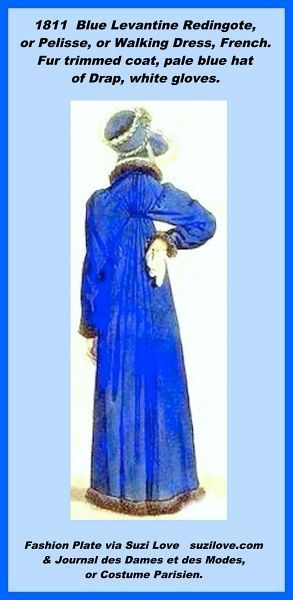
1811 Lady’s Redingote, or Pelisse, or Walking Dress, French. Blue Levantine walking dress, with pale blue hat of Drap. Fashion Plate via Journal des Modes et des Dames, or Costume Parisienne.
The term, Redingote, was used more in France and other parts of Europe and Pelisse or Walking Dress was used more in England.While the terms Redingote and Pelisse are often used interchangeably, the Redingote usually features a close fitted top and flares out at the hemline with a more tailored or military look than a Pelisse. Redingotes or Pelisses were needed to cover the flimsy dresses made of lightweight fabrics of the Regency years to provide warmth and some protection from windy conditions when gowns might lift and cause modesty issues.In Europe, a Redingote was a coat or robe like garment worn both indoors and out, indoors left open to reveal a dress while the outdoor version was made of heavier materials and of darker colors than the type worn indoors. The name comes from the term ‘riding coat.’
Definition Drap: Made of wool, shiny and velvety after treatment, hair uniformly laid in the direction of the cut, thick and resistant. Used for coats.
Definition Levantine: Stout silk cloth in twill weave. First made in the Levant, a large area in the Eastern Mediterranean region of Western Asia.
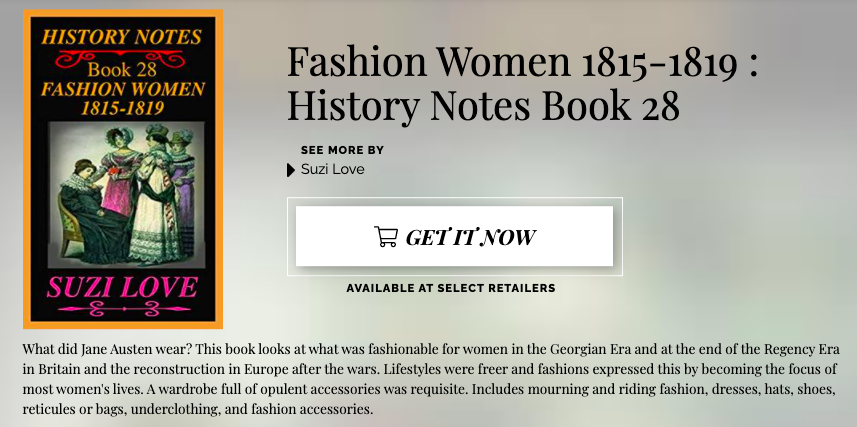
1819 January Red Redingote, French. Merino wool coat over a white dress with a high lace collar, matched with a black velour, or velvet, hat lined with white satin. Military style shoulder pads and front buttons. It was fashionable at the time to wear military inspired clothing to show support of all the men fighting in wars across the world. The type of outfit young Regency Era ladies would have worn if they were out shopping on Bond Street, walking in a park, or taking a carriage ride through Hyde Park. Fashion Plate via Journal des Dames et des Modes, or Costume Parisien.
Definition Redingote Or Pelisse Or Walking Dress Or Coat: French word developed from English words, riding coat. Long fitted outdoor coat worn over other garments for warmth. Often left open at the front to show off the dress underneath. Sometimes cut away in front. Originally made with several capes and trimmed with large buttons. French fashion plates call these coats Redingotes and they are designed for women, men and children. English fashion plates call them a Pelisse, a walking dress, Promenade dress, or Carriage dress.
1819 January Red Redingote, French. Also called a Pelisse or Walking Dress in England. Merino wool coat over a white dress with a high lace collar, matched with a black velour, or velvet, hat lined with white satin. Fashion Plate via suzilove.com and Journal des Dames et des Modes, or Costume Parisien.
1819 Red Merino Wool Redingote Or Coat With Matching Bonnet. #Regency #Fashion #FashionPlate #French https://www.books2read.com/SuziLoveFashionWomen1815-1819
1808 Gorgeous Women’s Fashion In The Times Of Jane Austen. Fashion plates from Journal des Dames et des Modes or Costume Parisien. Dresses, coats or Redingotes, Spencers in purple and red, shawls, fichu or shoulder cape, shoes, hats and headdresses, gloves, and Reticules or bags. https://books2read.com/SuziLoveFashionWomen1805-1809
1808 High-Waisted White Dress, French. White Fichu over the shoulders, pale blue shoes, pink striped hat.1808 White Dress With Purple Spencer, French. 1800 White Dress, French. Black ribbon criss-crossing the back bodice. 1808 White Dress With Train Under A Red Spencer, French. Pointed shawl bodice and long sleeves.1808 Negligee Or At-Home Dress, French. Orange redingote, or coat, white shawl, blue gloves and shoes.1808 Lady in a white At-Home dress and cap sitting at her dressing table, French. 1808 Gorgeous Women's Fashion In The Times Of Jane Austen. #Regency #JaneAusten #Fashion https://books2read.com/SuziLoveFashionWomen1805-1809 Share on XFashion Women 1805-1809 History Notes Book 26
What did Jane Austen and friends wear? This book looks at early 1800s fashions, which were elegant and pretty with high waists and fabrics that were almost transparent. These Empire style gowns, named after Napoleon’s first Empress, became popular throughout Europe, and were then copied around the world. Colorful outwear was added to make an ensemble more attractive and warmer.
https://books2read.com/SuziLoveFashionWomen1805-1809
Craftsmen created containers of precious metals, leather, and silks and decorated them with jewels and engraving. Jane Austen and her contemporaries would have used writing boxes, linen boxes when travelling, boxes to hold their food and drink supplies while traveling by carriage, and decorative boxes to keep letters, ribbons, gloves, hairpins etc. Boxes, Cases, and Necessaires By Suzi Love, History Notes Book 11. books2read.com/suziloveBoxesCases.
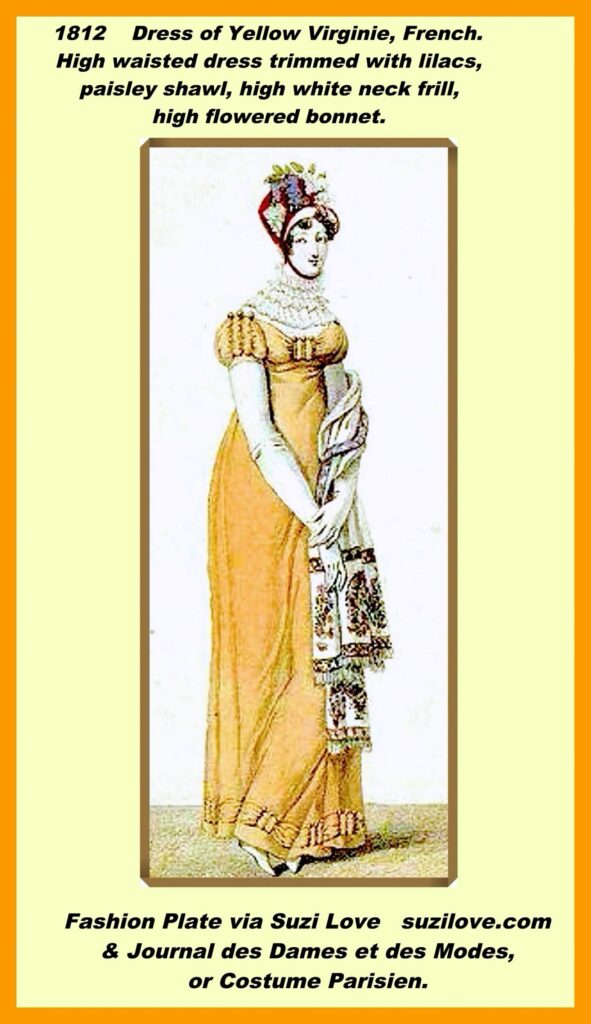
1812 Dress of Yellow Virginie, French. High waisted dress trimmed with lilacs, cashmere shawl, high white neck frill, high flowered bonnet. Fashion Plate via Journal des Dames et des Modes, Costume Parisien.
Typical of the Empire dresses worn by Jane Austen and her contemporaries. Low necklines and skirts that started directly under the bust and flowed into the classical relaxed wide styles of Greece and Rome. These high-waisted dresses were worn most days and cotton, silk or taffeta were the popular fabrics.
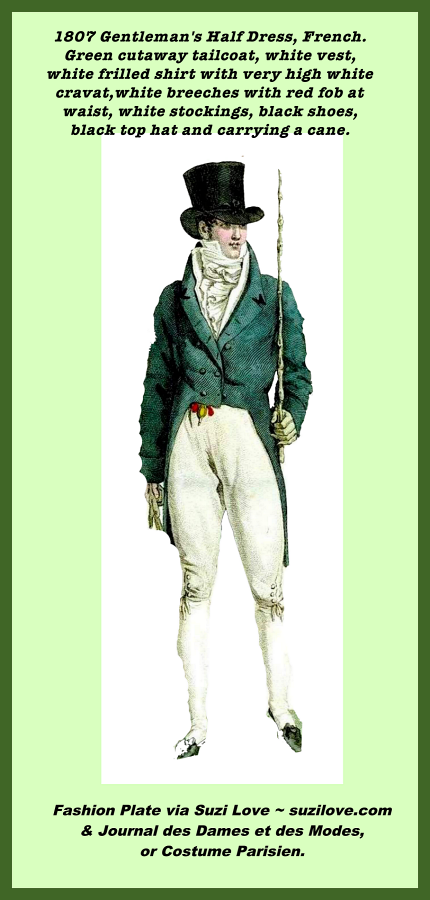
1807 Gentleman’s Half Dress, French. Green cutaway tailcoat, white vest, white frilled shirt with very high white cravat, white breeches with red fob at waist, white stockings, black shoes, black top hat and carrying a cane. Fashion Plate via Journal des Dames et des Modes, or Costume Parisien.
French fashions and Georgian and Regency Era fashions from Great Britain were copied around the world. This is the normal daily outfit for a gentleman in the early 1800s, or in the times of Jane Austen, for daily city and country life. https://books2read.com/SuziLoveFashionMen1800-1819
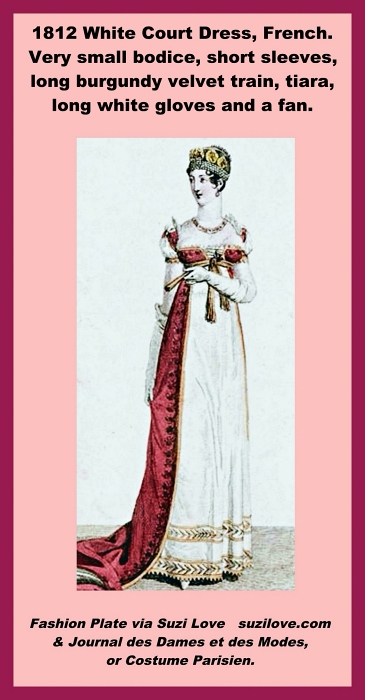
1812 White Court Dress, French. Very small bodice, short sleeves, long burgundy velvet train, tiara, long white gloves and a fan. Fashion Plate via Journal des Dames et des Modes, or Costume Parisien.
Definition Court Dress: Usually, the difference between a court dress and a ball dress was in the quality of fabrics used, how elaborate the design, and the number and quality of the accessories. Plus, in England in the early 1800s court dresses were required by Queen Charlotte to have hoops and in France and other European countries court dresses a long train, usually expensively decorated. During the Regency Era, white cotton dresses were considered suitable for many evening events, but definitely not for an evening event in a palace.
1812 Man’s Overcoat With Layered and Rounded Capes, French. Black breeches tied at the knees, white stockings, blue waistcoat, black shoes and carrying a bicorn, or two-cornered black hat. Fashion Plate via Journal des Dames et des Modes, Costume Parisien.
In the early 1800s, men no longer wore complicated styles and extravagant fabrics. Men’s fashion simplified and became more conservative. A well cut tailcoat, vest, pantaloons and an immaculate cravat of beautiful white linen in the style of George Bryan, or Beau, Brummell. Clothes were a status symbol and indicated a man’s social position. These clothing items were the sort worn by Jane Austen’s male family and friends.
From the finish of the 18th century until 1820, men’s fashions in European and European-influenced countries moved away from the formal wear of brocades, lace, wigs and powder to more informal and relaxed styles. Focus was on undress rather than formal dress. Typical menswear in the early 1800s included a tailcoat, a vest or waistcoat, either breeches, pants, or the newer trousers, stockings, shoes or boots, all worn with an overcoat and hat. This basic ensemble was accessorized with some form of neckcloth or cravat, gloves, walking stick, cane or riding crop, handkerchief, fobs, watch and perhaps a quizzing glass or eye glass.
Skirted coats were replaced with short-fronted, or cutaway, tailcoats worn over fitted waistcoats and plain, white linen shirts. Knee breeches were gradually replaced by tight-fitting pantaloons and later trousers, decorative shoes with buckles were replaced with a variety of boot styles, and fussy and ruffled neckwear gave way to intricately tied, white linen neck cloths. A Regency Era, or early 1800s, gentleman was outfitted in more practical fabrics, such as wool, cotton and buckskin rather than the fussy brocades and silks of the late 1700s.