1820 Ball Gown of Embroidered Net, British. Silk satin and silk net embroidered with metal and trimmed with silk blonde bobbin lace, hand sewn. Short-sleeved ball gown comprising of an underdress of silk satin and an overdress of machine-made silk net embroidered with metal and trimmed with blonde bobbin lace. The dress has a low oval neckline, puffed short sleeves, a wedge shaped front bodice panel, and a medium high waist. The skirt has a central front panel, wedge shaped panels and the centre back panels are tightly gathered at the waist.
From the Museum Curator: ‘Women saved their most elaborate dresses for special occasions such as balls. Lavish gowns embellished with gold thread or sparkling beads glittered in the artificial light of the dancing room. Thin, gauzy materials created a soft dreamy look. These light materials also prevented the wearer from getting too hot while dancing in stuffy, overcrowded spaces’. Victoria and Albert Museum, London, UK
1816 August Walking Costume, or Pelisse, or Coat, English. Round dress, composed of cambric and trimmed with lace. The body is let in with a profusion of lace. Plain long sleeves, very full, except at the wrist where the fulness is confined by small plaits, sleeve finished by double frill of lace. Over the dress is a Pelisse of blue and white shot sarcenet, lined with white sarcenet and trimmed with white satin. Pelisse sleeve is very full and finished at the wrist by a cuff and bows of ribbon. Pelisse is made half high and finished at neck with a triple fall of rich lace but the neck is bare. White satin hat is turned up in front and ornamented with flowers. Kid gloves, blue kid shoes and a parasol. We are indebted for this tasteful dress to Mrs. Gill of Cork Street, Burlington Garden, London. Fashion Plate via Rudolph Ackermann’s ‘The Repository of Arts’.
Definition: Pelisse Or Redingote: Woman’s long, fitted coat often worn open in front to show off the dress underneath. Sometimes cut away in front. Originally made with several capes and trimmed with large buttons. French word developed from English words, riding coat. reefer. Single- or double-breasted, fitted, tailored, over-all coat usually made from sturdy fabric. Jane Austen and her contemporaries wore long coats like these to keep warm when out and about, visiting, shopping etc. The thin muslin dresses worn in the early 1800s were little protection against European winters. #Regency #Fashion #History
1807 Healthful Dipping. Lady in her white linen chemise, or shift, preparing to take a dip in the spa waters. Scenes of Spa life. By F. Eginton, New Bath Guide. ‘How the ladies did giggle and set up their clacks, All the while an old lady was rubbing their backs.’ From Anstey’s ‘The New Bath Guide’. In Jane Austen’s novels, the resorts of Brighton, Scarborough, Cromer, Lyme and the fictional Sandy ton or Sanditon all get mentions. Women bathed in the sea, via bathing machines pulled down to the water’s edge, or promenaded along beautiful walkways, such as in Cheltenham, near Bat in Britain. Visiting seaside resorts became very popular during the Regency years. Le Beau Monde, or fashionable society, went to spa and beach towns to ‘take the waters’ or to holiday in a fashionable town. To see and be seen. Ladies dressed in light muslin gowns but added colorful accessories to make outfits more interesting.
Chemise Or Shift: Sleeveless, mid-calf length garment of white cotton or muslin was worn next to the skin under stays or corset. Called ‘Shift’ from early Georgian (1700-1750) until Late Georgian (1750-1790) to replace ‘Smock’. By 1800, name replaced by ‘Chemise’.
1826 Almack’s Revisited by Charles White. The ball of this evening passed off as all other balls at the same place, creating envy, jealousy, and hatred in the minds of many of those who have been unsuccessful in procuring tickets; affording real amusement to few, and disappointing a greater portion of those who, by dint of manoeuvring, petitioning, parliamentary interest, or presents, have been enabled to obtain the desired vouchers; and as this was one of the last balls of the season, and a general election already talked of, the mixture of company and the number was much greater than usual; and, consequently, it was what the most correct persons called, “horrid bad Almack’s!”
Almack’s or Willis’s Rooms, King Street, St James, London, UK. Almack’s Assembly Rooms, founded by William Almack at No. 26-28, were on the site of the present Almack House. The club was originally a gaming establishment but moved from Pall Mall. The Assembly rooms were on the South side of King Street in St James’s and were opened on February 12, 1765. At the time the subscription was ten guineas for which there was a ball and supper each week for the twelve weeks of the season.
1805 Lady With Her Sketching Portfolio In Half Dress, French. White, At-Home, High-waisted, relaxed & flowing dress with white cap and pink flowers to match, long gloves, slippers. Fashion Plate via Journal des Dames et des Modes, or Costume Parisien. Definition Caps: Worn as morning caps, night caps, or under other hats. Jane Austen and her family and female friends would have worn caps like these, sometimes during the morning at home, to bed to keep their long hair from becoming knotted, or under a bonnet to hold a hairstyle in place. Caps sometimes had hanging ties, or tails, and were also called ‘follow me lads’, or ‘flirtation ribbons’. Or flaps covering theirs called Lappets. Magazine Journal des Dames et des Modes, or Costume Parisien, French. French fashion magazine published between 1797 and 1839 and second oldest fashion magazine published in France. Pierre de la Mesangere was editor and published every five days, which is why there is an abundance of French fashion plates from these years in France and internationally.
What was fashionable for women in the late 1700s? Extravagant colors and fabrics and outrageous styles were all seen in these flamboyant fashions. #Georgian #nonfiction #amwriting books2read.com/suziloveFashWomen1700s
1817-1820 ca. Spencer, English. Green silk, brown satin puffs, silk cord on deep V collar and sleeves. With the rise of fashionable waistlines in women’s dresses after around 1800, women’s outerwear followed suit. This jacket with very short bodice and long sleeves was known as a Spencer and was named after the male coat made famous by the Earl Spencer. The jacket is said to have originated in an accident to Lord Spencer in hunting when his coat tails were torn off and a cropped jacket was invented. via Museum of London, UK. museumoflondon.org.uk. books2read.com/suziloveSpencers. Jane Austen and her contemporaries often walked to places and so would have needed the warmth of a Spencer over her dress in the cold British winters.
Definition Spencer: Short jacket, cropped at the waist, worn over a dress, or gown. These close-fitting, tight sleeved, waist length jackets were modeled on a gentleman’s riding coat, but without tails. Delicate and regency dresses provided so little protection from the cold, so over garments were essential for warmth, modesty and good health.
1816. June Blue Merino wool riding dress with high waist and embroidered and ornamented round the bust and cuffs and fastens on the back of the shoulder. Double ruff of fine Vandyke lace is separated from shirt collar by a Chinese silk handkerchief of blue and white. Small round hat made of fine beaver or moss silk, the half boots are of blue kid with Limerick gloves worked and seamed with blue and she is carrying a riding whip. These riding habits were usually designed by men and were in two pieces, a jacket and a skirt, worn over a shirt but this is in one piece and the full skirt falls from directly under the bust. Fashion Plate via John Belle’s La Belle Assemblée or, Bell’s Court and Fashionable Magazine, London. https://books2read.com/SuziLoveFashionWomen1815-1819
Typical of the riding costumes worn by Jane Austen’s female contemporaries. The style is still in the Empire fashion of a high-waist with the full skirt falling from just under the bust and with a frill and small decorations on the wrists and shoulders to make it look unique.
1820 Brown Evening Dress Of Figured Silk Muslin With Brown Gauze Trim. An evening dress of tobacco coloured figured silk muslin, warp float, small sprig repeat design. Shallow, round neckline, short puffed sleeves, high, empire-style waistline and long tubular skirt. Bodice has narrow cream lace trim above a band of self fabric edged with cream silk braid and brown silk taffeta piping. Bodice front has brown silk gauze joined on at side seams with 3 van dyke points down sides of centre front. Edges of points bound with silk taffeta and trimmed with ball buttons covered in brown silk floss.
Centre front panel has brown silk cord lacing through 17 handworked eyelets bordered by 2 v-shaped strips of same silk taffeta rouleaus. Self fabric waistband is trimmed with cream braid and piping, with two van dyke points either side of centre back. Bodice laced at back from neck to waistband while gauze overlay from front forms a band tucked over the waist, which extends over skirt to form a narrow peplym, also van dyke pointed and bound with taffeta. Two self fabric epaulettes attached at sleeve seams and trimmed with brown silk passmenterie tassel, at shoulder and with same braid and piping. Short sleeves overlaid with brown silk gauze ruched between rouleaux bands stitched to lining. Cuff bands piped and braided and cut into 8 van dyke points above overlay. Points are trimmed with braid, piping and silk covered ball buttons. Skirt of dress falls to the ground, trained at back, and flounce of satin striped silk gauze falling from corded seam. Bodice lined with cream cotton. Via Powerhouse Museum, Sydney, Australia. collection.maas.museum.
Passementerie: Art of making elaborate trimmings or edgings (in French, passements) of applied braid, gold or silver cord, embroidery, colored silk, or beads for clothing or furnishings.Styles of passementerie include the tassel, fringes, ornamental cords, galloons, pompons, rosettes, and gimps, as well as other forms. Tassels, pompons, and rosettes are point ornaments, and the others are linear ornaments.
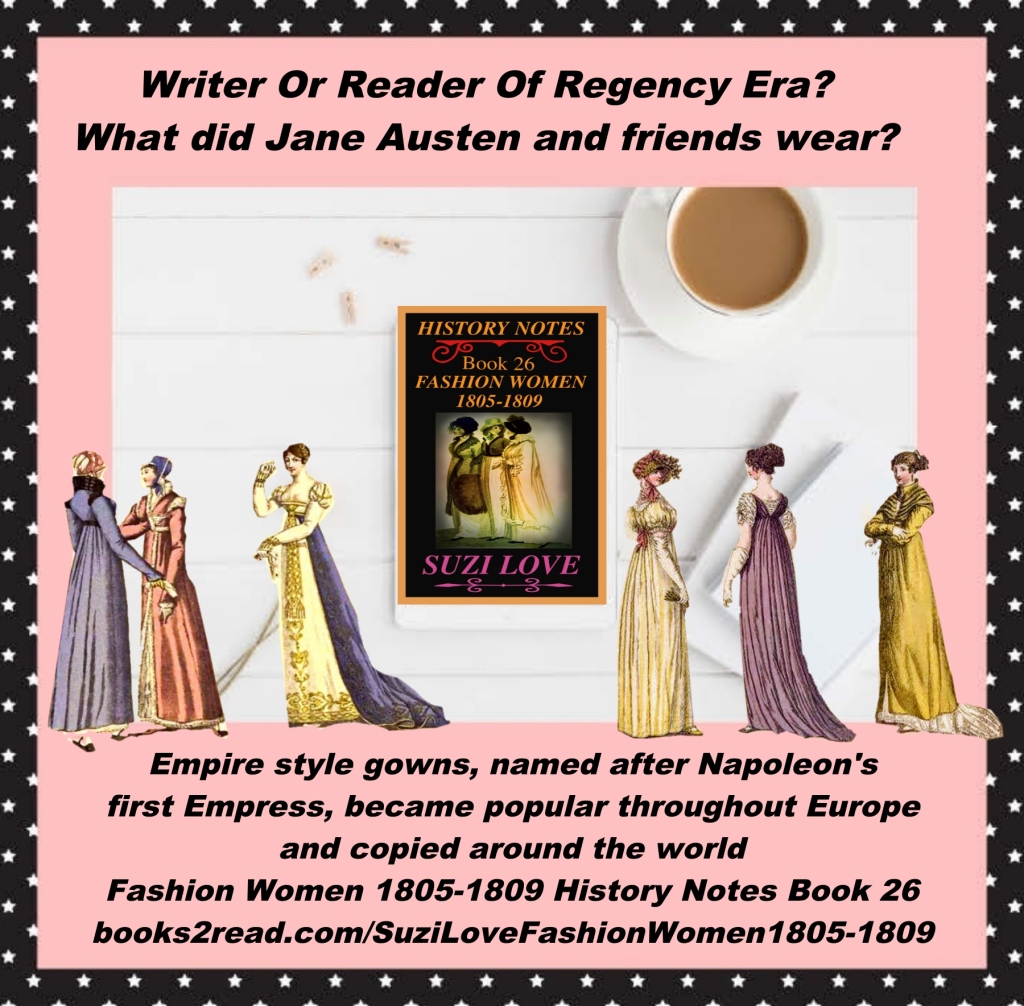
What did Jane Austen and friends wear? Early 1800s fashions were elegant and pretty with high waists and fabrics that were almost transparent. These Empire style gowns, named after Napoleon’s first Empress, became popular throughout Europe, and were then copied around the world. Colorful outwear was added to make an ensemble more attractive and warmer. History Notes Book 26 Fashion Women 1805-1809. https://books2read.com/SuziLoveFashionWomen1805-1809



![1805_HalfDress_WhiteAtHomeDress_LadywithSketchingPortfolio_CP_Lge.jpg ]](https://www.suzilove.com/wp-content/uploads/2022/11/1805_HalfDress_WhiteAtHokmeDress_LadywithSketchingPortfolio_CP_Sml.jpg)