1823 Hackney Cab, London, U.K. This small cabriolet was built by coach builder, David Davies, and licensed for public convenience. Name ‘hackney’ derived from village of Hackney, Middlesex, famous for horse drawn carriages. French word cabriolet was shortened to cab, hence ‘Hackney Cab’. In 1813, there were 1100 hackney coaches for hire in London. Designs changed constantly and in 1834 Joseph Hansom registered his design for a cabriolet named ‘Hansom Cab’.
1823 Hackney Cab, London, U.K. This small cabriolet was built by coach builder, David Davies, and licensed for public convenience. Name ‘hackney’ derived from village of Hackney, Middlesex, famous for horse drawn carriages. French word cabriolet was shortened to cab, hence ‘Hackney Cab’.
1823 Hackney Cab, London, built by coach builder, David Davies. #Regency #London #Carriage https://books2read.com/SuziLoveTravel
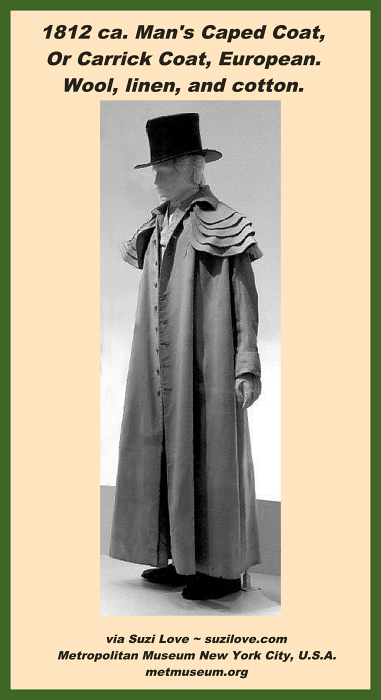
1812 Man’s wool, linen, and cotton long coat with four shoulder capes, European. Also called a Carrick Coat, a Driving Coat, or a Redingote in France. via Metropolitan Museum, NYC, USA. ~ metmuseum.org
A Regency Era, or early 1800s, gentleman was outfitted in more practical fabrics, such as wool, cotton and buckskin rather than the fussy brocades and silks of the late 1700s. The men in Jane Austen’s life and the Bridgerton men would have worn this sort of warm and practical coat like this when riding his horse in inclement weather or when driving his carriage.
Definition: Carrick Coat: Or Garrick or Coachman’s coat, with capes, or collars, popular in 19th century for riding and travel.
1812 ca. Back View. Man’s Caped Coat, Or Carrick Coat, European.
Wool, linen, and cotton. via Metropolitan Museum New York City, U.S.A. metmuseum.org1812 ca. Front View. Man’s Caped Coat, Or Carrick Coat, European.
Wool, linen, and cotton. via Metropolitan Museum New York City, U.S.A. metmuseum.org1812 ca. Back View Black and White. Man’s Caped Coat, Or Carrick Coat, European.
Wool, linen, and cotton. via Metropolitan Museum New York City, U.S.A. metmuseum.org1812 ca. Front View Black and White. Man’s Caped Coat, Or Carrick Coat, European.
Wool, linen, and cotton. via Metropolitan Museum New York City, U.S.A. metmuseum.org1812 ca. Front View Black and White With Umbrella. Man’s Caped Coat, Or Carrick Coat, European.
Wool, linen, and cotton. via Metropolitan Museum New York City, U.S.A. metmuseum.org
1816 December. Promenade Dress, or Pelisse, English, also called a Redingote in France. High cambric muslin dress trimmed at the bottom with a single flounce of work, shaped without any fulness to fit the body, plain long sleeve finished by a triple fall of narrow lace. Over this is the Angouleme pelisse of crimson velvet, lined with white Sarsnet, and trimmed with a single Welt of crimson satin, a shade lighter than the pelisse. Shaped the to the body and without much fullness, confined at the short waist with narrow velvet band, edged to match. Small stand-up collar, supports a rich lace ruff, which is worn open in front of the throat. Sleeve has little fullness and is confined at the wrist by three narrow bands of puckered satin. Bonnet of white satin a la Royale with a large bunch of flowers and tied under the chin with satin ribbon and finished in front with a full quilling of tulle. Black silk ridicule, exquisitely worked in imitation of the ends of an India shawl and trimmed with black silk fringe. White kid gloves and black walking shoes. Fashion plate, hand-colored engraving on paper. Published in Rudolph Ackermann’s ‘The Repository of Arts’, London.
Promenade Dress, Pelisse, Redingote, Or Walking Dress. Jane Austen and her contemporaries wore long coats like these to keep warm when out and about, visiting, shopping etc. The thin muslin dresses worn in the early 1800s were little protection against European winters.
1816 December. Promenade Dress, or Pelisse, English, called Redingote in France. High cambric muslin dress trimmed at the bottom, plain long sleeve finished by a triple fall of narrow lace. Over this is the Angouleme pelisse of crimson velvet, lined with white Sarsnet, and trimmed with a single Welt of crimson satin, a shade lighter than the pelisse. Bonnet of white satin a la Royale with a large bunch of flowers and tied under the chin with satin ribbon. White kid gloves and black walking shoes. Fashion Plate in Rudolph Ackermann’s ‘The Repository of Arts’, London. Fashion Women 1815-1819 History Notes Book 28 https://books2read.com/SuziLoveFashionWomen1815-1819
Love the Bridgerton family and Jane Austen? Reader Or Writer of Regency Era stories? Mourning and riding fashion, dresses, hats, shoes, reticules or bags, underclothing and fashion accessories. books2read.com/SuziLoveFashionWomen1815-1819
History Notes 28 Fashion Women 1815-1819: This book looks at what was fashionable for women in the Georgian Era and at the end of the Regency Era in Britain and the reconstruction in Europe after the wars. Lifestyles were freer and fashions expressed this by becoming the focus of most women’s lives. A wardrobe full of opulent accessories was requisite. Includes mourning and riding fashion, dresses, hats, shoes, reticules or bags, underclothing, and fashion accessories.
Are you a reader or writer of the Regency Era? Lover of the Bridgertons and Jane Austen? Mourning and riding fashion,underclothing and corsets. #Bridgerton #JaneAusten #RegencyFashion #mourningFashion https://books2read.com/SuziLoveFashionWomen1815-1819
Fashion Women 1815-1819 History Notes Book 28 What did Jane Austen wear? This book looks at what was fashionable for women in the Georgian Era and at the end of the Regency Era in Britain and the reconstruction in Europe after the wars. Lifestyles were freer and fashions expressed this by becoming the focus of most women’s lives. A wardrobe full of opulent accessories was requisite. Includes mourning and riding fashion, dresses, hats, shoes, reticules or bags, underclothing, and fashion accessories.
1809 Wedgwood and Byerley showrooms for Wedgwood china, York Street, London, UK. Plate via Rudolph Ackermann’s Repository of Arts. The premises of master potter Josiah Wedgwood in York Street, St James’ Square, London, U.K. Wedgwood china was known for its high quality, beautiful glazes and Wedgwood trademark printed on the back of each item. The London show-room was managed by Thomas Byerley, who also held a quarter share of the business. From 1790 to 1810 the firm was known as Wedgwood and Byerley. Josiah Wedgwood had smallpox as a child with left him with a weakened knee so he couldn’t work the foot pedal of a potter’s wheel. Instead, he concentrated on designing pottery and unique glazes. By 1763, he was commissioned by high ranking British people, including Queen Charlotte.
In 1780, his longtime partner died and Wedgwood’s left leg had been amputated so he asked Erasmus Darwin to help run the business and their children married. The Wedgwood inheritance allowed Charles Darwin to pay for being a naturalist. From 1786 to 1789, Wedgwood took on the project of duplicating the Portland Vase from the 1st century BD. His two sons took over the business and Josiah died at home in 1795. During his life, he helped invent modern marketing and direct mail, money-back guarantees, traveling salesmen, self-service, free deliver, buy one get one free and illustrated catalogs.
1809 Josiah Wedgwood and Thomas Byerley China Showrooms in Jane Austen’s times in York Street, London. #JaneAusten #RegencyEra #London #trade https://books2read.com/suziloveYLD
Love After. Waterloo: Blurb: When Lady Melton and her son, Daniel, are forced to join antagonistic Captain Belling and the last group of wounded British soldiers evacuating Waterloo and traveling back to London, she expects clashes with army deserters. What she doesn’t anticipate is how much she and her son will need the belligerent Captain after they reach London. https://books2read.com/suziloveLAW
Book Hook: Lady Melton had conversed with gentlemen in Brussels who’d held similar views to the Captain, and who had looked down their aristocratic noses at any lady who defied tradition. Explaining her long-term interest in medicine to men who assumed that ladies lived to sip, shop, and embroider had been futile, and one of many reasons that she’d gladly left London and traveled to the Continent to live with her brothers. Ironic that she and her unborn child had been safer in battle-torn Europe than in the country of her birth, and sad that she and Daniel were now forced to return to family members that she disliked and a claustrophobic lifestyle that she barely tolerated.
She glanced around the Captain’s headquarters. Most of the walls remained intact, so at least she and her son would be partially protected from the elements tonight. Her brothers’ house hadn’t fared so well. British infantrymen had commandeered a French cannon and had been dragging it down the road towards Brussels when it had misfired. The shell had gone high over the trees and exploded near Brendon’s camp-side hospital. The majority of the roof had collapsed, dragging down large sections of the walls, and forcing them to sleep in army tents the past few nights.
Despite Wellington’s victory over Napoleon four days earlier, soldiers, to use the term loosely, still lingered around Waterloo. They and deserters from both sides had joined local famers in picking through the remains of bodies, uniforms, and armory to pilfer anything of value. There’d been nowhere safe to hide a lady and her son, so her brothers had packed what remained of their equipment and taken them, along with a few wounded British soldiers, to the Captain’s quarters, knowing that his orders were to protect whoever remained of French stragglers and deserters.
The twins hadn’t lingered, because Wellington and what was left of his British troops were marching back towards Brussels and Brendon’s skills as a physician were urgently needed. Benjamin, an aide to Wellington, had stayed to organize the repatriation of their soldiers and the departure of their sister and nephew.
When Lady Melton and son join antagonistic Captain Belling and last group of wounded British soldiers evacuating Waterloo, she expects clashes with army deserters.What she doesn’t anticipate is how much she and her son will need the belligerent Captain after they reach London. #RegencyRomance #MilitaryRomance https://books2read.com/suziloveLAW
Book Hooks: Ironic that Lady Melton and her unborn child had been safer in battle-torn Europe than in England. #MilitaryRomance #RegencyRomance #BattleofWaterloo books2read.com/suziloveLAW
1814 Statistics On Classes, Properties and Population In Great Britain. From: 1814 A Treatise On Wealth and Power. By Patrick Colquhoun. These are the statistics for England in Jane Austen’s time, or the early 1800s, or Regency Era.
1814 Statistics On Classes, Properties, Population In Jane Austen’s Great Britain. #JaneAusten #BritishHistory #RegencyEra #Statistics books2read.com/suziloveROver
1827 ca. Gentleman’s Dressing Box, London. Mahogany box with brass carrying handles, lid opens to velvet and leather interior with twelve engraved silver topped bottles, all with an engraving of an oak tree engraving, ivory handled cut throat razors, scissors, boot pulls, tongue scraper, section for letters etc. Top tray lifts out to another tray of tools. via Antique Tea Caddies, U.K.
1827 ca. Mahogany Gentleman’s Dressing Box With Silver Topped Bottles, London. #RegencyEra #Antiques #London books2read.com/suziloveBoxesCases
HN_11_D2D_Craftsmen created containers of precious metals, leather, silks, and decorated them with jewels to make exquisite and expensive items as well as practical carrying cases. books2read.com/suziloveBoxesCases
Craftsmen created containers of precious metals, leather, and silks and decorated them with jewels and engraving. Jane Austen and her contemporaries would have used writing boxes, linen boxes when travelling, boxes to hold their food and drink supplies while traveling by carriage, and decorative boxes to keep letters, ribbons, gloves, hairpins etc. Boxes, Cases, and Necessaires By Suzi Love, History Notes Book 11. books2read.com/suziloveBoxesCases.
HN_11_Craftsmen created containers of precious metals, leather, silks, and decorated them with jewels to make exquisite and expensive items as well as practical carrying cases. books2read.com/suziloveBoxesCases
Jane Austen and the Bridgerton family used boxes of metal, leather, or silks, decorated with jewels and engraving. #Bridgerton #Travel #JaneAusten #RegencyEra #Antiques books2read.com/suziloveBoxesCases
1818 May Morning and Evening Fashionable Dresses, English. Pale blue dress, heavily decorated with lace, matching hat and with hand held glasses. Lavender dress with low cut bodice, tiny sleeves, lace decoration on the hem, white paisley shawl, long white gloves and large bonnet. Fashion Plate via Lady’s Magazine.
Definition: Morning Walking Dress: Worn out shopping, walking in a city park or the country estate. Presentable and warm, more fashionable than relaxed Morning Dress but not heavily accessorized apart from a shawl that was usually added for warmth.
Definition Evening Dress: There were minute distinctions between ball, dinner, evening and opera gowns, which meant different quality of fabrics and designs. A Ball Gown differed from an evening dress as expensive silk fabrics were usually worn, light or heavy, decorated with lace, embroidery or beading, with low-cut bodice, short or no sleeves, and full skirts. In the early 1800s, white cotton dresses were considered suitable for many evening events, but not for balls. And definitely not for an evening event in a palace. White dresses with white embroidery for evening were considered fashionable and exclusive as only the wealthy could afford them.
Lorgnette: Eye glass on a long ornamental handle, into which glasses fold when not in use. Also opera glasses, especially with long handle.
1818 May Morning and Evening Fashionable Dresses As Worn By the Bridgerton Ladies. #bridgerton #RegencyFashion #FashionPlate https://books2read.com/SuziLoveFashionWomen1815-1819