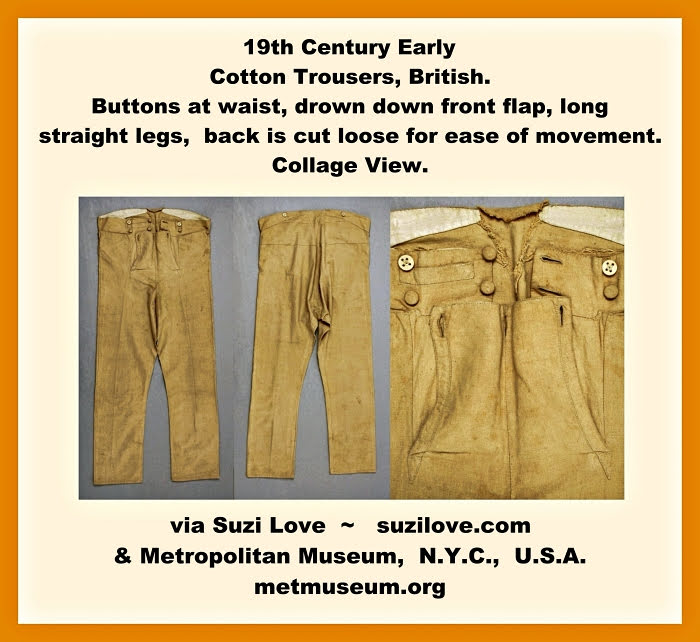
19th Century Early Cotton Trousers, British. Buttons at waist, drop down front flap with buttons and cut with excess material to allow easy movement. via Metropolitan Museum New York City, U.S.A. metmuseum.org.
Trousers: In the early 19th century, trousers were sewn with a flap in front called a fall front and was held in place by two or three buttons. Trousers were held up by tight-fitting waists which were adjusted by gusset ties in back of the waist. Seats were baggy to allow a man to rise comfortably from a sitting position.
1813 October White Empire style, or high-waisted, Carriage Dress, English. Brown shawl, brown boots, and a lace cap tied under the chin. Typical of the carriage fashions that would have been worn by Jane Austen and her contemporaries. Fashion Plate via The Lady’s Magazine Or Entertaining Companion for the Fair Sex.
Definition Empire Style Dress: High-waisted white gown defined women’s fashion during the Regency Era. ‘Empire’ is the name given to the period when Napoleon Bonaparte built his French Empire. High-waisted, loose gowns were adopted by the aristocracy as a symbol of turning away from the fussy, elaborate and expensive clothing worn in the 1700s. https://books2read.com/SuziLoveFashion1810-1814
Keep Calm and Read my Scandalous Siblings Series Books 1-3. The scientifically gifted Jamison siblings beg assistance from the St. Martin clan to battle a greedy railway investment syndicate. https://books2read.com/suziloveES
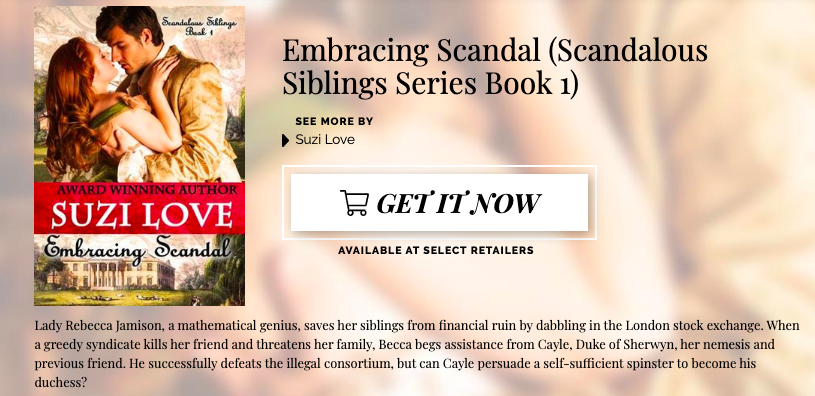
Embracing Scandal By Suzi Love Book 1 Scandalous Siblings. Lady Rebecca Jamison saves her family from financial ruin by investing in railways, but when a greedy syndicate murders her friend, Becca is forced to beg assistance from Cayle St. Martin, the new Duke of Sherwyn. https://books2read.com/suziloveES
Scenting Scandal Book 2 Scandalous Siblings Series. Lady Laura Jamison uses her extraordinary olfactory senses to sniff out her perfect match, but after she evades an assassin’s bullets, twice, she is forced to accept the protection of their family friend, and her nemesis, Richard St. Martin, the Earl of Winchester. https://books2read.com/suziloveSS
The Jamisons join the St. Martins at the duke’s country estate but a December snowstorm doubles guest numbers. #Holidays #FamilySaga #HistoricalRomance https://books2read.com/suziloveDS
ES_ Embracing Scandal Book 1 Scandalous Siblings Series D2D_ES_ https://books2read.com/suziloveES
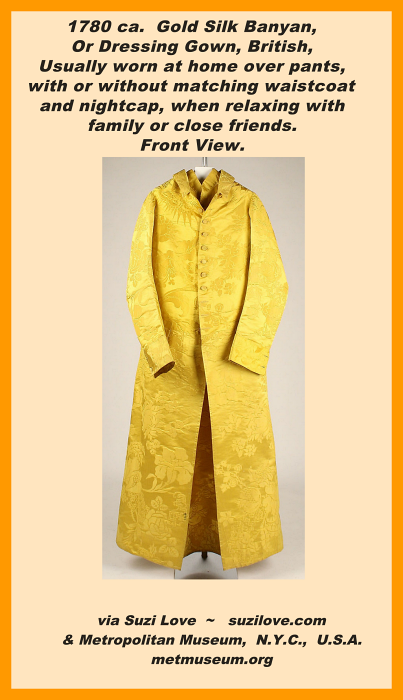
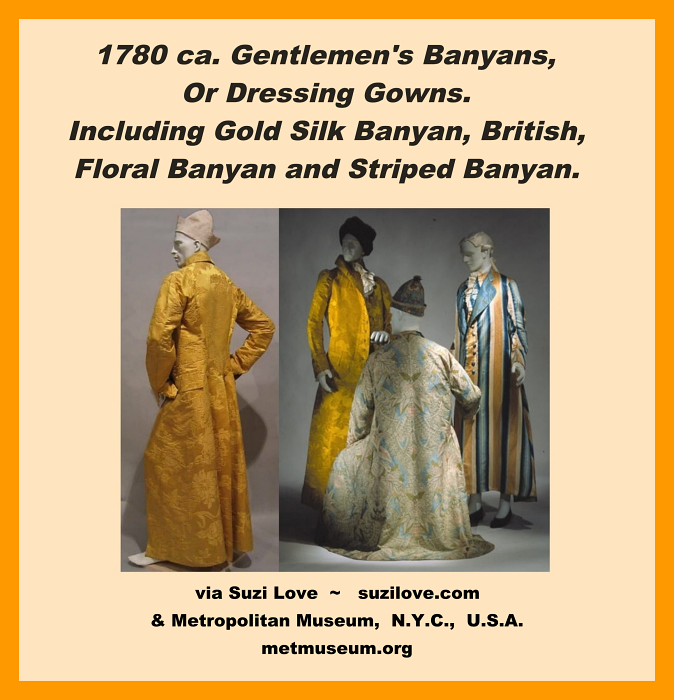
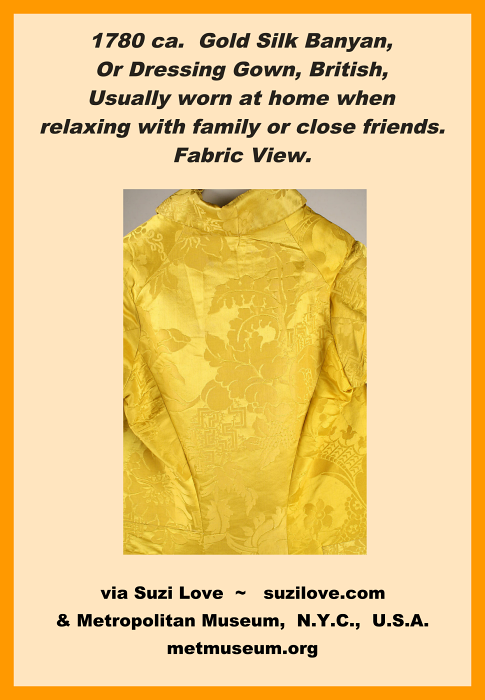
1780 ca. Gold Silk Banyan, British. For at-home wear, a gentleman had a dressing gown, often with a matching waistcoat, and an undress cap or turban. “This yellow damask banyan with its bold Chinese Chippendale – inspired pattern would have been an imposing sight on the streets or in the drawing rooms of London.” via Metropolitan Museum New York City, U.S.A. metmuseum.org Credit: Catharine Breyer Van Bomel Foundation Fund, 1978 Accession Number:1978.135.1
From the Curator: ‘For at-home wear, a gentleman had a dressing gown, often with a matching waistcoat, and an undress cap or turban.As for breeches, they were not designed especially for this casual ensemble, but rather borrowed from other suits.The dressing gown was cut like a man’s loose coat and usually hung to the floor, though there were also versions that stopped below the knees. Since there were no fastenings, the wearer overlapped the dressing gown in front when he walked so that the sides did not billow out behind him.The sleeves were originally rolled back to form cuffs, but later dressing gowns display the fashionable cuff of their period.In England these dressing gowns were called “banyans” or “Indian nightgowns” because of their kimono-like form and Eastern origin. Banyans were made in a variety of fabrics, including silk brocades, damasks, and printed cottons. By the 1780s, gentlemen ventured out of doors in this comfortable and stylish costume. According to Town and Country Magazine in 1785: “Banyans are worn in every part of the town from Wapping to Westminster, and if a sword is occasionally put on it sticks out of the middle of the slit behind. This however is the fashion, the ton, and what can a man do? He must wear a banyan.”This yellow damask banyan with its bold Chinese Chippendale – inspired pattern would have been an imposing sight on the streets or in the drawing rooms of London.’ via Metropolitan Museum New York City, U.S.A. metmuseum.org
1780 ca. Front View. 1780 ca. Back View.1780 ca. Back View. 1780 ca. Fabric View. RL_2_D2D_RetailerBuyLink_RL_2
https://books2read.com/suziloveYGD
As the Duke of Stirkton, Max was well accustomed to being watched. Young pups copied his dress style. Toad-eaters mimicked his behavior in futile attempts to ingratiate themselves into his life. Conservative groups applauded his somber public behavior, while cartoonists ridiculed his straight-laced demeanor and suggested he take a mistress. Or two.
Whichever way people viewed him, no one had dared ridicule him to his face. Until this evening. The Countess had side-stepped his butler and marched into his drawing room as if an unannounced call upon an unmarried duke was something she did regularly. Max had informed her, in great detail, of the extensive search he and his cousin had undertaken to locate her and the other women. She’d huffed and rolled her eyes.
Normally, his month-about- mistresses gleefully accepted his proposal because sharing a duke’s bed for a month would set them up for the rest of their lives. Apart from the financial benefits, he was a generous lover. One benefit of his abnormal upbringing had been an early and full education into what women wanted in a bed partner. Until the Countess had laughed at him, he’d never had reason to doubt his sexual prowess. In the brief time she’d been in his house, she’d challenged several of his beliefs.
“It’s the ideal solution.” And something he needed. “I will help you search my grandfather’s boxes by day and, in exchange, you’ll make yourself available to me in the evenings.” Max waited, unsure what to expect. An odd situation for a man who prided himself on reading adversaries as easily as he tallied the accounts. books2read.com/suziloveFTAV
1826 The Cyprian’s Ball At the Argyll Rooms. A Regency Gentleman’s Life. From The English Spy By Robert Cruikshank.
1826 The Cyprian’s Ball At the Argyll Rooms. A Regency Gentleman’s Life. From The English Spy By Robert Cruikshank. RL_2_D2D_RetailerBuyLink_RL_2
https://books2read.com/suziloveYGD
1810 ca Spectacles Or Eye Glasses, British. Fashion accessories as worn by both men and women in the time of the Bridgertons and Jane Austen. via Museum Of London museumoflondon.org. https://books2read.com/SuziLoveFashionMen1800-1819
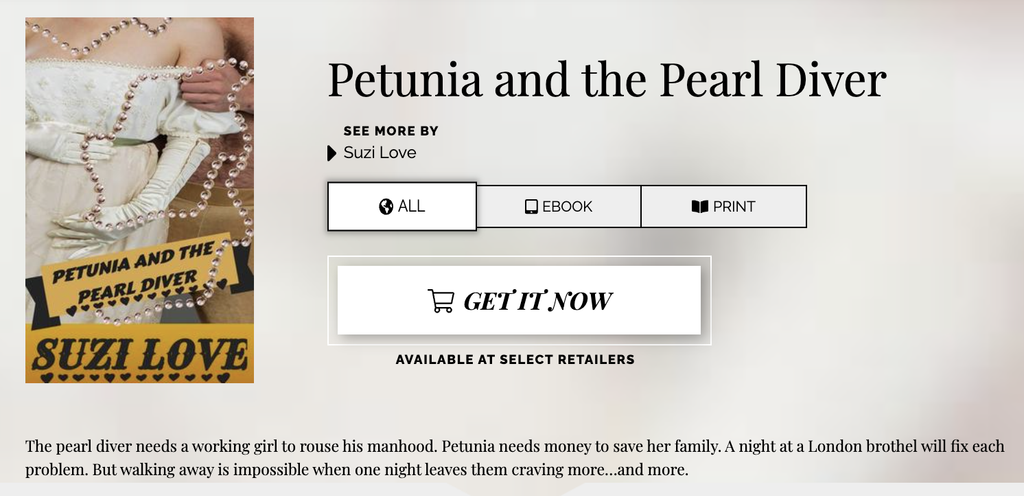
Petunia and the Pearl Diver: A hot Regency romance. Petunia needs money to save her aristocratic family. The pearl diver needs a woman to save him, body and soul. Their night together at a London brothel could solve both problems. But can their relationship survive in the real world? Because walking away becomes impossible when one night leaves them craving more…and more.
Book Hook: Once again, the pearl diver wondered at Petunia’s diction. Too well spoken for a brothel worker. “Who are you?”
She scowled at him, again. “Petunia.” She raised a brow. “You?”
He grinned. “I imagine you’d rather call me slave.” At her blank look, he asked, “Or servant? Footman? Driver?” She shook her head, clearly bewildered. “Isn’t that why you’re here? To pretend you’re a grand lady enjoying a naughty tryst with one of her servants?”
A rush of color flooded her cheeks, turning them bright pink. Not a sight he expected to see in a brothel unless it was rouge lavishly applied to hide a street worker’s age and to make her appear prettier. Petunia was pretty enough without rouge, and her blush screamed innocence.
He yanked at his restraints, suddenly worried that he’d walked into some sort of a nightmarish fantasy. “What the hell is going on here?”
Petunia didn’t look evil enough to have set up the sort of sadistic scene that some men fancied in these sorts of places. And he’d never heard of sadism being a sport particularly enjoyed by women, though he was in no position to know. He’d spent years taking the King’s shilling and fighting the little upstart Emperor all over the continent, and then, when he’d been wounded and shipped back to bonny England, he hadn’t been able to handle continual questions and false sympathy. Leaving for the South Seas had been the best decision he’d ever made.
The diving had strengthened his muscles, mended his weak leg, and allowed him to return to London a rich man. A very rich man. Pity that years of swimming and plenty of coin hadn’t also guaranteed that his sex drive would return. He’d give his entire fortune to reclaim the peace of mind and the virility of his much younger self.
A portrait from 1810-1814 of Rudolph Ackermann, shop owner and founder of ‘The Repository Of Arts’ magazine, The Strand, London. via National Portrait Gallery, London. Plus, an image of Ackermann’s premises in 1809. His ‘Repository of Arts, Literature, Fashion, Manufactures, etc.’ was published from 1809 to 1829 with images of Regency London, Regency furnishings and grand homes as well as beautiful fashion prints and descriptions every month. Ackermann originally supplied artists, amateur and professional, with supplies for watercolor painting. In 1799, he began manufacturing and selling his own watercolor paint blocks which were supplied by other colourmen, although at least three colors were his own mixture – Ackermann’s Green, White and Yellow. From 1817, his eldest son Rudolph Ackermann junior was responsible for the watercolor manufacturing. Ackermann also trained as a carriage designer. He began publishing prints and colour-plate books like ‘The Microcosm of London’ and ‘Doctor Syntax’ in the early 1800s.
The Repository of Arts was one the most popular magazines in Jane Austen’s time as it displayed everything ladies wanted to learn e.g. history, important country seats and houses in England, music, current events such as theatre plays, plus fashion plates and embroidery patterns. Ackermann’s shop in The Strand, London, was one of the fashionable places to shop during the Regency Era. The Repository also included poetry, travel reports, society reports and upcoming lectures. It also included serious subjects e.g. politics, legal matters, medicine and agriculture, a meteorological journal and details of the London markets. In 1817, the price of the magazine was 4 Shillings, so quite expensive for the time.
In the first issue, published for January 1809, Ackermann included an ‘introduction to the history of the useful and polite arts’ which said: “It is universally admitted, that to cultivate a taste for the arts, and an acquaintance with the sciences, is a pleasure of the most refined nature; but to do this without regard to its influence upon the passions and affections, is to ‘tear a tree for its blossoms, which is capable of yielding the richest and most valuable fruit.’ The cultivation of this taste may and ought to be subservient to higher and more important purposes: it should dignify and exalt our affections, and elevate them to the admiration and love of that Being who is the author of every thing that is fair, sublime, and good in nature.”
1810-1814 Portrait of Rudolph Ackermann, shop owner and founder of The Repository Of Arts magazine. via National Portrait Gallery, London.
1809 January Ackermann’s Repository of Arts, 101 Strand, London, U.K. Drawn by Augustus Pugin and Thomas Rowlandson. Published By Rudolph Ackermann. Etching and aquatint with hand coloring.