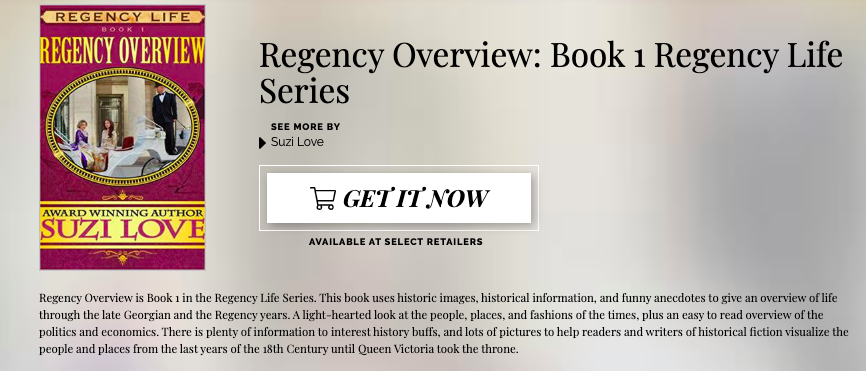
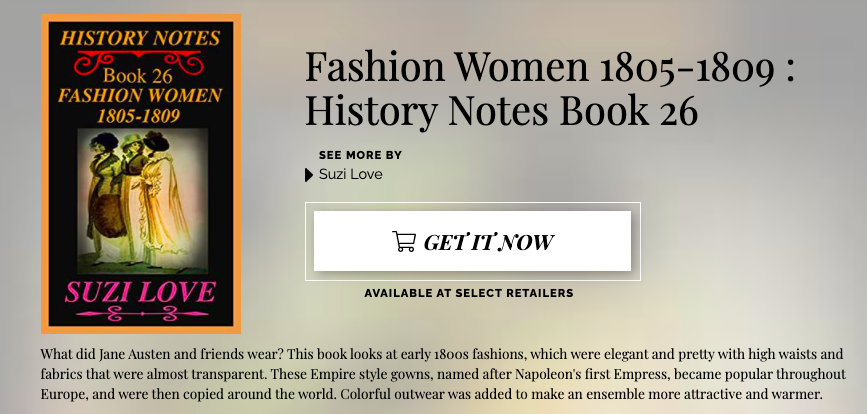
Love the life of Jane Austen and her stories? Fan of the Bridgerton series? Reader or writer of the early 1800s, or Regency Era? For information and pictures, try Regency Life Series by Suzi Love. Light-hearted series about Regency Era, or early 1800s. For writers, readers and history lovers.
Thes books use historic images, historical information, and funny anecdotes to give an overview of life through the late Georgian and the Regency years. A light-hearted look at the people, places, and fashions of the times, plus an easy to read overview of the politics and economics. There is plenty of information to interest history buffs, and lots of pictures to help readers and writers of historical fiction visualize the people and places from the last years of the 18th Century until Queen Victoria took the throne.
Try Books 1-5 Regency Life Series by Suzi Love. Regency Overview – Young Gentleman’s Day – Older Gentleman’s Day – Young Lady’s Day – Older Lady’s Day
1816-1817 ca. Man’s Linen Shirt, American. High collar, ruffles down front opening, fullness from gathered shoulders and sleeves for unrestricted movement. Beautifully created and monogrammed by Elizabeth Wild Hitchings for her husband, Benjamin Hitchings, a sea captain. Wives or servants regularly hand stitched shirts from 1800s-1840s, before sewing machines, but handiwork rarely recorded.
From The Creator: This shirt was created, from the linen fiber to the finished garment, by the donor’s great-grandmother, Elizabeth Wild Hitchings, for her husband Benjamin Hitchings, a sea captain, in 1816. It was common practice for a wife or servant to hand stitch family members’ shirts prior to the mid-19th century, but rarely was such handiwork recorded, making this case rare and intriguing. In addition, its elegant stitching makes it a perfect example of the familial care taken in sewing prior to the common possession and use of the sewing machine. via Metropolitan Museum, N.Y.C., U.S.A. metmuseum.org
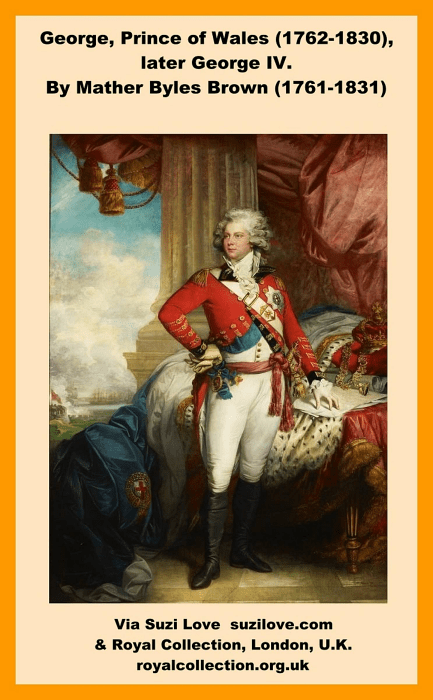
George, Prince of Wales (1762-1830), later George IV. By Mather Byles Brown (1761-1831) via Royal Collection, London, U.K.
The decision to make Prince George the Regent took a lot of political debate. After nearly two and a half months of political wrangling, the British government agreed to grant the title of Prince Regent on George. The Act of Parliament was finally passed by a commission in the House of Lords on February 5th 1811 and the Prince was formally sworn in as Regent at Carlton House the next day. He continued to rule as Regent until 1820 when, on his father’s death, he assumed the title George IV and reigned until his own death in 1830.
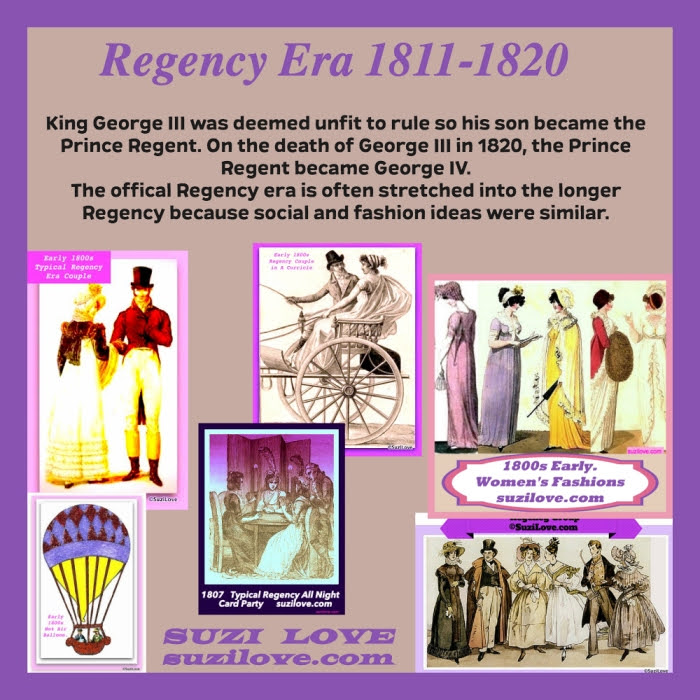
The British Regency was the period from 1811-1820. King George III was deemed mad and unfit to rule so his son became his proxy, the Prince Regent, or Prinny to his close friends. This was the situation when Jane Austen was alive. The Regency Era was famous for its beautiful clothing as well as the magnificent buildings erected and furnished in the ‘Regency Style’ under orders from the extravagant Prince Regent.
Regency Era Overview: Images, information, funny anecdotes give overview of Jane Austen’s and Bridgerton’s times. #Bridgerton #RegencyEra #JaneAusten #BritishHistory https://books2read.com/suziloveROver
1826 Locked up in a sponging house on Carey Street, London, because they are unable to pay their bill. From A Regency Gentleman’s Life. From: 1826 The English Spy By Robert Cruikshank. via Google Books (PD-180)
Definition Sponging House: Place of temporary confinement for debtors. Creditors would lay a complaint with the sheriff, the sheriff sent his bailiffs, and the debtor was taken to the local sponging-house. This was not a debtors’ prison but a private house, often the bailiff’s own home. The debtor was held there temporarily in the hope that they could make some arrangement with the creditors.
Light-hearted look at a young man’s day in the early 1800s. Depicts the ups and downs of a young gentleman’s day in the Regency Era, or Jane Austen’s years. Through historic images, historical information, and funny anecdotes, it shows how a young man about town fills his day, where he goes, and who he spends time with. This light-hearted look at the longer Regency years is an easy to read overview of what people did and wore, and where they worked and played. There is plenty of information to interest history buffs, and lots of pictures to help readers and writers of historical fiction visualize the people and places from the last years of the 18th Century until Queen Victoria took the throne. Regency Life Series Book 3 Young Gentleman’s Day.com/suziloveYGD
1810 Three Piece Gentleman’s Purple Court Suit, French. Worn by a rich and fashionable gentleman after Napoleon Bonaparte revived court traditions when he crowned himself Emperor of France in 1804. Gentlemen were expected to wear extravagant court dress, but the working class despised these luxurious fashions and royal overspending. Wastage of France’s money spurred French peasants to rise up in revolt and create the French Revolution. via Metropolitan Museum, N.Y.C., U.S.A.metmuseum.org
1801-1818 ca. ‘Diablo, or devil on two sticks’. Lessons In The Devil Series Plate 55: Man teaching a woman how to play diabolo, or devil on two sticks. via 1801-1818 Le Bon Genre, French. Gentleman in blue tailcoat, high white shirt and cravat, pants and black shoes. Lady in white dress with high frilled neckline, long sleeves and wearing green walking boots. Hand-colored etching. Published by: Pierre La Mésangère. Via British Museum, London, UK britishmuseum.org (PD-Art)
Jane Austen and Games: In Jane Austen’s times, games were a part of daily life. Families played all sorts of games, indoors and outside, to pass the time, especially at house parties or family gatherings.
Diablo, Or Devil On Two Sticks: Double cone type of yo-yo that is twirled, spun, tossed and caught on a string attached to two hand sticks. The toy, or Diablo, is kept spinning by manipulating it back and forth along the string and by tossing into the air. Numerous tricks can be performed e.g. toss, trapeze, cat’s tail and the umbrella.
1826 The Cyprian’s Ball At the Argyll Rooms. A Regency Gentleman’s Life. From The English Spy By Robert Cruikshank.
Cyprians: High-class prostitutes who dressed well and were interesting and entertaining. They were often under the protection of a wealthy gentleman for a time and were gifted clothing, jewelry and temporary housing. Called a multitude of names, none of which were flattering. Ladybird, lady of easy virtue, impure, fashionable impure, soiled doves, Covent Garden nun, Drury Lane vestal, left-handed wife, short-heeled wench, three-penny upright, woman of pleasure.
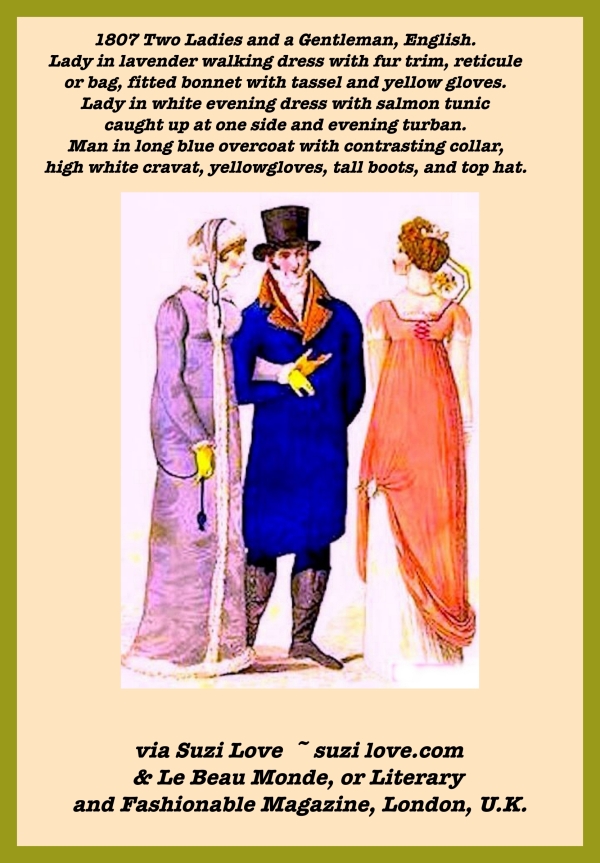
1807 Two Ladies and a Gentleman, English. Lady in lavender walking dress, or Pelisse, with fur trim, holding a blue reticule or bag, fitted lavender bonnet with tassel and yellow gloves. Lady in white evening dress with salmon tunic caught up at one side and evening turban. Man in long blue overcoat, or Redingote, with contrasting collar, high white cravat, yellow gloves, tall Hessian boots with tassels, and wearing a top hat. via Le Beau Monde, or Literary and Fashionable Magazine, London, U.K.
These are the types of outfits worn by Jane Austen and contemporaries in England and shown in their English magazines. The same designs had probably already been seen in France, because English publishers obsessively copied French fashions despite the two countries being at war for many years.
1811-1820 Regency Era Overview. The British Regency was the period from 1811-1820. King George III was deemed mad and unfit to rule so his son became his proxy, the Prince Regent, or Prinny to his close friends. The Prince Regent was often a figure of ridicule in Jane Austen’s times and featured regularly in caricatures, or cartoons, as a fat man who overindulged in everything and spent an exorbitant amount of money.
As a period in Britain’s official history, the Regency lasted less than ten years, although scholars apply the term Regency to a much longer period. It began in 1811, when George Ill was declared mad and the Prince of Wales was appointed Regent. It ended in 1820 when the King finally died and the Regent was crowned George IV. However, the Regency was a period in Britain’s history that had an effect on the social and cultural life for four decades, from the start of the French Revolution in 1789 to the passing of Britain’s Great Reform Act in 1832.
The decision to make George IV the Regent took a lot of political debate. After nearly two and a half months of political wrangling, the British government agreed to grant the title of Prince Regent on George. The Act of Parliament was finally passed by a commission in the House of Lords on February 5th 1811 and the Prince was formally sworn in as Regent at Carlton House the next day. He continued to rule as Regent until 1820 when, on his father’s death, he assumed the title George IV and reigned until his own death in 1830.
During the Regency, royalty and upper class ladies and lords, or the Beau Monde, lived elegant and extravagant lives that also allowed excesses and depravity. Britain was united behind exceptional heroes in long wars against France, but internally divided by class distinction and political agitation. The foundations of a modem industrial nation were laid by engineers, inventors and scientists. while Romantic poets and visionary artists dreamt of escape to earlier times and more ideal worlds. From: Queen’s Gallery, London, U.K. For more on this, take a look at my book Regency Overview. https://books2read.com/suziloveROver