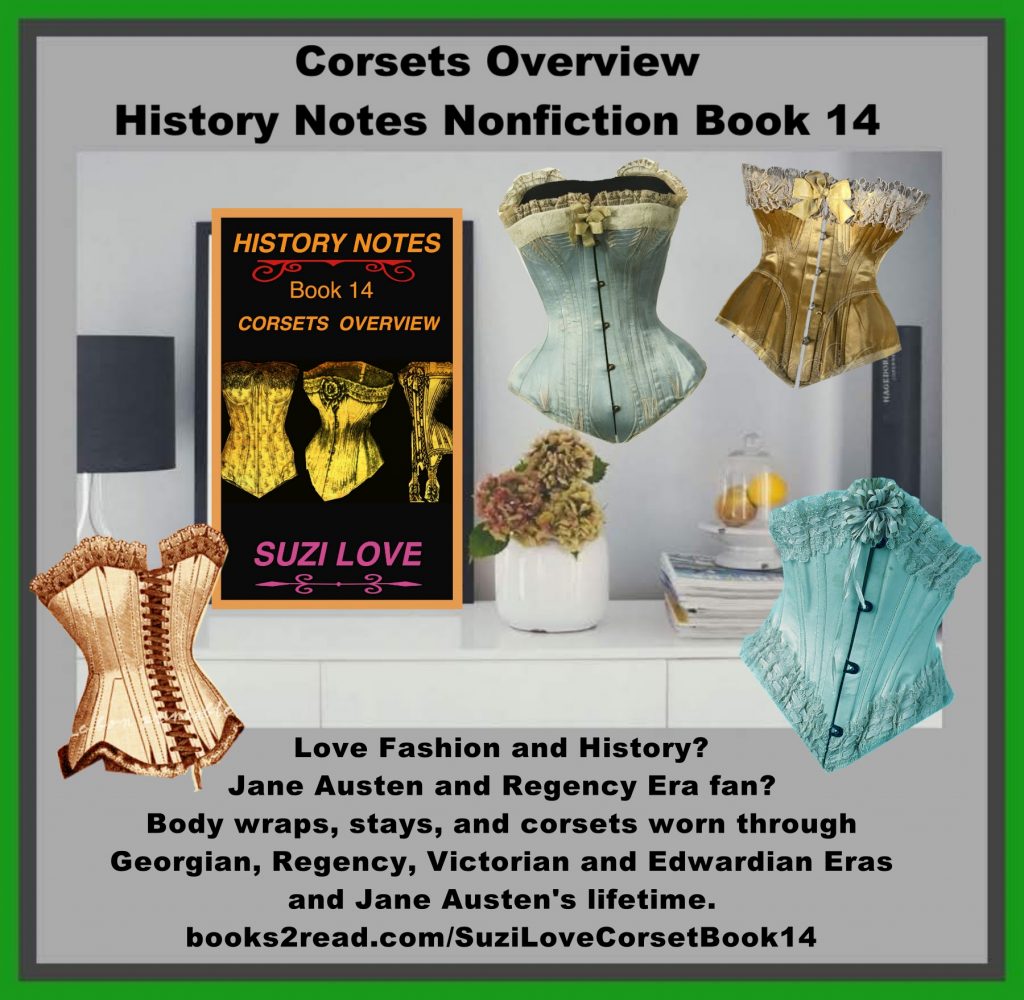
1830-1840 ca. Woman’s Corset, English. Cotton sateen, quilted, with cotton twill and cotton plain-weave tape. Designed to be worn over a chemise and petticoat. This corset is designed to be easy to tie and fasten so a woman could manage it by herself. The front ties are pulled tight and tied at the waist. Center back length: 15 7/8 in. (40.32 cm) via Los Angeles County Museum of Art, California, USA. via Los Angeles County Museum of Art. via Los Angeles County Museum of Art, California, USA.
. 1830-1840 ca. Woman’s Corset, English. Cotton sateen, quilted, with cotton twill and cotton plain-weave tape. Designed to be worn over a chemise and a petticoat. This corset is designed to be easy to tie and fasten so a woman could manage it by herself. The front ties are pulled tight and tied at the waist. Center back length: 15 7/8 in. (40.32 cm) via Los Angeles County Museum of Art, California, USA. 1830-1840 ca. Woman's Quilted Cotton Sateen Corset, English. #Corset #RomanticEra #BritishHistory. https://books2read.com/SuziLoveCorsetBook18 Share on XHN_18_D2D_Corsets 1830-1850. https://books2read.com/SuziLoveCorsetBook18
Richard, Earl of Winchester, has no time for their family friend and mad scientist, Lady Laura Jamison, yet when he’s with her, passion and desire explodes. Scenting Scandal By Suzi Love Book 2 Scandalous Siblings Series. books2read.com/suziloveSS
Richard had schooled himself into playing the role of mentor with such brilliance, Laura’s brothers and sisters would applaud his aptitude for match-making. He’d find Laura’s perfect husband as quickly as possible. And at those long and interminable dinners, he’d prove his own unsuitability by arguing until their fellow diners rolled their eyes and closed their ears to another of their battles of wit. When their companions’ eyes glazed over and they turned to more interesting conversation, he’d be free to let his eyes roam and his senses feast on Laura as she raved about the wonders of evolutionary science.
It was more likely that he’d need to dig his fingers into the elegant carvings on his chair to stop himself leaping across the table like a lunatic and shocking everyone at the sixty-seat table. He’d been in control of himself and his minor kingdom since he’d turned eighteen. So, for pity’s sake, why did being within thirty yards of Laura turn him into a wet-behind-the ears randy youth?
After her olfactory tests had proved he wasn’t her ideal mate, he should feel relieved, not affronted. And rather than reveling in a bachelor’s escape from the clutches of another would-be countess, Laura’s rejection had prompted him to childishly extol his own virtues. For an earl who also held minor titles and controlled several estates, being categorized as ‘Examined and Disregarded’ was as abnormal as it was lowering.
“Laura,” he said, dodging lace frills. “Picture my brutalized face if Michael and Jonathon caught me, the one man able to resist your charms and ignore your demands, composing appalling odes to the length of your lashes like your other fawning fops.”
“Is that why Sherwyn needed to coerce you into acting as my keeper?”
Ah yes, trust Laura to demand to know the reason he complied with his cousin’s wishes. “I was the only able-bodied male available for the time required.”
1840 Group In An Outdoor Setting, French. Two men in top hats. Modes de Longchamps’. Men’s outfits, a woman’s riding habit and a small boy, all tailored by Robin of 21 Rue Saint Marc, Paris. via Le Bon Ton. via Victoria and Albert Museum, London, UK. collections.vam.ac.uk.
Lady Rebecca Jamison ticked off numbers on the fingers of one revolting brown glove. “First, I’m not a thief. Second, I’m not a courtesan needing coin. Third, I’ve never been your mistress.” She looked down at her maid’s drab clothes, shuddered. “And if the women you’re taking to your bed dress this shabbily, I suggest you raise your standards.”
The Duke of Sherwyn drew several shuddering breaths. “Correct, on all counts. Now, appease my burning curiosity. What deception did you employ to hoodwink my servant?”
One shoulder lifted in the semblance of a shrug. “Oh, that! A child’s ploy. I laid coins on the fourth step and paid a street urchin to knock on your door and then run. When your gatekeeper bent to retrieve the coins, I slipped around the door and inside.”
Incredulity, then infuriation, surrendered to mirth. The simplicity of her ruse, alongside her detached style of recounting her deception, startled him into a snort of amusement.
“Huh! My ever-vigilant butler diverted by the sight of a few pennies.”
“Oh, no, not mere pennies. Gleaming new gold coins. Rest easy. Your servant’s momentary distraction cost me a high price.”
He lifted his hand to hide his smirk. Since he’d become Sherwyn, Jenner’s behavior vacillated between extreme formality due a duke or nose-lifting disdain owed to the family’s black sheep. This chink in Jenner’s polished armor pleased him.
He dipped his head, and said, “I bow to your finesse as a trickster. Now for my next pressing question. Why are you here?”
“I need your assistance.”
He grinned. “Ah, so once again your white knight is being asked to draw an imaginary sword and defend your ladyship’s honor.”
She groaned. “If only things were still as uncomplicated as in our childhood games.”
Keep Calm and Read my Scandalous Siblings Series Books 1-3. The scientifically gifted Jamison siblings beg assistance from the St. Martin clan to battle a greedy railway investment syndicate. https://books2read.com/suziloveES
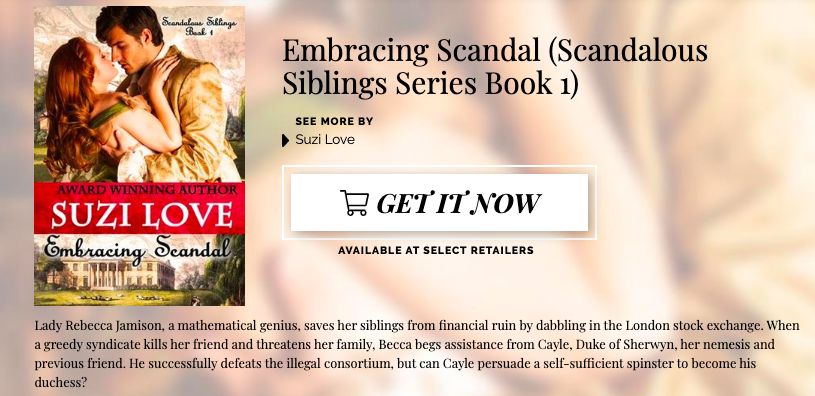
Embracing Scandal By Suzi Love Book 1 Scandalous Siblings. Lady Rebecca Jamison saves her family from financial ruin by investing in railways, but when a greedy syndicate murders her friend, Becca is forced to beg assistance from Cayle St. Martin, the new Duke of Sherwyn. https://books2read.com/suziloveES
Scenting Scandal Book 2 Scandalous Siblings Series. Lady Laura Jamison uses her extraordinary olfactory senses to sniff out her perfect match, but after she evades an assassin’s bullets, twice, she is forced to accept the protection of their family friend, and her nemesis, Richard St. Martin, the Earl of Winchester. https://books2read.com/suziloveSS
The Jamisons join the St. Martins at the duke’s country estate but a December snowstorm doubles guest numbers. #Holidays #FamilySaga #HistoricalRomance https://books2read.com/suziloveDS
1930-1939 ca. Louis Vuitton Wardrobe Trunk. Monogrammed coat hangers, leather handle.1930-19391930-1939 ca. Louis Vuitton Steamer Trunk.18th Century Late – 19th Century Early. Hide covered, two tier traveling chest or box. Via Bonham’s Auctions.17th Century Iron Trunk With Locking Mechanism. 1900s Early Bags and Suitcases.
1st Dibs Auctions. 1859 ca. Packing Case or Trunk By Louis Vuitton, French. Iron trim, wooden slats, brass studs and locks.17th – 20th Centuries Luggage For Travel. #RegencyEra #VictorianEra #EdwardianEra books2read.com/SuziLoveTravel Share on XHN_10_D2D_RetailerBuyLink_ History Notes Book 10 books2read.com/SuziLoveTravel

What did the Bridgerton ladies and Jane Austen use to carry her personal items? Ridicule, Reticule, Or Handbag? Call them what you like: purses, bags, handbags, reticules, ridicules, clutches, or pocket replacements. They all did the same job and they changed greatly with the prevailing fashions of time. books2read.com/suziloveReticules
Definition Of A Reticule; Bag or purse, often with a drawstring to pull closed and usually made of cloth or covered cardboard and often decorated with beading or embroidery. A reticule, or purse, or handbag, was usually carried by a woman during the Regency period to carry all their daily necessities. Earlier, women used pockets that tied at the waistline and were hidden in the folds of their skirts. Empire style, or early 1800s, high-waisted dresses made it impossible to either sewn in a pocket or to tie on a pocket, so women began carrying small, decorated bags called Reticules, or ridicules, which generally pulled close at the top with a drawstring. These Reticules, or bags, were the forerunners of our modern day purses.
The term ‘ridicule’ derived from the Latin ‘ridiculum’ and first used in France during the 17th century and meant subjecting something or someone to mockery. As women’s tiny bags were mocked, or ridiculed, for being a useless fashion accessory carried outside when they were first used in the late 1700s, it’s likely this is how the name ‘ridicule’ started. The later term ‘reticule’ derived from the Latin reticulum, meaning ‘netted bag’ and was applied when bags became larger and often made from netting. In the late 1700s and early 1800s, they were also known as indispensables as they carried all the personal items a lady needed upon her person every day. They were easily made by ladies, easy to carry and became an indispensable fashion accessory.
In the early nineteenth century, reticules started to look like future handbags as they were often made from rigid card or molded mâché or card into a variety of shapes. Early bags were circular and with a drawstring but as women wanted their reticules to look individual they could be made with two halves and a hinged metal closure or with concertina sides. Materials varied from silk, cotton and string and shapes were round, hexagonal or lozenge shapes with shell shaped bags becoming very popular during the Regency and Romantic Eras.
1800s magazines were written for well bred women who could read, so they gave plenty of ideas for how ladies could make and embellish reticules for their own use and as pretty gifts. Needlework was highly encouraged as a pastime for a lady so bags were frequently embroidered or decorated with beading. By the 1820s, reticules became more like our modern handbags using soft leather gathered at the top or hard leather with a rigid fastener and metal chain for carrying.
While writing about perfumes and oils, a favourite subject of mine, for my book, Scenting Scandal, I sniffed out some fascinating snippets on the history of early perfume suppliers in London. I have a nose for these things ( He He!) as in my past life I also blended oils and perfumes. One name stood out in historic London- Juan Floris.
He opened his shop at 89 Jerym St. in the elegant quarter of St. James’ London soon after his arrival from the Mediterranean in 1730. After starting as a barber and comb-maker, he missed the aromas of his Mediterranean youth and began blending oils, essences and fixatives, from Europe, into the first Floris fragrances.
‘ Purveyors of The Finest Perfumes & Toiletries to the Court of St James’ Since the Year 1730.’
In the same manner that Fortnum & Mason held Royal Warrants to supply groceries to the Royals, Floris held Royal Warrants to supply perfumes, shaving items and toiletries.
The first Royal Warrant granted to J.Floris Ltd was in 1820 as ‘Smooth Pointed Comb-makers’ to the then newly appointed King George IV. Then, the social elite followed the court until the Floris ledgers held accounts for an array of public figures, including practically every European Royal. Combs, tooth brushes and mouth washes were greatly valued by the company’s elite clientele.
These days, and at the same premises, Floris still supplies royalty and world celebrities with an array of fragrances and bathroom accessories.
The Floris archives hold letters from famous customers detailing their preferences and their thanks, including the following examples:
Winston Churchill, according to records held by Floris, purchased Special No. 127 Eau de Toilette and Stephanotis in 1934.
Marilyn Monroe was also known to have purchased from Floris on at least one occasion, having made a purchase of Rose Geranium while staying at the Beverly Hills Hotel, California in 1959.
Florence Nightingale wrote a 25 July 1863 letter thanking Mr Floris for his ‘sweet-smelling nosegay’.
Mary Shelley, whilst abroad, sent friends instructions to purchase her favourite combs and toothbrushes from Floris.
Beau Brummell in the early 19th century would discuss his current fragrances at length with Mr Floris.
Between 1820 and 1840 textile printers began to produce designs that were based on the woven silk dress fabrics of the 1750’s. Designs showing curving trails of lace or ribbons between bouquets of flowers became as popular in the 1830s as they had been in the 18th century.
Roller Printed Cotton.
The pattern on printed cotton was made with an engraved metal roller and additional colors were built up by wooden surface roller. Roller printing on textiles was introduced in the late 18th century and at first used mainly for small-patterned dress fabrics. By the 1830s, roller printing was highly mechanized process and had largely replaced block printing for fashionable furnishings.
Materials and Making The development of roller printing coincided with a radical transformation in the dyestuffs available for printing on cotton. Until the beginning of the 19th century printing had been based on the use of vegetable dyes. In Britain, France and Germany new chemical processes were developed and mineral colors produced that transformed the palette of colors available to the printer and made combinations such as shades of pink and orange possible.
Design and Designing The false trails of lace and bouquets of flowers in the fabric are inspired by the patterns of woven silks from nearly a century earlier. Changing taste made this design suitable for furnishing a room in the 1830s, while the 18th-century silk that was its inspiration would have been intended for a woman’s gown.
Time The styles considered fashionable in 1830s furnishings were widely diverse. Among the more recognisable historical references were Rococo, Elizabethan and Gothic. A design such as this seems to be relying on novelty of effect for its success.
Embracing Scandal Book 1, Scandalous Siblings Series. Lady Rebecca Jamison sneaks into the house of the Duke of St. Martin to beg his assistance to combat a rogue and murderous group of railway investors.
Lady Rebecca Jamison told The Duke of St. Martin. ‘We utilize Foster and Braithwaite as our stock trading agents and invest through them using the minimum identification on any documents.”
“Impressive. I heard that Foster and Braithwaite’s business grew twelve fold in the last few years by riding on railway stocks.”
“Hence, our problem. Their profits, our profits, became legendary. People speculated about the mysterious names on share certificates.” At his puzzled look she added, “Simple enough. We draw up letters. Ladies sign with their initials and family name, nothing more, so no one realizes the investors aren’t men. Or rather, no one did before.”
“And now?”
“Two weeks ago, some members of the outer circle approached my brother, Michael. They believe him to be personally responsible for our own change in fortune.”
“How big a change in fortune?”
“Oh, nothing too major.” She waved a hand in a vague manner and hoped her face didn’t flush. “Modest successes. Dividend rates in excess of six percent in some situations.”
His eyebrows shot upwards. “Six percent! Nobody I do business with calls that modest. No wonder they wish to obliterate all reference to your family, and your Society.”
“Yes, if only we’d been able to keep our good fortune a secret. We take the uttermost care with our clandestine activities, as we value our privacy and our reputations.”
The Duke raised a brow and pointed at his clock. “Oh, yes. Great care with your reputation!”
She chose to ignore him. “Michael laughed it off. Refused to join their so-called group of friends who dabbled in investing. So they raised the stakes. If he refuses to hand over m … his calculations for all the new railway share ventures opening, within the next two weeks, they vowed to destroy the members of his family. One by one, until he gives in.”
“Ah, now I understand. That’s why they’re keeping you alive. They’re waiting to acquire the records. They assume as eldest, and involved in a charitable society, you hold the most knowledge of…” When he mumbled, she stiffened. Did he guess? “Of Michael’s future stock predictions. Then, when they have all they require, they’ll kill all–”
“Yes, yes, I know. They’ll dispense with us regardless.”
She lifted her chin a notch. “But I can resolve this situation. Given a little more time, plus a little assistance from you.”
“Ah! Back to the crux of the matter. What you require from me.”