1826 A Regency Gentleman’s Life In Jane Austen’s Times. #JaneAusten #RegencyEra #Cartoon #England. via 1826 The English Spy By Robert Cruikshank via Google Books (PD-150)
The young man’s friends may help him decide what activities they would engage in. Perhaps they would decide to watch a dogfight or a cockfight. Or perhaps go and see a mill, where two burly boxers would pummel each other’s faces until one was declared winner and bets could be settled. Later that night, the rowdy group would head to whatever gambling hell was in vogue where they would pass several hours drinking and playing cards. Dark and sordid rooms, smoky interiors, loud and drunken men, and losing your quarter’s allowance from your father were all willingly suffered if a young man had enticed a buxom wench to sit on his lap and make him forget his woes. And how angry his father would be when he learned his son had gambled away yet another three months of his allowance.
Having filled in their morning, the men wander into Town to meet their cronies for luncheon. Thank goodness it’s time for a few bottles of claret!! Just the thing for fixing a hang-over, plus, a great place to discuss how to eke out their never-enough allowances until the young men could beg their long-suffering fathers for a little more spending money.
Price Egan’s ‘Life In London in 1823 described a young man’s entertainment choices. ‘ …bit of a stroll,’ in order to get rid of an hour or two. A turn or two in Bond Street, a stroll through Piccadilly, a look in at Tattersall’s, a ramble through Pall Mall, and a strut on the Corinthian path, fully occupied the time until the hour for dinner arrived, when a few glasses of rich wine put them on the path for vice.’ A group of young men would then head to Vauxhall. ‘‘…if enjoyment is your motto, you may make the most of an evening at Vauxhall, more than at any other place in the metropolis. It is all free-and-easy. Stay as long as you like, and depart when you think proper.’
1826 The Buff Club at the Pig and Whistle, Avon Street, Bath, U.K. 1826 House of Lords in High Debate, London, 1826 The Cyprian Ball At The Argyll Rooms.1826 A Cyprian Ball at the Argyll Rooms, London. 1826 A Sarcastic Look At Those Admitted To The Stock Exchange, London. 1826 Buff Club at the Pig and Whistle, Avon Street, Bath, England.
Writing Regency Era Fiction Or Nonfiction? Need more information on Older Gentleman’s Day in early 1800s, or the Bridgerton family or Jane Austen’s Regency Era. A lighthearted overview of an older gentleman’s clothing, social life, and responsibilities in the early 1800s. Take a look at where an older man went, what he wore, and how he managed the family’s finances and his estates. Older Gentleman’s Day Regency Life Series Book 3 books2read.com/suziloveOGD
RLAn overview of an older gentleman’s clothing, social life, and responsibilities in the early 1800s. books2read.com/suziloveYGD
Are you a reader or writer of Regency Romance? Love Jane Austen’s books? Want to know more about the mourning, riding, underclothing and other Regency Era women’s fashions in Regency romances? What was fashionable for women in Jane Austen’s times? Mourning, riding, daytime, evening clothing, plus underclothing, corsets and accessories. This book looks at what was fashionable for women in Jane Austen’s times, or the early 1800s, or the Regency Era in Britain. Wars were being fought around the globe so women’s fashion adopted a military look in support of soldiers. Fashions, like the lifestyle, became progressively more extravagant and accessories went from colorful to over-the-top. https://books2read.com/SuziLoveFashion1810-1814
Cheltenham Spa, England: Pittville Pump Room: Cheltenham is a famous spa town within easy reach of the Cotswolds in in the county of Gloucestershire, England, and was a popular Georgian and Regency spa town where one could rest and recuperate. It became famous as a Spa town following the discovery of mineral springs in 1716, and claims to be the most complete Regency town in Britain. The Pittville Pump Room is an elegant Grade 1 listed Regency building and perhaps the most famous example of Regency architecture in Cheltenham, despite the town being filled Regency buildings. The Pittville Pump Room was the last and largest of the spa buildings to be built in Cheltenham.
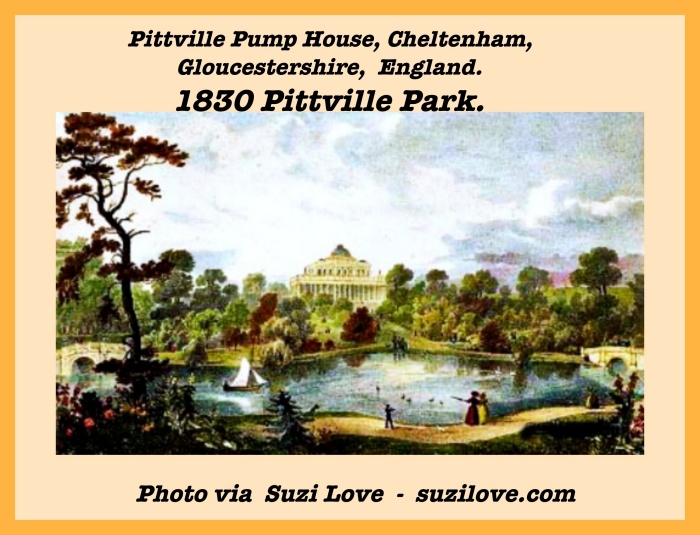
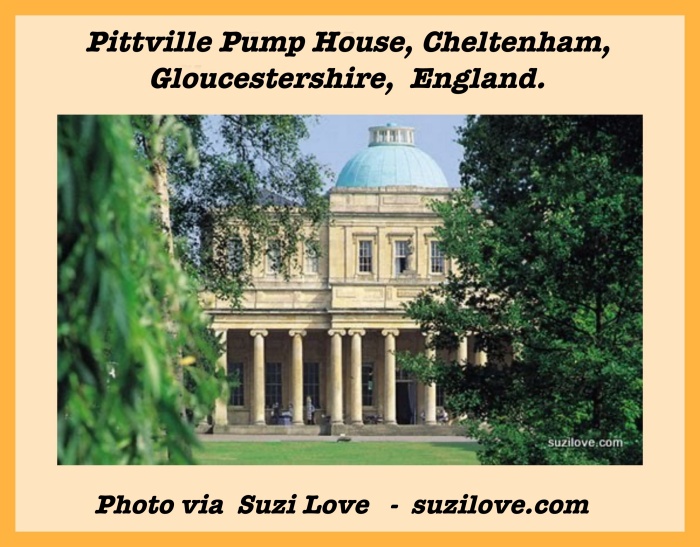
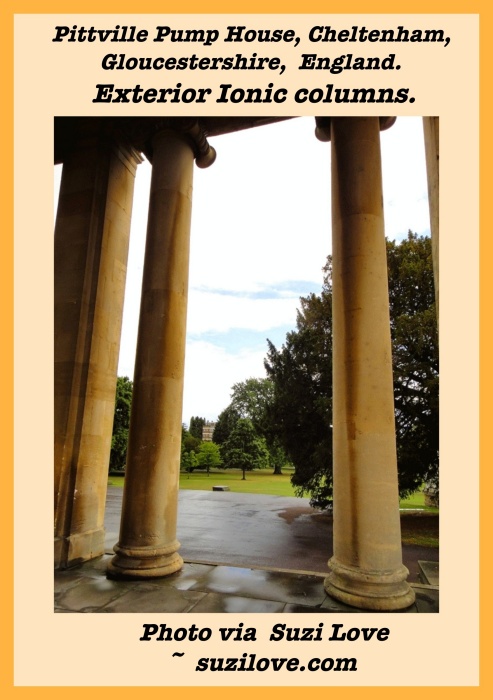
Location: The Pump Room stands at one end of Pittville Park, about two miles from Cheltenham’s town centre, and is a monument to more than 100 years of fame which Cheltenham enjoyed as a Spa town. The building is set in beautiful parkland and is surrounded on three sides by a grand colonnade of ionic columns opening into the impressive hall with its domed ceiling and original crystal chandeliers. The park has extensive open lawns surrounded by trees and ornate bridges and pathways lead around the lakes where swans and ducks swim.
Cheltenham Tour Map. Pittville Pump House, Cheltenham, Gloucestershire, England.
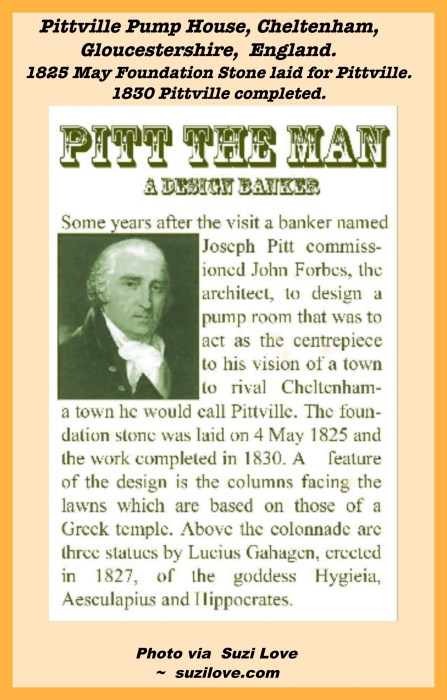
History: The waters were first discovered in around 1715 on a site now occupied by Cheltenham Ladies’ College. In 1788 George III and Queen Charlotte came to take the waters and it was their visit that set the seal on Cheltenham’s future. After a visit to Cheltenham, a banker named Joseph Pitt commissioned the architect John Forbes to design a pump room that was to act as the centrepiece to his vision of a town to rival Cheltenham – a town he would call Pittville.
The foundation stone was laid on 4 May 1825 and the work completed in 1830. The laying of the foundation was celebrated by the ringing of the bells, firing of cannons, as well as a Masonic Procession which set out from the Masonic Hall in Portland Street. In the evening banquets were held at two of the town’s hotels and grand fireworks display was to be seen at Pittville. The building took five years to complete. Following disagreements between Forbes and the builder, a second architect, John Clement Mead from London, was employed to finish the interior. He designed the elaborate stoves which heated the building. The original official opening on 6th July, 1830 was postponed until 20th July, 1830 because of the death of George IV. A grand public breakfast and ball marked the occasion.
1830 Pittville Park. Pittville Pump House, Cheltenham, Gloucestershire, England. 1831 Pittville Park. Pittville Pump House, Cheltenham, Gloucestershire, England. 1834 View Of Pump House Outside Cheltenham. Pittville Pump House, Cheltenham, Gloucestershire, England. Pittville Pump House, Cheltenham, Gloucestershire, England. Pittville Pump House, Cheltenham, Gloucestershire, England. Poster: Pittville Pump Room latest and grandest water spas built in Cheltenham.1820s Early Joseph Pitt, Banker.
Commissioned architect John Forbes to design a pump room
as centrepiece to his vision of a town to rival Cheltenham,
a town he would call Pittville.1825 May Foundation Stone laid for Pittville.
1830 Pittville completed.Pittville Pump House, Cheltenham, Gloucestershire, England.
Building the Pump Room: The total cost of the project was over £40,000, and incredible price for that time. Like many bankers of his time, Pitt ran into financial difficulties, the building went out of favour and was sold in 1890 to the Borough of Cheltenham for £5,400, a fraction of the original cost. The building is decorated in Ionic style and the great hail reflects the genius of John Forbes with the spa opening on the north side and the gallery and dome surmounting the hall.
The grand building is 92 feet long by 43 feet, surrounded by a colonnade 13 feet wide the roof of which are supported by fluted Ionic columns 22 feet high. Along the facade stand three figures representing Aesculapius, Hygeia and Hippocrates, originally made by Lucius Gahagan of Bath. In its design, the building combines elements of both Greek and Roman architecture. It was modelled on the temple on Illisus in Athens, the engravings of which appeared in Stuart and Revett’s Antiquities of Athens (1762).
The inspiration for the dome probably came from the Panthenon in Rome. A large ballroom was situated on the ground floor where even today visitors can attend music concerts, dances and other events. With a capacity of 400 and remarkable acoustics, it is Cheltenham’s finest concert venue. The spa with an oval pump room to the rear of the building are still there for the visitors to enjoy, available from a marbled pump and counter. A reading room, library and billiard room occupied the first floor.
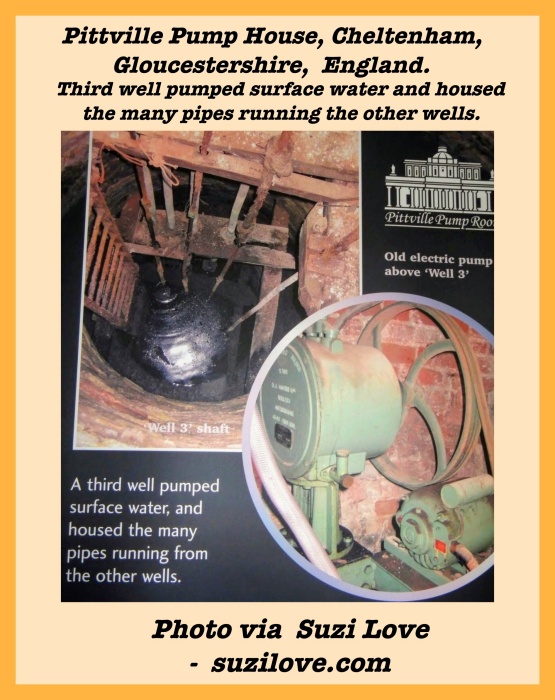
Third well pumped surface water and housed
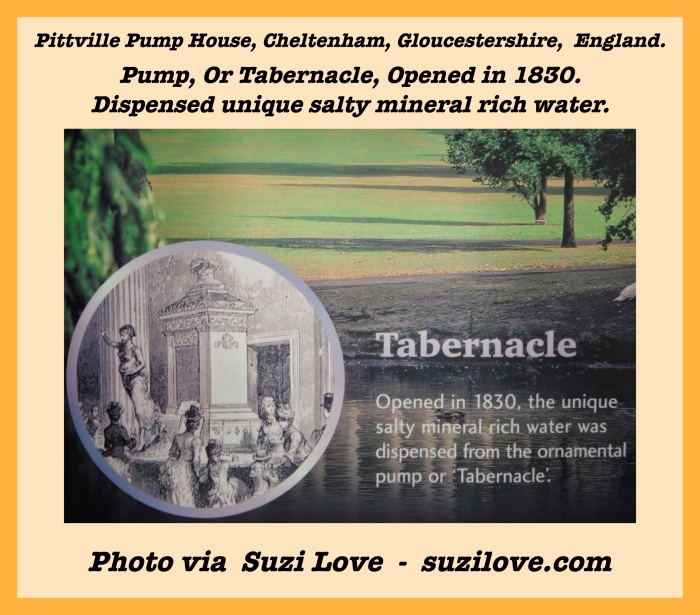
the many pipes running the other wells. Pittville Pump House, Cheltenham, Gloucestershire, England. Pump, Or Tabernacle, Opened in 1830.
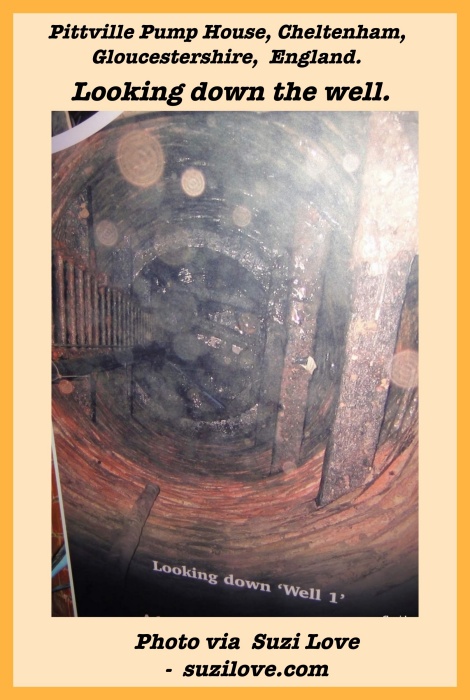
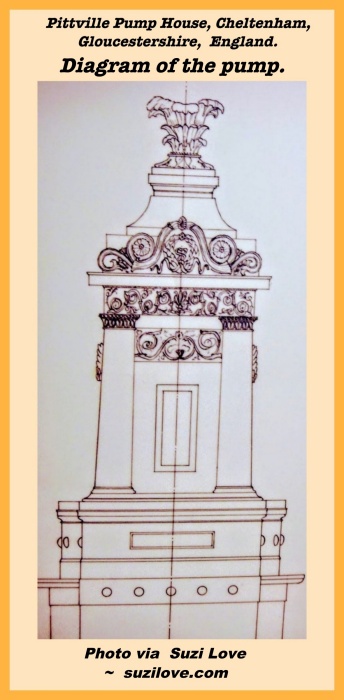
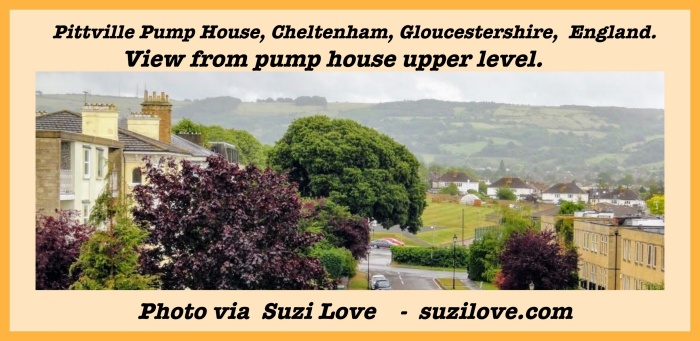
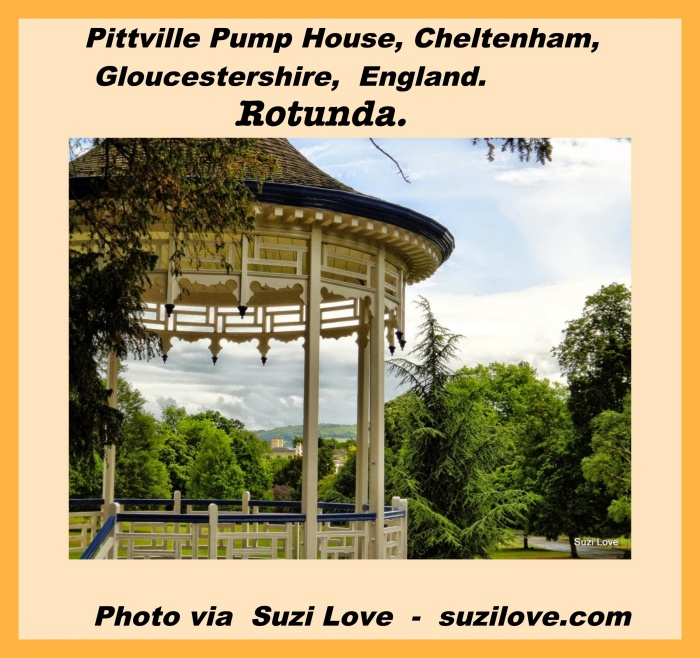
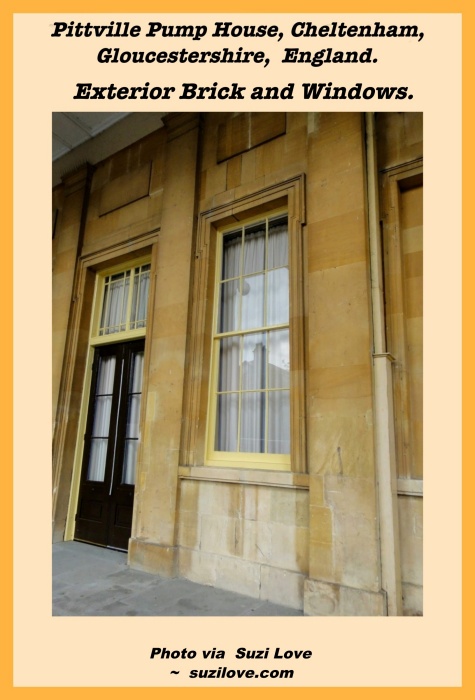
Dispensed unique salty mineral rich water. Pittville Pump House, Cheltenham, Gloucestershire, England. Looking down the well. Pittville Pump House, Cheltenham, Gloucestershire, England. Two wells with side tunnels supplied spa water. Pittville Pump House, Cheltenham, Gloucestershire, England. Diagram of the pump.Pittville Pump House, Cheltenham, Gloucestershire, England. View from pump house upper level.Side View. Pittville Pump House, Cheltenham, Gloucestershire, England. Rotunda. Pittville Pump House, Cheltenham, Gloucestershire, England. Rotunda and exterior of building. Rotunda. Pittville Pump House, Cheltenham, Gloucestershire, England. Ionic columns surrounding the Pump House. Pittville Pump House, Cheltenham, Gloucestershire, England. Exterior with Ionic columns. Pittville Pump House, Cheltenham, Gloucestershire, England. Exterior Brick and Windows. Pittville Pump House, Cheltenham, Gloucestershire, England.
Fashion History: “Cheltenham will be the summer village of all that is fashionable and all that is dignified; the residence of the royal ” family being a thing quite new so far from the metropolis . Already we hear of nothing but Cheltenham modes — the Cheltenham cap — the Cheltenham bonnets — the Cheltenham buttons — the Cheltenham buckles , in short all the fashions are completely Cheltenhamized throughout Great Britain.” via 1826 Griffith’s New Historical Description of Cheltenham and Its Vicinity.
Second World War: The Pump Room housed British and American army personnel, when dry rot was allowed to creep through the structure unchecked, and only after the war was the full extent of the damage revealed. Plaster, brickwork, timber: nearly everything had been affected. The dome was only held in position by a shell of plaster; the timber had been eaten away by the fungus.
The Duke of Wellington: Public subscriptions carne to the rescue, which were accompanied by Public Works grants and Historic Building Council contributions. A total of £43,250 was raised and by 1960 the building was partially restored to its former glory and reopened in 1960 by the Duke of Wellington. The old card room had been replaced by a new foyer, cloakrooms and second staircase, and heating and new lighting were in stalled.
Recent History: In 2003, the old Victorian wells were leaking and allowing ground water to dilute the natural mineral water so Pittville Pump Room no longer qualified as a spa and the well was shut down. The spa was then repaired and reopened so visitors can taste the only alkaline spa water in the country. The Pump Room’s old maple-strip floor was replaced with a stunning English oak floor, better flooring found for the ball room, and old pipes replaced. Nowadays the Pittville Pump Room is in use most days of the year for private and public functions and is one of Cheltenham’s most popular wedding venues. The venue is also used frequently by orchestras, choirs and chamber groups because it has stunning acoustics.
Light-Hearted look at an Older Lady’s Life In Jane Austen’s Times, or early 1800s. An easy to read overview of what an older lady did, wore, and how she lived in the early 19th Century. Information for history buffs and pictures for readers and writers of historical fiction. Older Lady’s Day, Regency Life Series, Book 5, by Suzi Love. books2read.com/suziloveOLD
The older lady’s day usually started with her toilette in her bedroom, where her maid helped her dress for the day and styled her hair. After that, she would join her family downstairs for breakfast unless she preferred a tray with either tea or hot chocolate in her bedroom as she prepared for her busy day. Her day would be made up of speaking with the housekeeper and the cook about the week’s menus, assuring that the servants were all available that day and no one was ill, and checking the list of foods needed. She would also enquire if the laundry was up to date and that they had enough good linen to make up all the beds before extended family members and guests arrived. If she was in the country and hosting a weekend house party, she would assign rooms to the guests on her lists and query that all was in readiness for their arrival.
Regency London 1820 The English Metropolis By John Corry Via Google Books (PD-180)
This great metropolis is sixty miles distant from the sea; it is built on the banks of the river Thames; is about seven miles in length, from east to west, but of an irregular breadth, being in some parts two miles, in others three, and at the broadest part four miles. Its three distinct and municipal divisions are, the city of London, the city of Westminster, and the borough of Southwark, which, with their extensive suburbs, cover a space of more than twenty miles in circumference. According to the Population Return of 1811, this metropolis then contained 149,430 houses, including those building and uninhabited; and since that period there have been but few new houses built, so that the real number is probably not more than 150,000.
In the year 1801, the population of London was ascertained to be 900,000. The number in 1811, amounted to 1,009,546. Beneath the pavement large arched sewers communicate with the houses by smaller ones, with the street by small openings covered with iron grating, and with the Thames, which contributes much to the cleanliness and health of the inhabitants of this populous place. Houses on each side of these streets are lofty, spacious, and commodious, generally four stories high, and chiefly occupied by tradesmen, whose shops present the most beautiful and perfect productions of nature and art for the general accommodation of man, There are two extensive lines of commercial streets from east to west, the principal of which begins at Mile End, and thence through Whitechapel, Aldgate,Leadenhall-street, Cornhill, Cheapside, St. Paul’s Church-yard,Ludgatehill, Fleet-street, the Strand, Pall Mall, St. James’s-street, and’ Piccadilly, to the southern side of Hyde Park. But besides these numerous storehouses of merchandise, there are also many thousand shops in various directions. Ample supplies of water afforded by the Thames And New River Water-works, are essentially conducive to the health and comfort of the inhabitants.
St. Paul’s Church is the most magnificent. It is situated near the northern bank of the Thames, and when viewed from Blackfriar’s Bridge in the vicinity, presents one of the noblest ornaments of superb architecture ever beheld by the human eye. This beautiful cathedral is built of Portland stone, in the form of a. cross, adorned in the central part by a lofty dome, on the summit of which is a light and elegant lantern, ornamented with Corinthian columns, and surrounded by a balcony. Next to St. Paul’s cathedral for magnificence, and even greater in extent, is that fine monument of gothic architecture Westminster Abbey, or the collegiate church of St. Peter.Among the modern churches that of St. Mary-le-Bone is remarkable for a spacious and stately portico composed of eight columns and two pilasters of Portland stone, in the Corinthian order. This church is built north and south, and the northern front, which is opposite the Regent’s Park.
The Tower of London, which has been the scene of many a tragic and affecting event, is the only fortress in the city. It is situated on the northern bank of the Thames, eastward of London Bridge, contains the Jewel Office, Mint, three armouries, and the royal train of artillery. The menagerie, near the west entrance, has for ages been a principal object of attraction to rustic visitors, who on their arrival considered it indispensable to see the lions.
Easy to read overview of what an older lady did, wore, and how she lived in Jane Austen and Bridgerton’s time. Information for history buffs and pictures for readers and writers of historical fiction. Older Lady’s Day Regency Life Series Book 5 by Suzi Love books2read.com/suziloveOLD
On January 27th, 1772, The Pantheon opened on Oxford Street, London. Designed by James Wyatt, The Pantheon featured a rotunda which was one of the largest rooms in England at the time. The Pantheon was intended as London’s answer to Ranelagh Gardens for winter entertainment and opened to a crush when nearly “two thousand persons of rank and fashion assembled.” The Pantheon officially closed for public entertainments in 1814, after Lord Chamberlain restrictions on the building’s use as a theatre made the final venture unprofitable. It was converted to a bazaar in 1833 and in 1867 became a winemakers office and showrooms until being demolished in 1937.
From 1819 Ackermann: The Pantheon was built “for the purpose of public evening entertainments” and was a “superb and beautiful structure” with elegant interiors furnished with fine paitnings, gilt vases, and statues depicting gods and goddesses. The building consisted of a suite of fourteen rooms, and between 1789-1792 (until a fire) was used as an exhibition space for Italian operas after the destruction by fire of the King’s Theatre in Haymarket.
1814 January The Pantheon via Ackermann’s Repository : This once noble structure, situated on the south side of Oxford-street, was originally built by Mr. James Wyatt, for the purpose of public evening entertainments. It was a most superb and beautiful structure, the admiration of all connoisseurs, foreigners as well as natives. The interior was fitted up in such a magnificent style, that it is scarcely possible for those who never saw it to conceive the elegance and grandeur of the apartments, the boldness of the paintings, or the effect produced by the disposition of the lights, which were reflected from gilt vases. Below the dome were a number of statues, representing most of the heathen gods and goddesses, supposed to be the ancient Pantheon at Rome, from which it derived its name. To these were added three beautiful statues of white porphyry, representing the King and Queen and Britannia.
The whole building formed a suite of fourteen rooms, each affording a striking specimen of taste and splendor. After the destruction of the King’s Theatre in the Haymarket by fire in June 1789, the Pantheon was used for the exhibition of Italian operas, and was frequently honored with the presence of their Majesties; till on the 14th of January, 1792, this beautiful structure also fell a prey to the same devouring element.
The fire broke out in the new buildings which had been added for the most convenient performance of operas; and before any engine reached the spot, the flames had gained such a height, that all attempts to save the building were in vain. Owing to the scenery, oil, paint and other combustible materials in the house, the conflagration was so rapid that not a single article could be saved. Persons who witnessed the progress of this tremendous fire, declare that the appearances exhibited through the windows, the lofty pillars enveloped in flames and smoke, the costly damask curtains waving from the rarefaction of the air, and the superb chandeliers turning round from the same circumstance, together with the successive crashing and falling of different portions of the building, furnished to their minds a more lively representation of Pandemonium than the imagination alone cam possibly supply.
The effects, too, of the intense frost which then prevailed, upon the water poured from the engines upon the blazing pile, are described as equally singular and magnificent. The loss occasioned by this catastrophe amounted to £60,000; only one fourth of which sum was insured. The height of the walls fortunately prevented the conflagration from spreading to the contiguous houses.
The Pantheon has been rebuilt; the original elegant front and portico still remain, but the rest of the edifice exhibits not eve a shadow of its former magnificence. Since its re-edification, it has been used principally for exhibitions, and occasionally for masquerades. Various plans have at different times been brought forward for opening it for dramatic representations; and this was actually done a few months since under a license from the magistrates, by a Mr. Condy, who is understood to have embarked a considerable fortune in the concern; but whose right has been contested by the winter theatres, and is likely to become a subject of legal discussion.
1800 Pantheon Masquerade, London, U.K. via Rudolph Ackermann’s Microcosm of London. Engraved by John Bluck. (1791-1831)
What was fashionable for outer wear in past centuries? Different names in different countries: Pelisse, Redingote, Coat, Or Walking Dress. The Bridgertons and Jane Austen and her contemporaries wore long coats like these to keep warm when out and about, visiting, shopping etc. The thin muslin dresses worn in the early 1800s were little protection against European winters. http://books2read.com/suzilovePelisse
Pelisse, Redingote, Or Walking Dress. History Notes Book 5 By Suzi Love. What was fashionable for outer wear in past centuries? Call them what you like: Coat, Pelisse, Redingote, Walking Dress, Promenade Dress. Take a look at what was being worn by women, men, and children. books2read.com/suzilovePelisseD2D_RetailerBuyLink_HN_5_books2read.com/suzilovePelisse
1816 July Opera Dress, English. Dress of white lace worn over a rich soft white satin slip. Skirt trimmed in a style of peculiar elegance, with lace festooned at regular distances, festoons edged by plain band of byas satin and finished by pearl ornaments of a very novel and pretty shape. Lace body is cut byas and richly ornamented round the bosom with pointed lace. Plain long sleeve, very full, except towards the wrist, which is nearly tight to the arm, and elegantly finished with lace. Hair ornamented with a wreath of French roses, parted in front, and simply dressed in loose curls, which fall very low on each side. Hind hair forms a tuft at the back of the head. Necklace, ear-rings, and bracelets of pearl. White satin slippers, and white kid gloves and a blush colored French silk scarf. Fashion Plate via Rudolph Ackermann’s ‘The Repository of Arts’.
Gorgeous Regency Era clothing came in a wide range of styles to suit every season and occasion. Ladies in the Bridgerton series and in Jane Austen’s times wore Empire style dresses which were usually made of light fabric and floaty in style. By the later 1810s, stripes were very popular and lace and frills were added to make the dress more individual.
Fashion Women 1815-1819 History Notes Book 28 What did Jane Austen wear? https://books2read.com/SuziLoveFashionWomen1815-1819