Christmas: Typical Christmas Food Eaten By the Bridgerton and Jane Austen Families. #Christmas #Food #JaneAusten #Bridgerton
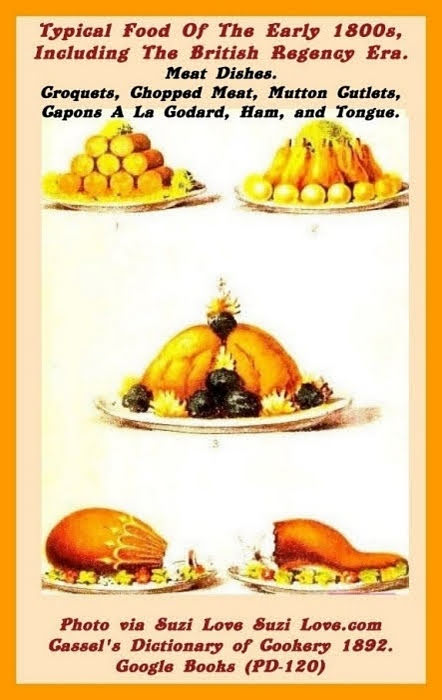
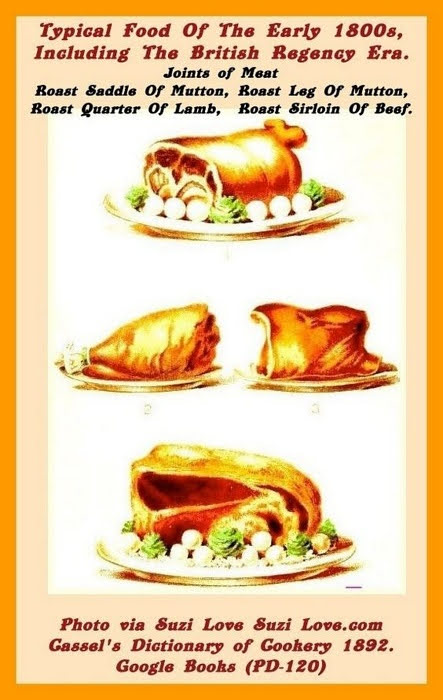
On the Christmas menu was generally mince pies and perhaps a goose or a piece of beef, depending on the family’s wealth and status. Mince pies were not made of fruit mince as we do now, but of offal or meat such as bullock’s tongue cooked with spices, orange peel, and wine and then used to fill pastry cases.
Another Christmas specialty was a Yorkshire Christmas pie which would be filled with turkey, goose, a hen, or perhaps woodcocks, partridge, or pigeons. And after the main courses, came the Plum Pudding, mixed on Stir-Up Sunday according to each family’s recipe and then boiled in a cloth.
First made in 1850 by a London sweet maker called Tom Smith who decided it would a fun idea if his sweets and toys opened with a crack when their fancy wrappers were pulled in half. In early 1830, Tom Smith started work in a bakers and ornamental confectioners shop in London, selling sweets such as fondants, pralines and gum pastilles. He worked hard and took particular interest in the wedding cake ornaments and decorations, experimenting and creating new, more exciting and less crude designs in his spare time. Before long he was successful enough to leave and start up his own business in Goswell Road, Clerkenwell, East London. On a trip to Paris in 1840, he discovered the ‘bon bon’, a sugared almond wrapped in a twist of tissue paper. He brought the ‘bon bon’ to London and they sold extremely well, but in January demand virtually ceased and once again he was reliant on sales of cake and table decorations and ornaments.
Anxious to stimulate sales, Tom placed a small love motto in the tissue paper and encouraged his regular customers to take supplies. Tom took a risk and concentrated on developing it further, while still running the wedding cake ornament and confectionery business. The majority of ‘bon bons’ were sold at Christmas so Tom thought up ways to capitalize on this short, but very profitable, season. It was the crackle of a log as he threw it on his fire that gave him the flash of inspiration which eventually led to the crackers we know today. A ‘ crackle’ added excitement to his novelty ‘bon bon’ so he experimented to find a compound which gave a satisfactory bang. He perfected his chemical explosion to create a ‘pop’ caused by friction when the wrapping was broken and the trade jumped at Tom Smith’s latest novelty.
He quickly refined his product by dropping the sweet and the ‘bon bon’ name, calling his new crackers Cosaques, but he kept the motto and added a surprise gift. Delighted at his overnight success, Tom took his cracker abroad but an Eastern manufacturer copied his idea and delivered crackers to Britain just before Christmas. So Tom designed 8 different kinds of cracker, working his staff day and night and distributing stocks in time for Christmas. He lived to see the new branch of his firm grow to swamp the original premises in Goswell Road and the company moved to Finsbury Square in the City of London where it remained until 1953. When he died he left the business to his three sons, Tom Henry and Walter. A few years later, a drinking fountain was erected in Finsbury Square by Walter Smith in memory of his mother, Mary, and to commemorate the life of the man who invented the great British Cracker.
His three sons developed the cracker designs, contents and mottoes. Walter Smith, the youngest son, introduced a topical note to the mottoes which had previously been love verses. Special writers were commissioned to compose snappy and relevant maxims with references to every important event or craze at the time from greyhounds to Jazz, Frothblowers to Tutankhamen, Persian Art to The Riviera. The original early Victorian mottoes were mainly love verses. Eventually these were replaced by more complicated puzzles and cartoons, and finally by the corny jokes and riddles which characterise our crackers today.
Walter also introduced the paper hats, many of which were elaborate and made of best tissue and decorative paper on proper hatmakers stands and he toured the world to find new, relevant and unusual ideas for the surprise gifts, such as bracelets from Bohemia, tiny wooden barrels from America, and scarf pins from Saxony. Some were assembled in the factory, like the thousands of tiny pill boxes filled with rouge complete with powder puff.
A six foot cracker decorated Euston Station in London, and in 1927 a gentleman wrote to the Company enclosing a diamond engagement ring and 10 shilling note as payment for the ring to be put in a special cracker for his fiancee. Unfortunately he did not enclose an address and never contacted the Company again; the ring, letter and 10 shilling note are still in the safe today. In the early days, there was a large variety of specialist boxes, including Wedgwood Art Crackers from original designs by permission of Josiah Wedgwood and Sons, and designs such as Japanese Menagerie crackers containing the latest novelties from Japan, including animals, birds, reptiles and mottoes in Japanese.
Crackers were created for the War Heroes, Charlie Chaplin, The Wireless, Motoring, The Coronation and even the Channel Tunnel in 1914. Exclusive crackers were also made for members of the Royal Family and still are to this day. During the Second World War restrictions were placed on the production of cracker snaps.
The Ministry of Defence commissioned Tom Smith to fold and tie bundles of three to six snaps together with special string and regulation knots. These bundles were then used by soldiers in training as, when the string was pulled, they mimicked the noise of machine gun fire. After the war, vast quantities of these surplus cracker snaps were released back into the cracker trade. As the demand for crackers increased, Tom Smith merged with Caley Crackers in 1953 taking over their headquarters and factory in Norwich, East Anglia.
Tom Smith Group Limited currently hold a royal warrant from: HM QUEEN ELIZABETH II Ê 1906: Tom Smith were granted their first Royal Warrant by the then Prince of Wales which entitled them in 1909 to become members of the Royal Warrant Holders Association. 1910: In December, the reigning monarch, King George V granted Tom Smith his warrant as suppliers of Christmas Crackers. Tom Smith still holds the honour of producing special crackers each year for the Royal Household.
In the countries that now use them, a cracker is set next to each plate on the Christmas dinner table and a colourful party hat, a toy or gift and a festive joke falls out when the cracker is pulled in half with a loud bang! The party hats look like crowns, supposedly to symbolise the crowns worn by the Wise Men.
Another British company strongly associated with the cracker business was Batger and Co. Like Tom Smith, they sold a wide variety of crackers in highly decorated boxes and once again many were themed or in commemoration of a special event. Batger’s Gretna Green Crackers for the famous place for eloping lovers where couples in the Regency period ran off in a carriage to Scotland to be married at the blacksmiths forge at Gretna Green.
Crackers were an incredibly expensive luxury at the time costing from 14 shillings to 30 shillings a box. Others were Peerless Crackers and Mead and Field Crackers. Cabaret Girl from the Peerless series of Christmas crackers, from 1933, which promises that each cracker contains ‘both a juvenile costume and fancy hat or cap, amusing joke or riddle, a good snap.
I love finding out the tradition behind some of the things we do and say at Christmas, don’t you? So I am going to do a series of posts this week covering lots of the historical aspects of our celebrations. Why we say things, why we do things, and why we use things to decorate our houses. Enjoy the festive season with me with more posts to follow.
CHRISTMAS
The word has been around for centuries, with some dictionaries putting it in the late Old English period and others to the 12th century. Old forms include cristes masse and christmasse, meaning the festival (mass) of Christ. It replaced other pagan midwinter festivals when the church tried to persuade Romans to convert to Christianity.
XMAS
This abbreviation annoys a lot of people but it isn’ t simply modern shorthand. X was used to represent the Greek symbol chi, which is also the first letter in Christ. This has been used since Roman times.
DECORATE
The word means to adorn and is from the 16th century, but the seasonal meaning of to deck with ornamental accessories dates from the 18th century. The word originates from the Latin decoratus (beautify).
TINSEL
It was first seen in the expression tinsell saten which means strips of shining metal used for ornament. It also describes things that are showy and worthless. It is believed to have come from the Anglo Norman with ancestors in Old French.
Christmas pudding originated as a 14th century porridge called ‘frumenty’ , made of beef and mutton with raisins, currants, prunes, wines and spices. Often more like soup, it was eaten as a fasting meal in preparation for Christmas festivities. By 1595, frumenty changed into a plum pudding thickened with eggs, breadcrumbs, dried fruit and flavoured with beer and spirits. It became the customary Christmas dessert around 1650, but in 1664 the Puritans banned it as a bad custom. In 1714, King George I re-established it as part of the Christmas meal, having tasted and enjoyed Plum Pudding.
“In December, the principal household duty lies in preparing for the creature comforts of those near and dear to us, so as to meet old Christmas with a happy face, a contented mind, and a full larder; and in stoning the plums, washing the currants, cutting the citron, beating the eggs, and mixing the pudding, a housewife is not unworthily greeting the genial season of all good things.” Via 1861 Beeton’s Book of Household Management.
The Sunday closest to St. Andrew’s Day was Stirring-up Sunday, and the day to prepare the family’s Christmas pudding. The eldest member of the household or a visitor would give the first stir and charms were stirred into the pudding. A ring meant a coming marriage, a button was bachelorhood, a thimble meant spinsterhood, and a sixpence was good luck. Puddings were steamed in a pudding bag and stored in a cool place until Christmas Day.
Our modern Christmas tree tradition probably began in Germany in the 18th century, though some argue that Martin Luther began the tradition in the 16th century. An evergreen fir tree was used to celebrate winter festivals (pagan and Christian) for thousands of years. Nobody is really sure when Fir trees were first used as Christmas trees but it probably began 1000 years ago in Northern Europe. Many early Christmas Trees seem to have been hung upside down from the ceiling using chains.
The English phrase “Christmas tree”, first recorded in 1835, came from the German words Tannenbaum (fir tree) or Weinachtenbaum (Christmas tree). The Christmas tree is often explained as a Christianization of pagan tradition and ritual surrounding the Winter Solstice, which included the use of evergreen boughs, and an adaptation of pagan tree worship. At first, a figure of the Baby Jesus was put on the top of the tree. Over time it changed to an angel or fairy that told the shepherds about Jesus, or a star like the Wisemen saw.
Christian tradition associates the holly tree with the crown of thorns, and says that its leaves were white until stained red by the blood of Christ. Along with a Christmas tree, the interior of homes were decorated with plants, garlands, and evergreen foliage and in Victorian times, Christmas trees were decorated with candles to represent stars.
The early Germans conceived of the world as a great tree whose roots were hidden deep under the earth, but whose top, flourishing in the midst of Walhalla, the old German paradise, nourished the she-goat upon whose milk fallen heroes restored themselves. Yggdnafil was the name of this tree, and its memory was still green long after Christianity had been introduced into Germany, when much of its symbolic character was transferred to the Christmas-tree. At first fitted up during the Twelve Nights in honor of Berchta, the goddess of spring, it was subsequently transferred to the birthday of Christ, who, as the God-man, is become the “resurrection and the life.”
Queen Victoria saw a Christmas tree as a girl in 1832. The little princess wrote excitedly in her diary that her Aunt Sophia had set up two “trees hung with lights and sugar ornaments. All the presents being placed around the tree.” In 1841, Prince Albert, Queen Victoria’s German husband, arranged for a fir tree to be brought from Germany and decorated. By 1850, Victoria and Albert had Christmas trees erected in the British Royal Palaces and their children started the tradition of gathering around the tree.
‘The Christmas-tree is doubtless of German origin. Though in its present form it is comparatively of recent date, yet its pagan prototype enjoyed a very high antiquity.’ From 1873 Harper’s Bazaar, America.
A print of the royal family gathered about the Christmas tree at Windsor Castle appeared in the Illustrated London News in 1848, then in Godey’s Lady’s Book in 1850, and was reprinted again ten years later. The six-foot fir sits on a table, each tier laden with a dozen or more lighted wax tapers. An angel with outstretched arms poses at the top. Gilt gingerbread ornaments and tiny baskets filled with sweets hang by ribbons from the branches. Clustered around the base of the tree are dolls and soldiers and toys.
Christmas trees did exist in America before Queen Victoria made them famous, but mainly only amongst migrant groups from Europe. The writer of an 1825 article in The Saturday Evening Post mentions seeing trees in the windows of many houses in Philadelphia, a city with a large German population. He wrote, Their “green boughs laden with fruit, richer than the golden apples of the Hesperides, or the sparkling diamonds that clustered on the branches in the wonderful cave of Aladdin.” Gilded apples and nuts hung from the branches as did marzipan ornaments, sugar cakes, miniature mince pies, spicy cookies cut from molds in the shape of stars, birds, fish, butterflies, and flowers. A woman visiting German friends in Boston in 1832 wrote about their unusual tree hung with gilded eggshell cups filled with candies.
Not until the mid-nineteenth century did Christmas trees start spreading to homes with no known German connection. But once Queen Victoria approved of the custom of a Christmas tree, the practice spread throughout England and America and, to a lesser extent, to other parts of the world, through magazine pictures and articles. Upper-class Victorian Englishmen loved to imitate the royal family, and other nations copied the custom. Late in the century, larger floor-to-ceiling trees replaced the tabletop size.
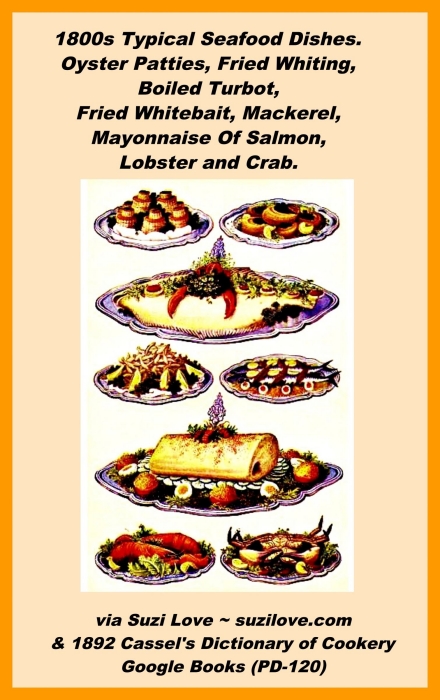
19th Century Typical Meals and Table Settings for the Family and For Guests. This is typical of the food that would have been served at Jane Austen’s meal times. Historic food from 1860s Mrs. Beeton’s Household Management.
1800spical Modern Table Settings.1800s Typical China For Serving Dinner and Dessert. Dinner Plates, Soup Tureen, Covered Cheese Dish, Jug, Dessert plates and Serving Dish. From: 1860s Mrs. Beeton’s Book of Household Management. via Google Books (PD-150)RL_5_D2D_RetailerBuyLink_RL_5_
https://books2read.com/suziloveOLD
Reticule Or Bag: Purse, often with a drawstring to pull closed and usually made of cloth or covered cardboard and often decorated with beading or embroidery. Carried by a woman during the Regency period to carry all their daily necessities. in the place of pockets.
Spencer: Short jacket, cropped at the waist, worn over a dress, or gown. Delicate and regency dresses provided so little protection from the cold, so over garments were essential for warmth, modesty and good health.
Pelisse Or redingote Or Walking Dress: Coat worn over clothing of both sexes for warmth and protection from the elements.
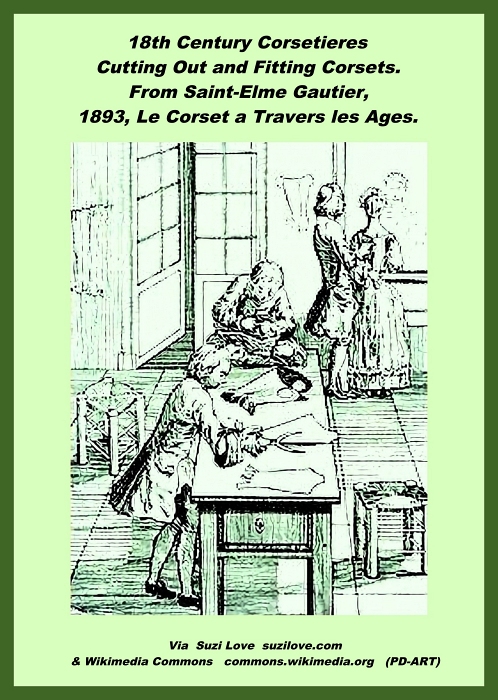
There has been some discussion on the names for Corset Makers. I’ve seen lots of names, including Stay Maker, Stay Manufacturer, Corset Maker, Body Tailor and Milliner. It was mainly men who were Stay Makers, but there were also some women who included stay making with their millinery.
Corsets Overview History Notes Nonfiction Book 14. This book shows how body wraps, stays, and corsets were worn to create a variety of fashionable silhouettes through past centuries. Corsets flattened breasts and accentuated rounded hips or pushed up breasts and showed off the bust line depending on the fashions of the time and the desired silhouette. Includes corsets through the Georgian, Regency, Victorian and Edwardian Eras and Jane Austen’s lifetime. Overview of corsets through history, including the Georgian, Regency, Victorian and Edwardian Eras and Jane Austen’s lifetime.
1776 April 28th John McQueen, Stay Maker., New York. At the sign of the White Stays in Smith Street,near the Mayor’s baths, New York. Making all sorts of stays in the newest fashion that is worn by the ladies of Great Britain or France. Packthread stays for babies from one month to seven years, stays for children of Tabby, Ruffled Canvas, Or Buckram, and for older girls an assortment of thin boned stays of different sorts and sizes.1835 Milliner, Dress and Corset Maker to the Royal Family. Mrs. Langdon. 37 Milson Street, Bath, U.K. Local Trade Advertisements. From 1835 The Historical and Local New Bath Guide By C. Duffield. via Google Books (PD- 150)18th Century Interior of the shop of a body tailor, or corset maker. From 1893 The Art of the Tailor of the Bodies of Women and Children.1835 Fashionable Long and Short Stay Manufacturer. Robert Drew & Co. Local Trade Advertisements. From- 1835 The Historical and Local New Bath Guide. Published by C. Duffield via Google Books (PD-150)18th Century Corset Maker From 1893 Le Corset, A Travers Les Ages.18th Century Corsetieres cutting out and fitting. From Saint-Elme Gautier, Le Corset a Travers les Ages. en.wikipedia.org
19th Century Early Women’s Cotton Caps. Worn as morning caps, night caps, or under other hats. The proper 19th century woman wore various forms of headwear throughout the day and evening. Unstructured, finely decorated cotton caps were worn in the morning hours with the informal attire appropriate for the early part of the day. Jane Austen and her family and female friends, and the Bridgerton family, would have worn caps like these, sometimes during the morning at home, to bed to keep their long hair from becoming knotted, or under a bonnet to hold a hairstyle in place. via Museum of Fine Arts, Boston, U.S.A. mfa.org
Definition Boudoir Or Morning Cap: worn by women in the privacy of their ‘boudoir’ and was not a simple night-cap but a lightweight, decorated cap which covered the hair before it was dressed for daytime activities or for at-home pursuits.
Definition Cornette or Morning Cap: Muslin or other lightweight material, worn to cover hair during at-home pursuits such as reading or sketching, tied under chin and sometimes worn under bonnet.
Definition Lappets: Two long strips of material, often lace, hanging from top of head down back or over shoulders. Sometimes extensions of a headdress and a requirement for court dress.