↓
 

Suzi Love

Making history fun, one year at a time.

Header_
  • Home
  • Newsletter
  • Pre order form
  • Shop
    • Cart
    • Checkout
    • My account
    • Refund and Returns Policy
  • Blog
  • BOOKS
    • History Events
    • Kelly’s Justice
    • Outback Arrival
    • Irresistible Aristocrats
    • History Notes
    • Scandalous Siblings
    • Love After Waterloo
    • Regency Life Series
  • Privacy Policy
  • EVENTS
Home » Edwardian Era » Page 6 << 1 2 … 4 5 6 7 >>

Category Archives: Edwardian Era

Post navigation

← Previous Post
Next Post→

Christmas Pudding #Christmas #holidays #Food #Traditions #Customs

Suzi Love Posted on December 6, 2025 by Suzi LoveDecember 6, 2025

Christmas pudding originated as a 14th century porridge called ‘frumenty’ , made of beef and mutton with raisins, currants, prunes, wines and spices. Often more like soup, it was eaten as a fasting meal in preparation for Christmas festivities. By 1595, frumenty changed into a plum pudding thickened with eggs, breadcrumbs, dried fruit and flavoured with beer and spirits. It became the customary Christmas dessert around 1650, but in 1664 the Puritans banned it as a bad custom. In 1714, King George I re-established it as part of the Christmas meal, having tasted and enjoyed Plum Pudding.

“In December, the principal household duty lies in preparing for the creature comforts of those near and dear to us, so as to meet old Christmas with a happy face, a contented mind, and a full larder; and in stoning the plums, washing the currants, cutting the citron, beating the eggs, and mixing the pudding, a housewife is not unworthily greeting the genial season of all good things.” Via 1861 Beeton’s Book of Household Management. 

The Sunday closest to St. Andrew’s Day was Stirring-up Sunday, and the day to prepare the family’s Christmas pudding.  The eldest member of the household or a visitor would give the first stir and charms were stirred into the pudding. A ring meant a coming marriage, a button was bachelorhood, a thimble meant spinsterhood, and a sixpence was good luck. Puddings were steamed in a pudding bag and stored in a cool place until Christmas Day. 

Christmas Pudding
Christmas Pudding
Christmas Pudding
Christmas Pudding
Christmas Pudding
Christmas Pudding
Christmas Pudding
Christmas Pudding
Christmas Pudding

Posted in 1700s, 1800s, 1900s, Australia, Canada, Christmas, Edwardian Era, England, Europe, Food and Drink, Georgian Era, household, Regency Era, Romantic Era, Suzi Love Images, U.S.A, Victorian Era | Tagged British history, Christmas, Customs and Traditions, Food, History Of Christmases Past, household

Christmas: Symbols and Their Meanings #Christmas #holidays #Traditions #Customs

Suzi Love Posted on December 3, 2025 by Suzi LoveDecember 1, 2025

Christmas Symbols and Their Meanings

Angels – Heralds for the news of the birth of a baby in a manger.

Bells – Bells have rung out for all important events for centuries, plus lost sheep are found by the sound of the bell.

Candy Cane  – Symbolizes the crook of the shepherds who visited Christ.  Red represents the blood that was spilled and white is for purity. The peppermint oil that flavors is known for its strong healing properties.

Cards – Produced in Britain in 1843 to be sent with love to family and friends around the world by the new Postal services.

Carols – Poems and stories of worship made into songs.

Carolers – Groups of people who strolled the streets singing Christmas songs

Feasting – To celebrate the joy of the baby’s arrival on the 25th December. 

Gift Giving – The Wise Men bowed before the baby and gave him gold, frankincense and myrrh.

Gold – Decorating using the color of one of the gifts of the wise men.

Green – Decorating using the color of evergreens which show everlasting love.

Holly – Represents Eternal Life and the crown of thorns worn by Jesus.

Mistletoe: In the 18th Century, men kissed a woman who stood under mistletoe to show love, friendship and goodwill. If a woman was un-kissed, she would (supposedly) never marry.

Nativity: The birth of Jesus Christ

Poinsettia –  Red flowers used in countries such as Mexico to symbolize Christmas time.

Stockings – Hung by children to receive gifts

Twelve Days of Christmas: Twelve days between the birth of Christ on December 25 and the coming of the Magi on January 6, the Epiphany.

Tree – Evergreen tree symbolizes eternal life and love

Wreath – Made of evergreens to symbolize never ending love

Posted in 1700s, 1800s, 1900s, Bridgerton, Christmas, Customs & Manners, Edwardian Era, England, Europe, Food and Drink, Georgian Era, History Of Christmases Past, household, Jane Austen, Pastimes, Regency Era, Suzi Love Books, Victorian Era | Tagged Bridgerton, British history, Christmas, Customs and Traditions, europe, History Of Christmases Past, Jane Austen, Regency Era, Victorian Era

Christmas: Tree History #Christmas #holidays #Traditions #RegencyEra

Suzi Love Posted on December 1, 2025 by Suzi LoveDecember 1, 2025

Christmas Trees and Their History

Our modern Christmas tree tradition probably began in Germany in the 18th century, though some argue that Martin Luther began the tradition in the 16th century. An  evergreen fir tree was used to celebrate winter festivals (pagan and Christian) for thousands of years. Nobody is really sure when Fir trees were first used as Christmas trees but it probably began 1000 years ago in Northern Europe. Many early Christmas Trees seem to have been hung upside down from the ceiling using chains.

The English phrase “Christmas tree”, first recorded in 1835, came from the German words Tannenbaum (fir tree) or Weinachtenbaum (Christmas tree). The Christmas tree is often explained as a Christianization of pagan tradition and ritual surrounding the Winter Solstice, which included the use of evergreen boughs, and an adaptation of pagan tree worship.   At first, a figure of the Baby Jesus was put on the top of the tree. Over time it changed to an angel or fairy that told the shepherds about Jesus, or a star like the Wisemen saw.

Christian tradition associates the holly tree with the crown of thorns, and says that its leaves were white until stained red by the blood of Christ. Along with a Christmas tree, the interior of homes were decorated with plants, garlands, and evergreen foliage and in Victorian times, Christmas trees were decorated with candles to represent stars.

The early Germans conceived of the world as a great tree whose roots were hidden deep under the earth, but whose top, flourishing in the midst of Walhalla, the old German paradise, nourished the she-goat upon whose milk fallen heroes restored themselves. Yggdnafil was the name of this tree, and its memory was still green long after Christianity had been introduced into Germany, when much of its symbolic character was transferred to the Christmas-tree. At first fitted up during the Twelve Nights in honor of Berchta, the goddess of spring, it was subsequently transferred to the birthday of Christ, who, as the God-man, is become the “resurrection and the life.”

Queen Victoria saw a Christmas tree as a girl in 1832. The little princess wrote excitedly in her diary that her Aunt Sophia had set up two “trees hung with lights and sugar ornaments. All the presents being placed around the tree.” In 1841, Prince Albert, Queen Victoria’s German husband, arranged for a fir tree to be brought from Germany and decorated. By 1850, Victoria and Albert had Christmas trees erected in the British Royal Palaces and their children started the tradition of gathering around the tree.

Xmas_Christmas Tree
Xmas_Christmas Tree
Xmas_Christmas Tree
Xmas_Christmas Tree
Xmas_Christmas Tree
Xmas_Christmas Tree
Xmas_Christmas Tree
Xmas_Christmas Tree
Xmas_Christmas Tree
Xmas_Christmas Tree
Xmas_Christmas Tree
Xmas_Christmas Tree

‘The Christmas-tree is doubtless of German origin. Though in its present form it is comparatively of recent date, yet its pagan prototype enjoyed a very high antiquity.’ From 1873 Harper’s Bazaar, America.

A print of the royal family gathered about the Christmas tree at Windsor Castle appeared in the Illustrated London News in 1848, then in Godey’s Lady’s Book in 1850, and was reprinted again ten years later. The six-foot fir sits on a table, each tier laden with a dozen or more lighted wax tapers. An angel with outstretched arms poses at the top. Gilt gingerbread ornaments and tiny baskets filled with sweets hang by ribbons from the branches. Clustered around the base of the tree are dolls and soldiers and toys.

Christmas trees did exist in America before Queen Victoria made them famous, but mainly only amongst migrant groups from Europe. The writer of an 1825 article in The Saturday Evening Post mentions seeing trees in the windows of many houses in Philadelphia, a city with a large German population. He wrote, Their “green boughs laden with fruit, richer than the golden apples of the Hesperides, or the sparkling diamonds that clustered on the branches in the wonderful cave of Aladdin.” Gilded apples and nuts hung from the branches as did marzipan ornaments, sugar cakes, miniature mince pies, spicy cookies cut from molds in the shape of stars, birds, fish, butterflies, and flowers. A woman visiting German friends in Boston in 1832 wrote about their unusual tree hung with gilded eggshell cups filled with candies.

Not until the mid-nineteenth century did Christmas trees start spreading to homes with no known German connection.  But once Queen Victoria approved of the custom of a Christmas tree,  the practice spread throughout England and America and, to a lesser extent, to other parts of the world, through magazine pictures and articles. Upper-class Victorian Englishmen loved to imitate the royal family, and other nations copied the custom. Late in the century, larger floor-to-ceiling trees replaced the tabletop size.  

Posted in 1700s, 1800s, 1900s, Australia, Bridgerton, Canada, Christmas, Customs & Manners, Edwardian Era, Europe, Georgian Era, History Of Christmases Past, household, Jane Austen, Pastimes, Regency Era, Romantic Era, South Pacific, Suzi Love Images, U.S.A, Victorian Era | Tagged British history, Christmas, Customs and Traditions, europe, History Of Christmases Past, household, Regency Life, Regency Royalty, Suzi Love Research, Victorian Era

How did people travel in Jane Austen’s Day? What did they take to make themselves comfortable? #Bridgerton #JaneAusten #GeorgianEra #RegencyEra #VictorianEra

Suzi Love Posted on September 2, 2025 by Suzi LoveAugust 30, 2025

Travel and Luggage By Suzi Love History Notes Book 10. How did people travel in Jane Austen’s times. In past centuries? What did they take with them to make their long journeys easier? Travel by road, ship, canal, or railway all took a long time and had dangers so people learned to prepare. And then, in the nineteenth century, road improvements, inventions, and scientific developments made travel more pleasurable. books2read.com/SuziLoveTravel

Travel and Luggage By Suzi Love History Notes Book 10. How did people travel in past centuries? What did they take with them to make their long journeys easier? Travel by road, ship, canal, or railway all took a long time and had dangers so people learned to prepare. And then, in the nineteenth century, road improvements, inventions, and scientific developments made travel more pleasurable.  books2read.com/SuziLoveTravel
HN_10_D2D_RetailerBuyLink_HN_10.books2read.com/SuziLoveTravel
D2D_RetailerBuyLink_HN_10. books2read.com/SuziLoveTravel
Posted in 1700s, 1800s, Australia, Box Or Container, Carriage, cartoon, Decorative Item, Edwardian Era, England, Europe, Food and Drink, Georgian Era, Grand Tour, History, History Notes, Jane Austen, medical, Regency Era, Romantic Era, sewing, Suzi Love Books, Suzi Love Images, travel, U.S.A, Victorian Era, Writing Tools | Tagged Book 10, Box Or Container, Bridgerton, carriages, drinks, fashion accessories, Food, Georgian era, History Notes, Jane Austen, medical, sewing, Suzi Love Books, travel, Writing Tools

1900-1910 ca. Livingstone Medicine Chest, England. #EdwardianEra #Medical #England

Suzi Love Posted on August 15, 2025 by Suzi LoveJuly 7, 2025

1900-1910 ca. Livingstone Medicine Chest, England. via Science Museum, London, U.K.
sciencemuseum.org.uk

1900-1910 ca. Livingstone Medicine Chest, England. via Suzi Love suzilove.com & Science Museum, London, U.K. sciencemuseum.org.uk
Suzi Love Book Bub https://www.bookbub.com/profile/suzi-love
Posted in 1900s, Box Or Container, Edwardian Era, England, London, medical, Regency Era, Suzi Love Images | Tagged Box Or Container, Edwardian Era, medical, Science Museum

How did people travel in Bridgerton and Jane Austen’s years? What did they take to make themselves comfortable? #Bridgerton #JaneAusten #GeorgianEra #RegencyEra #VictorianEra

Suzi Love Posted on August 11, 2025 by Suzi LoveAugust 9, 2025

Travel and Luggage By Suzi Love History Notes Book 10. How did people travel in Bridgerton’s and Jane Austen’s times? What did they take with them to make their long journeys easier? Travel by road, ship, canal, or railway all took a long time and had dangers so people learned to prepare. And then, in the nineteenth century, road improvements, inventions, and scientific developments made travel more pleasurable. books2read.com/SuziLoveTravel

HN_10_Travel and Luggage By Suzi Love History Notes Book 10. How did people travel in Jane Austen's times. In past centuries? What did they take with them to make their long journeys easier? Travel by road, ship, canal, or railway all took a long time and had dangers so people learned to prepare. And then, in the nineteenth century, road improvements, inventions, and scientific developments made travel more pleasurable. books2read.com/SuziLoveTravel
HN_10_D2D_RetailerBuyLink_HN_10.books2read.com/SuziLoveTravel
D2D_RetailerBuyLink_HN_10. books2read.com/SuziLoveTravel
Posted in 1700s, 1800s, Australia, Box Or Container, Carriage, cartoon, Decorative Item, Edwardian Era, England, Europe, Food and Drink, Georgian Era, Grand Tour, History, History Notes, Jane Austen, medical, Regency Era, Romantic Era, sewing, Suzi Love Books, Suzi Love Images, travel, U.S.A, Victorian Era, Writing Tools | Tagged Book 10, Box Or Container, Bridgerton, carriages, drinks, fashion accessories, Food, Georgian era, History Notes, Jane Austen, medical, sewing, Suzi Love Books, travel, Writing Tools

Names For Corset Makers in Jane Austen and Bridgerton times? Lots of them including Stay Maker, Corset Maker, Body Tailor and Milliner. #janeausten #bridgerton #Corset

Suzi Love Posted on August 9, 2025 by Suzi LoveAugust 9, 2025

There has been some discussion on the names for Corset Makers. I’ve seen lots of names, including Stay Maker, Stay Manufacturer, Corset Maker, Body Tailor and Milliner. It was mainly men who were Stay Makers, but there were also some women who included stay making with their millinery.

Corsets Overview History Notes Nonfiction Book 14. This book shows how body wraps, stays, and corsets were worn to create a variety of fashionable silhouettes through past centuries. Corsets flattened breasts and accentuated rounded hips or pushed up breasts and showed off the bust line depending on the fashions of the time and the desired silhouette. Includes corsets through the Georgian, Regency, Victorian and Edwardian Eras and Jane Austen’s lifetime.  Overview of corsets through history, including the Georgian, Regency, Victorian and Edwardian Eras and Jane Austen’s lifetime. 

1776 April 28th John McQueen, Stay Maker., New York.
At the sign ogf the White Stays in Smith Street, 
near the Mayor's baths, New York. 
Making all sorts of stays in the newest fashion 
that is worn by the ladies of Great Britain or France. 
Packthread stays for babies from one month to seven years,  
stays for children of Tabby, Ruffled Canvas, Or Buckram,
 and for older girls an assortment
 of thin boned stays of different sorts and sizes.
1776 April 28th John McQueen, Stay Maker., New York. At the sign of the White Stays in Smith Street,near the Mayor’s baths, New York.
Making all sorts of stays in the newest fashion that is worn by the ladies of Great Britain or France. Packthread stays for babies from one month to seven years, stays for children of Tabby, Ruffled Canvas, Or Buckram, and for older girls an assortment of thin boned stays of different sorts and sizes.
1835  Milliner, Dress and Corset Maker to the Royal Family. Mrs. Langdon. 37 Milson Street, Bath, U.K. Local Trade Advertisements.
From 1835 The Historical and Local New Bath Guide By C. Duffield. via Google Books (PD- 150)
1835 Milliner, Dress and Corset Maker to the Royal Family. Mrs. Langdon. 37 Milson Street, Bath, U.K. Local Trade Advertisements.
From 1835 The Historical and Local New Bath Guide By C. Duffield. via Google Books (PD- 150)
18th Century Interior of the shop of a body tailor, or corset maker. From 1893 The Art of the Tailor of the Bodies of Women and Children.
1835  Fashionable Long and Short Stay Manufacturer. Robert Drew & Co. Local Trade Advertisements. From- 1835 The Historical and Local New Bath Guide. Published by C. Duffield via Google Books (PD-150)
1835 Fashionable Long and Short Stay Manufacturer. Robert Drew & Co. Local Trade Advertisements. From- 1835 The Historical and Local New Bath Guide. Published by C. Duffield via Google Books (PD-150)
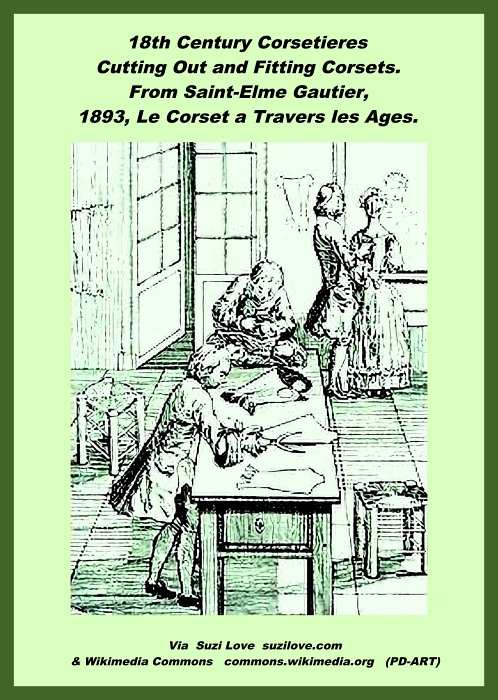
18th Century Corset Maker From 1893 Le Corset, A Travers Les Ages.
18th Century Corsetieres cutting out and fitting. From Saint-Elme Gautier, Le Corset a Travers les Ages. en.wikipedia.org
https://books2read.com/SuziLoveCorsetBook14
Posted in 1700s, 1700s Womens Fashion, 1800s, 1800s women's fashion, Australia, Canada, cartoon, Corset, Edwardian Era, England, Europe, Georgian Era, Georgian Fashion, Regency Era, Regency Fashion, Romantic Era, Suzi Love Images, U.S.A, underclothing, Victorian Era | Tagged 1700s Or Georgian Era, 1800s women's fashion, Bridgerton, Corset, Georgian Fashion, google books, Jane Austen, Regency Fashion, Romantic Era, underclothing, Victorian fashion
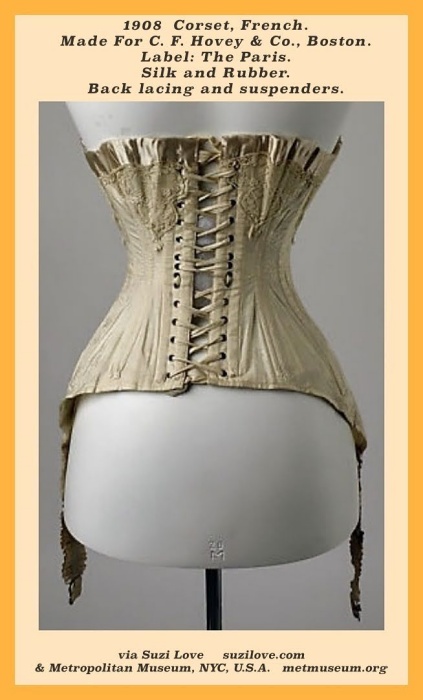
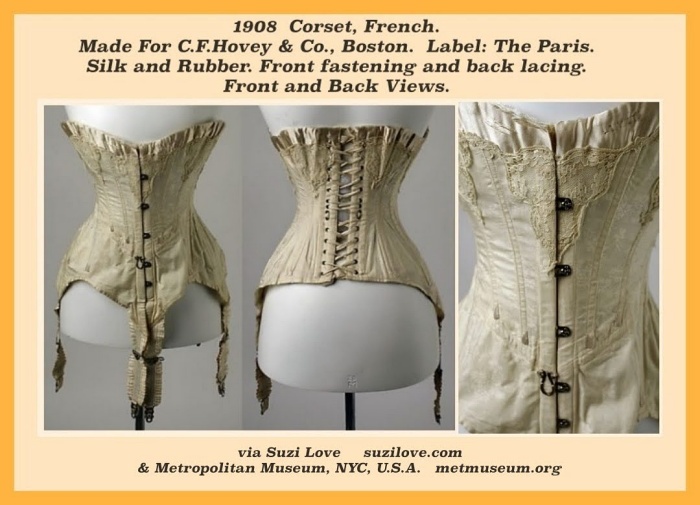
corset_1908 Front Suspenders and Fastenings and Back Lacing Silk and Rubber Corset, French. Front fastening and back lacing. Made For C. F. Hovey & Co., Boston.

1908 Silk and Rubber Corset, Front Fastenings and Suspenders and Back Lacing, French. #Edwardian #Corset #HistoricalFashion #France

Suzi Love Posted on July 13, 2025 by Suzi LoveJuly 7, 2025

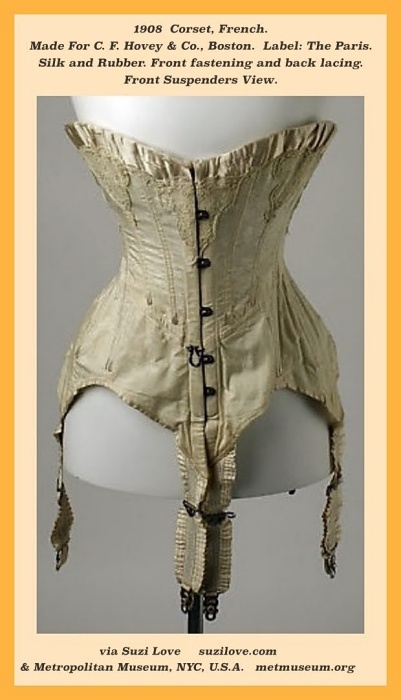
1908 Silk and Rubber Corset, French. Front fastening, front suspenders, and back lacing. Made For C. F. Hovey & Co., Boston. Label: The Paris. Marking: label “7.50, Made in France, Véritable Baleine, Brévété S.G.D.G., Best Whalebone THE PARIS, Made in France, expressly or C.F. Hovey and Co., Boston.” stamped on bone lining of corset]; “Corset de Paris” paper label via Metropolitan Museum, NYC, USA Credit Line: Gift of Mrs. Earl Rowe, 1951 Accession Number: C.I.51.15.25a, b

corset_1908 Front Fastening View Of Corset, French. Made For C. F. Hovey & Co., Boston. Label: The Paris. Silk and Rubber. Front fastening and back lacing. via Suzi Love suzilove.com & Metropolitan Museum, NYC, U.S.A. metmuseum.org
1908 Front Fastening View Of Corset, French. Made For C. F. Hovey & Co., Boston. Label: The Paris. Silk and Rubber. Front fastening and back lacing. via Suzi Love suzilove.com & Metropolitan Museum, NYC, U.S.A. metmuseum.org
1908 Back Lacing Of Corset, French. Made For C. F. Hovey & Co., Boston. Label: The Paris. Silk and Rubber. Front fastening and back lacing. via Metropolitan Museum, NYC, U.S.A. metmuseum.org
corset_1908 Label For Front Fastening and Back Lacing Silk and Rubber Corset, French. Front fastening and back lacing. Made For C. F. Hovey & Co., Boston.
1908 Label For Front Fastening and Back Lacing Silk and Rubber Corset, French. Front fastening and back lacing. Made For C. F. Hovey & Co., Boston.
corset_1908 Front Suspenders and Back Lacing Silk and Rubber Corset, French. Front fastening and back lacing. Made For C. F. Hovey & Co., Boston.
1908 Front Suspenders and Back Lacing Silk and Rubber Corset, French. Front fastening and back lacing. Made For C. F. Hovey & Co., Boston.
corset_1908 Front Suspenders and Fastenings and Back Lacing Silk and Rubber Corset, French. Front fastening and back lacing. Made For C. F. Hovey & Co., Boston.
1908 Front Suspenders and Fastenings and Back Lacing Silk and Rubber Corset, French. Front fastening and back lacing. Made For C. F. Hovey & Co., Boston.
HN_21_D2D_Corsets 1900s
Corsets 1900s History Notes Book 21 Corsets during early 1900s when a fashionable silhouette became of paramount importance and a well-fitted corset a fashion essential. books2read.com/SuziLoveCorsetBook21
Posted in 1900s, Corset, Edwardian Era, Europe, France, Suzi Love Images, U.S.A | Tagged 1900s, Corset, Edwardian Era, France, Metropolitan Museum NYC, Suzi Love Images, USA

1890-1920 ca. Sterling Silver Chatelaine With Medallion With Portraits. #VictorianEra #EdwardianEra #Chatelaine #Antique

Suzi Love Posted on January 23, 2025 by Suzi LoveJanuary 19, 2025

1890-1920 ca. Sterling Silver Chatelaine, England. Center Medallion With Portraits, three drops of monogrammed mesh purse, globe-shaped watch and book-shaped case. Via Augusta Auctions – augusta-auction.com

Definition

  • The word Chatelaine is French and means the keeper of the keys
  • Chatelaine” derives from the Latin word for castle
  • In Medieval times, the chatelaine was in charge of the day-to-day running of the castle.

What did a chatelaine do?

  • Most important task was keeper of the keys.
  • Also ordered supplies, did bookkeeping, supervised servants, taught castle children, and organized guests.
  • Castle keepers needed keys safe, yet easily accessible.
  • By 1700’s, a metal jeweled ornament hung from pockets, attached to belts, or by hooks into skirt waistbands
  • During 1800’s, women wore large collections of tools hung from chains
  • Young girls sewed and did needlework and needed to carry sewing notions eg scissors, thimbles
1890-1920 ca. Sterling Silver Chatelaine, England. Center Medallion With Portraits, three drops of monogrammed mesh purse, globe-shaped watch and book-shaped case. Via Augusta Auctions - augusta-auction.com

What were chatelaines used for?

  • Worn by women of all classes, from workers to nobility
  • Varied depending on class and finances.
  • Made of silver, brass, steel, leather, or fabric
  • During 19th century, fashionable dresses often had no waist and nowhere to hang chatelaines
  • Chatelaines became decorative brooches
  • Often given as a wedding present from a husband to bride
  • Later became fashion accessories
D2D_RetailerBuyLink_HN_9
books2read.com/SuziLoveChatelaines
D2D_RetailerBuyLink_HN_9. Chatelaines and Chains History Notes Book 9 By Suzi Love. #regency Women in charge of houses wore long chains holding important household items around their waist e.g. keys, pen, notebook, sewing. books2read.com/SuziLoveChatelaines
Posted in 1800s, 1800s women's fashion, 1900s, Australia, Decorative Item, Edwardian Era, England, Europe, fashion accessories, household, sewing, South Pacific, Suzi Love Images, U.S.A, Victorian Era, Writing Tools | Tagged 1800s women's fashion, 1900s, antiques, Augusta Auctions, chatelaines, decorative, Edwardian Era, fashion accessories, Victorian Era

1800s Silver and Carved Mother-of-Pearl Writing and Desk Set, French. #Regency #JaneAusten #Writing

Suzi Love Posted on September 10, 2024 by Suzi LoveAugust 28, 2024

1800s Silver and Carved Mother of Pearl Writing and Desk Set, French. Wax Seal, Dip Pen and Letter Opener in the style that Jane Austen would have used to write her novels and her letters. via Ruby Lane Antiques. rubylane.com. books2read.com/SuziLoveWritingTools

1800s Silver and Carved Mother of Pearl Writing and Desk Set, French. Wax Seal, Dip Pen and Letter Opener. via suzilove.com and Ruby Lane Antiques. rubylane.com

HN_13_D2D_WritingTools Book 13 What did the lady of the house use to pen notes? What sat on the desk of the man of the house when managing his accounts? #History #Nonfiction #travel books2read.com/SuziLoveWritingTools

Posted in 1700s, 1800s, 1900s, Australia, Box Or Container, Canada, Decorative Item, Edwardian Era, England, Europe, Georgian Era, History, Jane Austen, Regency Era, Romantic Era, Suzi Love Images, U.S.A, Victorian Era, Writing Tools | Tagged France, Jane Austen, Regency Era, Ruby Lane Antiques, Writing, Writing Tools | Leave a reply

Post navigation

← Previous Post
Next Post→

SUBSCRIBE TO SUZI LOVE'S NEWSLETTER.

Recent Posts

  • 1805-1808 ca. Man’s Three Piece Court Suit As Worn In Jane Austen’s Years: Coat, Waistcoat, Breeches, French. #JaneAusten #RegencyEra #HistoricalFashion #Breeches
  • 1815 Pink Cashmere Dress With Diamond Pointed Hem as worn by Jane Austen and Bridgerton women. #Bridgerton #RegencyFashion #JaneAusten
  • 1700s Late Gorgeous Gentlemen’s Coats As Worn by Jane Austen’s male family and friends. #JaneAusten #GeorgianFashion #HistoricalFashion #Coat
  • 19th Century Bridgerton Or Jane Austen Style Embroidered Silk Reticule, Or Bag, Japan. #Bridgerton #JaneAusten #RegencyFashion #Reticule
  • 1816 August Jane Austen Or Bridgerton Style Walking Costume With Blue Pelisse and Turned-Up White Satin Hat. #Bridgerton #RegencyFashion #JaneAusten #HistoricFashion

Recent Comments

  1. Suzi Love on Book Hooks: Petunia and the Pearl Diver. Petunia was too well spoken for a brothel worker. #Regencyromance #historicalromance #London #mfrw
  2. Bianca White on Book Hooks: Petunia and the Pearl Diver. Petunia was too well spoken for a brothel worker. #Regencyromance #historicalromance #London #mfrw
  3. Suzi Love on Book Hooks: Petunia and the Pearl Diver. Petunia was too well spoken for a brothel worker. #Regencyromance #historicalromance #London #mfrw
  4. Suzi Love on Book Hooks: Petunia and the Pearl Diver. Petunia was too well spoken for a brothel worker. #Regencyromance #historicalromance #London #mfrw
  5. Suzi Love on Book Hooks: Petunia and the Pearl Diver. Petunia was too well spoken for a brothel worker. #Regencyromance #historicalromance #London #mfrw

Login

  • Log in

Archives

  • November 2026
  • October 2026
  • September 2026
  • August 2026
  • July 2026
  • June 2026
  • May 2026
  • April 2026
  • March 2026
  • February 2026
  • January 2026
  • December 2025
  • November 2025
  • October 2025
  • September 2025
  • August 2025
  • July 2025
  • June 2025
  • May 2025
  • April 2025
  • March 2025
  • February 2025
  • January 2025
  • December 2024
  • November 2024
  • October 2024
  • September 2024
  • August 2024
  • July 2024
  • June 2024
  • May 2024
  • April 2024
  • March 2024
  • February 2024
  • January 2024
  • November 2023
  • October 2023
  • September 2023
  • August 2023
  • June 2022
  • April 2022

Categories

  • 1700s
  • 1700s Mens fashion
  • 1700s Womens Fashion
  • 1800s
  • 1800s Mens Fashions
  • 1800s women's fashion
  • 1900s
  • art
  • Australia
  • Bath
  • bedroom fashion
  • Book Hooks
  • Box Or Container
  • Bridgerton
  • Bus Trips
  • Canada
  • Carriage
  • cartoon
  • Celebrity
  • Chatelaine
  • children
  • Children
  • Christmas
  • Coat or Pelisse Or Redingote
  • Contemporary
  • Corset
  • Couple
  • Customs & Manners
  • dancing
  • December Scandal
  • Decorative Item
  • Dress Or Robe
  • Easter
  • Edwardian Era
  • Embracing Scandal
  • England
  • Ester In Images
  • Europe
  • Events
  • Fashion
  • fashion accessories
  • Food and Drink
  • Four Times A Virgin
  • France
  • furniture
  • Georgian Era
  • Georgian Fashion
  • Google Books
  • Grand Tour
  • Group
  • hats
  • History
  • History Events
  • History Notes
  • History Of Christmases Past
  • household
  • Hygiene
  • Irresistible Aristocrats
  • Jane Austen
  • Keanu Reeves
  • Kellys Justice
  • Legal
  • London
  • Love After Waterloo
  • Loving Lady Katharine
  • medical
  • military
  • money
  • mourning
  • Music
  • Outback Arrival
  • pants
  • Pastimes
  • peerage
  • People
  • Petunia and Pearl Diver
  • Places
  • Pleasure House Ball
  • postal
  • Queensland
  • Quotations
  • Regency Era
  • Regency Fashion
  • Regency Life Series
  • Reticule or Bag
  • riding
  • Romantic Era
  • Royalty
  • Russia
  • Scandalous Siblings Series
  • Scenting Scandal
  • Self Publishing
  • sewing
  • Shirt
  • shoes
  • Shopping
  • South Pacific
  • Spencer
  • sports
  • Suit
  • Sunday Snippet
  • Suzi Love
  • Suzi Love Books
  • Suzi Love Images
  • Suzi Love Writing
  • Swain Cove
  • THe Viscount's Pleasure House
  • travel
  • U.S.A
  • underclothing
  • Vest or Waistcoat
  • Victorian Era
  • Victorian Fashion
  • weapons
  • weddings
  • Writing Tools
1800s men fashion 1800s women's fashion antiques Bridgerton British history Cartoons Corset cravat decorative Dress Or Gown England europe fashion accessories Fashion Plate France Georgian era Georgian Fashion gloves google books Hats And Hair historical romance History Notes household Jane Austen jewelry Journal des Dames et des Modes London Metropolitan Museum NYC pants Redingote Or Pelisse Or Coat Regency Era Regency Fashion Regency London reticule or bag riding Romantic Era sewing shawls Shoes Suzi Love Books Suzi Love Images Tailcoat The Repository Of Arts underclothing Vest or Waistcoat

©2026 - Suzi Love - Weaver Xtreme Theme Privacy Policy
↑