1845-1865 ca. Cream Silk Evening Slippers, British. Cream evening shoes with ankle ties and lace trim. Trim is unusual because mid 19th Century ladies’ shoes were often plain as only toes showed beneath fashionable long skirts. Designed By Hobbs, famous London shoemaker, and with a label attached to lining with a regal crest to show maker’s royal patronage. via Metropolitan Museum, NYC, U.S.A. metmuseum.org
Fashion Women 1815-1819 History Notes Book 28 https://books2read.com/SuziLoveFashionWomen1815-1819
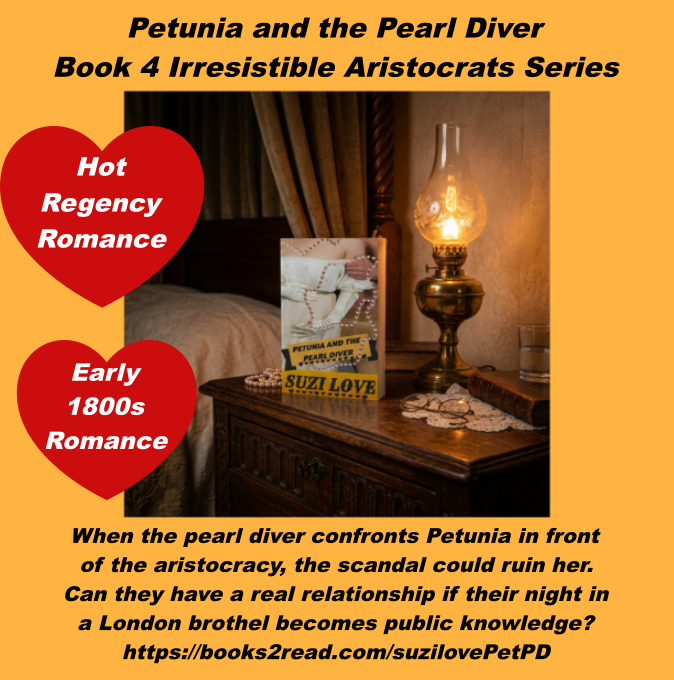
Petunia and the Pearl Diver: A hot Regency romance. Petunia needs money to save her aristocratic family. The pearl diver needs a woman to save him, body and soul. Their night together at a London brothel could solve both problems. But can their relationship survive in the real world?Because walking away becomes impossible when one night leaves them craving more…and more.
Book Hook: Petunia pointed the whip at the pearl diver a second time. “Move.” She gave him her sternest look. “Onto the bed.” The whiptail ran smoothly back and forth through her fingers, hopefully reinforcing the idea that she was an experienced mistress of punishments. “Now.”
The captain’s eyebrows shot upwards and he finally focused on her face, or as much as her sleek leather mask allowed him to see. Good. Without his full attention, Petunia had no hope of carrying out this farce. He unwound his lean length the way she imagined he’d unwind coiled rope on his pearl trawler. Slowly, carefully, and as sensually as a dancer, he straightened to his full height, putting him a good foot taller than her. Her heart thudded in her chest and her pulse raced.
If he stirred her lust merely by standing up, she’d never survive the sensual overload if they danced at a ball and he held her in his arms. She shivered. Dancing with him was one of the things that must never happen, because the close contact might trigger the memory of when her brother had introduced them. If they met at a formal social occasion, she prayed he’d never associate that well-bred lady with a girl he’d paid for in a brothel, because she’d heard that war had changed him and she didn’t know if it was for the better, or worse.
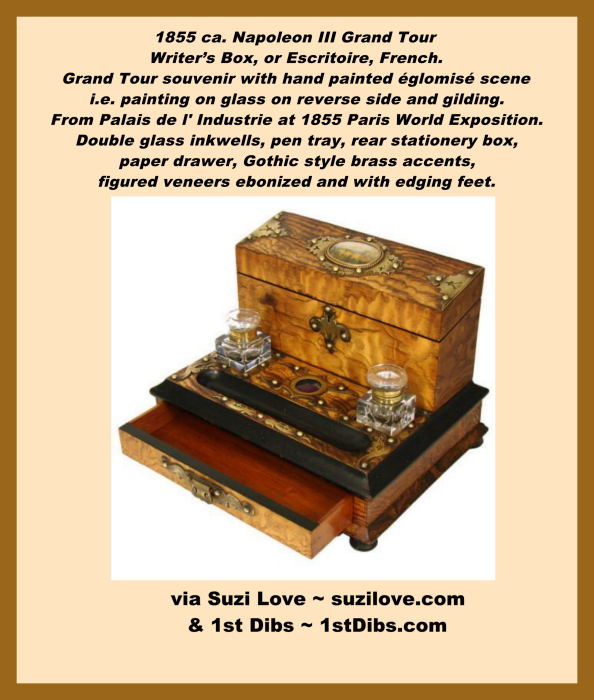
1855 ca. Napoleon III Grand Tour Influenced Travel Writer’s Box, Or Ecritoire, French. Double inkwell with rear stationery box, Gothic style brass accents and Grand Tour souvenir hand painted eglomise scene, the Palais de l’ Industrie from the 1855 Paris World Exposition! Figured veneers, ebonized edging, feet and pen tray and brass or bronze accents. via 1st Dibs 1stdibs.com
HN_13_D2D_WritingTools Book 13 What did the lady of the house use to pen notes? What sat on the desk of the man of the house when managing his accounts? #History #Nonfiction #travel books2read.com/SuziLoveWritingTools
19th Century Early. Gilt and Patinated Bronze Inkstand , or Encrier, or a little reservoir of ink. Rectangular base mounted with a round lidded ink pot with a porcelain container and a sand pot, each raised on winged lion feet, centered by a palm decorated columnar carrying handle, with two pen holes. via 1st Dibs Auctions 1stdibs.com
The type of inkstand that households would have in Bridgerton and Jane Austen households for writing letters and keeping track of estate matters.
HN_13_D2D_WritingTools Book 13 What did the lady of the house use to pen notes? What sat on the desk of the man of the house when managing his accounts? #History #Nonfiction #travel books2read.com/SuziLoveWritingTools
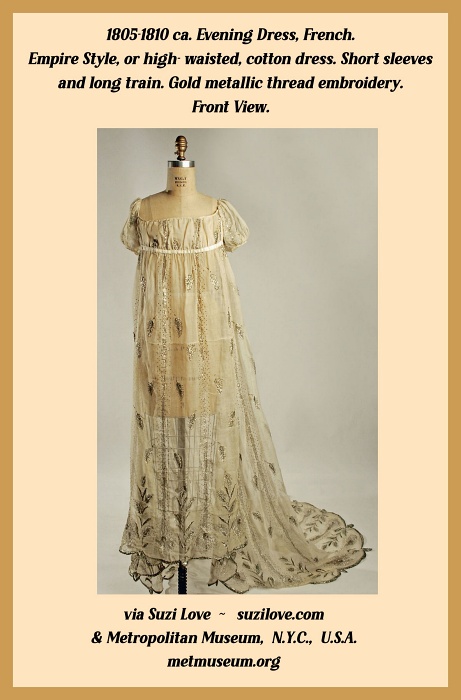
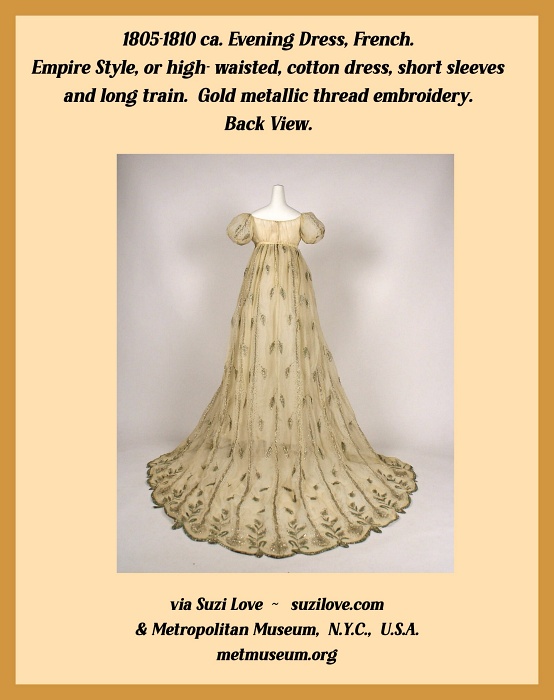
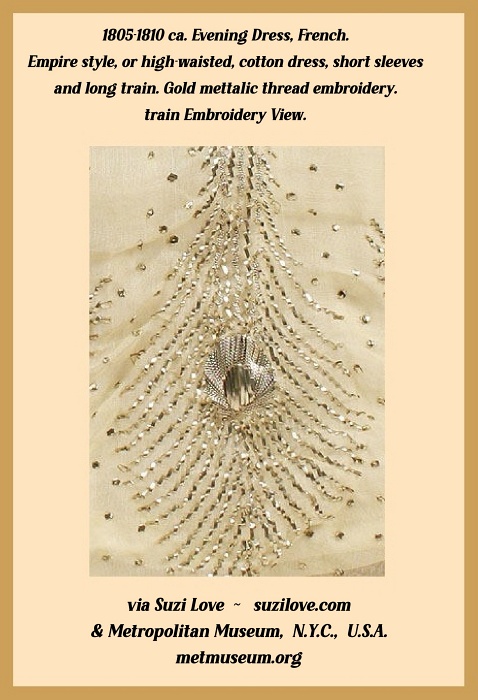
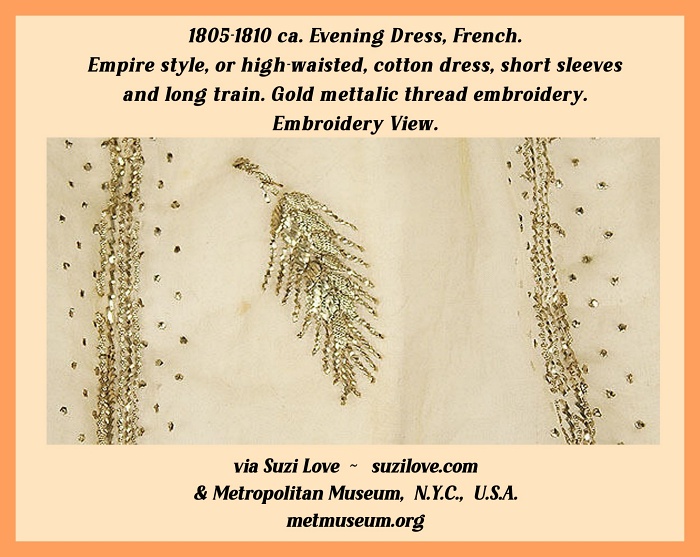
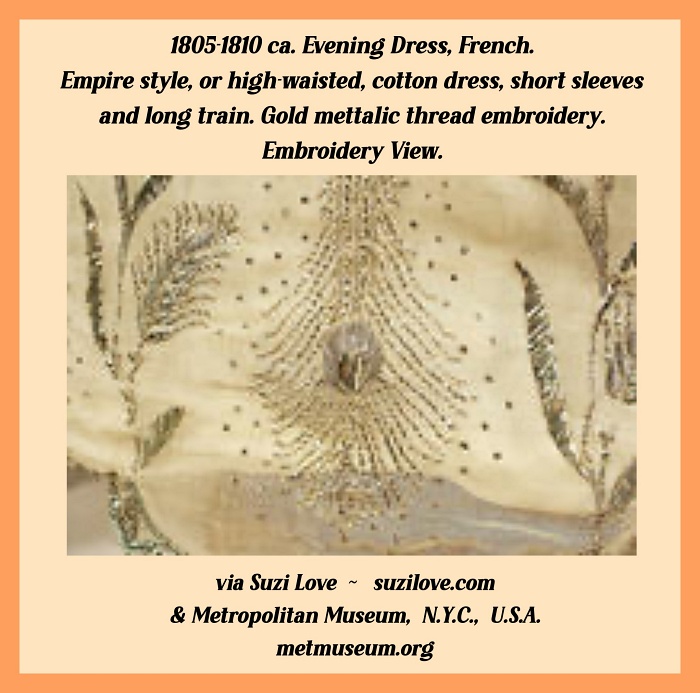
1805-1810 ca. Evening Dress, French. Empire style, or high-waisted, cotton dress, short sleeves and long train. Gold metallic thread embroidery. via Metropolitan Museum, N.Y.C., U.S.A.
1805-1810 ca. Front Evening Dress, French. Empire style, or high-waisted, cotton dress, short sleeves
and long train. Gold metallic thread embroidery. via Suzi Love ~ suzilove.com
& Metropolitan Museum, N.Y.C., U.S.A. metmuseum.org1805-1810 ca. Back Evening Dress, French. Empire style, or high-waisted, cotton dress, short sleeves
and long train. Gold metallic thread embroidery. via Suzi Love ~ suzilove.com
& Metropolitan Museum, N.Y.C., U.S.A. metmuseum.org1805-1810 ca. Side Evening Dress, French. Empire style, or high-waisted, cotton dress, short sleeves
and long train. Gold metallic thread embroidery. via Suzi Love ~ suzilove.com
& Metropolitan Museum, N.Y.C., U.S.A. metmuseum.org1805-1810 ca. Train Evening Dress, French. Empire style, or high-waisted, cotton dress, short sleeves
and long train. Gold metallic thread embroidery. via Suzi Love ~ suzilove.com
& Metropolitan Museum, N.Y.C., U.S.A. metmuseum.org1805-1810 ca. Embroidery Evening Dress, French. Empire style, or high-waisted, cotton dress, short sleeves
and long train. Gold metallic thread embroidery. via Suzi Love ~ suzilove.com
& Metropolitan Museum, N.Y.C., U.S.A. metmuseum.org1805-1810 ca. Embroidery. Evening Dress, French. Empire style, or high-waisted, cotton dress, short sleeves
and long train. Gold metallic thread embroidery. via Suzi Love ~ suzilove.com
& Metropolitan Museum, N.Y.C., U.S.A. metmuseum.org1805-1810 ca. Embroidery. Evening Dress, French. Empire style, or high-waisted, cotton dress, short sleeves
and long train. Gold metallic thread embroidery. via Suzi Love ~ suzilove.com
& Metropolitan Museum, N.Y.C., U.S.A. metmuseum.org1805-1810 ca. Embroidery Evening Dress, French. Empire style, or high-waisted, cotton dress, short sleeves
and long train. Gold metallic thread embroidery. via Suzi Love ~ suzilove.com
& Metropolitan Museum, N.Y.C., U.S.A. metmuseum.org1805-1810 ca. Embroidery. Evening Dress, French. Empire style, or high-waisted, cotton dress, short sleeves
and long train. Gold metallic thread embroidery. via Suzi Love ~ suzilove.com
& Metropolitan Museum, N.Y.C., U.S.A. metmuseum.org Fashion Women 1805-1809 History Notes Book 26 What did Jane Austen and friends wear? https://books2read.com/SuziLoveFashionWomen1805-1809
“The more I know of the world the more I am convinced that I shall never see a man whom I can really love. I require so much!” Jane Austen ~ Sense and Sensibility (1811)
“The more I know of the world the more I am convinced that I shall never see a man whom I can really love. I require so much!” Jane Austen ~ Sense and Sensibility
(1811)
1804 London Hairstyles, Gorgeous Gold Hats. via Fashion Plate via Fashions of London and Paris, Published By Richard Phillips, St. Paul’s Church Yard, London, UK. These styles of hats and hairstyles would have been worn by Jane Austen and her contemporaries as hats were an essential fashion item during the Regency years.
1804 London Hairstyles, Gorgeous Gold Hats. via Fashion Plate via Fashions of London and Paris,
Published By Richard Phillips,
St. Paul’s Church Yard, London, UK.25_D2D_Corset_1790-1810
1815-1818 ca. Cocoa Silk Figured Dress with Spencer. High-waisted, Empire style, dress with long sleeved Spencer, decorated shoulders, bodice and hem. The Bridgertons, Jane Austen, and their family and friends would have worn this style of dress and Spencer. via Whitaker Auction whitakerauction.smugmug.com Spencers were needed to cover the flimsy dresses made of lightweight fabrics of the Regency years, to provide warmth and some protection from windy conditions when the transparency of gowns might cause modesty issues. Jane Austen and her contemporaries often walked to places and so would have needed the warmth of a Spencer over her dress in the cold British winters.
Definition Spencer: Short jacket said to have originated from an accident to Lord Spencer’s coat when hunting and tails were torn off.
Fashion Women 1815-1819 History Notes Book 28 https://books2read.com/SuziLoveFashionWomen1815-1819
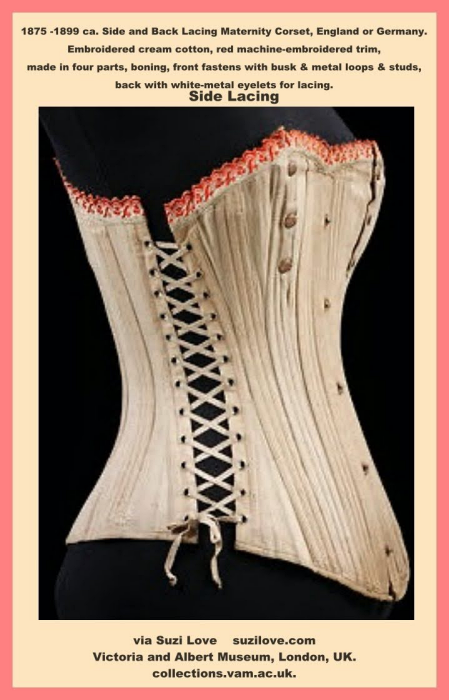
1875-1899 ca. Side Lacing Maternity Corset, Possibly England Or Germany. Embroidered cotton with metal and boning, possibly used as a maternity corset. This corset is made of cream cotton with red machine-embroidered trim and trimmed with a scallop edged tape. The corset is made in four parts and fastens at the front with a busk and with five white metal loops and studs. At the back are seventeen sets of white metal bound eyelets for threading through a lace. At each side, there are twelves sets of metal bound eyelets to fasten with elasticated laces. There is a vertical opening at the bust which fastens with three bronze gilt press studs, clamped into the fabric, and a diamond pattern impressed on the head which shows on the face of the fabric. On the reverse of the stud is a mark.
The corsets reach from the bust to the middle of the hip descending to a point at about the middle of the belly in the centre front. They are machine-stitched and seem lightly boned, encased and sewn to the face of the fabric. Bound at the top and bottom with grey tape. The breast gussets and side lacing suggest this is a maternity corset. Corsets designed for pregnancy and nursing were advertised throughout the 19th century. This maternity corset is a typical example. It is constructed like a fashionable corset, with boning and a central busk. It has side laces, to enable the wearer to adjust the corset to her changing figure. The cups can be opened for breastfeeding by releasing the press studs. via Victoria and Albert Museum, London, UK.
1875-1899 ca. Side Lacing Maternity Corset, Possibly England Or Germany. via collections.vam.ac.uk1875-1899 ca. Side Lacing Maternity Corset, Possibly England Or Germany. via collections.vam.ac.uk1875-1899 ca. Side Lacing Maternity Corset, Possibly England Or Germany. SideView. via collections.vam.ac.uk
1875-1899 ca. Side Lacing Maternity Corset, Possibly England Or Germany. #corset #maternity #victorianfashion https://books2read.com/SuziLoveCorsetBook19