1818 High-waisted Promenade Dress, English. White dress with multiple layers of lace from hem upwards. Narrow striped scarf of bright colors, large brimmed hat decorated with flowers and a pink parasol. Fashion Plate via John Belle’s La Belle Assemblée or, Bell’s Court and Fashionable Magazine, London.
Definition Empire Style Dress: High-waisted white gown defined women’s fashion during the Regency Era. ‘Empire’ is the name given to the period when Napoleon Bonaparte built his French Empire. High-waisted, loose gowns were adopted by the aristocracy as a symbol of turning away from the fussy, elaborate and expensive clothing worn in the 1700s.
For many centuries, road travel was the main way of getting from place to place, but roads were notoriously rutted and badly maintained, especially in Britain. The Romans laid down the roads but they very poorly maintained through the 17th and 18th Centuries. It wasn’t until the 19th Century that improvements were made and rose travel opened up.
Roman Road Construction. Roman roads were constructed in layers. Rubble, slabs of stone, pebbles and gravel, smooth paving stones. Average width of road was 15 to 18 feet.
The dreadful condition of British roads caused great apprehension to all classes of travelers. Making a journey anywhere in the country was a big undertaking and often a gentleman composed his last will and testament before his departure. Traveling in vehicles was only possible during the day or on the nights with very bright moonlight with few vehicles attempting road travel in winter and any travel on a Sunday was frowned upon.
From: 1815 Journal of Tour of Great Britain by a French Tourist via Google Books (PD-180) ‘The roads very narrow, crooked, and dirty, continually up and down. The horses we get are by no means good, and draw us with difficulty at the rate of five miles an hour. We change carriages as well as horses at every post house. They are on four wheels, light and easy, and large enough for three persons. The post boy sits on a cross bar of wood between the front springs, or rather rests against it. This is safer, and more convenient both for men and horse, but does not look well and, as far as we have seen, English post horses and postillions do not seem to deserve their reputation.’
If you’ve read Jane Austen you’ll know that it was improper for a woman to travel alone, which meant that well-bred women were dependent on male relations to accompany them or else they had to take a maid in the carriage with her and be accompanied by a driver and footmen, which of course added to the cost of carriage travel. Any woman traveling by herself on a mail coach would be subject to speculation and probably malicious gossip.
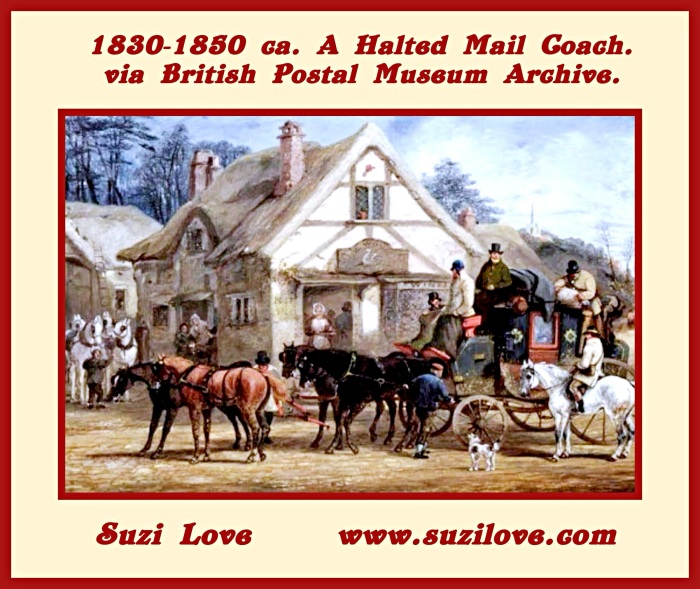
Mail coaches raced across these roads trying to stick to a time table but there were numerous accidents on roads that were often flooded, covered in snow, or up such steep hills that passengers had to alight and either push the coach or walk ups the hill.
1790 Turnpike Gates In The Vicinity Of London, U.K.
Tolls were collected on many roads in Britain but, because the turnpikes were mainly on land belonging to the nobility, money collected went into their personal coffers and very little went to road maintenance. This caused a continual push in parliament to make those who owned the land and collected the money responsible for repairing their roads, but these pleas fell on deaf ears as the lords in who sat in parliament had no interest in spending money to better travel for the common people.
Description of Stage Coach Travel in England. via 1815 Journal Tour of Great Britain.
“The gentlemen-coachmen, with half-a dozen great coats about them,—immense capes,—a large nosegay at the button-hole,—high mounted on an elevated seat,—with squared elbows,—a prodigious whip, beautiful horses, four in hand, drive in a file to Salthill, a place about twenty miles from London, and return, stopping in the way at the several public-houses and gin-shops where stage-coachmen are in the habit of stopping for a dram, and for parcels and passengers on the top of the others as many as seventeen persons. These carriages are not suspended, but rest on steel springs, of a flattened oval shape, less easy than the old mode of leathern braces on springs. Some of these stage coaches carry their baggage below the level of the axletree.”
1825 Observations on the Management of Turnpikes by John Loudon Mc Adam. Via Google Books (PD-150)
John Loudon McAdam, born Ayr, Scotland. (1756 -1836) He acted as a magistrate and assumed other civic roles including one as as trustee of the Ayrshire Turnpike in 1783, where he developed an interest in road construction and engineering, eventually becoming general surveyor for the Bristol Corporation in 1804. He wrote papers on the benefits of raising roads, making them from layers of stone and gravel, and giving priority to drainage. However, no roads were made this way until McAdam was put in charge of remaking the Bristol Turnpike in 1816, when he put his theories into practice and demonstrated macadamization, known as macadam. He made him numerous enemies on the Turnpike Trusts, who preferred to keep the money made from tolls rather than ploughing it back into road improvements but Macadam was soon in widespread use.
John Loudon McAdam (1756 – 1836), Scottish engineer and road-builder who started a new way of raising roads called ‘macadamization’. Via Wikimedia Commons.
1825 John McAdam Observation of English Roads. “In a Country like England, inhabited by an ‘ intelligent people, well educated, active, and enterprising, where every hint at improvement is eagerly caught at and prosecuted with spirit, it is only possible to account for the apathy respecting Roads, and the want of exertion in prosecuting the means given for improvement, by showing that a strong counteracting principle exists in the defects of the Road Laws, and that although much want of encouragement has arisen from the prejudices of old practitioners— the great obstacle to success remains in the zealous opposition of those who profit by mismanagement in various ways.”
McAdam Report on Bristol District Roads, March, 1815.
Expenditure and Debt.
• 1802 – 1812 only two roads maintained themselves.
• Neither able to pay £100 of the debt they owed.
• No other roads supported themselves at all.
McAdam’s List of Reasons for Bad Roads.
• Ignorance and incapacity of Surveyors
• Lack of any control over the lavish spending of Road Trusts
• Trust accounts being in an inexplicable mess
• No system or scientific mode of constructing roads
• Every part of a road being differently formed
• Each road managed by a different person
• Each area managed by a different Turnpike Trust
• Winford Road Trust produced no account books
McAdam informed the Road Trusts that smooth roads were the most useful and lasted longer because carriages do little damage to a smooth road because the horses exert themselves less and the carriages do not rock and roll.
Unfortunately for travelers in the late 1700s and early 1800s, the smoothness of a road surface depended on the preparation and distribution of the road building materials used and was therefore entirely in the hands of each individual road-maker. In 1816, Mc Adam reported to the Bristol District the difference in revenue if roads were built of good material, regularly maintained, and if the finances of Turnpike Trusts were under someone’s control.
1823 ‘Construction of a Macadam Road’ by Carl Rakeman. Via Wikimedia Commons.
Travel on these roads was also dangerous as highwaymen stopped and robbed anyone who came along. Male or female made no difference to highwaymen in Britain, nor to the bushrangers in Australia or the gangs on American roads, as they robbed indiscriminately and often with violence.
By the end of the 18th Century, however, travel as a pleasurable pursuit came into vogue and numerous guides were written for traveling all over the British Isles as well as on the continent.
The 1812 ‘Tour Of Dr. Syntax’ was an ironic look at the new obsession of travel and travel guides. Before he set off for the Lake District, Dr. Syntax said to his wife, “You well know what my pen can do, and I’ll employ my pencil too: I’ll ride and write, and sketch and print and thus create a real mint: I’ll prose it here, I’ll verse it there and picturesque it everywhere. I’ll do what all have done before; I think I shall and somewhat more.”
Georgian and Regency travelers were envious of aristocrats, even if they were of the nobility themselves, and loved to view all the British Great Houses.
A gentleman and his wife would even drive up to the front door of a mansion house and demand to be given a tour of the house. If they weren’t admitted, they would write in their journals of the inhospitable nature of the people on a particular estate. Thomas Pennant, William Mavor, and others, loved to write about these bad experiences and have them published. Paterson’s British Itinerary, a travel guide had 17 editions between 1785-1832 – it outlined the roads used by the stage and mail coaches, the tolls, the bridges, etc.
This new touring craze created an industry of hospitality that encompassed more than simple mail coach trips from place to place, and more than a noble family traveling from their country seat to the Metropolis of London for parliamentary sittings. Inns had to improve the quality of the linens and meals if they wanted to attract the wealthier traveling class. Before that, many travelers carried their own linen, crockery, glasses, and utensils, as they didn’t trust the hygiene or standards of country inns.
Travel became something written about by poets with many sonnets written to the beauty of places like the Lake District in England, or the pyramids in Egypt. Inns became cleaner and more respectable so they could welcome travelers of the upper classes. This also meant that women could travel more as roads were slowly improved from rutted tracks that were only suitable for horse riding to roads that family coaches could travel along, though these roads were still narrow and subject to extremes of weather, such as flooding. The race was on to travel from places like London to Edinburgh in the fastest possible time.
1817-1875 ca. Vehicles. From: Pierre Larousse’s World Dictionary Of the 19th Century.
1812 October Autumnal Carriage Or Morning Costume, English. Loose white jaconet muslin dress, high in the neck, with double frills of deep vandyke lace that fall over the Spencer. Blue satin Spencer ornamented with silver cord and buttons ‘en militaire’ and held at the throat with a cord and tassels, a quartered foundling cap of lace tied under the chin with a full band and decorated with an autumnal flower. Grey kid shoes, lemon gloves and a ridicule, or bag, of purple velvet. Fashion Plate via Rudolph Ackermann’s ‘The Repository of Arts’.
Dress – Morning: Worn either at home, out shopping, or for walking in the park or country. Presentable but not overly accessorized.
Spencer: Short body-hugging jacket worn for warmth &modesty. Said to have originated in accident to Lord Spencer in hunting when coattails torn off.
1811 Evening Dress, French. Red cashmere dress over white under shirt with short puffed sleeves, carrying a white shawl, long white gloves, earrings and white evening shoes. Fashion Plate via Journal des Dames et des Modes, or Costume Parisien. Though this is a French fashion plate, the outfit is typical of the dresses worn by Jane Austen and her contemporaries. An Empire style, or high-waisted, dress with a white underdress and for warmth there is an extra layer with the shawl.
Definition Cashmere: Soft, fine wool, historically used for costly dress fabric, usually in twill weave. Originally made of yarn handspun from the wool of Cashmere goats but later from other soft wools. Used for dresses, infants’ coats.
1816 January Blue Carriage Dress, English. High neck but no collar, front is fitted but back has slight fullness and very short bodice. Puffed roll to decorate the hem, trimmed in bias cut blue satin, long sleeves finished at wrists with satin, gloves of white kid and ‘sandals’ or shoes of blue kid leather. Head-dress à la mode de Paris is an unusual cap of white lace and decorated with two rolls of ribbon. “We are indebted to the tasteful fancy of Mrs. Bean, of Albemarle Street, for both our dresses this month.” Fashion Plate via Rudolph Ackermann’s ‘The Repository of Arts’.
Jane Austen and her contemporaries would have worn this style of outdoor, or carriage ensemble with a coat over a dress. These outdoor dresses were labelled a variety of names. In England, this might also have been called a Walking Or Promenade dress, or Pelisse. In Europe, it would be called a Redingote.
Definition: Pelisse, Walking Dress, Carriage dress, Promenade Dress, Redingote. Long, fitted coat sometimes cut away in front to show off the dress underneath. Originally made for men with several capes and trimmed with large buttons, they were adapted to add an additional, and warmer, layer to the typical white muslin dresses worn in the early 1800s. Those light weight dresses were good in summer but not suited to harsh winters. Over the carriage dress, a shawl could be added as well as a muff to give a warm and comfortable outfit for traveling by carriage.
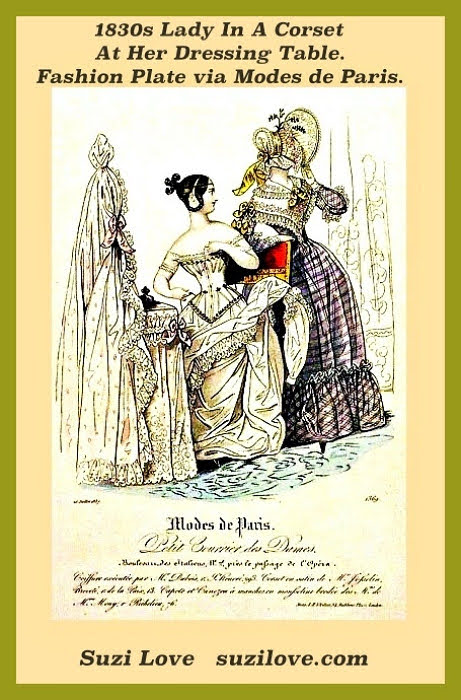
1860 Corset, American. Cotton, metal, and bone. Manufacturer: Langdon Batcheller and Company, A1851-1860 ca. Blue Ribbed Silk Corset, English. Front and Back. Front hooks and back lacing. via Museum of London, UK. museumoflondon.org.uk
As some of my historical romance books are set in a house in Grosvenor Square, its history fascinates me. How about you? Do you love the history associated with Grosvenor Square? The Jamison family in Embracing Scandal and Scenting Scandal live in Grosvenor Square.
Grosvenor Square - Pronounced ˈɡrovna’, is a large garden square in the exclusive Mayfair district and the centrepiece of the Mayfair property of the Duke of Westminster and takes its name from their surname, “Grosvenor”.
In 1710, Sir Richard Grosvenor obtained a licence to develop Grosvenor Square and the surrounding streets and development started around 1721. Grosvenor Square became one of the most fashionable residential addresses in London from its construction until the Second World War, with numerous leading members of the aristocracy in residence. The early houses had five or seven bays, basement, three main stories, and an attic. Colen Campbell produced a design for a palatial east side to the square featuring thirty Corinthian columns but this was not carried out and in the end most of the houses were built to individual designs. There were mews behind all four sides. Many houses were rebuilt later and acquired an extra storey. Number 23 (later 26) was rebuilt in 1773–74 for the 11th Earl of Derby by Robert Adam and shows how grandeur of effect and sophisticated planning might be achieved on a confined site. It was demolished and rebuilt again in the 1860s.
1761 – Sir Richard Grosvenor, the 7th Baronet, was created Baron Grosvenor of Eaton in the County of Chester
1784 – Became Viscount Belgrave and Earl Grosvenor under George III.
1831- At coronation of William IV, Robert Grosvenor, the 2nd Earl Grosvenor, became Marquess of Westminster
1874 – Queen Victoria created the title Duke of Westminster and bestowed it upon Hugh Grosvenor, 3rd Marquess of Westminster.
Current title holder is Gerald Grosvenor, 6th Duke of Westminster and his seat is at Eaton Hall, Cheshire The Dukedom and Marquessate are in the Peerage of the United Kingdom The rest are in the Peerage of Great Britain. The courtesy title of the eldest son and heir to the Duke is Earl Grosvenor.
Nearly all of the older houses were demolished during the 20th century and replaced with blocks of flats in a neo-Georgian style, hotels and embassies. The central garden was originally reserved for the occupants of the houses but is now a public park managed by The Royal Parks. Grosvenor Square. Grosvenor Square has been the traditional home of the official American presence in London since John Adams established the first American mission to the Court of St. James’s in 1785. Adams lived, from 1785 to 1788, in the house which still stands on the corner of Brook and Duke Streets. During World War II, Eisenhower established a military headquarters at 20 Grosvenor Square, and during this time the square was nicknamed “Eisenhower Platz”.
The former American Embassy of 1938–1960 on the square was purchased by the Canadian government and renamed Macdonald House. In 1960, a modern USA Embassy was built on the western side of Grosvenor Square and caused controversy in the mainly Georgian and neo-Georgian area. In 2008, the United States Government chose a site for a new embassy in the Nine Elms area, south of the River Thames with with relocation completed by 2016 or 2017. In October, 2009, English Heritage granted Grade II listed status to the building which means new owners will not be allowed to change the facade.
Grosvenor Square in Literature In Little Dorrit by Charles Dickens the Barnacles are said to live at “four Mews Street Grosvenor” which “was not absolutely Grosvenor Square itself but it was very near it”. Caroline Bingley makes a comment regarding the local dance in Pride and Prejudice ”We are a long way from Grosvenor Square, are we not, Mr Darcy”. It appears in the title of several novels including The Lonely Lady of Grosvenor Square by Mrs. Henry De La Pasture (1907) and The House in Grosvenor Square by Linore Rose Burkard (2009) In Oscar Wilde’s play Lady Windermere’s Fan, the Duchess of Berwick says, “I think on the whole that Grosvenor Square would be a more healthy place to reside in. There are lots of vulgar people live in Grosvenor Square, but at any rate there are no horrid kangaroos crawling about.”
1800s A Young Lady Riding and Carriage Driving, England. #Riding #Regency #Victorian #Cartoon From: 1860 Mr. Sponge’s Sporting Tour by Robert Smith Surtees. via Google Books (PD-100)
A Lady On The Hunt Riding Side-Saddle. From: 1860 Mr. Sponge’s Sporting Tour by Robert Smith Surtees. via Google Books (PD-100) suzilove.comA bold young man kissing a young lady at the hunt. via 1860 Mr. Sponge’s Sporting Tour By Robert Smith Surtees. via Google Books (PD-150) suzilove.com1860 Rebellious Lady driving and smoking a cigar.via 1860 Mr Sponge’s Sporting Tour by Robert Smith Surtees via Google Books (PD-100)1860 A Day at the Turf. Lady riding side-saddle with gentleman. From- 1860 Mr Sponge’s Sporting Tour by Robert Smith Surtees. via Google Books (PD-100) suzilove.comA lady and a gentleman in a carriage. Lady driving and smoking. via 1860 Mr. Sponge’s Sporting Tour by Robert Smith Surtees. via Google Books (PD-100) suzilove.com
1807 Cotton Linen Shirt, British. Non-regulation shirt worn under uniform. High collar to allow room for a stock, fullness and pleated sleeves enable wearer to fit into tight arms popular in coats. The men in Jane Austen’s life would have worn a shirt like this, especially if they were in the military as many men were during the Napoleonic Wars. via Royal Museums Greenwich collections.rmg.co.uk