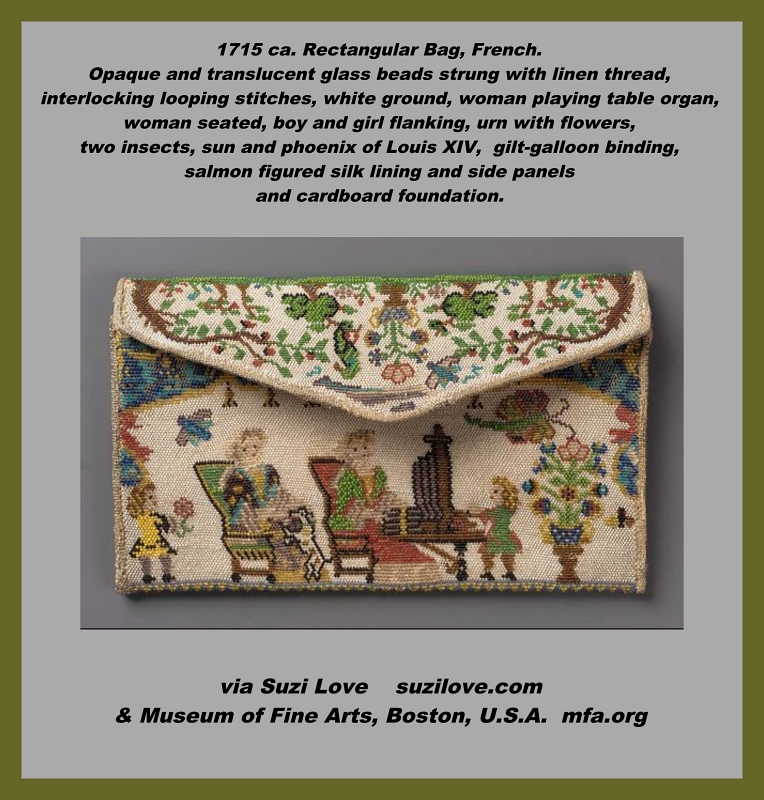
Reticule Or Bag: Purse, often with a drawstring to pull closed and usually made of cloth or covered cardboard and often decorated with beading or embroidery. Carried by a woman during the Regency period to carry all their daily necessities. in the place of pockets.
Spencer: Short jacket, cropped at the waist, worn over a dress, or gown. Delicate and regency dresses provided so little protection from the cold, so over garments were essential for warmth, modesty and good health.
Pelisse Or redingote Or Walking Dress: Coat worn over clothing of both sexes for warmth and protection from the elements.
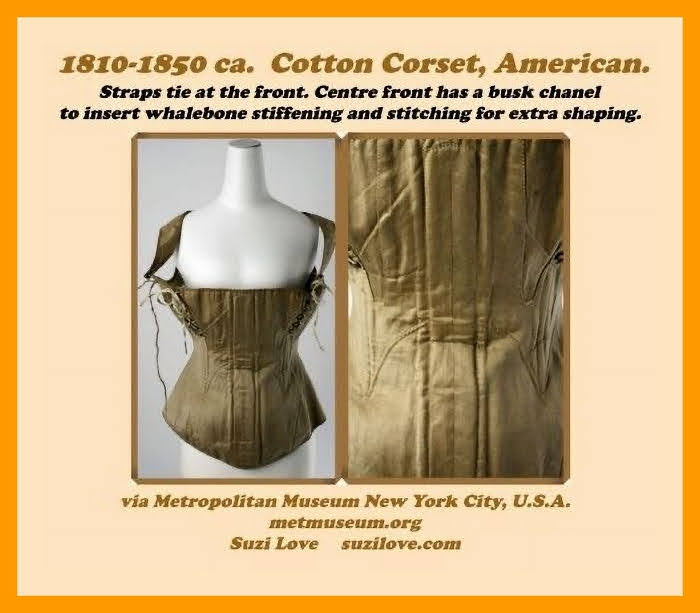
1810-1850 ca. Cotton Corset With Whalebone Busk, American. Straps tie at the front. Center front has a busk Chanel to insert a whalebone to keep the corset stiff and in place. There is extra stitching on the corset to give more shape and extra reinforcing to keep the corset upright and the dress worn over it smooth and flat. Marking stamped on the lining, ‘Jane Laney’ and Mrs. Bishop, Corset Maker, 108 Hudson St., New. York, USA. via Metropolitan Museum New York City, U.S.A. metmuseum.org
Surviving stays, or corsets as they became to be called in the nineteenth century, show that both longline and shorter corsets were worn and that they were made of cotton, silk and sateen. A lot of these corsets were front fastening, plus many were laced at both the front and the back so our aristocratic fictional heroines could indeed dress and undress themselves without the assistance of a maid.
Definition Busk: Central panel in a corset to give it extra shape. Made from wood, bone which was usually whalebone, ivory, and in the latter 1800s from metal.
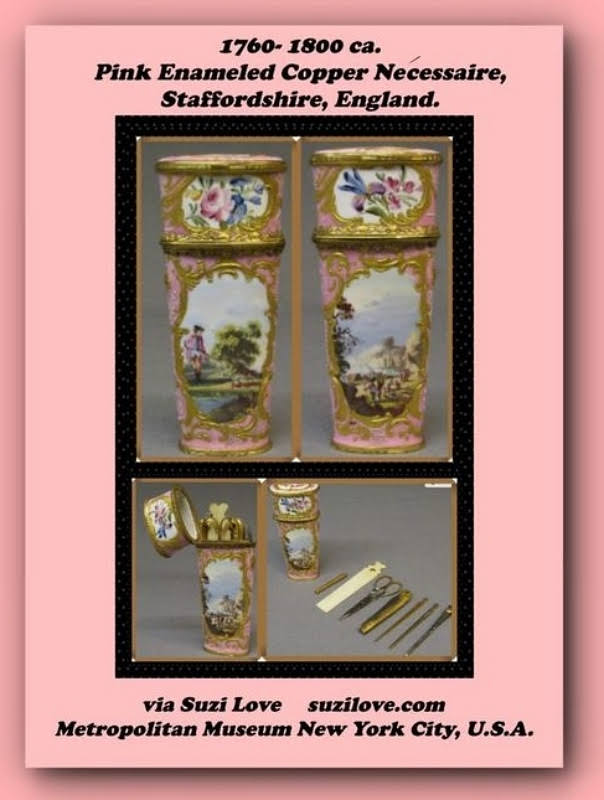
1760-1800 ca. Pink Enamel and Copper Necessaire Or Etui, Staffordshire, England. Dimensions: 3 3/4 x 1 5/8 in. (9.5 x 4.1 cm) Credit: Pierpont Morgan, 1917 via Metropolitan Museum, N.Y.C., U.S.A. metmuseum.org
Definition Necessaire Or Etui: Small toiletry, writing, or sewing containers were called Necessaire or Etui: Tiny boxes or containers were carried in large castles or sprawling manor houses so a lady or gentleman had their essentials with them all day. They were also important when traveling by coach, trains, or on ships where space was always limited. A necessaire or Etui was easily carried in a bag, reticule, or pocket so essentials were on hand for personal grooming, to repair a ripped hem, replace a button, to embroider, or to write a note or letter.
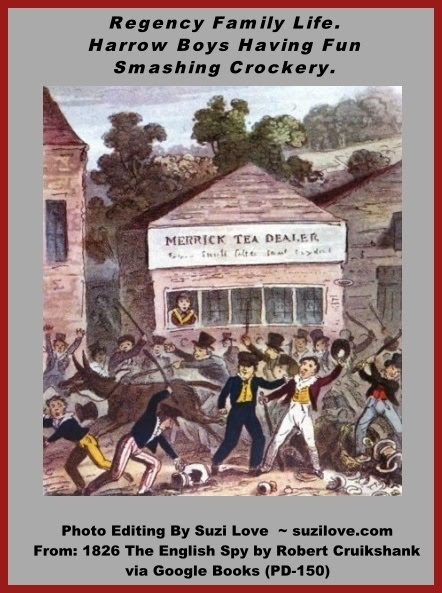
1826 Harrow Boys Having Fun Smashing Crockery. Regency Family Life. Photo Editing By Suzi Love. From: 1826 The English Spy By Robert Cruikshank via Google Books (PD-150)
1800s Typical Breakfast and Tea China, England. Tea cups, Bread and Butter plates, Teapot, Butter Dish, Coffee Cups, Tea Set, Milk Jug, Water Jug, Bread Dish, Sardine Dish, Bacon Dish, Marmalade Jar and Breakfast Cups. From: 1860 Mrs. Isabella Beeton’s Book of Household Management. These are the sort of salads that Jane Austen’s family would have eaten to accompany main dishes during the early 1800s, or Regency Era.
Travel and Luggage By Suzi Love History Notes Book 10. How did people travel in Jane Austen’s times. In past centuries? What did they take with them to make their long journeys easier? Travel by road, ship, canal, or railway all took a long time and had dangers so people learned to prepare. And then, in the nineteenth century, road improvements, inventions, and scientific developments made travel more pleasurable. books2read.com/SuziLoveTravel
“There is nothing I would not do for those who are really my friends. I have no notion of loving people by halves, it is not my nature.” Jane Austen ~ Northanger Abbey (1817) #JaneAusten #RegencyEra #Quotation
What salads were served in Jane Austen and the Bridgerton households? Salads “Persons in health, who feel a craving for salad, may indulge in the enjoyment of it to a great extent with perfect impunity, if not with positive benefit. Oil, when mixed in salad, appears to render the raw vegetables and herbs more digestible. Vinegar likewise promotes the digestion of lettuce, celery, and beet-root.
“Endive is very wholesome, strengthening, and easy of digestion; but when strong seasoning is added to it, it becomes an epicurean sauce. — Mayo.”
Recipe for a Winter Salad, by the late Rev. Sydney Smith. Two large potatoes, passed through kitchen sieve, Unwonted softness to the salad give, Of mordent mustard add a single spoon; To add a double quantity of salt; Three times the spoon with oil of Lucca crown, And once with vinegar, procured from town. True flavor needs it, and your poet begs The pounded yellow of two well-boiled eggs. Let onion atoms lurk within the bowl, And, scarce suspected, animate the whole; And, lastly, on the flavored compound toss A magic teaspoon of anchovy sauce. Then, though green turtle fail, though venison’s tough, And ham and turkey are not boiled enough, Serenely full the Epicure may say,- Fate cannot harm me—I have dined to-day!
The Spanish proverb says four persons are wanted to make a good salad: a spendthrift for oil, a miser for vinegar, a counsellor for salt, and a madman to stir all up.
1859 Hints for the Table by John Timbs.
1800s Typical Salads: Cucumber, Beetroot and Potato, Macedone Salad, Tomato Salad, Jellied Russian and Italian Salads, Prawn Salad, Egg and Lettuce, Lobster Salad and Salad Dumas. From: Mrs. Beeton’s Book of Household Management. via Google Books (PD-150)
1715 ca. Rectangular Envelope Style Bag, French. Polychrome opaque and translucent glass beads strung with linen thread, held together by interlocking looping stitches (sablé). Design on white ground: woman playing table organ, woman seated, boy and girl flanking, urn with flowers right, two insects and curtain above (obv.); sun and phoenix of Louis XIV, ribbon above inscribed IE VIS SANS MOURIR, inscribed at bottom and right SI IE MEURS CE NEST QUE POVR REVIVRE (rev.); vegetative scene (flap). Gilt-galloon binding. Salmon figured silk lining and side panels. Cardboard foundation. via Los Angeles County Museum of Art, California, USA. collections.lacma.org
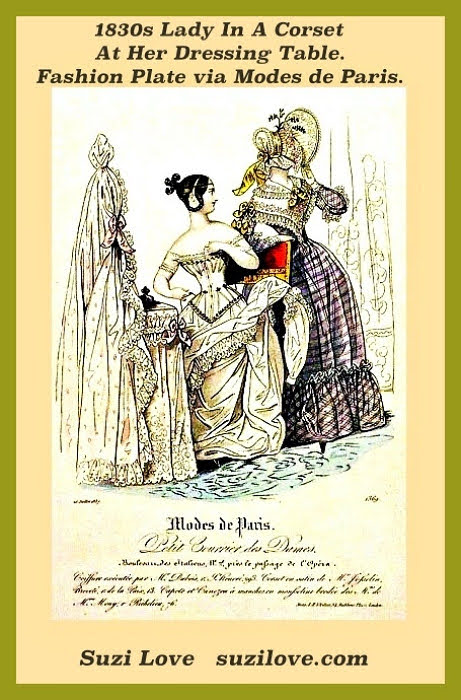
1830s Lady In A Corset At Her Dressing Table. Fashion Plate via Modes de Paris.
Romantic Era women’s corsets supported plus fitted well to give a fashionable silhouette. Becoming a fashion item, rather than simply hidden underclothing. https://books2read.com/SuziLoveCorsetBook18