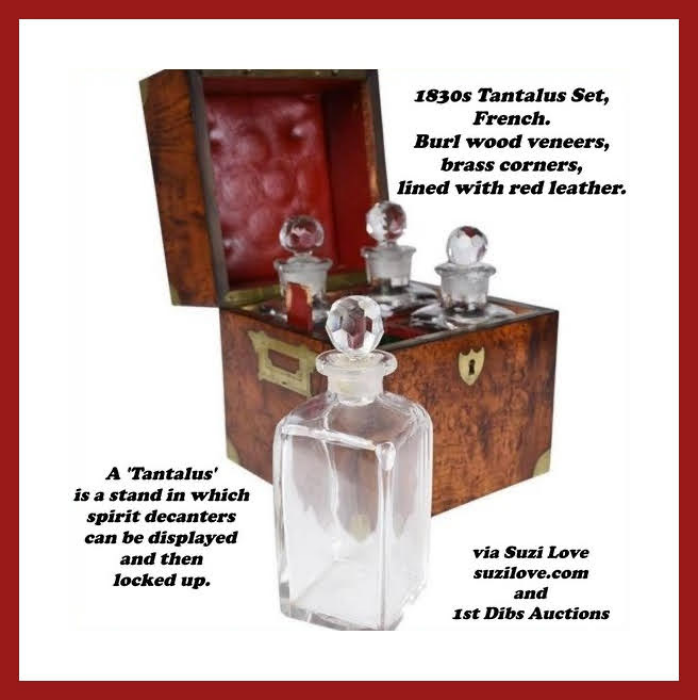
1830s Tantalus Set, French. Burl Wood veneers, brass corners and lined with red leather. Tantalus: Small box or cabinet containing decanters. Lock and key keep unauthorized people from drinking the contents e.g. servants and younger sons, yet still allowing the decanters of drinks to be on show. The word, Tantalus, is a reference to the unsatisfied temptations of the Greek mythological character, Tantalus.
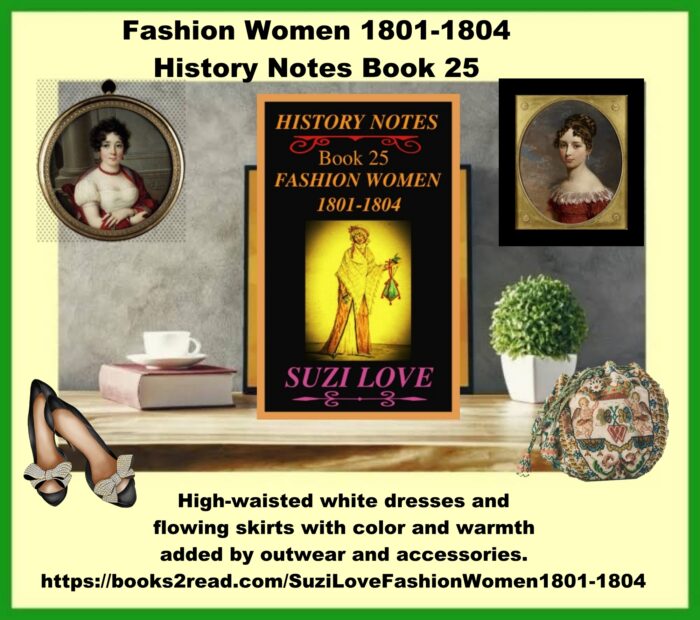
Writer Or Reader Of Regency Era?What did Jane Austen and friends wear? Women’s clothing changed dramatically in early 1800s. New silhouette copied simplistic styles of Greeks and Romans. High-waisted white dresses and flowing skirts with color and warmth added by outerwear and accessories. Fashion Women 1801-1804 History Notes Book 25 https://books2read.com/SuziLoveFashionWomen1801-1804
Definition Empire Style Dress: High-waisted white gowns defined women’s fashion during the Regency Era. ‘Empire’ is the name given to the period when Napoleon Bonaparte built his French Empire. High-waisted, loose gowns were adopted by the aristocracy as a symbol of turning away from the elaborate clothing worn in the 1700s. This sort of high-waisted dress would have been worn by Jane Austen and her contemporaries in England.
Definition Shawls: The shawl started off in India as a fine wool garment for men that could be worn as a scarf, turban or as a mantle: the word comes from the Persian shäl. Originally imported from the East, European Kashmir shawls were made first in Norwich and Edinburgh in Britain in the late 18th century. Shawls were an essential item in the early 1800s to cover the thin gowns women wore. They were made of muslin, gauze, silk, wool, and velvet, though cashmere shawls were the softest and most prized.
Fashion Women 1801-1804 History Notes Book 25 This book looks at the changes to women’s clothing in the early 1800s and the move away from complicated styles and heavy fabrics. The new silhouette copied the simplistic styles of the Greeks and Romans. White dresses were high-waisted and skirts were flowing, with color and warmth added by outwear and accessories. https://books2read.com/SuziLoveFashionWomen1801-1804
1815 The First Quadrille at Almack’s Assembly Rooms, London. Left to Right: Marquis of Worcester, Lady Jersey, Clanronald MacDonald and Lady Worcester. “It was not until 1815 that Lady Jersey introduced from Paris the favourite quadrille, which has so long remained popular. I recollect the persons who formed the very first quadrille that was ever danced at Almack’s: they were Lady Jersey, Lady Harriett Butler, Lady Susan Ryde, and Miss Montgomery; the men being the Count St Aldegonde, Mr Montgomery, Mr Montague, and Charles Standish.” From The Reminiscences of Captain Gronow 1810-1860.
The patronesses of Almack’s controlled a lot of a young lady’s acceptance into English society in Jane Austen’s times. To be given a voucher and admitted to an assembly, there was an introduction into London’s polite society.
1787 St. George’s Church, Hanover Square, London, U.K. By T. Malton. A favorite place to be married for the Regency aristocracy during Bridgerton and Jane Austen times, but also a haunt of pickpockets.
From the Edinburgh Annual Register 1810: Complaints have been made of numerous robberies, by daring gangs of pickpockets in the daytime, in the public streets, also at churches, chapels, and meetings, particularly at St. George’s church, Hanover-square. The Countess of Aylesford, and several other ladies of distinction, having been robbed there, mentioned the circumstances to Townsend, the officer. The Countess of Aylesford said, she had no doubt but she was robbed by a short fat woman. Townsend went to the church and observed Mary Blakeman, alias Hills, a well-known female pickpocket, genteelly dressed in a black velvet pelisse and a cottage straw bonnet. When he called her outside, no stolen property was found on her person, despite him knowing her to be a thief for 25 years.
19th Century Mid Dance Card or Aide de Memoire. Jeweled and enameled gold dance card with concealed timepiece. Lid with a blue enamel with rose-cut diamonds floral wreath, opening to compartment with watch dial, pencil, and notebook. via Sotheby’s Auctions. sothebys.com
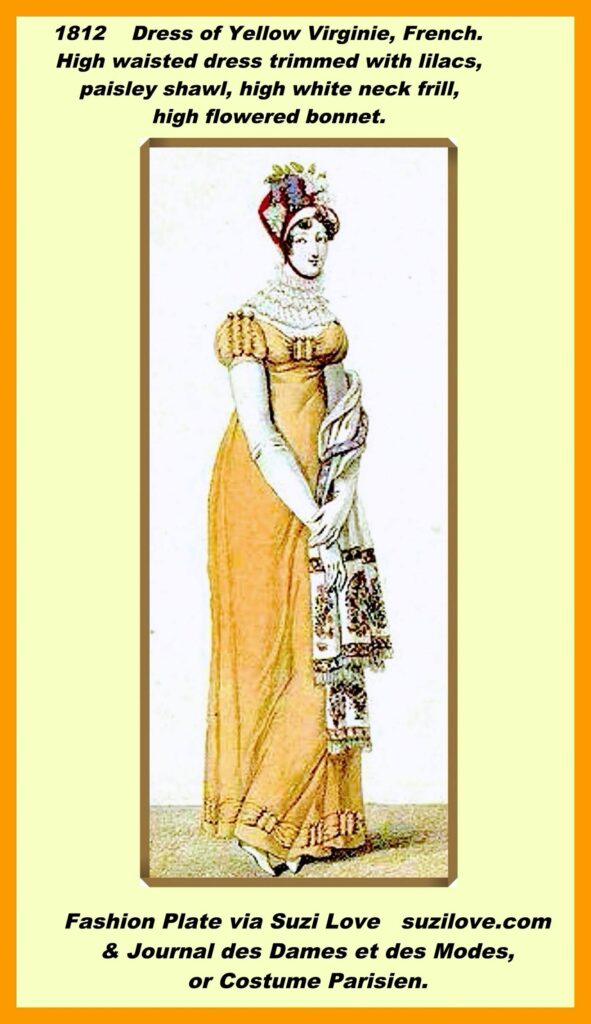
1812 Dress of Yellow Virginie, French. High waisted dress trimmed with lilacs, cashmere shawl, high white neck frill, high flowered bonnet. Fashion Plate via Journal des Dames et des Modes, Costume Parisien.
Typical of the Empire dresses worn by Jane Austen and her contemporaries. Low necklines and skirts that started directly under the bust and flowed into the classical relaxed wide styles of Greece and Rome. These high-waisted dresses were worn most days and cotton, silk or taffeta were the popular fabrics.
Definition Empire Style Dress: Named after the First Empire in France. Empire dresses had a low neckline and skirts started directly under the bust and flowed into the classical relaxed wide styles of Greece and Rome. This style of dress is associated with Jane Austen and her contemporaries as a high-waisted dress was worn most days. Cotton, silk or taffeta were the popular fabrics. Only the very wealthy could afford white dress in this style as the cottons were imported from India and had to be carefully cleaned, usually by a lady’s maid.
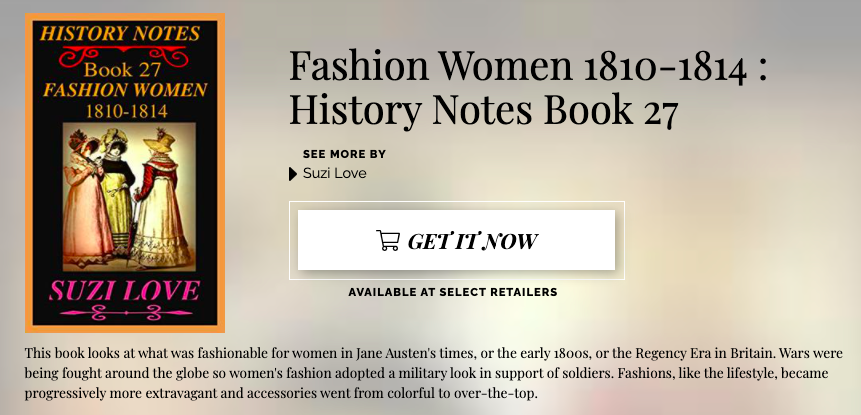
Fashion Women 1810-1814 History Notes Book 27 This book looks at what was fashionable for women in Jane Austen’s or the Bridgerton family’s times, or the early 1800s, or the Regency Era in Britain. Wars were being fought around the globe so women’s fashion adopted a military look in support of soldiers. Fashions, like the lifestyle, became progressively more extravagant and accessories went from colorful to over-the-top.
The Earl of Winchester’s mouth widened into a roguish grin. “I’m flattered by your scrutiny of my anatomy and amused by your blush, especially after your studies into animal reproduction.”
Lady Laura Jamison’s hand flew to her cheek and her heavy reticule knocked her arm. “I never blush.” To have him observe her ogle him was embarrassing and gave her another reason to be irritated by his company, petty though her reasons might be. She tugged, but her hand was imprisoned under his. With her nose raised a fraction, she said, “For the sake of propriety, I was ensuring your garments were intact. You’ve a reputation for disappearing into dark corners and re-emerging with your clothing askew. As though hasty hands ripped your garments from your body.”
“Tut, tut, my pet. Has jealousy driven you to spying?”
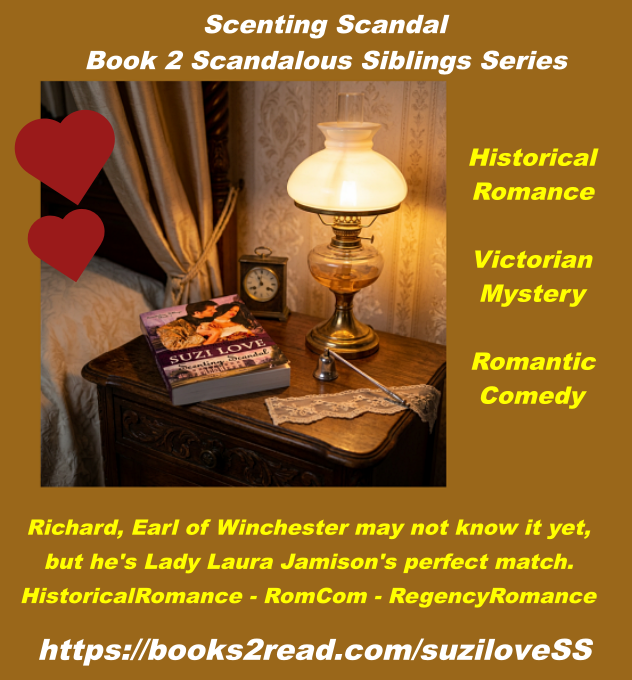
“Jealousy? Over the class of females you consort with? I was reassuring myself your clothing was intact for the sake of my elderly aunt. The entire congregation watched that woman, the Countess, beckon you to the back of the church. Heaven knows what you were doing while the bride and groom were signing the register.” Scenting Scandal Book 2 Scandalous Siblings “For the sake of propriety,” Lady Jamison informed the Earl. “I was ensuring your garments were intact. You’ve a reputation for disappearing into dark corners and re-emerging with your clothing askew.” #HistoricalRomance https://books2read.com/suziloveSS
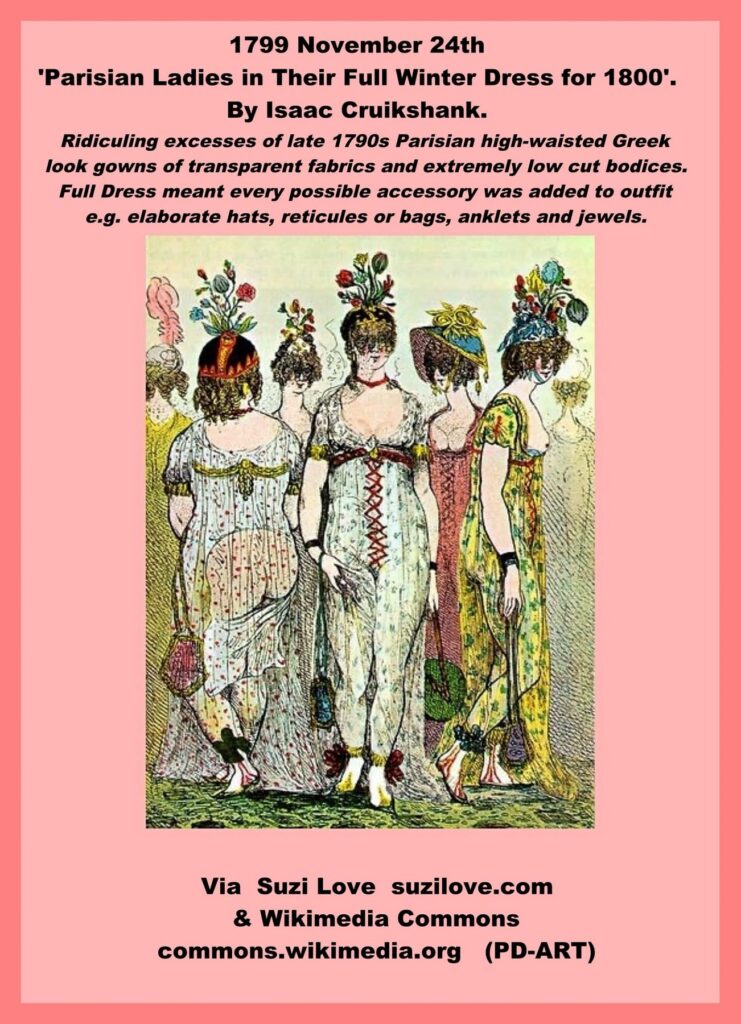
1799 November 24th ‘Parisian Ladies in Their Full Winter Dress for 1800’. By Isaac Cruikshank. Ridiculing excesses of late 1790s Parisian high-waisted Greek look gowns of transparent fabrics and extremely low cut bodices.Full Dress meant every possible accessory was added to outfits.g. elaborate hats, reticules or bags, anklets and jewels. Via British Museum, London, UK. britishmuseum.org (PD-Art)
HN_1 Fashion Women Late 1700s History Notes Book 1 by Suzi Love.
What was fashionable for women in the late 1700s? Extravagant colors and fabrics and outrageous styles were all seen in these flamboyant fashions.
books2read.com/suziloveFashWomen1700s
1825-1835 ca. Cotton Corset, Possibly American. Waist shaping at the almost natural waistline, flared hips, cording, widely spaced shoulder straps with front ties. Via Winterthur Museum Collection museumcollection.winterthur.org.
Corsets 1810-1830 History Notes Book 17: For Readers or Writers of historical fiction, the corsets worn during the Regency Era, or Jane Austen’s lifetime, or the Bridgerton years when dresses were lowcut with square necklines. https://books2read.com/SuziLoveCorsetBook17
1825-1835 ca. Cotton Corset, Possibly American. Waist shaping at the almost natural waistline, flared hips, cording, widely spaced shoulder straps with front ties. 1825-1835 ca. Cotton Corset, Possibly American. Waist shaping at the almost natural waistline, flared hips, cording, widely spaced shoulder straps with front ties. 1825-1835 ca. Cotton Corset, Possibly American. Waist shaping at the almost natural waistline, flared hips, cording, widely spaced shoulder straps with front ties.
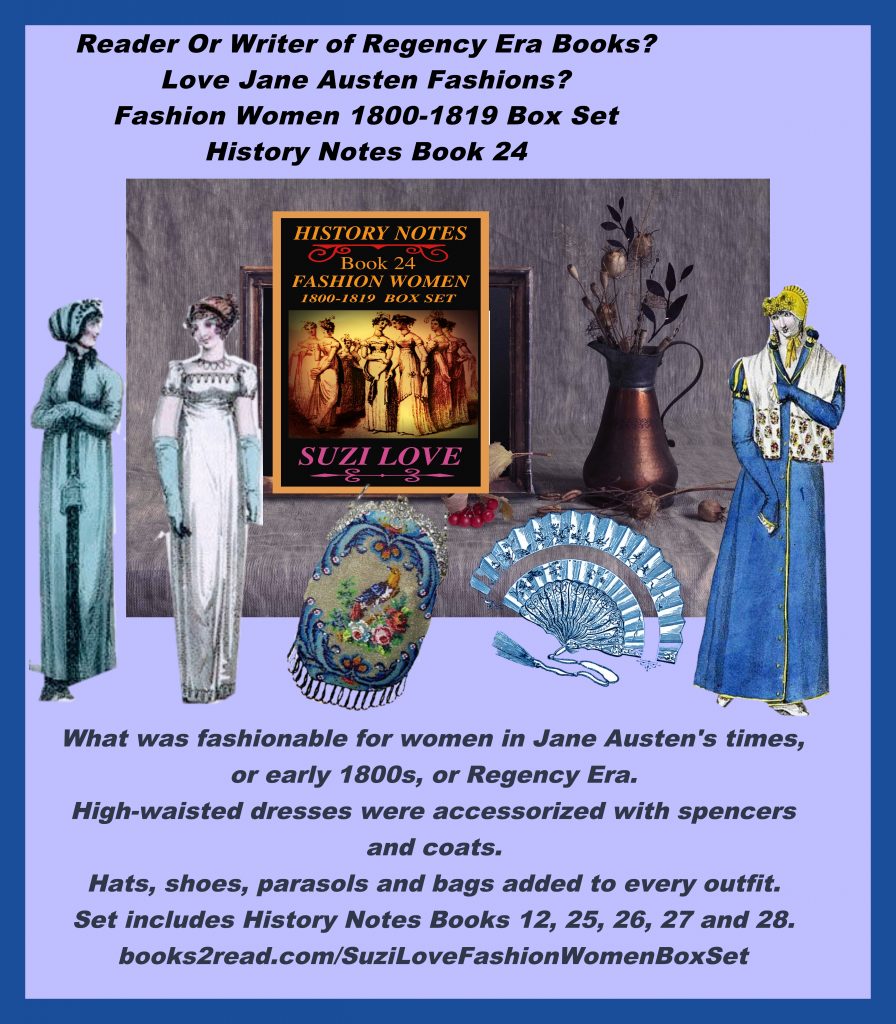
An overview of women’s fashions in the first twenty years of the 19th century. What was fashionable for women in Jane Austen’s times, or the early 1800s. Wars were being fought around the globe, so women’s fashion adopted a military look in support of soldiers. In Britain, the Prince Regent ruled instead of his father, King George III, so fashions, like the lifestyle, became more extravagant and accessories went from pretty to opulent. This set includes books 12, 25, 26, 27 and 28. https://books2read.com/SuziLoveFashionWomenBoxSet
Ladies clothing in the early 1800’s featured a high waist line called an Empire Line, or Empire style dress, with a waist line just under the natural bust line and much higher than the natural waist. The high-waisted, or short-bodied, Regency styles shifted focus away from the natural waist and so left the natural waist unconstricted, in direct contrast to previous and future styles. Britain took these simple European styles and progressively made them more elaborate by adding more and more complicated embroidery onto white fabrics to create the white on white look popular for many years.
The empire look of fine muslin dresses left women more exposed than in the Georgian Era when fabrics had been thicker and styles bulkier. Women, especially in England, preserved their modesty by adding lace, frills, flounces, ruches, and fabric plaits to dresses to adequately cover any parts that might inadvertently be exposed. Outer layers, such as Spencers, Redingotes or Pelisses or coats, and shawls, were also added for warmth and to brighten outfits.
This Empire fashion was totally dependent on a supply of fine, translucent cotton muslin – at first imported from India, then later, less exclusive imitations often woven and printed or embroidered in Britain. Fabrics were soft and lightweight and muslins and other cotton fabrics from India and other Asian countries were in high demand.