Cartoons For Riders At The Hunt. Typical comical scenes from The Bridgertons and Jane Austen’s Daily Lives. From: 1860 Mr. Sponge’s Sporting Tour by Robert Smith Surtees. via Google Books (PD-100)




Cartoons For Riders At The Hunt. Typical comical scenes from The Bridgertons and Jane Austen’s Daily Lives. From: 1860 Mr. Sponge’s Sporting Tour by Robert Smith Surtees. via Google Books (PD-100)
1817 June Blue Riding Costume, English. Loose riding habit with a train on the skirt, high white neck frill on the shirt underneath, and rows of decoration on the shoulders and cuffs of the habit jacket, an extra high hat with multiple plumes, or, feathers and gloves. Fashion Plate via The Lady’s Magazine Or Entertaining Companion for the Fair Sex.
Male tailors made most women’s riding habits during the Regency years and they were constructed similarly to men’s riding outfits. Generally in two pieces, a jacket and a skirt, and with a shirt with a frilled collar or front opening underneath. The trains of a habit could be caught up for walking, usually with a button and loop, and unhooked and let down so that the skirt flowed over the woman’s legs when she rode side saddle. Due to the numerous wars during the early 1800s, it was seen as patriotic for women to add military style touches to outfits in support of military men. The shoulder and cuff trims resemble the epaulettes and coat trims of a military uniform.


1815 White Dress and Reticule, French. White dress, green bonnet with pink trim to match the adorable pink reticule and green gloves. Fashion Plate via Journal des Dames et des Modes, or Costume Parisien. Jane Austen and her contemporaries would have worn this style of outdoor walking outfit and flowered hat.
Definition Reticule: Bag or purse, often with a drawstring to pull closed and usually made of cloth or covered cardboard and often decorated with beading or embroidery. A reticule, or purse, or handbag, was usually carried by a woman during the Regency period to carry all their daily necessities. Earlier, women used pockets that tied at the waistline and were hidden in the folds of their skirts. Empire style, or early 1800s, high-waisted dresses made it impossible to either sewn in a pocket or to tie on a pocket. So women began carrying small, decorated bags called Reticules, or ridicules, which generally pulled close at the top with a drawstring.

1807 Gentleman’s Everyday Outfit, French. Brown coat, high collared shirt, and vest simply tied, wit a cravat and a black hat and a cane. Brutus style hair cut of curled hair. Fashion Plate via Journal des Dames et des Modes, or Costume Parisien.
https://books2read.com/SuziLoveFashionMen1800-1819
French fashions and Georgian and Regency Era fashions from Great Britain were copied around the world. This is what men wore in the times of Jane Austen for city and country life.


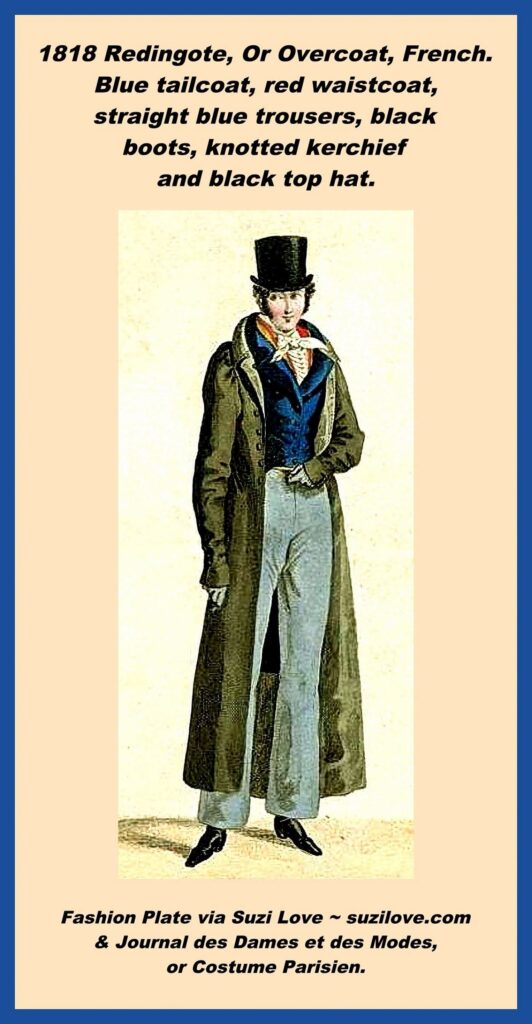
1818 Redingote, Or Overcoat, French. Blue tailcoat, red waistcoat, straight blue trousers, black boots, knotted kerchief and black top hat. Fashion Plate via Journal des Dames et des Modes, or Costume Parisien.
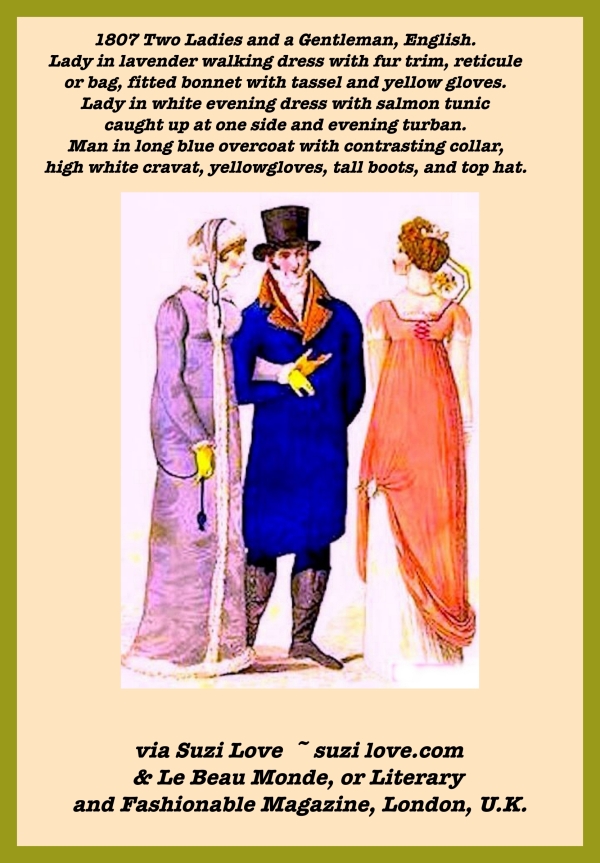
1807 Two Ladies and a Gentleman, English. Lady in lavender walking dress with fur trim, reticule or bag, fitted bonnet with tassel and yellow gloves. Lady in white evening dress with salmon tunic caught up at one side and evening turban. Man in long blue overcoat with contrasting collar, high white cravat, yellow gloves, tall boots, and top hat. Typical of the sort of outfits ladies and gentlemen in Jane Austen’s times would have worn while out walking, visiting friends or for an evening event, like a dinner party. A long coat, or Redingote or Pelisse for warmth when outdoors, and all matched with the essentials, day or night, of hats and gloves. via Le Beau Monde, or Literary and Fashionable Magazine, London, U.K.

1818 November ‘Fashionables Of 1818’ By George Cruikshank.Couple walk arm-in-arm with the man wearing Dandy costume of bell-shaped top-hat, trousers strapped under high-heeled boots without spurs and jauntily carried cane. Much shorter lady wears enormously high bonnet, striped over-dress over frilled white muslin, skirt above ankles, and carries a large ermine muff. Via British Museum, London, UK. britishmuseum.org (PD-Art)
These are the sort of outfits a couple would wear in Jane Austen’s times although these are exaggerated in caricatures to poke fun at the extremes of Regency fashion when women’s hats were so large and high that a lady was dwarfed by her devotion to fashion and a gentleman’s collar and neckcloth were so high he couldn’t turn his head to speak to the lady.

1806-1809 ca. Unissued One Pound Banknote. Issued in Alton, Hampshire, UK. The type of currency used by Jane Austen and her brother when dealing with the family’s finances. Issuer Alton Bank. Unissued banknote. (obverse) Emblem with initials, floral design and crown on top at left. Text at centre. Design printed in black. via British Museum.
A pound was a lot of money for the majority of people during the Regency, so the general population didn’t trust flimsy paper banknotes. A metal coin held its value in gold or silver, whereas paper banknotes were easily lost or damaged and very easy to forge. The original banknotes were merely a piece of paper that promised payment for a set amount and were issued by individual banks. The Bank of England used these notes from its inception in 1694 and regional banks continued issuing them until the changes to the Act in 1844. By the mid 1700s, notes started to become standardized, with ten and five pound notes appearing, but as they were all hand-lettered and signed they were viewed with skepticism. Most transactions were therefore done with metal coins, with many shopkeepers routinely biting down on a coin to ensure it was legitimate.


1790-1810 ca. Woman’s Black Wool Shoes. Pointed toe and low wedge heel covered in same fabric, black tape binding, leather straight or symmetrical sole, linen insole and lining. Wool satin with wool twill tape binding, plain weave linen lining, and leather sole. Place of Use: Lexington, Massachusetts, United States. Place of Manufacture: possibly Massachusetts, United States Provenance: Worn by a member of the Robbins family; inherited by Ellen A. Stone; gift to MFA, 1899. Credit Line Gift of Miss Ellen A. Stone via Museum of Fine Arts, Boston, U. S.A.
In Jane Austen’s years, she and her contemporaries spent a lot of time outdoors. Fragile slippers were worn for balls and evening events but for walking sturdier shoes were needed, In the early 1800s, these were typically made of leather and were flat or had a very small heel.

1808 Two Ladies, French. Apricot Evening Dress Or Moire Brochee, French. Patterned dress with very low cut bodice, short sleeves, long white gloves, and holding a Lorgnette, or looking glass, and a handkerchief. Grey Redingote with high waist and holding a red shawl. Fashion Plate via Journal des Dames et des Modes, or Costume Parisien.
The French magazine, Journal des Dames et des Modes, frequently made fashion plates with a single woman, two women or a woman with a man where they wear the same outfit. The two variations show innovative ideas for decorating plain white muslin dresses with a range of colorful accessories, and the early 1800s were definitely the years when accessories were the fashion highlight. Add a pair of colorful long gloves, a draped shawl or scarf, a reticule, handkerchief, fan or looking glass and the typical white dress is given individuality and personality.

Here is the companion to the above fashion plate with the single lady in her apricot dress. The lady in a grey Redingote is added.


