Reticule Or Bag: Purse, often with a drawstring to pull closed and usually made of cloth or covered cardboard and often decorated with beading or embroidery. Carried by a woman during the Regency period to carry all their daily necessities. in the place of pockets.
Spencer: Short jacket, cropped at the waist, worn over a dress, or gown. Delicate and regency dresses provided so little protection from the cold, so over garments were essential for warmth, modesty and good health.
Pelisse Or redingote Or Walking Dress: Coat worn over clothing of both sexes for warmth and protection from the elements.
Travel and Luggage By Suzi Love History Notes Book 10. How did people travel in Jane Austen’s times. In past centuries? What did they take with them to make their long journeys easier? Travel by road, ship, canal, or railway all took a long time and had dangers so people learned to prepare. And then, in the nineteenth century, road improvements, inventions, and scientific developments made travel more pleasurable. books2read.com/SuziLoveTravel
Travel and Luggage By Suzi Love History Notes Book 10. How did people travel in Bridgerton’s and Jane Austen’s times? What did they take with them to make their long journeys easier? Travel by road, ship, canal, or railway all took a long time and had dangers so people learned to prepare. And then, in the nineteenth century, road improvements, inventions, and scientific developments made travel more pleasurable. books2read.com/SuziLoveTravel
Are you a reader or writer of Regency Romance? Love Jane Austen’s books? Want to know more about the mourning, riding, underclothing and other Regency Era women’s fashions in Regency romances? What was fashionable for women in Jane Austen’s times? Mourning, riding, daytime, evening clothing, plus underclothing, corsets and accessories. This book looks at what was fashionable for women in Jane Austen’s times, or the early 1800s, or the Regency Era in Britain. Wars were being fought around the globe so women’s fashion adopted a military look in support of soldiers. Fashions, like the lifestyle, became progressively more extravagant and accessories went from colorful to over-the-top. https://books2read.com/SuziLoveFashion1810-1814
An overview of women’s fashions in the first twenty years of the 19th century. What was fashionable for women in Jane Austen’s times, or the early 1800s. Wars were being fought around the globe so women’s fashion adopted a military look in support of soldiers. In Britain, the Prince Regent ruled instead of his father, King George III, so fashions, like the lifestyle, became more extravagant and accessories went from pretty to opulent.
Reader Or Writer of Regency Era? Love Jane Austen and Bridgerton fashions? What was fashionable for women in Jane Austen’s times, or 1800s, or Regency Era. High-waisted dresses were extravagantly accessorized and hats, shoes, parasols and bags were added. Set includes History Notes Books 12, 25, 26, 27 and 28. https://books2read.com/SuziLoveFashionWomenBoxSet
Ladies clothing in the early 1800’s featured a high waist line called an Empire Line, or Empire style dress, with a waist line just under the natural bust line and much higher than the natural waist. The high-waisted, or short-bodied, Regency styles shifted focus away from the natural waist and so left the natural waist unconstricted, in direct contrast to previous and future styles. Britain took these simple European styles and progressively made them more elaborate by adding more and more complicated embroidery onto white fabrics to create the white on white look popular for many years.
The empire look of fine muslin dresses left women more exposed than in the Georgian Era when fabrics had been thicker and styles bulkier. Women, especially in England, preserved their modesty by adding lace, frills, flounces, ruches, and fabric plaits to dresses to adequately cover any parts that might inadvertently be exposed. Outer layers, such as Spencers, Redingotes or Pelisses or coats, and shawls, were also added for warmth and to brighten outfits. This Empire fashion was totally dependent on a supply of fine, translucent cotton muslin – at first imported from India, then later, less exclusive imitations often woven and printed or embroidered in Britain. Fabrics were soft and lightweight and muslins and other cotton fabrics from India and other Asian countries were in high demand.
Spencers Or Regency Jackets By Suzi Love. History Notes Book 4. What was fashionable for outer wear in past centuries? Call them what you like: Spencers, short jackets, or Regency jackets were very popular. Take a look at the jackets being worn by women in the early 1800s or the times of Jane Austen. books2read.com/suziloveSpencers
Definition: Spencer – Short, bodice hugging, usually long sleeved, outer jacket. For warmth and for fashion.
Definition Caroline Spencer: Worn during the Directoire and First Empire (1790-1815 C.E.). Spencer with pelerine cape that was made of white kerseymere and trimmed with light blue satin cut on bias.
Spencers were short jackets cut to match the high waistlines of Empire dresses. They often copied military styling, such as braiding, shoulder decoration, buttons and loop fasteners, and wrist adornments. They were generally of complex construction, often with a diamond shaped piece in the back.
Fashion Women 1800 By Suzi Love History Notes Book 12 #Regency #Fashion Love gorgeous historical women’s fashions? Take a look at what women wore and carried in 1800 in Europe and around the world. This is the world Jane Austen lived in and the fashions she wore. books2read.com/SuziLoveFashionWomen1800
Women’s dress changed dramatically after 1785. The rich fabrics and complicated, formal shapes of the late 18th century gave way to simple, light fabrics that draped easily. These new gowns achieved something of the effect of the simple tunics shown on classical Greek and Roman statues and vases. Inspired in part by the statuary of ancient Greece and Rome, the new fashion was epitomised by light cotton gowns falling around the body in an unstructured way, held around the high waist with a simple sash and accompanied by a soft shawl draped around exposed shoulders. This style was ideal for the Indian imports like Kashmiri shawls and Bengali muslin, as used in this embroidered gown. Championed by such influential figures as Emma Hamilton in England and Madame Récamier in France, the so-called ‘Empire’ style catapulted Indian muslin into the forefront of fashion.
Empire Dress: Owes its name, physical emancipation, popularity, and even its sexiness to France. In this English example, French style is slavishly followed in the gown’s high waist and modish stripes.
Empire style, or early 1800s, high-waisted dresses made it impossible to either sewn in a pocket or to tie on a pocket. So women began carrying small, decorated bags called Reticules, or ridicules, which generally pulled close at the top with a drawstring.
Inspired in part by the statuary of ancient Greece and Rome, the new fashion was epitomised by light cotton gowns falling around the body in an unstructured way, held around the high waist with a simple sash and accompanied by a soft shawl draped around exposed shoulders. This style was ideal for the Indian imports like Kashmiri shawls and Bengali muslin, as used in this embroidered gown. Championed by such influential figures as Emma Hamilton in England and Madame Récamier in France, the so-called ‘Empire’ style catapulted Indian muslin into the forefront of fashion.
Reticule Or Bag: Purse, often with a drawstring to pull closed and usually made of cloth or covered cardboard and often decorated with beading or embroidery. Carried by a woman during the Regency period to carry all their daily necessities. in the place of pockets.
Spencer: Short jacket, cropped at the waist, worn over a dress, or gown. Delicate and regency dresses provided so little protection from the cold, so over garments were essential for warmth, modesty and good health.
Pelisse Or redingote Or Walking Dress: Coat worn over clothing of both sexes for warmth and protection from the elements.
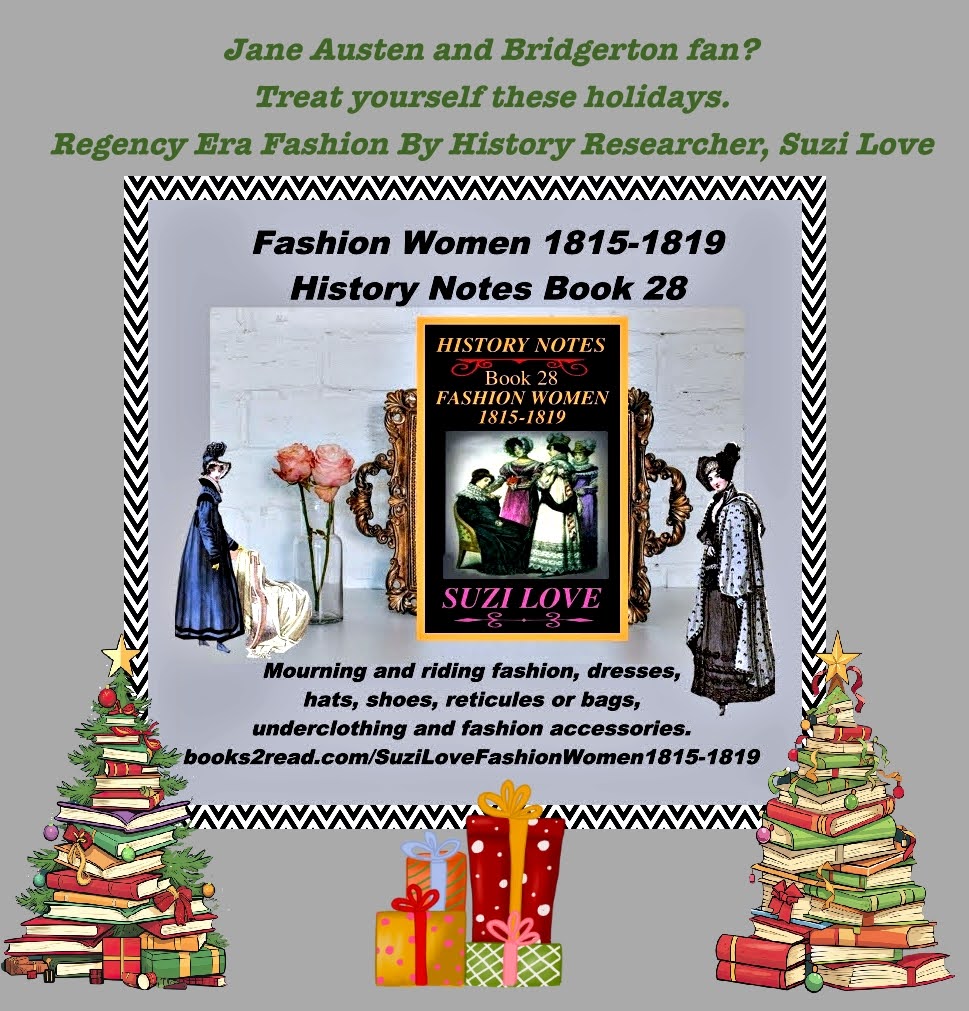
What did Jane Austen and friends wear? Early 1800s fashions were elegant and pretty with high waists and fabrics that were almost transparent. These Empire style gowns, named after Napoleon’s first Empress, became popular throughout Europe, and were then copied around the world. Colorful outwear was added to make an ensemble more attractive and warmer. History Notes Book 26 Fashion Women 1805-1809. https://books2read.com/SuziLoveFashionWomen1805-1809
The Empire waist gown defined women’s fashion during the Regency Era. ‘Empire’ is the name given in France to the period when Napoleon built his French Empire. High-waisted, loose gowns were adopted by the aristocracy as a symbol of turning away from the fussy, elaborate and expensive clothing worn in the 1700s. Jean-Jaques Rousseau advocated copying peasants and returning to a simpler life and more natural fashions. Unrestricting clothing was part of the new Democracy in France and these simpler and flowing fashions were adopted all over Europe, including Britain and despite the continual wars being fought against France during the early 1800s. Not even war stopped fashions from being copied everywhere.