17th Century Late – 18th Century Early. Purse, French. Silk and Metal. via Metropolitan Museum, N.Y.C., U.S.A. metmuseum.org



17th Century Late – 18th Century Early. Purse, French. Silk and Metal. via Metropolitan Museum, N.Y.C., U.S.A. metmuseum.org
1784-1826 ca. Woman’s Under Dress. White high-waisted underdress with drawstrings at neck and waist, narrow shoulder straps, back tie closure, embroidered with large scale scrolling floral motifs with meandering vine and bands of dots along the bottom edge. The type of underdress worn by Jane Austen’s female friends and family. via Museum of Fine Arts, Boston, U.S.A. mfa.org


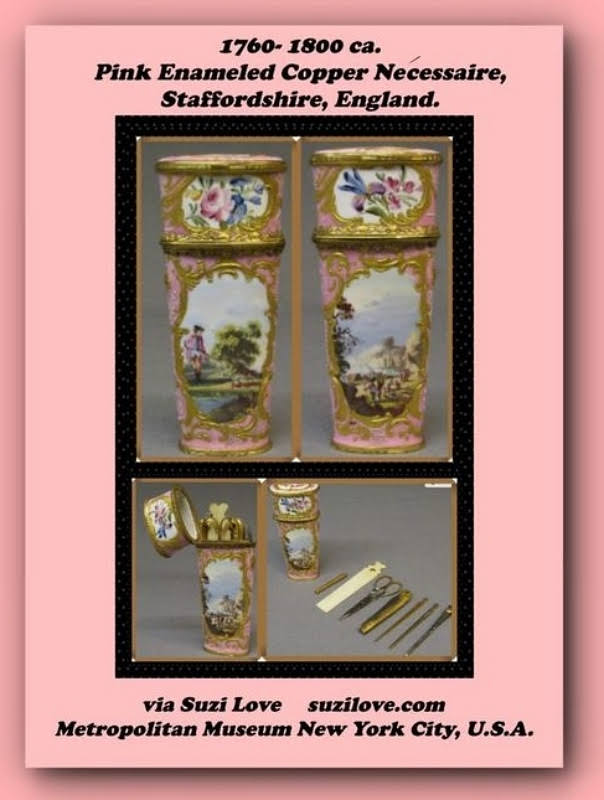
1760-1800 ca. Pink Enamel and Copper Necessaire Or Etui, Staffordshire, England. Dimensions: 3 3/4 x 1 5/8 in. (9.5 x 4.1 cm) Credit: Pierpont Morgan, 1917 via Metropolitan Museum, N.Y.C., U.S.A. metmuseum.org
Definition Necessaire Or Etui: Small toiletry, writing, or sewing containers were called Necessaire or Etui: Tiny boxes or containers were carried in large castles or sprawling manor houses so a lady or gentleman had their essentials with them all day. They were also important when traveling by coach, trains, or on ships where space was always limited. A necessaire or Etui was easily carried in a bag, reticule, or pocket so essentials were on hand for personal grooming, to repair a ripped hem, replace a button, to embroider, or to write a note or letter.

Travel and Luggage By Suzi Love History Notes Book 10. How did people travel in Jane Austen’s times. In past centuries? What did they take with them to make their long journeys easier? Travel by road, ship, canal, or railway all took a long time and had dangers so people learned to prepare. And then, in the nineteenth century, road improvements, inventions, and scientific developments made travel more pleasurable. books2read.com/SuziLoveTravel


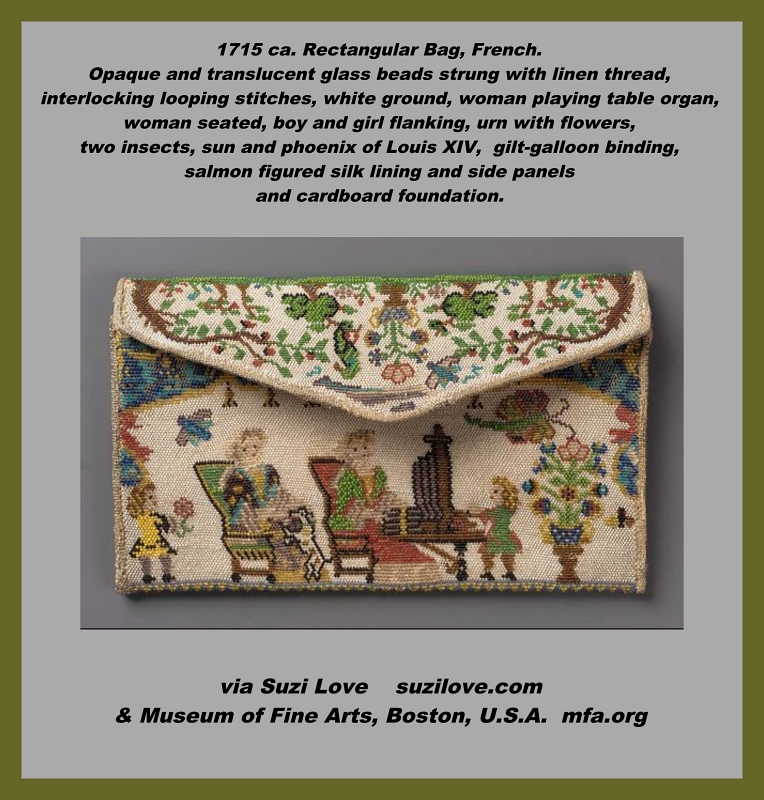
1715 ca. Rectangular Envelope Style Bag, French. Polychrome opaque and translucent glass beads strung with linen thread, held together by interlocking looping stitches (sablé). Design on white ground: woman playing table organ, woman seated, boy and girl flanking, urn with flowers right, two insects and curtain above (obv.); sun and phoenix of Louis XIV, ribbon above inscribed IE VIS SANS MOURIR, inscribed at bottom and right SI IE MEURS CE NEST QUE POVR REVIVRE (rev.); vegetative scene (flap). Gilt-galloon binding. Salmon figured silk lining and side panels. Cardboard foundation. via Los Angeles County Museum of Art, California, USA. collections.lacma.org
Travel and Luggage By Suzi Love History Notes Book 10. How did people travel in Bridgerton’s and Jane Austen’s times? What did they take with them to make their long journeys easier? Travel by road, ship, canal, or railway all took a long time and had dangers so people learned to prepare. And then, in the nineteenth century, road improvements, inventions, and scientific developments made travel more pleasurable. books2read.com/SuziLoveTravel

I love golf and I love bits and pieces of history, so these facts on Golf Holes combine my two loves,
Suzi
The 18 holes come from the renovations of the Old Course at St. Andrews, the ostensible first golf course from 1400’s.
In 1848 or so, with the invention of the new, cheap, golf ball, the Brits went golf mad, like the tennis buffs in the 1970’s and the joggers in the ‘1980’s. They were churning up the Old Course something fierce, playing the 9 holes both directions, (this was way it was done, up, then back same course.)
So decisions were made to alleviate the problem. First thought was to extend the course and bring it around into a circle, ending at beginning. This was met with great uproar and consternation. So the additional 8 greens were added by increasing the width and people go up “the back nine” and back the additional.
Then George V saw what they had done and had an 18 hole course built at Richmond Palace, with the object in mind to provide the people who couldn’t afford the private clubs a golf course. Old Course at St. Andrews 18 hole, this Prince’s and the subsequent Duke’s courses are part of the heart of the British people.

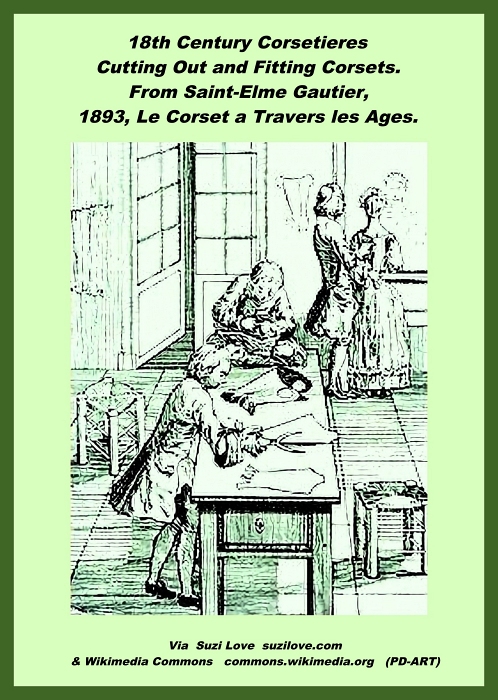
There has been some discussion on the names for Corset Makers. I’ve seen lots of names, including Stay Maker, Stay Manufacturer, Corset Maker, Body Tailor and Milliner. It was mainly men who were Stay Makers, but there were also some women who included stay making with their millinery.
Corsets Overview History Notes Nonfiction Book 14. This book shows how body wraps, stays, and corsets were worn to create a variety of fashionable silhouettes through past centuries. Corsets flattened breasts and accentuated rounded hips or pushed up breasts and showed off the bust line depending on the fashions of the time and the desired silhouette. Includes corsets through the Georgian, Regency, Victorian and Edwardian Eras and Jane Austen’s lifetime. Overview of corsets through history, including the Georgian, Regency, Victorian and Edwardian Eras and Jane Austen’s lifetime.


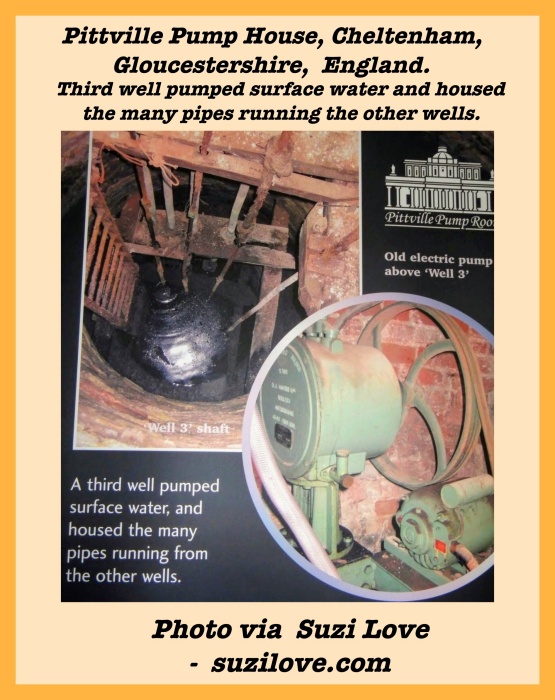
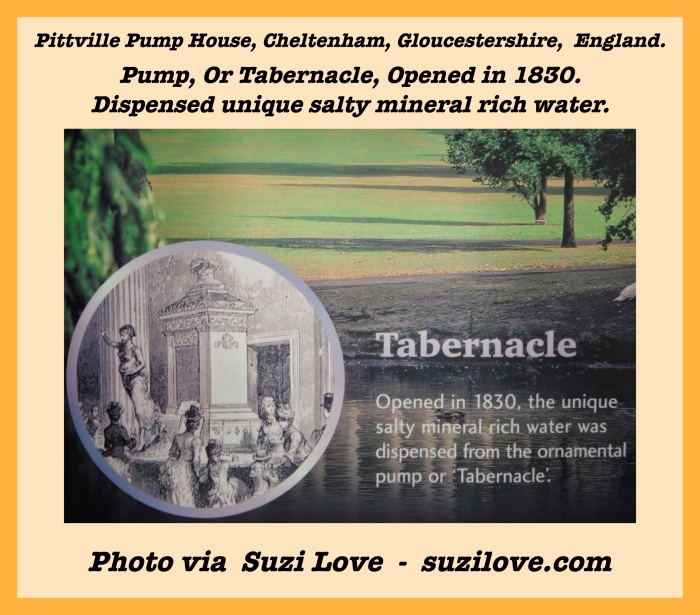
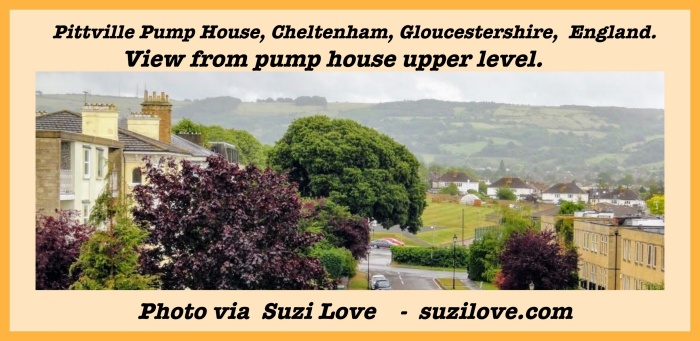
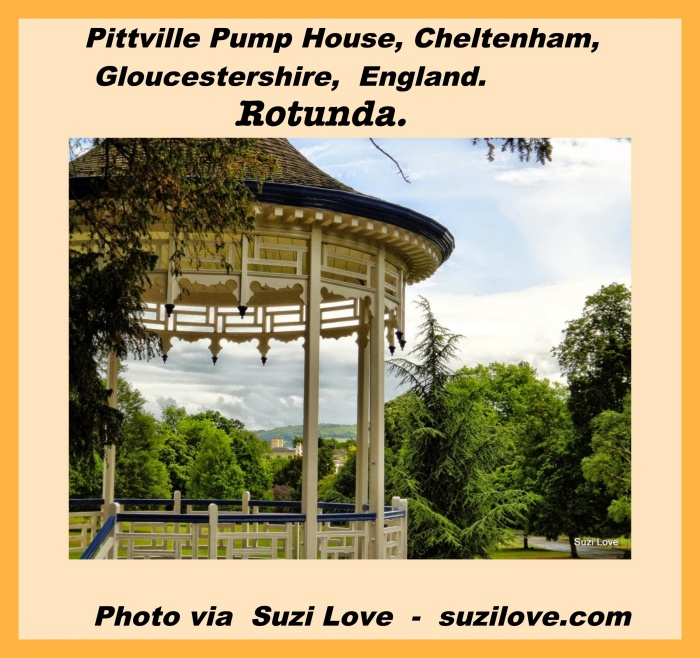
Cheltenham Spa, England: Pittville Pump Room: Cheltenham is a famous spa town within easy reach of the Cotswolds in in the county of Gloucestershire, England, and was a popular Georgian and Regency spa town where one could rest and recuperate. It became famous as a Spa town following the discovery of mineral springs in 1716, and claims to be the most complete Regency town in Britain. The Pittville Pump Room is an elegant Grade 1 listed Regency building and perhaps the most famous example of Regency architecture in Cheltenham, despite the town being filled Regency buildings. The Pittville Pump Room was the last and largest of the spa buildings to be built in Cheltenham.
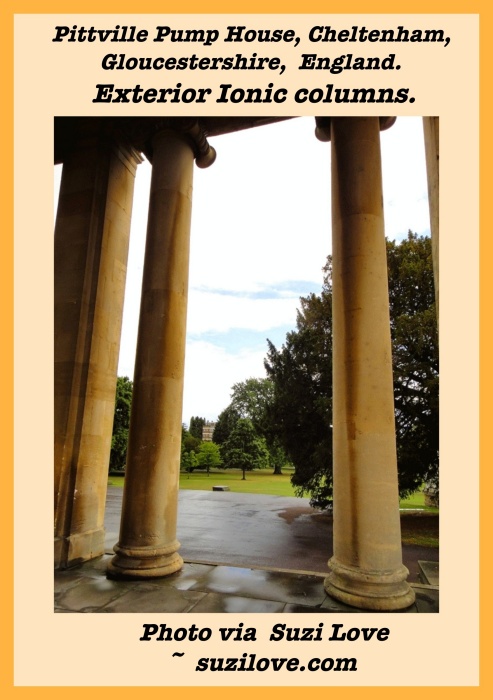
Location: The Pump Room stands at one end of Pittville Park, about two miles from Cheltenham’s town centre, and is a monument to more than 100 years of fame which Cheltenham enjoyed as a Spa town. The building is set in beautiful parkland and is surrounded on three sides by a grand colonnade of ionic columns opening into the impressive hall with its domed ceiling and original crystal chandeliers. The park has extensive open lawns surrounded by trees and ornate bridges and pathways lead around the lakes where swans and ducks swim.

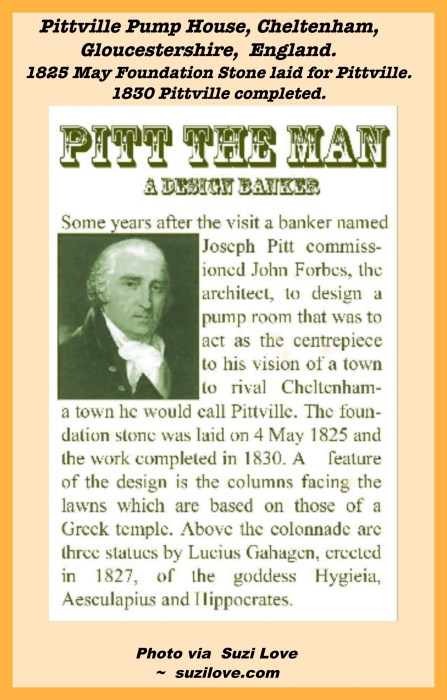
History: The waters were first discovered in around 1715 on a site now occupied by Cheltenham Ladies’ College. In 1788 George III and Queen Charlotte came to take the waters and it was their visit that set the seal on Cheltenham’s future. After a visit to Cheltenham, a banker named Joseph Pitt commissioned the architect John Forbes to design a pump room that was to act as the centrepiece to his vision of a town to rival Cheltenham – a town he would call Pittville.
The foundation stone was laid on 4 May 1825 and the work completed in 1830. The laying of the foundation was celebrated by the ringing of the bells, firing of cannons, as well as a Masonic Procession which set out from the Masonic Hall in Portland Street. In the evening banquets were held at two of the town’s hotels and grand fireworks display was to be seen at Pittville. The building took five years to complete. Following disagreements between Forbes and the builder, a second architect, John Clement Mead from London, was employed to finish the interior. He designed the elaborate stoves which heated the building. The original official opening on 6th July, 1830 was postponed until 20th July, 1830 because of the death of George IV. A grand public breakfast and ball marked the occasion.
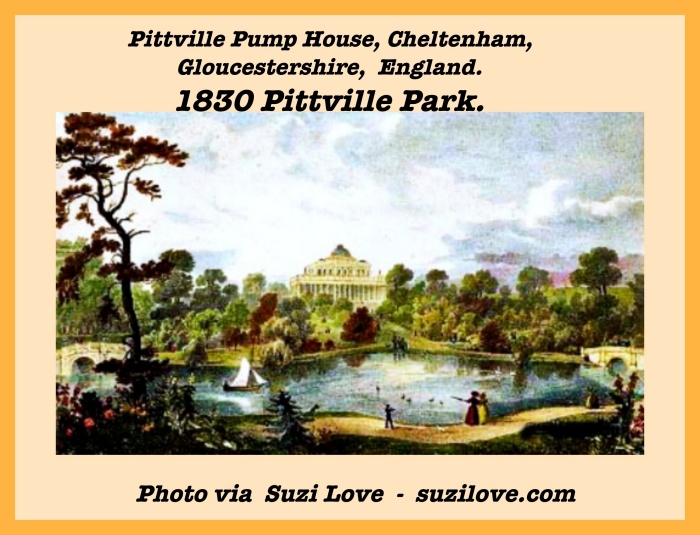

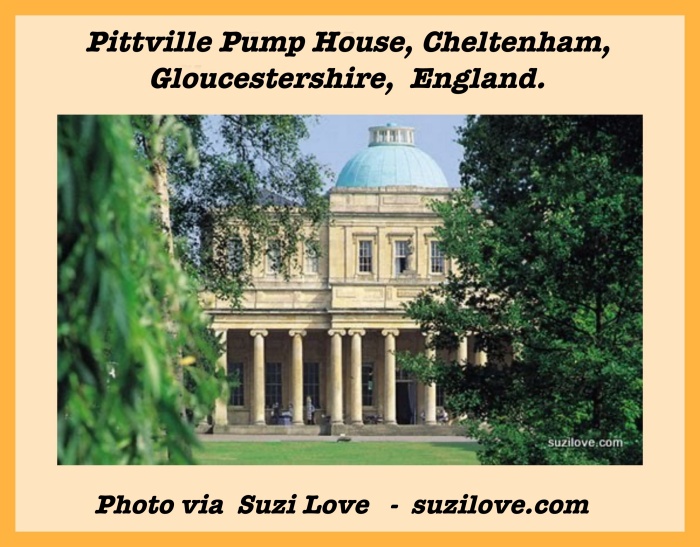


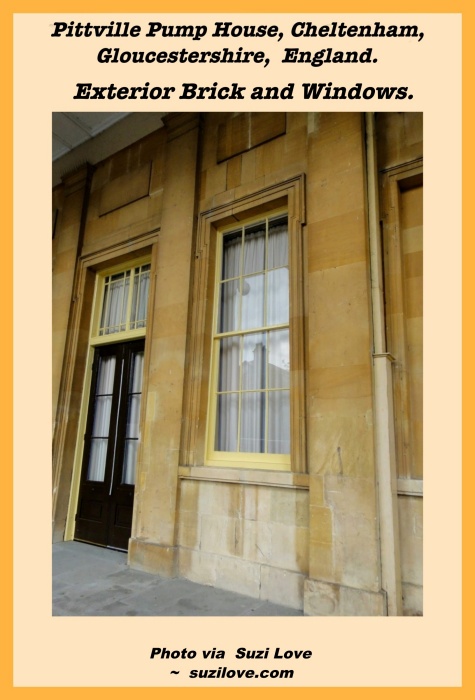
Building the Pump Room: The total cost of the project was over £40,000, and incredible price for that time. Like many bankers of his time, Pitt ran into financial difficulties, the building went out of favour and was sold in 1890 to the Borough of Cheltenham for £5,400, a fraction of the original cost. The building is decorated in Ionic style and the great hail reflects the genius of John Forbes with the spa opening on the north side and the gallery and dome surmounting the hall.
The grand building is 92 feet long by 43 feet, surrounded by a colonnade 13 feet wide the roof of which are supported by fluted Ionic columns 22 feet high. Along the facade stand three figures representing Aesculapius, Hygeia and Hippocrates, originally made by Lucius Gahagan of Bath. In its design, the building combines elements of both Greek and Roman architecture. It was modelled on the temple on Illisus in Athens, the engravings of which appeared in Stuart and Revett’s Antiquities of Athens (1762).
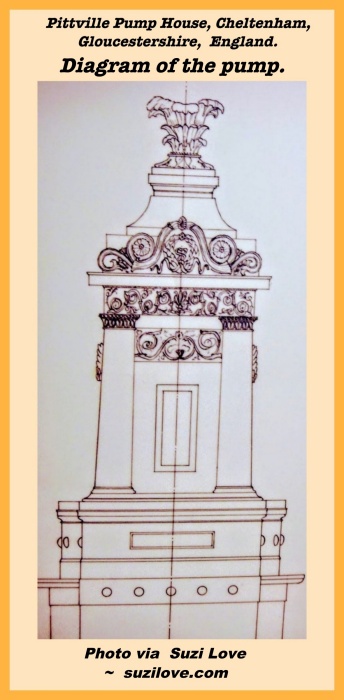
The inspiration for the dome probably came from the Panthenon in Rome. A large ballroom was situated on the ground floor where even today visitors can attend music concerts, dances and other events. With a capacity of 400 and remarkable acoustics, it is Cheltenham’s finest concert venue. The spa with an oval pump room to the rear of the building are still there for the visitors to enjoy, available from a marbled pump and counter. A reading room, library and billiard room occupied the first floor.




Fashion History: “Cheltenham will be the summer village of all that is fashionable and all that is dignified; the residence of the royal ” family being a thing quite new so far from the metropolis . Already we hear of nothing but Cheltenham modes — the Cheltenham cap — the Cheltenham bonnets — the Cheltenham buttons — the Cheltenham buckles , in short all the fashions are completely Cheltenhamized throughout Great Britain.” via 1826 Griffith’s New Historical Description of Cheltenham and Its Vicinity.
Second World War: The Pump Room housed British and American army personnel, when dry rot was allowed to creep through the structure unchecked, and only after the war was the full extent of the damage revealed. Plaster, brickwork, timber: nearly everything had been affected. The dome was only held in position by a shell of plaster; the timber had been eaten away by the fungus.
The Duke of Wellington: Public subscriptions carne to the rescue, which were accompanied by Public Works grants and Historic Building Council contributions. A total of £43,250 was raised and by 1960 the building was partially restored to its former glory and reopened in 1960 by the Duke of Wellington. The old card room had been replaced by a new foyer, cloakrooms and second staircase, and heating and new lighting were in stalled.
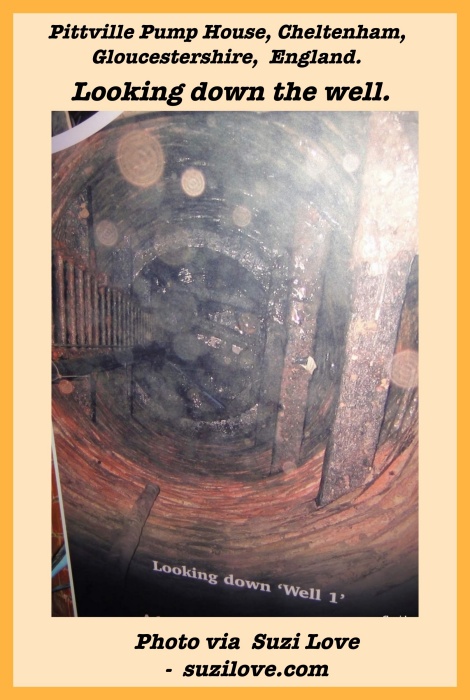
Recent History: In 2003, the old Victorian wells were leaking and allowing ground water to dilute the natural mineral water so Pittville Pump Room no longer qualified as a spa and the well was shut down. The spa was then repaired and reopened so visitors can taste the only alkaline spa water in the country. The Pump Room’s old maple-strip floor was replaced with a stunning English oak floor, better flooring found for the ball room, and old pipes replaced. Nowadays the Pittville Pump Room is in use most days of the year for private and public functions and is one of Cheltenham’s most popular wedding venues. The venue is also used frequently by orchestras, choirs and chamber groups because it has stunning acoustics.

1725-1730 ca. Gold Double-Opening Snuffbox, France. Two tortoiseshell pique panels and two miniatures inside, of Louis XV of France and his wife Marie Leczinska. Made by Jean Baptiste Massé, painter.
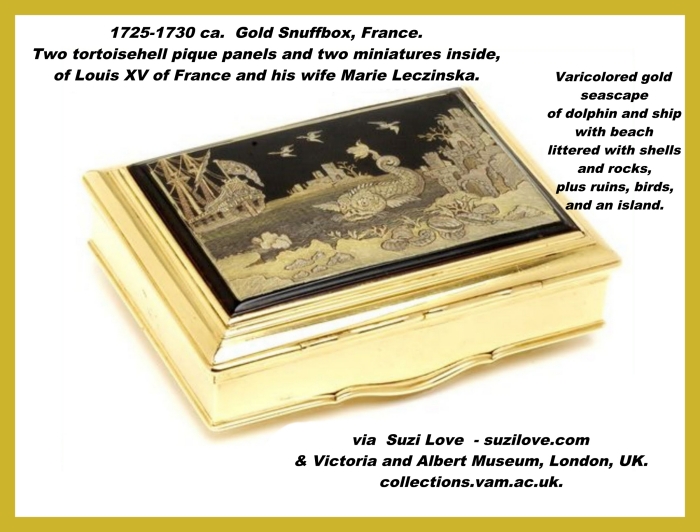
Varicolored gold seascape of dolphin and ship with beach littered with shells and rocks, plus ruins, birds,
and an island. Inside the box are miniature portraits of Louis XV of France and his wife Marie Leczinska. It has been suggested that the box commemorates the birth of the ‘dauphin’ Louis in 1729, the royal couple’s fourth child, and first son, heir to the throne. A few elements contradict this suggestion: the dolphin does not bear any regal symbol such as a crown, the marks that date the box indicate that it was initiated before the birth of Louis, when the arrival of a son was unknown.
It is most probable that these delicate panels, together with the miniature of Louis XV, date from 1725-1730 and have been associated later into this gold snuffbox, and a later miniature of Queen Marie Leczinska.The miniature of the king may have been painted by Jean-Baptiste Massé – he is recorded as supplying miniatures of the king for boxes intended as diplomatic gifts from 1720-26-, or by his lesser known contemporary Jean-Baptiste Ducanel.
The lid is hinged to reveal a miniature, under glass, of Marie Leczinska, queen of France, probably 19th century or heavily restored, wearing a cloak of blue embroidered with gold fleurs-de-lis and lined with ermine overa lace-trimmed dress of red embroidered with gold. In the base is a panel of tortoiseshell pique with a cornucopia of small shells, also hinged to reveal a contemporary miniature of Louis XV of France in armour, wearing a whitestock and the sash of the Order of the Holy Ghost. The gold box, probably early 19th century or later, has plain walls, reeded borders, and a double thumbpiece.
Sir Arthur Gilbert and his wife Rosalinde formed one of the world’s great decorative art collections, including silver, mosaics, enamelled portrait miniatures and gold boxes. Arthur Gilbert donated his extraordinary collection to Britain in 1996.
via Victoria and Albert Museum, London, UK. collections.vam.ac.uk.
Snuff Boxes: Decorative boxes of all types were prized, especially in the 18th Century when everything decorative and extravagant was in vogue and taking a pinch of snuff was fashionable. Snuff is made from ground or pulverized tobacco leaves, flavorings added, and then a pinch of snuff is placed on the back of the hand and sniffed.