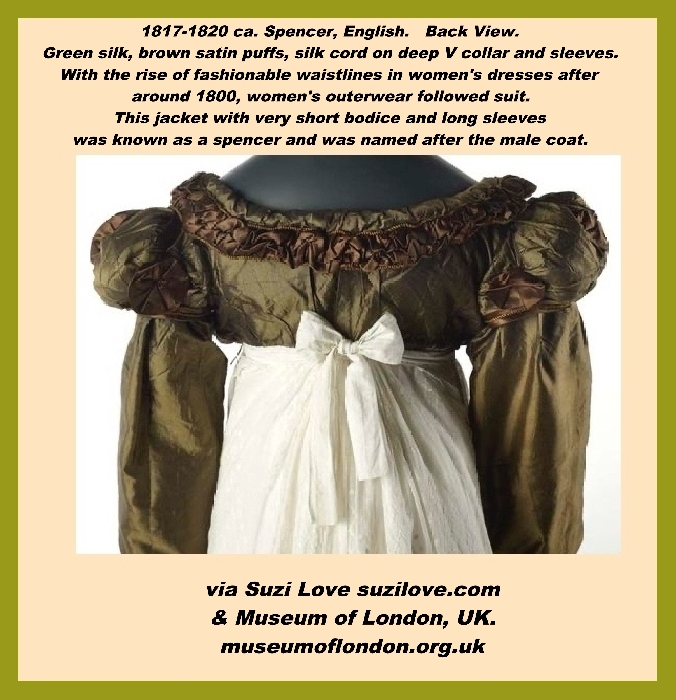
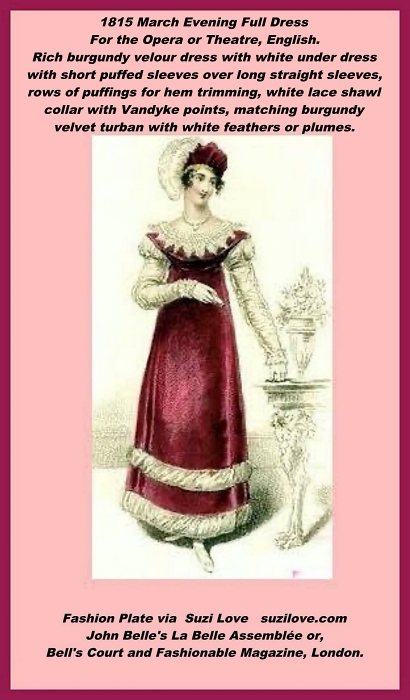
1818-1820 ca. Gold Redingote, French. Gorgeous Regency Fashion French Redingote of gold silk with the same fabric used to create a trailing pattern down the bodice and front opening. Short puffed sleeves over long straight sleeves in a leg-of-mutton style. via Metropolitan Museum, New York City. metmuseum.org
1818 Brown Silk Dress, English. Regency Fashion. Empire style, high-waisted dress with long sleeves, and with dark brown velour trim on the square neckline and hem. via The Metropolitan Museum, New York City, USA. metmuseum.org
Definition Empire Style Dress: Named after the First Empire in France. Empire dresses had a low neckline and skirts started directly under the bust and flowed into the classical relaxed wide styles of Greece and Rome. This style of dress is associated with Jane Austen and her contemporaries as a high-waisted dress was worn most days. Cotton, silk or taffeta were the popular fabrics. Only the very wealthy could afford white dress in this style as the cottons were imported from India and had to be carefully cleaned, usually by a lady’s maid.
1818 Brown Silk Dress, English, As Worn By the Bridgertons. #Bridgerton #RegencyFashion #HistoricalFashion #metmuseum books2read.com/SuziLoveFashionWomen1815-1819 Share on X Fashion Women 1815-1819 History Notes Book 28
What did Jane Austen wear? This book looks at what was fashionable for women in the Georgian Era and at the end of the Regency Era in Britain and the reconstruction in Europe after the wars. Lifestyles were freer and fashions expressed this by becoming the focus of most women’s lives. A wardrobe full of opulent accessories was requisite. Includes mourning and riding fashion, dresses, hats, shoes, reticules or bags, underclothing, and fashion accessories.
D2D_HN_28_https://books2read.com/SuziLoveFashionWomen1815-1819
Typical of the type of outfit a gentleman in the Georgian Era would wear to a wedding or important event. The jacket flares from the waist into multiple folds to give easier movement and the front has a long line of matching buttons. The breeches have a buttoning front flap. Part of the costume collection at Ham House, Surrey, UK. Part of the National Trust, UK. nationaltrustimages.org.uk
Between 1820 and 1840 textile printers began to produce designs that were based on the woven silk dress fabrics of the 1750’s. Designs showing curving trails of lace or ribbons between bouquets of flowers became as popular in the 1830s as they had been in the 18th century.
Roller Printed Cotton.
The pattern on printed cotton was made with an engraved metal roller and additional colors were built up by wooden surface roller. Roller printing on textiles was introduced in the late 18th century and at first used mainly for small-patterned dress fabrics. By the 1830s, roller printing was highly mechanized process and had largely replaced block printing for fashionable furnishings.
Materials and Making The development of roller printing coincided with a radical transformation in the dyestuffs available for printing on cotton. Until the beginning of the 19th century printing had been based on the use of vegetable dyes. In Britain, France and Germany new chemical processes were developed and mineral colors produced that transformed the palette of colors available to the printer and made combinations such as shades of pink and orange possible.
Design and Designing The false trails of lace and bouquets of flowers in the fabric are inspired by the patterns of woven silks from nearly a century earlier. Changing taste made this design suitable for furnishing a room in the 1830s, while the 18th-century silk that was its inspiration would have been intended for a woman’s gown.
Time The styles considered fashionable in 1830s furnishings were widely diverse. Among the more recognisable historical references were Rococo, Elizabethan and Gothic. A design such as this seems to be relying on novelty of effect for its success.
1818 High-waisted Promenade Dress, English. White dress with multiple layers of lace from hem upwards. Narrow striped scarf of bright colors, large brimmed hat decorated with flowers and a pink parasol. Fashion Plate via John Belle’s La Belle Assemblée or, Bell’s Court and Fashionable Magazine, London.
Definition Empire Style Dress: High-waisted white gown defined women’s fashion during the Regency Era. ‘Empire’ is the name given to the period when Napoleon Bonaparte built his French Empire. High-waisted, loose gowns were adopted by the aristocracy as a symbol of turning away from the fussy, elaborate and expensive clothing worn in the 1700s.
1860 Corset, American. Cotton, metal, and bone. Manufacturer: Langdon Batcheller and Company, A1851-1860 ca. Blue Ribbed Silk Corset, English. Front and Back. Front hooks and back lacing. via Museum of London, UK. museumoflondon.org.uk
1807 Cotton Linen Shirt, British. Non-regulation shirt worn under uniform. High collar to allow room for a stock, fullness and pleated sleeves enable wearer to fit into tight arms popular in coats. The men in Jane Austen’s life would have worn a shirt like this, especially if they were in the military as many men were during the Napoleonic Wars. via Royal Museums Greenwich collections.rmg.co.uk
1804–1805 ca. Evening Dress, French. Narrow white dress of sheer cotton mull, probably from India, and with sheer short sleeves, extra wide neckline, vertical white embroidery which was very fashionable at the time. The cotton fabric was probably imported from India already embroidered with heavy white cotton thread in transparent mull. At the beginning of the nineteenth century, this sort of dress was considered shocking and immodest after the wider hooped dresses of the eighteenth century. This style of dress was worn by most women in Jane Austen’s time, but only the wealthy could afford the best quality mull. Vertical white embroidery was very fashionable in the early 1800s, with the sheer cotton mull probably imported from India already embroidered with this heavy white cotton thread. These daring items of clothing copied the Grecian idea of loosely draped clothing and were the first of many changes to women’s outfits. Heavy fabrics were abandoned, especially in summer, in favor of lighter materials that allowed women to move about easier.
From the museum curator: “On December 24, 1803, Jerome Bonaparte (1784—1860), brother of Napoleon, wed Elizabeth Patterson (1785—1879) of Baltimore. The beautiful and fashionable young American was married in a dress of muslin and lace that, according to a contemporary, “would fit easily into a gentleman’s pocket.” Although originally thought to have been Patterson’s wedding dress, the formal gown illustrated here probably dates from 1804, when this type of vertical white embroidery became fashionable. Napoleon had the marriage annulled in 1805. Jerome was made king of Westphalia in 1807 and he married the princess of Wurttemberg. Elizabeth, banned from France by the emperor, remained in Baltimore with her son, Jerome Napoleon Bonaparte (1805—1870). Metropolitan Museum, New York City, USA.
1818 August English dinner Dress. White high-waisted, loose and flowing dress, multiple layers of frill and blue hem decoration, shawl collar, blue and white scarf and high flowered bonnet. Fashion Plate John Belle’s La Belle Assemblée or, Bell’s Court and Fashionable Magazine, London.
1795-1805 ca. Evening Dress, Spain. Batiste, embroidered with sequins and floral theme. Via Museum Collections in Spain. ceres.mcu.es
The Empire styles at the beginning of the 19th century were made of a soft, lightweight fabric gathered just under the breasts. It featured a low square neckline, and small, short, puffed sleeves with a low shoulder line. Although lawn and batiste were used, muslin was the fabric of choice as it was easy to clean. The thin muslin clung close to the body and emulated styles worn in ancient Greece. Shades of white predominated, with the addition of pale pastel shades worn for day wear.
Definition Batiste: Soft, sheer, cotton or linen fabric in white and delicate colors, used for handkerchiefs, nightwear and neckwear. Probably named for its inventor, Jean Baptiste, of Cambrai.