1805 January Two Ladies In White Paris Dresses, English. Two interesting bodices, long gloves, necklaces, shawl, fan and adorable hats. Fashion Plate via The Lady’s Magazine Or Entertaining Companion for the Fair Sex, London. These are the types of outfits worn by Jane Austen and contemporaries and were seen in English magazines, where French fashions were obsessively copied despite the two countries being at war for many years.
1806 Young French Gentleman. Brown Castorine Coat Over Blue Tailcoat, French. White cashmere breeches, white stockings, yellow gloves, black hat and a cane. Fashion Plate via Journal des Dames et des Modes, or Costume Parisien.
French fashions and Georgian and Regency Era fashions from Great Britain were copied around the world. This is the normal daily outfit for a gentleman in the early 1800s, or in the times of Jane Austen, for daily city and country life.
Le Beau Monde magazine made suggestions for men’s fashion in November 1806.
“The neckcloth should, by no means, be too greatly puffed out; but should be neatly united in front with a large unspread bow. Dark bottle green coats will be as generally worn this season, as those of brown colours were last winter.
“For morning dress frock coats will be prevalent: those of an olive hue, with a black velvet collar, will be the most universal. Fancied waistcoats of all manufactures may be worn with this kind of coat; but fashion ordains the invariable use of dark blue or light-coloured kerseymere pantaloons, and half-boots. The boots must rise somewhat higher in the leg than has recently been the custom, and the toes of them should be formed into a perfect semi-cirlce.
“Full dress coats will likewise be made of dark green cloth, double-breasted, and will possess the similar ornament of a black velvet collar. Single-breasted white waistcoats, and light-coloured kerseymere breeches will be in much estimation. Either flesh-coloured or now-white silk stockings fashion now considered as elegant.
“The hair, for morning dress, should be cut à la Titus; for full dress, it should be powdered. Buckles for the shoes are employed in full dress; but ribbands are allowed in afternoon or dinner dress.”
1819 White Dress With Short Sleeves, English. Styled after the Court of France. Yellow skirt with long train decorated with flowers. Flowered headdress, long white gloves, necklace.Fashion Plate via John Belle’s La Belle Assemblée or, Bell’s Court and Fashionable Magazine, London.
1819 White Dress With Short Sleeves Styled after the Court of France.#RegencyEra #JaneAusten #Fashion https://books2read.com/SuziLoveFashionWomen1815-1819
Fashion Women 1815-1819 History Notes Book 28 https://books2read.com/SuziLoveFashionWomen1815-1819
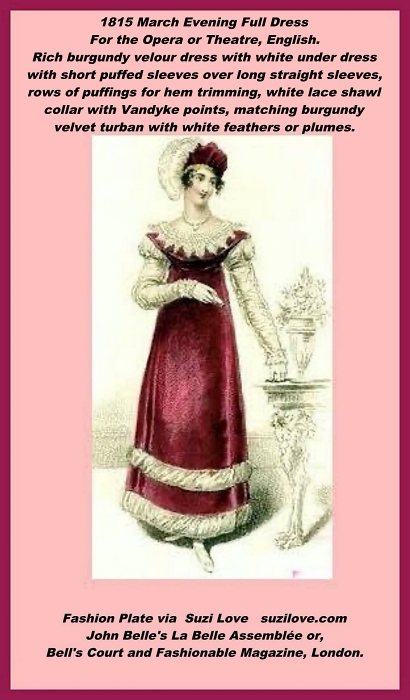
1815 March Evening Full Dress For the Opera or Theatre, English. Rich burgundy velour dress with white under dress with short puffed sleeves over long straight sleeves, rows of puffings for hem trimming, white lace shawl collar with Vandyke points, matching burgundy velvet turban with white feathers or plumes. Fashion Plate via John Belle’s La Belle Assemblée or, Bell’s Court and Fashionable Magazine, London. Definition Van Dyke Points: V-shaped lace and trims named after a 17th Century Flemish painter, Sir Anthony Van Dyck, known for painting V-shaped lace collars and scalloped edges on sitters.
Definition Evening Dress: There were minute distinctions between ball, dinner, evening and opera gowns meant different quality of fabrics and designs. A Ball Gown differed from an evening dress as expensive silk fabrics were usually worn, light or heavy, decorated with lace, embroidery or beading, with low-cut bodice, short or no sleeves, and full skirts. In the early 1800s, white cotton dresses were considered suitable for many evening events, but not for balls. And definitely not for an evening event in a palace or at the opera or theatre.
Dress Full Dress: The most formal and complete ensemble, worn for day or night events, and includes the fullest range of accessories that could be added to the outfit to make the most impressive display.
1815 March Evening Full Dress For the Opera or Theatre, English. Rich burgundy velour dress with white under dress with short puffed sleeves. Fashion Plate via John Belle’s La Belle Assemblée or, Bell’s Court and Fashionable Magazine, London. 1815 March Evening Full Dress For the Opera or Theatre With Vandyke Points. #Regency #JaneAusten #Fashion. https://books2read.com/SuziLoveFashionWomen1815-1819 Share on X Fashion Women 1815-1819 History Notes Book 28 What did Jane Austen wear? This book looks at what was fashionable for women in the Georgian Era and at the end of the Regency Era in Britain and the reconstruction in Europe after the wars. Lifestyles were freer and fashions expressed this by becoming the focus of most women’s lives. A wardrobe full of opulent accessories was requisite. Includes mourning and riding fashion, dresses, hats, shoes, reticules or bags, underclothing, and fashion accessories.
What did Jane Austen and friends wear? Early 1800s fashions were elegant and pretty with high waists and fabrics that were almost transparent. These Empire style gowns, named after Napoleon’s first Empress, became popular throughout Europe, and were then copied around the world. Colorful outwear was added to make an ensemble more attractive and warmer. History Notes Book 26 Fashion Women 1805-1809. https://books2read.com/SuziLoveFashionWomen1805-1809
Are you a reader or writer of Regency Romance? Love Jane Austen and the Bridgertons? Want to know more about the mourning, riding, underclothing and other Regency Era women’s fashions in Regency romances? What was fashionable for women in Jane Austen’s times? Mourning, riding, daytime, evening clothing, plus underclothing, corsets and accessories. This book looks at what was fashionable for women in Jane Austen’s times, or the early 1800s, or the Regency Era in Britain. Wars were being fought around the globe so women’s fashion adopted a military look in support of soldiers. Fashions, like the lifestyle, became progressively more extravagant and accessories went from colorful to over-the-top.
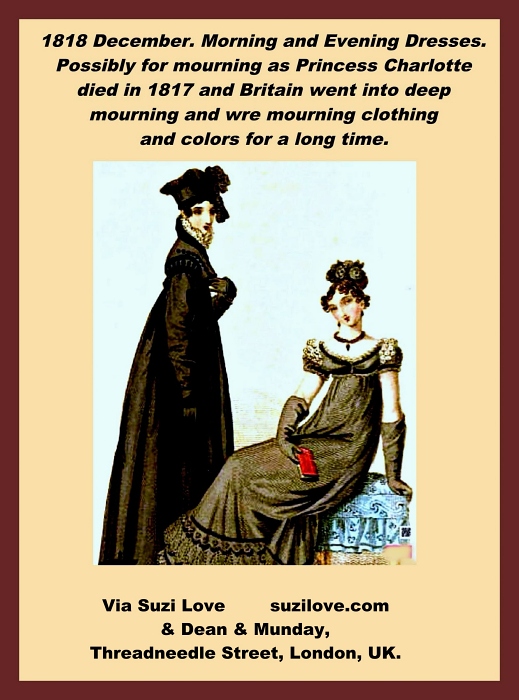
1818 December Morning and Evening Dresses, possibly for mourning as Princess Charlotte died in 1817. Published by Dean and Munday, Threadneedle Street, London, U.K.
Walking Dress is a plain high dress of black bombazine with long sleeves. Skirt trimmed on hem with a broad bias piece of black crape with narrow puffing of black crape. Sleeve hem has three narrow puffings of black crape. Fastens in front and ornamented on the bust with black crape, no collar but a very full mourning ruff of clear muslin. Over this dress is a Spanish coat of fine black Merino, cut tight to the body, short in the waist and trimmed with a row of black buttons on each side of the bust. Black velvet collar is finished round the edge with black crape, long sleeves of an easy fullness and trimmed at the wrist the same as the collar. Very tasteful epaulette is a mixture of black velvet and crape. Skirt is slightly full, trimmed up the fronts and round the hem with a broad band of black velvet, edged on each side by narrow rouleaux of black crape.
Dinner Dress is of black crape over a black sarsnet slip with a gored skirt, trimmed on the hem with black crape flounces, lower very narrow and higher considerably broader and surmounted by another narrow one. They are scalloped and finished at the edge by black satin, narrow rouleau of the same material heads top and bottom flounce. Corsage of black satin cut very low round the bust and waist and bust finished French style with points of black crape. Short full sleeve of black satin with three falls of black crape on the shoulder. Via Lady’s Monthly Museum ~ Dean & Mundy, Threadneedle Street, London, UK.
1818 December Morning and Evening Dresses, possibly for mourning as Princess Charlotte died in 1817. Published by Dean and Munday, Threadneedle Street, London, U.K.
1823 Couple In Evening Costumes, French. Short length dancing dress of white gauze, short sleeves, pink ribbon trim, flowers, parure, or jewelry set, dancing shoes and hair in a bandeau. Man in half dress of black tailcoat, yellow vest, short length white trousers, high white cravat, blue fob, and curled hair style. via Modes Francaises L’Indiscreet, France.
1823 Couple In Evening Costumes, French. Short length dancing dress of white gauze, short sleeves, pink ribbon trim, flowers, parure, or jewelry set, dancing shoes and hair in a bandeau. Man in half dress of black tailcoat, yellow vest, short length white trousers, high white
cravat, blue fob, and curled hair style. via Modes Francaises L’Indiscreet, France.
From the finish of the 18th century until 1820, men’s fashions in European and European-influenced countries moved away from the formal wear of brocades, lace, wigs and powder to more informal and relaxed styles. Focus was on undress rather than formal dress. Typical menswear in the early 1800s included a tailcoat, a vest or waistcoat, either breeches, pants, or the newer trousers, stockings, shoes or boots, all worn with an overcoat and hat. This basic ensemble was accessorized with some form of neckcloth or cravat, gloves, walking stick, cane or riding crop, handkerchief, fobs, watch and perhaps a quizzing glass or eye glass.
Skirted coats were replaced with short-fronted, or cutaway, tailcoats worn over fitted waistcoats and plain, white linen shirts. Knee breeches were gradually replaced by tight-fitting pantaloons and later trousers, decorative shoes with buckles were replaced with a variety of boot styles, and fussy and ruffled neckwear gave way to intricately tied, white linen neck cloths. A Regency Era, or early 1800s, gentleman was outfitted in more practical fabrics, such as wool, cotton and buckskin rather than the fussy brocades and silks of the late 1700s.
1818 January Fancy Mourning Dishabille. A lady reading a pink book while wearing Dishabille, or morning dress, though as this labeled ‘Fancy’, it was most likely more formal than any normal At-Home morning dress. Dress of crepe with a lavishly decorated hem, worn over a white cambric Spencer, ornamented with fine muslin, embroidered at the edge with black, finished at neck with a triple ruff of muslin, tied in front with black love. Black sarsnet French apron, edged round with a newly invented trimming of black love. Cornette, or hat, of fine muslin, crowned with a garland of black flowers. Black chamois slippers. Fashion Plate via John Belle’s La Belle Assemblée or, Bell’s Court and Fashionable Magazine, London. The magazine’s General Observations on Fashion and Dress tries to explain why the outfit is labeled ‘Fancy’, ‘However little versatility can possibly be attached to the sable garment of sorrow, yet the Print we have presented to our readers representing the home costume of a lady of high fashion, will prove to them how busy Fancy is in her endeavors to throw a changeful hue over the tinct of solid black.’
I can picture Jane Austen and her female friends and family wearing this sort of dress if they were in half-mourning yet wanted to look fashionable. .
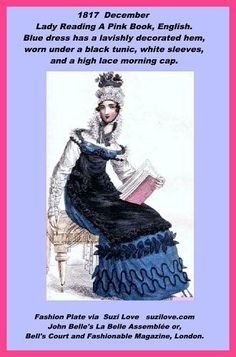
1817 December Lady Reading A Pink Book. Blue dress with a lavishly decorated hem, worn under a black tunic, white sleeves and a high lace morning cap. Fashion Plate via John Belle’s La Belle Assemblée or, Bell’s Court and Fashionable Magazine, London.