1825 Brown stays with center front busk, back lacing, hip shaping, breast gussets, widely spaced straps, cotton embroidered in ivory silks with hearts. via Kerry Taylor Auctions. kerrytaylorauctions.com https://books2read.com/SuziLoveCorsetBook17
The main purpose of corsets was to support and shape the breasts. Though they still slimmed the midriff, this was not the prime purpose of a corset in the 1820s. The waistline of dresses had lowered to below the bust line and nearer to the true waist so corsets were longer and were given added shaping by stitching and cording and by shaping the breasts with pleated or gathered cups.
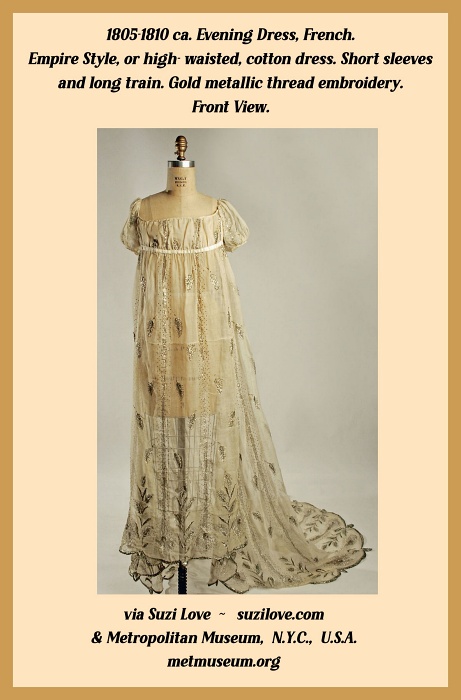
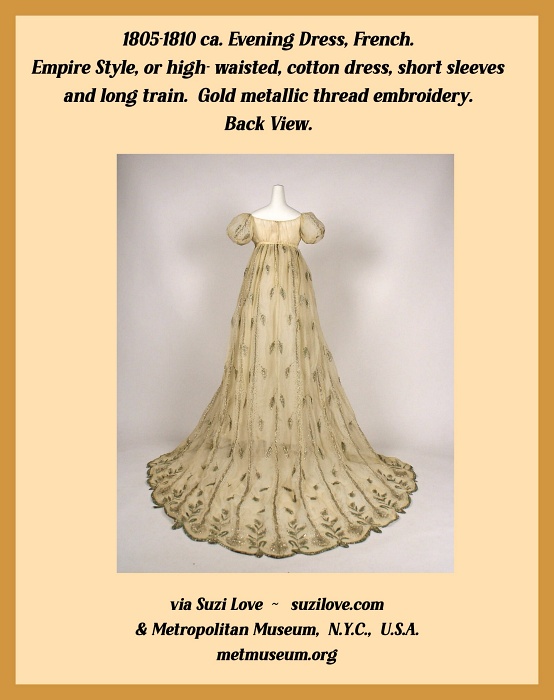
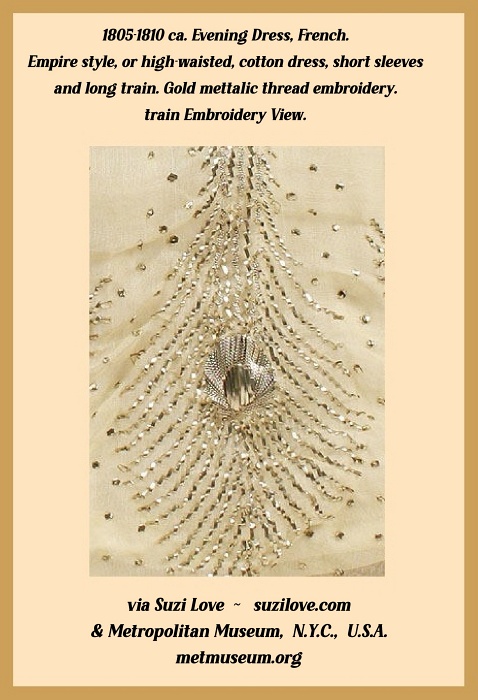
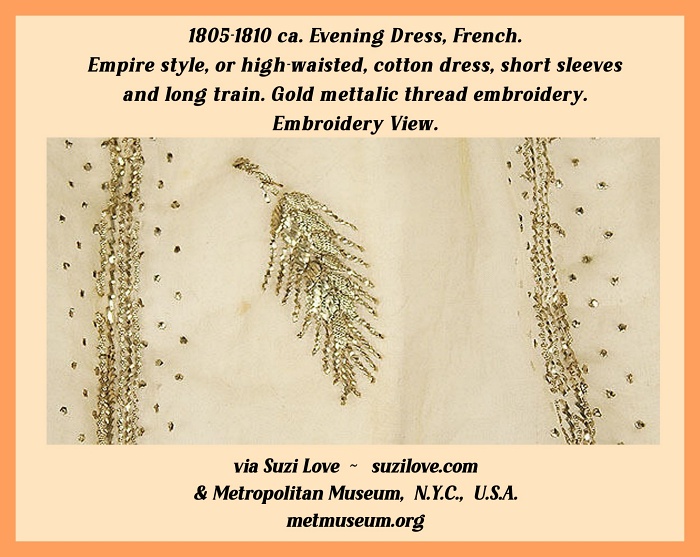
1805-1810 ca. Evening Dress, French. Empire style, or high-waisted, cotton dress, short sleeves and long train. Gold metallic thread embroidery. via Metropolitan Museum, N.Y.C., U.S.A.
1805-1810 ca. Front Evening Dress, French. Empire style, or high-waisted, cotton dress, short sleeves
and long train. Gold metallic thread embroidery. via Suzi Love ~ suzilove.com
& Metropolitan Museum, N.Y.C., U.S.A. metmuseum.org1805-1810 ca. Back Evening Dress, French. Empire style, or high-waisted, cotton dress, short sleeves
and long train. Gold metallic thread embroidery. via Suzi Love ~ suzilove.com
& Metropolitan Museum, N.Y.C., U.S.A. metmuseum.org1805-1810 ca. Side Evening Dress, French. Empire style, or high-waisted, cotton dress, short sleeves
and long train. Gold metallic thread embroidery. via Suzi Love ~ suzilove.com
& Metropolitan Museum, N.Y.C., U.S.A. metmuseum.org1805-1810 ca. Train Evening Dress, French. Empire style, or high-waisted, cotton dress, short sleeves
and long train. Gold metallic thread embroidery. via Suzi Love ~ suzilove.com
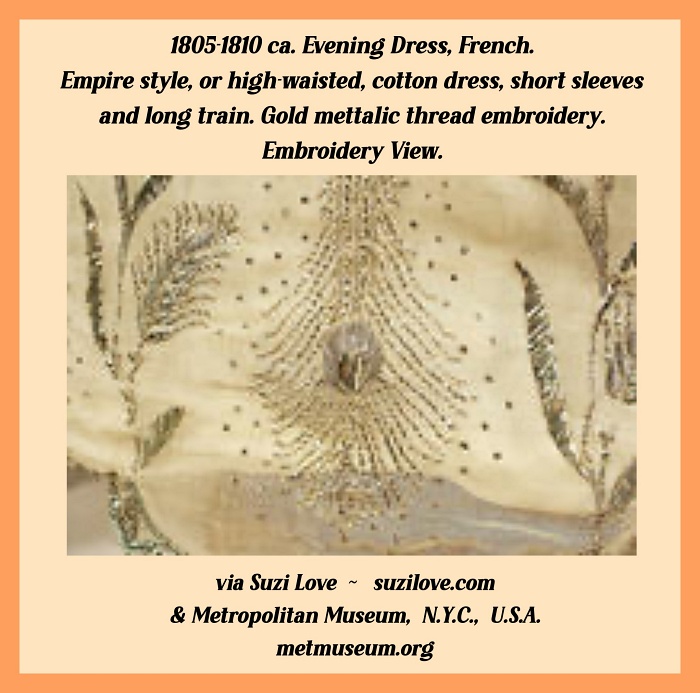
& Metropolitan Museum, N.Y.C., U.S.A. metmuseum.org1805-1810 ca. Embroidery Evening Dress, French. Empire style, or high-waisted, cotton dress, short sleeves
and long train. Gold metallic thread embroidery. via Suzi Love ~ suzilove.com
& Metropolitan Museum, N.Y.C., U.S.A. metmuseum.org1805-1810 ca. Embroidery. Evening Dress, French. Empire style, or high-waisted, cotton dress, short sleeves
and long train. Gold metallic thread embroidery. via Suzi Love ~ suzilove.com
& Metropolitan Museum, N.Y.C., U.S.A. metmuseum.org1805-1810 ca. Embroidery. Evening Dress, French. Empire style, or high-waisted, cotton dress, short sleeves
and long train. Gold metallic thread embroidery. via Suzi Love ~ suzilove.com
& Metropolitan Museum, N.Y.C., U.S.A. metmuseum.org1805-1810 ca. Embroidery Evening Dress, French. Empire style, or high-waisted, cotton dress, short sleeves
and long train. Gold metallic thread embroidery. via Suzi Love ~ suzilove.com
& Metropolitan Museum, N.Y.C., U.S.A. metmuseum.org1805-1810 ca. Embroidery. Evening Dress, French. Empire style, or high-waisted, cotton dress, short sleeves
and long train. Gold metallic thread embroidery. via Suzi Love ~ suzilove.com
& Metropolitan Museum, N.Y.C., U.S.A. metmuseum.org Fashion Women 1805-1809 History Notes Book 26 What did Jane Austen and friends wear? https://books2read.com/SuziLoveFashionWomen1805-1809
1804 London Hairstyles, Gorgeous Gold Hats. via Fashion Plate via Fashions of London and Paris, Published By Richard Phillips, St. Paul’s Church Yard, London, UK. These styles of hats and hairstyles would have been worn by Jane Austen and her contemporaries as hats were an essential fashion item during the Regency years.
1804 London Hairstyles, Gorgeous Gold Hats. via Fashion Plate via Fashions of London and Paris,
Published By Richard Phillips,
St. Paul’s Church Yard, London, UK.25_D2D_Corset_1790-1810
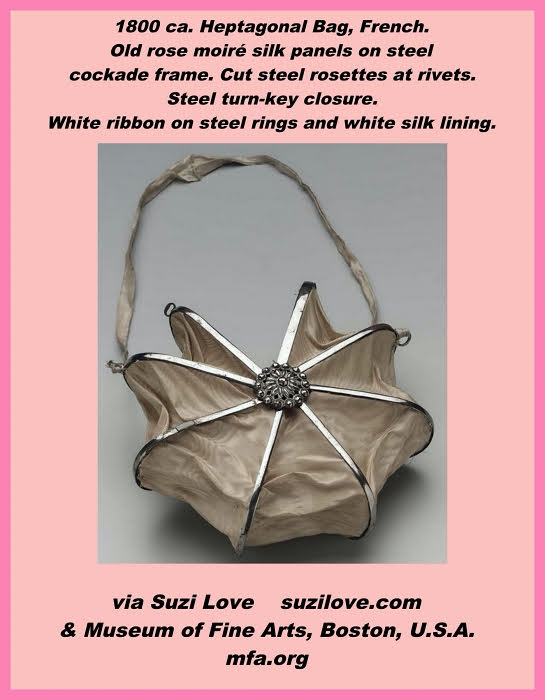
1800 ca. Heptagonal Bag, French. Old rose moiré silk panels on steel cockade frame. Cut steel rosettes at rivets. Steel turn-key closure. White ribbon on steel rings. White silk lining. Credit: The Elizabeth Day McCormick Collection via Museum of Fine Arts, Boston, U.S.A. mfa.org
Reticule Or Bag: As the silhouette of dresses became more form fitting and fabrics lighter and more transparent, pockets could no longer be hidden in the folds of skirts or underwear. Something else was needed to hold a lady’s essentials. Small purses, like men’s money pouches, were used by women to carry money for gambling, sewing necessities, and women’s daily requirements such as combs. A bag or purse, often with a drawstring to pull closed and usually made of cloth or covered cardboard and often decorated with beading or embroidery was called a reticule, or ridicule. They came in a variety of shapes, sizes, and materials. Jane Austen and her contemporaries would have purchased or hand made reticules, or bags, for each other for gifts and carried them with them whenever they went out.
1800 ca. Heptagonal Bag, French. Old rose moiré silk panels on steel cockade frame. Cut steel rosettes at rivets. Steel turn-key closure. White ribbon on steel rings. White silk lining. Credit: The Elizabeth Day McCormick Collection via Museum of Fine Arts, Boston, U.S.A. mfa.org
1800 ca. Heptagonal Bag Of Old Rose Moiré Silk Panels With A Steel Turn-Key Closure. #JaneAusten #France #Reticule books2read.com/suziloveReticules
1715-1775 ca. Flat Drawstring Bag, French. Strung glass beads, or sablé, held together by looping stitches. Polychrome Rococo design on white ground, shepherd, shepherdess, four sheep around orange tree center, border with cornucopias and flowers. Ecru silk cord drawstrings with floral bead-covered wood tassels. Blue silk lining. via Museum of Fine Arts, Boston.
1820-1850 ca. Cotton and Beadwork Reticule Or Bag, Dutch. Couple on shore, man in boat, house and windmill behind, musicians, dancers, onlookers. Yellow metallic frame and green braided silk cord. Beadwork on cotton foundation. Polychrome design: couple on shore, man in boat, house and windmill behind (obv.); musicians, dancers, onlookers (rev.); acanthus motif at base. Yellow metallic frame with dotted design, stud closure, green braided silk cord. Ecru silk lining. via Museum of Fine Arts, Boston, U.S.A. mfa.org
Definition Reticule Or Bag or Purse: Often with a drawstring to pull closed and usually made of cloth or covered cardboard and often decorated with beading or embroidery. A reticule, or purse, or handbag, was usually carried by a woman during the Regency period to carry all their daily necessities. Earlier, women used pockets that tied at the waistline and were hidden in the folds of their skirts. Empire style, or early 1800s, high-waisted dresses made it impossible to either sewn in a pocket or to tie on a pocket. So women began carrying small, decorated bags called Reticules, or ridicules, which generally pulled close at the top with a drawstring.
1820-1850 ca. Cotton and Beadwork Reticule Or Bag, Dutch. Couple on shore, man in boat, house and windmill behind, musicians, dancers, onlookers. Yellow metallic frame and green braided silk cord. via Museum of Fine Arts, Boston, U.S.A. mfa.org
1820-1850 ca. Cotton and Beadwork Reticule Or Bag, With Couple on Shore, Dutch. #holland #sewing #Reticule #RegencyEra #RomanticEra #HistoricalFashion #Antiques http://books2read.com/suziloveReticules
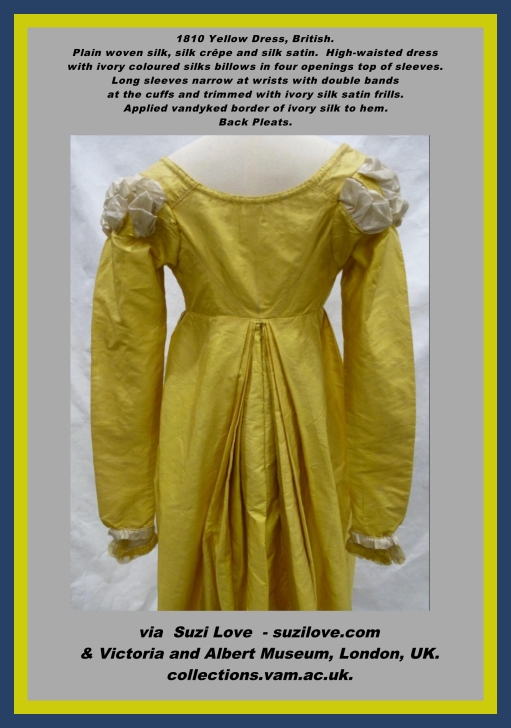
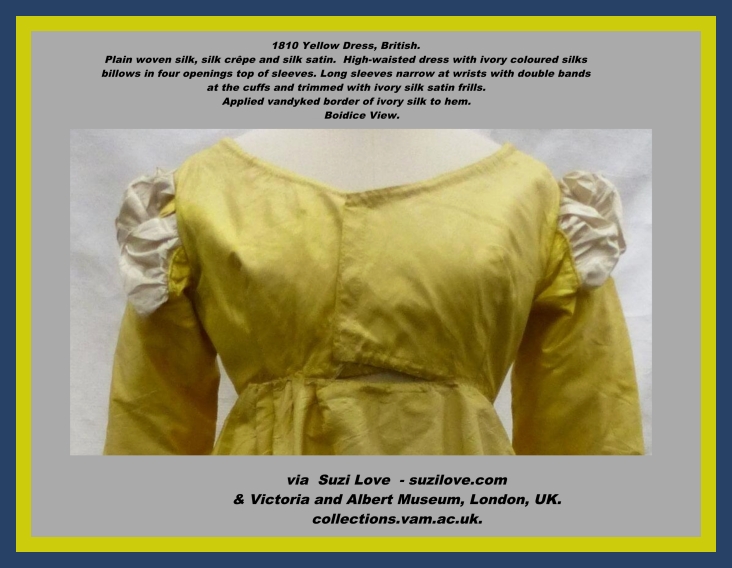
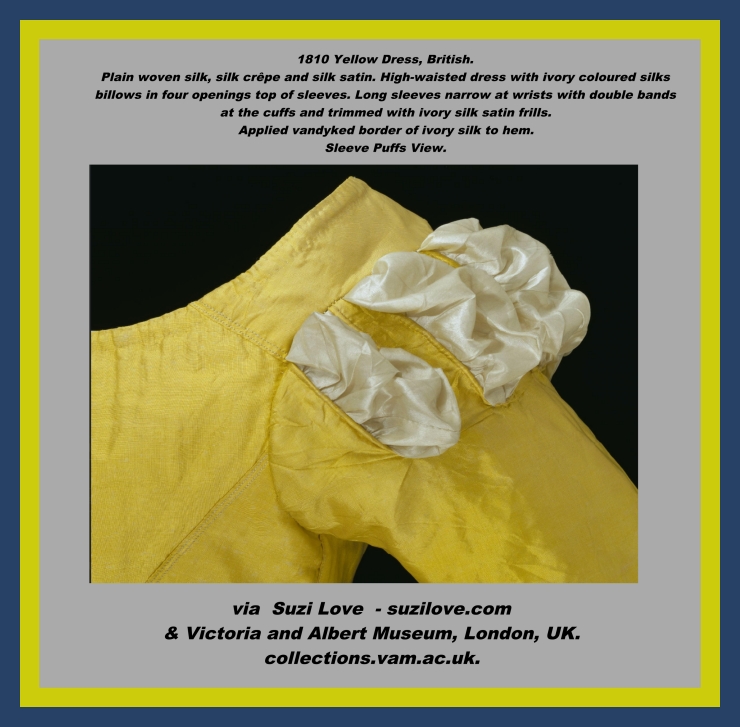
1810 Yellow Dress, British. Plain woven silk, silk crêpe and silk satin. High-waisted dress of yellow silk, ivory colored silks billow out of four openings at sleeve tops. The puffed trimmings are inspired by the fashionable slashing of garments in the Renaissance period when the top fabric was cut to reveal a colored lining or garment worn underneath. A long rectangular strip of ivory silk on inside of sleeve head and excess gathered into pudds through openings. The 19th-century version of slashing is much more controlled by cut, stitching and piped edges, rather than the raw cuts in fabric seen in the 16th century.
Long sleeves narrow at wrists with double bands at cuffs and trimmed with ivory silk satin frills, yellow silk crêpe, cream ribbon and cording. Trimming around lower hem of skirt of applied vandyked border of ivory silk. Length center back neckline to hem of train length: 158cm Front length shoulder to hem length: 139cm
1810_YellowSilkDressBritish_Plain wovensilk, silk crêpe and silk satin. High-waisted dress with shoulder decoration and contrasting hem trim_HemView_vam.ac.ukHN_27_D2D_fashwomen1810-1814
https://books2read.com/SuziLoveFashion1810-1814
1825 Pale Gold Pelisse, or Walking Dress, or Redingote, British. Pale gold silk with linen lining. Long sleeves puffed at shoulders and narrowed at wrist, large round collar, nipped in high wais and A-line skirt, zig-zag lace trim above the hem. A beautiful example of the love of gold and silver fabrics during the 1820s. Styles may have been simple, but fabrics were definitely not. They were luxurious and expensive. via Metropolitan Museum New York City, U.S.A. metmuseum.org
Definition Redingote Or Pelisse Or Walking Dress Or Coat: French word developed from English words, riding coat. Long fitted outdoor coat worn over other garments for warmth. Often left open at the front to show off the dress underneath. Sometimes cut away in front. Originally made with several capes and trimmed with large buttons. French fashion plates call these coats Redingotes and they are designed for women, men and children. English fashion plates call them a Pelisse, a walking dress, Promenade dress, or Carriage dress. books2read.com/suzilovePelisse
1825 Pale Gold Silk Pelisse, or Walking Dress, or Redingote, British. #RegencyFashion #Fashion #Pelisse books2read.com/suzilovePelisse
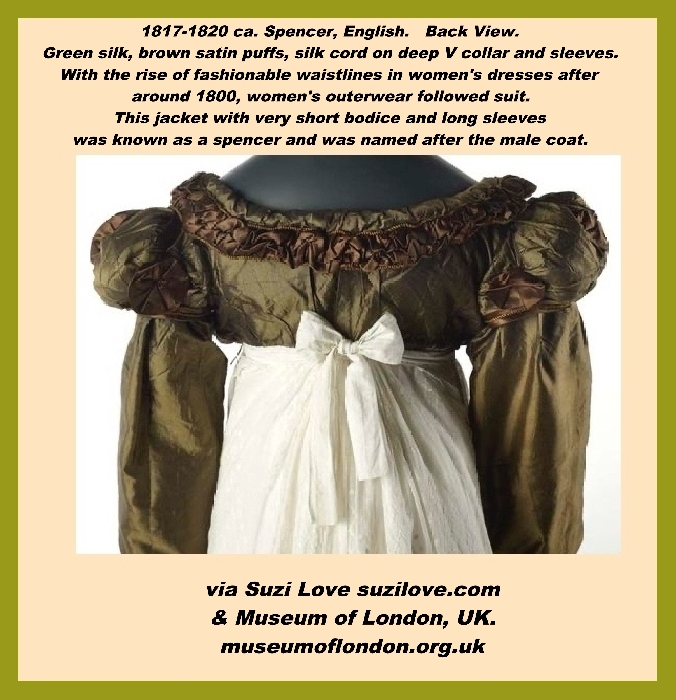
1817-1820 ca. Spencer, or Jacket, English. The sort of jacket worn by Jane Austen and friends over their loose Empire style dresses. Green silk Spencer, brown satin puffs, silk cord on deep V collar and sleeves. With the rise of fashionable waistlines in women’s dresses after around 1800, women’s outerwear followed suit. This jacket with very short bodice and long sleeves was known as a Spencer and was named after the male coat. via Museum of London, UK. museumoflondon.org.uk
Description Spencer: Short jackets worn for warmth over the high-waisted Empire style gowns that were popular after the French Revolution, where there was a shift away from opulence and decadence to simpler fashion. This jacket with very short bodice and long sleeves was known as a Spencer and was named after the male coat made famous by the Earl Spencer and said to have originated in accident to Lord Spencer in hunting when coat tails torn off and a cropped jacket was invented. The dresses in the early 1800s therefore became looser, lighter, and flowing and women became cold due to their very low cut and short bodices. Short fitted jackets that went easily over the dresses and provided extra modesty and some warmth. As Europe and many other parts of the world were deep in wars in the late 1700s and early 1800s, men in uniform were found everywhere. In support of these military men, fashions leaned towards military style shoulder paddings, shoulder embellishments, loops, buttons, and braids.
1817-1820 ca. Spencer, English. With the rise of fashionable waistlines in women’s dresses after around 1800, women’s outerwear followed suit. This jacket with very short bodice and long sleeves was known as a spencer. via Museum Of London.
1817-1820 ca. Jane Austen and Bridgerton Style Green Silk Spencer, Or Jacket, English. #Bridgerton #RegencyFashion #BritishFashion #JaneAusten https://books2read.com/SuziLoveFashionWomen1815-1819
1810 ca. Cotton Dress Ensemble With Train, French. Cut out in back, lace shawl with sequins can be added to cover shoulders, small low cut bodice, all over embroidery and very short decorative sleeves. Front, Back and Side Views. via Metropolitan Museum New York City, U.S.A. metmuseum.org
1810 ca. Cotton Dress Ensemble With Train in Jane Austen style. #RegencyFashion #JaneAusten #historicalfashion https://books2read.com/SuziLoveFashion1810-1814